


Invoice Definition: What Makes an Invoice Legally Valid for Insurance
Introduction
A legally valid invoice for insurance claims must satisfy three distinct validation layers before payment. An invoice rejected at the portal never reaches the adjuster's desk. The LEDES XML E-Billing 2.1 specification notes that law firms consistently report rejections due to validation failures in currency conversion and rounding — errors that occur before any human evaluates the substance of the work.
PRISM's Liability Defense Counsel Standards, adopted July 1, 2025, state at page 15 that invoices must include the law firm name and address, date of the bill, law firm tax identification number, the member entity or third-party administrator and their respective claim number, and the plaintiff name or names. These are not suggestions. An invoice missing any of these elements is incomplete, and incomplete invoices do not survive the first round of automated checks in most e-billing systems.
The stakes are higher in jurisdictions where a tax invoice is a legally required document. The LEDES Oversight Committee's white paper on XML E-Billing 2.1 explains at page 16 that in certain jurisdictions, a tax-only invoice cannot be adjusted — it is a legal instrument, not merely a billing record. Vendors are advised to program this limitation into their invoice review workflow. When an invoice must satisfy both carrier guidelines and statutory tax-invoice requirements, attorney billing descriptions that pass carrier review become non-negotiable.
Detailed itemization is the foundation. PRISM's standards require that invoices "accurately itemize, in detail, all work performed on a matter." That language does not permit summary entries, block billing, or narrative shortcuts. Each line item must stand on its own, with a description sufficient for a reviewer who was not present when the work was performed to understand what was done, why it was necessary, and how long it took.
The remainder of this article walks through the common failure points, the solution steps for building a compliant invoice, and the practices that reduce rejection rates before submission.
What Makes an Invoice Fail Validation?
The invoice you submit is not the invoice the carrier's system validates. Between your time entry and the carrier's payment decision sits a validation layer that rejects invoices for calculation errors, format mismatches, and missing fields — failures that have nothing to do with the work performed. One of the consistent complaints by law firms is rejection of invoices due to validation of the calculations on their submissions because of currency conversion and rounding.
Carriers require invoices in LEDES format, but LEDES itself does not define what makes an invoice legally valid — it defines data structure. The legal validity question sits one layer deeper: does the invoice satisfy the jurisdiction's documentary requirements for a tax invoice, does it contain sufficient narrative detail to survive bill review, and does it pass the carrier's outside counsel guidelines? An invoice can be a perfect LEDES file and still fail on legal sufficiency.
The Tax Invoice Problem
In certain jurisdictions, a tax-only invoice is a legally required document and cannot be adjusted. Carriers and e-billing platforms must program this limitation into their invoice review workflow, but many do not. The result: a law firm submits an invoice that meets the jurisdiction's tax-invoice requirements, the carrier's bill reviewer reduces a line item, and the revised invoice no longer satisfies the legal standard. The firm cannot reissue the tax invoice without violating local law, and the carrier will not pay the original.
Calculation and Rounding Failures
E-billing portals validate invoice arithmetic to the penny. Currency conversion, tax calculation, and rounding create mismatches between the firm's billing system and the carrier's validation rules. A two-cent discrepancy in a line-item extension triggers a hard rejection. The firm resubmits, the portal rejects again for a different rounding error, and the invoice sits in pending status while the matter budget clock runs.
The LEDES specification does not mandate a rounding method. Carriers do not publish their validation logic. The gap between what the firm calculates and what the portal expects is invisible until the rejection code arrives.
Narrative Detail and Guideline Compliance
An invoice that passes format validation can still fail on content. Carriers reduce or reject line items for block billing, vague task descriptions, and missing UTBMS codes. The rejection notice cites the outside counsel guidelines, but the guidelines themselves often conflict with the e-billing portal's field constraints. A guideline prohibits block billing; the portal's narrative field holds 250 characters; and a compliant entry describing three discrete tasks exceeds the limit.
The firm must choose: submit a guideline-compliant entry that the portal truncates, or submit a portal-compliant entry that the bill reviewer reduces. Either way, the invoice is not legally valid in the sense the carrier will pay it in full.
Solution Steps for Creating a Legally Valid Invoice
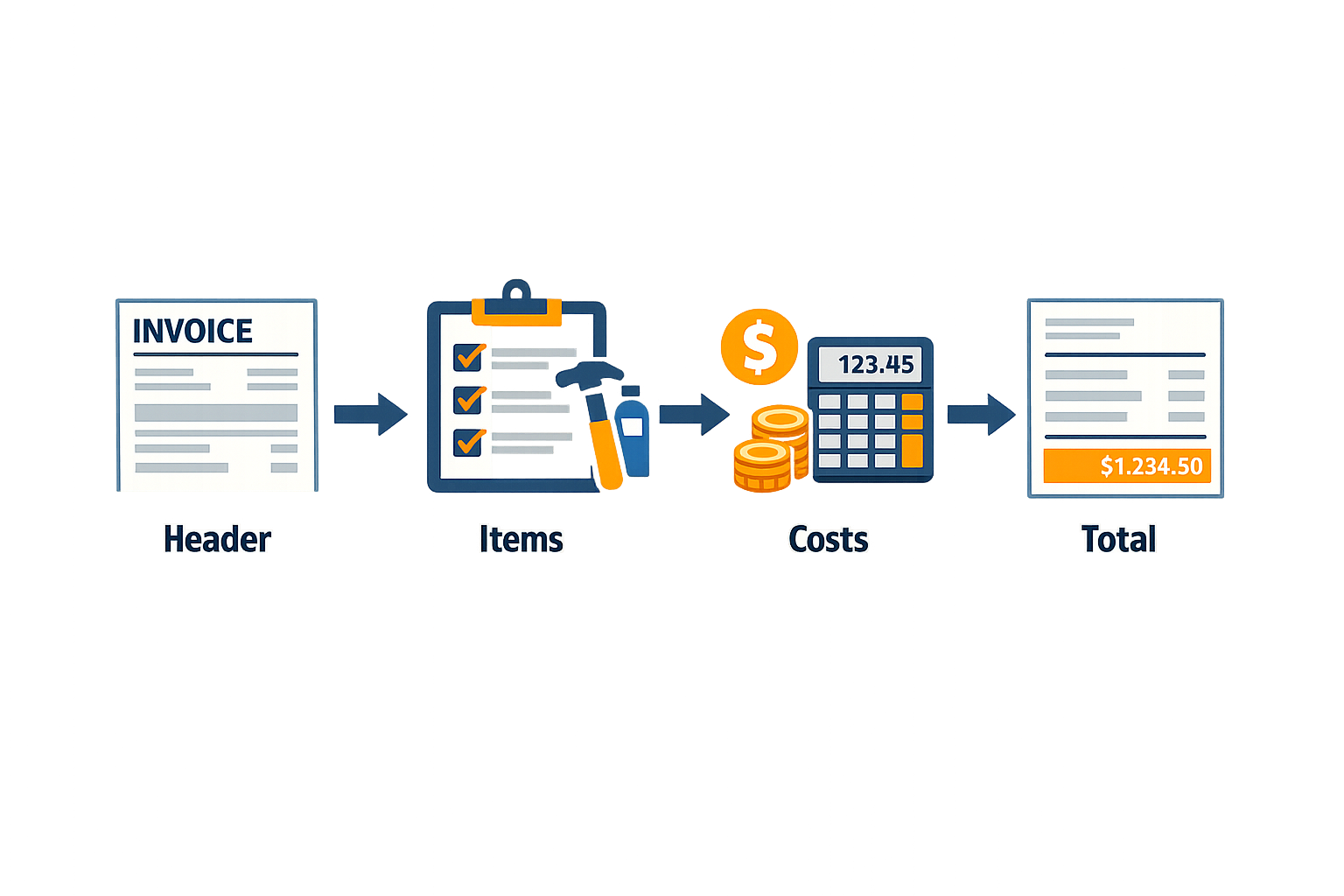
Creating a legally valid invoice for insurance claims means including specific elements in a specific order. PRISM's Liability Defense Counsel Standards, adopted July 1, 2025, list five mandatory components at page 15, section XII.A. Missing any one of them can trigger a rejection before a reviewer even opens the line-item detail.
Step 1: Include Firm Identification and Tax Information
Step 1
Firm name, address and tax ID
Every invoice must display the law firm name and address at the top, followed by the firm's tax identification number. PRISM's standards require the tax ID on each invoice; omitting it means the invoice does not meet the threshold for a legally valid submission.
The tax identification number is not decoration. In certain jurisdictions a tax-only invoice is a legally required document and cannot be adjusted, according to the LEDES XML E-Billing 2.1 White Paper at page 16. E-billing portals validate this field; if it is missing or malformed, the file fails at intake.
Step 2: Add the Invoice Date
The date of the bill must appear on the invoice. This is the date the invoice was prepared, not the date range of the work performed. Carriers use the invoice date to track submission deadlines, apply interest calculations and determine whether the invoice falls within the claim's coverage period.
Step 3: Identify the Claim and the Parties
Step 3
Member entity, TPA, claim number and plaintiff names
Include the Member Entity and/or TPA and/or their respective claim number, and list the plaintiff or plaintiffs by name. PRISM's standards treat these as separate required elements; an invoice that identifies the claim number but omits the plaintiff names is incomplete.
Claim numbers link the invoice to the carrier's internal file. Plaintiff names confirm that the invoice matches the matter description in the carrier's system. A mismatch between the invoice and the portal's matter record will generate a rejection code, and the firm will need to resubmit with corrected header data.
Step 4: Itemize All Work Performed in Detail
PRISM's standards state that invoices should accurately itemize, in detail, all work performed on a matter. This means each line item must describe a discrete task, state the timekeeper who performed it, record the date, specify the time spent and assign a UTBMS task and activity code where the carrier requires them.
One of the consistent complaints by law firms is rejection of invoices due to validation of the calculations on their submissions because of currency conversion and rounding, according to the LEDES XML E-Billing 2.1 White Paper at page 13. Ensuring that line-item amounts, tax calculations and currency conversions are mathematically correct before submission avoids this common rejection path. For detailed examples of compliant line-item narratives, see Sample Attorney Billing Descriptions PDF That Pass Carrier Review.
Step 5: Follow Carrier-Specific Procedures
Virginia Legal Ethics Opinion 1723 addresses procedures required by liability insurance companies, including requirements for detailed billing invoices reviewed by a third party. Each carrier publishes its own outside counsel guidelines; those guidelines specify billing increments, narrative standards, pre-approval thresholds and prohibited entries. An invoice that satisfies PRISM's baseline requirements may still be rejected if it violates a carrier-specific prohibition — for example, block billing when the guideline forbids it, or quarter-hour increments when the guideline mandates tenths.
Read the controlling guideline, quote what it says, and build the invoice to match. If the guideline is silent on a point, that silence is not permission; it means the carrier has not published a rule, and the invoice should follow the most conservative standard in the industry for that element. Review Outside Counsel Guidelines for Insurance Litigation for common requirements across carriers.
Tips and Tricks for Ensuring Invoice Validity
Carrier rejections cluster around calculation errors, missing detail, and third-party review workflows that lack client consent. The following practices address the most common validation failures and keep invoices moving through the submission pipeline.
Verify Calculations Before Submission
One of the consistent complaints by law firms is rejection of invoices due to validation of the calculations on their submissions because of currency conversion and rounding. E-billing portals enforce arithmetic checks at line-item and invoice-total levels. A single mismatched extension — hours times rate, or quantity times unit price — triggers an automatic validation failure. Check every extended amount before you export the LEDES file. If your billing system rounds to two decimals but the portal expects unrounded intermediate values, the mismatch will reject the invoice even when the final total is correct.
Obtain Client Consent for Third-Party Review
Insurance carriers routinely route invoices through bill-review vendors. Virginia Legal Ethics Opinion 1723 addresses procedures required by liability insurance companies which restrict discovery, use of third-party vendors, and require review of detailed billing invoices by a third party. The opinion makes clear that such review must occur with the insured client's consent or knowledge. Before you submit an invoice that will pass through a third-party auditor, confirm that the client has agreed to that workflow. Document the consent in your engagement letter or a separate acknowledgment. If the carrier imposes third-party review without notice, raise the issue before the first invoice goes out — retroactive consent is not a safe harbour.
Follow Carrier Procedures Exactly
Outside counsel guidelines specify submission formats, billing increments, narrative standards, and approval thresholds. Treat the guideline as the controlling document: if it says tenth-of-an-hour increments, do not bill in quarter hours. If it prohibits block billing, break compound entries into separate line items. If it caps certain tasks at a dollar threshold without pre-approval, stay under that threshold or obtain written approval before you perform the work. Guideline violations are reduction triggers, and reductions are harder to appeal than rejections. For specific examples of compliant entries, consult paralegal billing entry examples and what carriers pay for.
A guideline violation is a reduction trigger, and reductions are harder to appeal than rejections.
Designate Tax Invoices Where Required
In certain jurisdictions, a tax-only invoice is a legally required document and cannot be adjusted. LEDES XML E-Billing 2.1 accommodates a designation that marks an invoice as a tax invoice. If you practise in a jurisdiction that mandates a specific tax-invoice format, set that designation in your LEDES file and ensure the receiving system recognises it. A law firm may submit an invoice containing all line-item detail and mark it "This is a Tax Invoice," allowing the receiving system to display a view that satisfies the legal requirement. Confirm with the carrier or portal administrator that your tax-invoice designation will be honoured before you rely on it to meet a statutory filing obligation.
Maintain Contemporaneous Records
Bill review auditors compare narrative detail against matter chronology and court dockets. If a line item claims four hours for a motion hearing but the docket shows a fifteen-minute appearance, the auditor will reduce or reject the entry. Keep contemporaneous time records — captured the day the work occurs — and ensure the narrative matches the activity. Generic descriptions like "legal research" or "review correspondence" invite scrutiny. Specific descriptions tied to a document, a filing deadline, or a discoverable event withstand review.
Conclusion
A legally valid invoice for insurance claims is not a matter of preference or house style. It is a contract document that must meet the requirements of the carrier, the engagement letter, and in some jurisdictions the law itself. The invoice must identify the law firm, the matter, the work performed, and the amount claimed with enough specificity that a bill reviewer can verify each line item against the controlling guidelines and the court record. Where the invoice omits a required element — the tax identification number, the claim number, the plaintiff's name, or detailed narrative entries — it will be rejected or reduced, and the appeal path is narrow.
The steps outlined in this article — assembling the mandatory header fields, itemizing time and expense entries with UTBMS codes and narrative detail, calculating totals in the prescribed currency and rounding convention, and submitting through the designated e-billing portal — are not aspirational. They are the minimum threshold for a facially valid invoice under the defense counsel standards published by most panel carriers. An invoice that clears validation is not guaranteed payment, but an invoice that fails validation is guaranteed rejection.
Maintaining compliance begins with reading the outside counsel guidelines before the first hour is entered. It continues with contemporaneous time records, tenth-of-an-hour increments, and line-item narratives that describe one task per entry. It ends with a final review of the LEDES file against the carrier's published schema and the submission of a complete invoice package — including any required certificates, lien waivers, or tax documentation — within the guideline deadline. For firms handling insurance defense work across multiple carriers, understanding attorney billing increments and travel time billing rules prevents common rejection codes before the invoice is transmitted.
The invoice is the last document the carrier sees before it pays. It is also the first document the auditor will request if the matter is selected for review. A legally valid invoice protects both the payment and the record.
Frequently asked questions
What information must appear on a legally valid invoice for insurance claims?
A legally valid invoice for insurance claims must include: law firm name and address, invoice date, tax identification number, member entity or TPA name, claim number, and plaintiff name(s). PRISM's Liability Defense Counsel Standards list these as mandatory elements; omitting any one triggers rejection.
How does LEDES format affect invoice validity?
LEDES format defines the data structure e-billing portals use to validate invoices. Portals check arithmetic, field completeness, and format compliance before human review. A calculation error of even two cents can trigger automatic rejection, regardless of the work's quality or necessity.
What is a tax invoice and why can't it be adjusted?
In certain jurisdictions, a tax invoice is a legal document required by statute. Once issued, it cannot be altered without violating local law. If a carrier reduces a line item after submission, the revised invoice may no longer satisfy the jurisdiction's legal requirements, creating an unresolvable compliance conflict.
How detailed must invoice line items be?
PRISM standards require that invoices "accurately itemize, in detail, all work performed on a matter." Each line item must describe one discrete task with enough specificity that a reviewer unfamiliar with the matter can understand what was done, why it was necessary, and how long it took. Block billing and summary entries do not meet this standard.
What happens if my invoice fails validation?
An invoice that fails portal validation is automatically rejected and never reaches a human reviewer. The firm receives a rejection code, must correct the error, and resubmit. Repeated validation failures delay payment and can trigger carrier scrutiny of the firm's billing practices.