

Paralegal Billing Entry Examples PDF for Accurate Invoicing
Introduction
Paralegal billing entry examples demonstrate how a single line reading "legal research, 3.5" triggers reductions under most panel guidelines. Paralegal billing entries face the same scrutiny as attorney time, and the standards are no less exacting. A line item that lacks a clear task description, uses the wrong timekeeper classification, or aggregates multiple activities into a single narrative will be flagged, reduced, or rejected outright by the e-billing portal or the carrier's bill reviewer.
Paralegals generate a substantial portion of billable hours on insurance defense and corporate matters, yet their entries are often written with less attention to the narrative and coding detail that carriers demand. The result is predictable: reduction codes citing block billing, vague descriptions, or unsupported task codes, followed by appeals that consume more time than the original entry. The carrier's outside counsel guidelines do not distinguish between attorney and paralegal work when it comes to billing standards — both must meet the same threshold for contemporaneous detail, appropriate UTBMS task and activity codes, and compliance with the approved billing increment.
This article provides paralegal billing entry examples that meet carrier and e-billing portal standards. Each example includes the timekeeper classification, narrative structure, UTBMS codes, and the reasoning that supports the entry. The goal is to show what a compliant line item looks like in practice, so that paralegals and billing staff can draft entries that survive the first round of review and avoid the reduction-and-appeal cycle that delays payment and erodes trust with the client.
Problem Statement
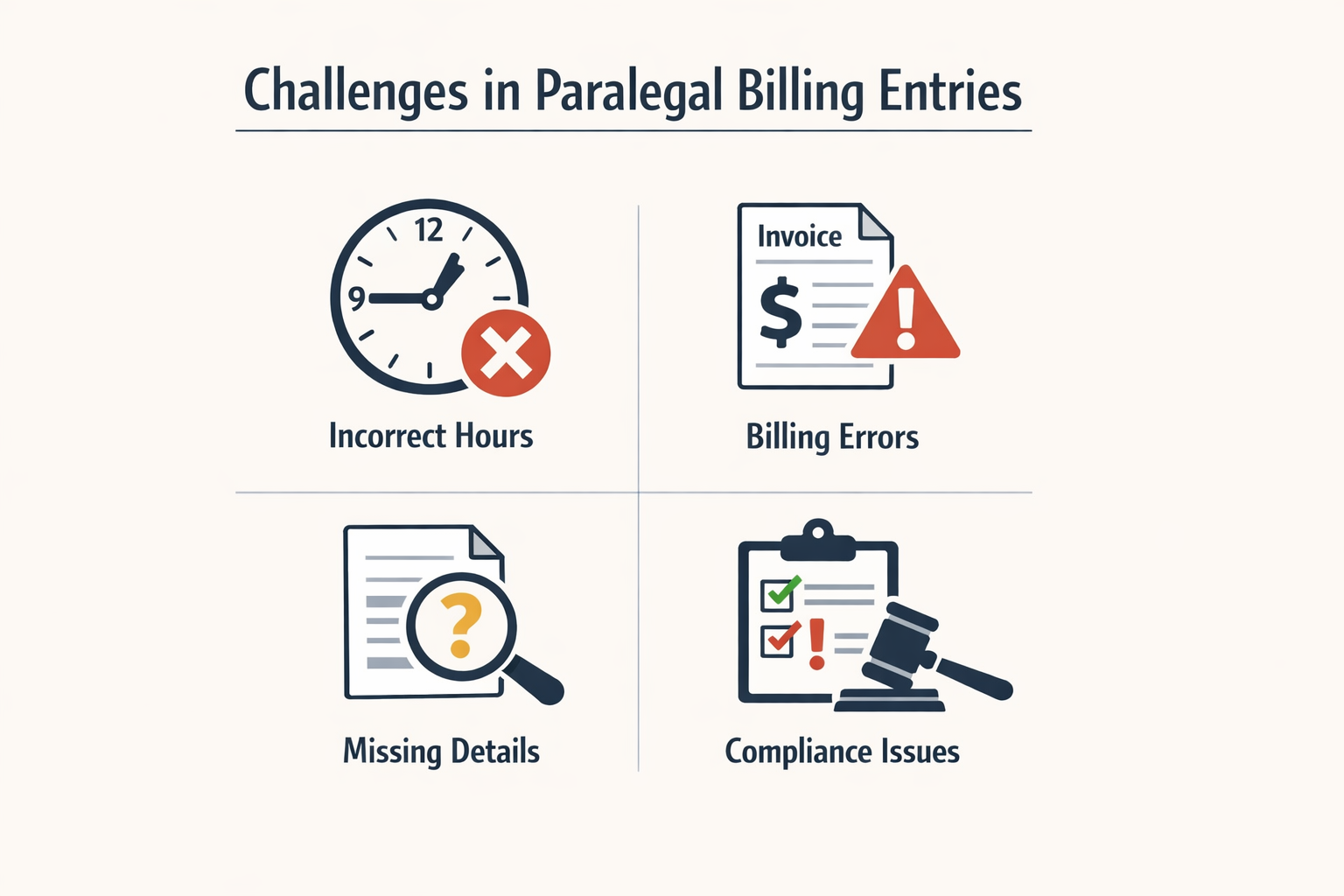
A single line reading "reviewed discovery documents, 3.5" will not survive bill review at most carriers. The entry lacks the detail required by published outside counsel guidelines, and it invites a reduction code the moment the invoice reaches the e-billing portal. Paralegals who prepare time entries without understanding timekeeper classification, narrative sufficiency and the structure of LEDES submissions create invoices that cost the firm money and credibility.
Timekeeper Classification Errors
Misclassification is the first point of failure. The LEDES Oversight Committee publishes a revised timekeeper classification reference that assigns each role a specific code. A paralegal performing discovery support is not classified the same way as a discovery attorney providing specialist advice on electronic discovery strategy. The distinction matters because carriers price the work differently and some guidelines prohibit billing attorney rates for paralegal tasks. When a firm submits a LEDES 1998B file with a paralegal's time under an attorney classification code, the portal flags the discrepancy and the line item is reduced or rejected outright.
Contract and temporary staff present additional classification problems. A contract attorney working on a temporary basis is classified under TEMPAT, not ASSOC. A temporary paralegal or other non-attorney staff member falls under TEMPOS. Firms that treat all contract timekeepers as regular employees in the billing system produce LEDES files that do not match the carrier's roster, and the mismatch triggers validation errors before a human reviewer ever sees the invoice.
Narrative Detail and Block Billing
Block billing — the practice of combining multiple tasks into a single time entry — is prohibited under most carrier guidelines. An entry that reads "research case law, draft motion, conference with client, 4.8" bundles three distinct activities into one narrative, making it impossible for the reviewer to allocate time to the correct UTBMS task and activity codes. The carrier's guideline will state that each task must be separately described and billed, and the firm's failure to comply results in a reduction that the paralegal did not cause but the firm must absorb.
Narrative detail standards vary by carrier, but the common requirement is contemporaneous description of the work performed. "Reviewed documents" is not sufficient; "reviewed 47 pages of medical records for treatment dates and provider names" is. The level of detail required is not guesswork — it is specified in the guideline version the carrier published and the firm agreed to follow. Paralegals who write vague narratives because they are accustomed to internal time-tracking conventions produce entries that fail the moment they are submitted to a panel carrier.
Billing Increment and Rounding Inconsistencies
Three of the four major carriers with published guidelines specify tenth-of-an-hour increments. The fourth is silent, which is not the same as permissive. A paralegal who rounds a nine-minute task to 0.2 hours when the guideline requires 0.1-hour precision has created an overbilling that the bill reviewer will catch and reduce. The error is small in isolation, but across dozens of line items it compounds into a pattern that invites closer scrutiny of the entire invoice.
Increment discipline is not a matter of firm preference. When a carrier guideline states that time must be recorded in tenths of an hour, that requirement governs every line item in every invoice submitted under that engagement letter. Paralegals who prepare entries in quarter-hour or six-minute increments because that is how the firm's internal system is configured must convert those entries to the carrier's standard before submission, or the LEDES file will be rejected at validation.
UTBMS Task and Activity Code Mismatches
Every LEDES line item carries a UTBMS task code and an activity code. The task code describes the phase of the matter — discovery, motions, trial — and the activity code describes the specific work performed within that phase. A paralegal who enters time under task code L300 (discovery) with activity code A101 (plan and prepare for issue development and for the matter overall) has created a mismatch: A101 is a case assessment activity, not a discovery activity, and the combination will be flagged by the e-billing portal's validation engine.
Carriers rely on UTBMS codes to track spending by phase and to compare the firm's work product to the matter budget. When the codes are wrong, the carrier's internal reporting is wrong, and the firm's invoice is suspect. Paralegals who do not understand the UTBMS code sets — or who rely on outdated code lists — produce entries that fail validation even when the narrative and the hours are correct. For more detail on how these codes map to specific activities, see UTBMS Activity Codes A101-A111 for Legal Billing.
The cheapest invoice is the one the carrier pays without a reduction code — and that requires entries that match the guideline before they reach the portal.
How Do You Write Compliant Paralegal Billing Entry Examples?
Step 1: Identify the correct timekeeper classification code
Step 1
Select the LEDES timekeeper classification
Every paralegal billing entry submitted through a LEDES file must carry a timekeeper classification code. The LEDES Oversight Committee publishes a revised timekeeper classification reference that defines each code. For paralegal work, the classification depends on the nature of the services and the firm's staffing structure. A paralegal performing discovery support may fall under one classification, while a paralegal handling administrative tasks may fall under another. Review the client's outside counsel guidelines to confirm which classifications the carrier accepts for non-attorney timekeepers.
When a law firm attorney functions in multiple capacities on a matter, the billing system must assign the correct classification to each line item based on the work performed, not the timekeeper's primary role. For example, an attorney providing specialist services associated with discovery is classified under DSCATT for those entries, even if the same attorney bills under ASSOC for other tasks on the same matter.
Step 2: Record time in the required billing increment
Most carrier guidelines specify tenth-of-an-hour increments. A paralegal who spends twelve minutes on a task records 0.2 hours, not 0.25 or a rounded quarter-hour. The guideline controls the increment, and the e-billing portal validates submissions against that rule. Entries recorded in non-compliant increments trigger automatic rejections before a human reviewer ever sees the invoice.
Step 3: Write a narrative that identifies the task and the work product
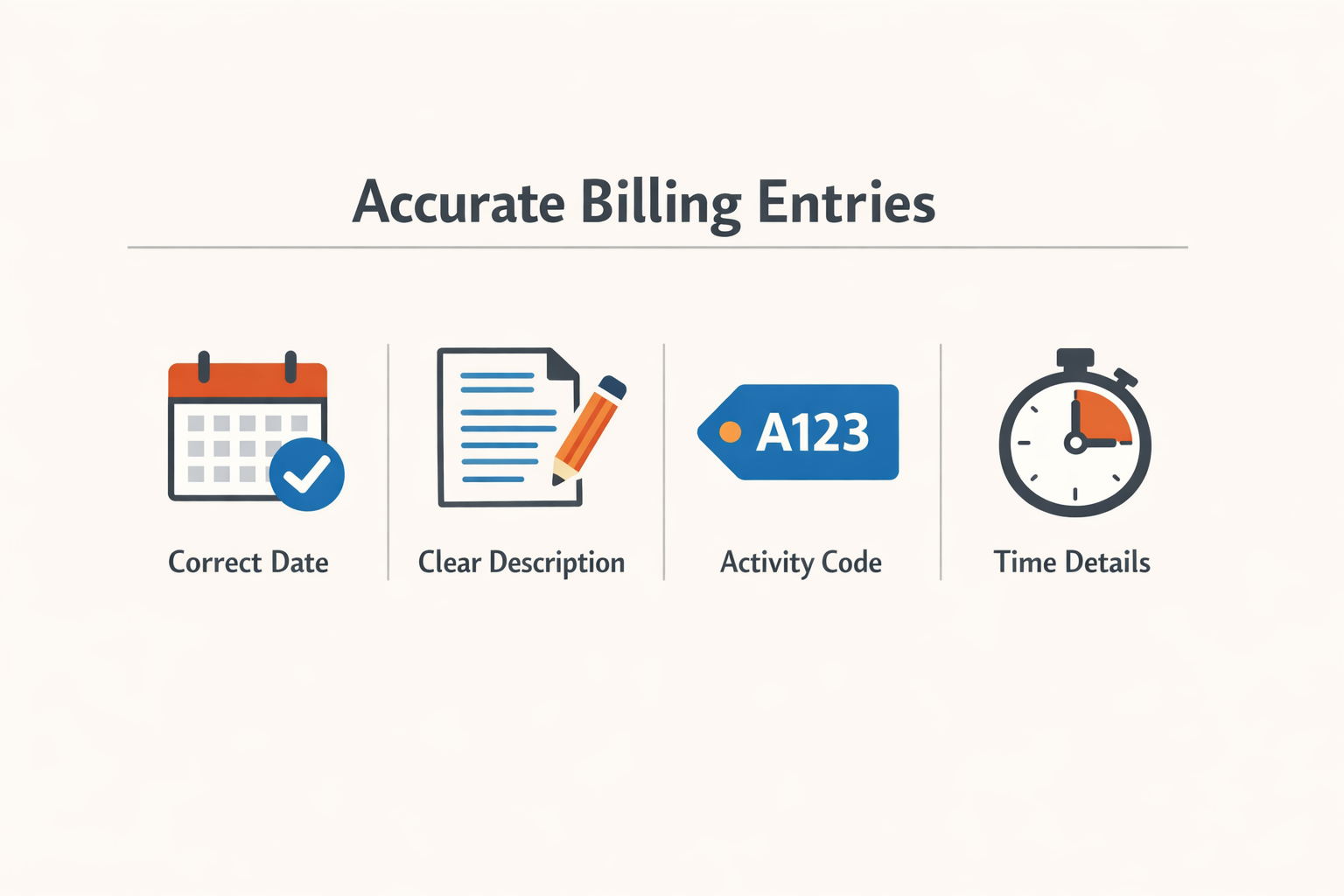
A compliant billing entry names the activity and the deliverable in enough detail that a reviewer can confirm the work was necessary and the time reasonable. "Review documents, 2.4" is block billing and will be reduced or rejected. "Review 47 pages of medical records for summary chart, 2.4" identifies what was reviewed, how much, and why. The narrative must be specific enough to survive guideline scrutiny but general enough to avoid waiving privilege.
For detailed guidance on how narrative standards interact with activity codes, see UTBMS Activity Codes A101-A111 for Legal Billing.
Step 4: Assign the correct UTBMS task and activity codes
The Uniform Task-Based Management System defines task codes (L100, L200, etc.) and activity codes (A101, A102, etc.) that describe the nature of the work. A paralegal summarizing deposition testimony assigns a discovery task code and an activity code for document review or analysis. The codes must match the narrative. A line item coded as legal research but described as filing a motion will be flagged by the portal or the bill reviewer.
Step 5: Validate the entry against the outside counsel guidelines before submission
Before the invoice leaves the firm, compare each paralegal entry to the carrier's published guidelines. Check the timekeeper classification, the billing increment, the narrative detail, the task and activity codes, and any rate or staffing caps. If the guideline prohibits paralegal time for a specific task, remove the entry or seek pre-approval. If the guideline requires a paralegal-to-attorney staffing ratio, confirm the invoice complies. Most e-billing portal invoice rejections can be avoided by reading the guideline and following it exactly.
Tips and Tricks
Three timekeepers billed 4.5 hours on the same conference call, and the carrier reduced all three entries to zero. The narrative was identical across all three invoices, the task code matched, and the increment was compliant — but the duplication triggered an automatic flag. Avoiding that outcome requires attention to detail at the line-item level, not just compliance with the published guideline.
Use Distinct Narratives for Each Timekeeper
When multiple timekeepers work on the same activity, each entry must describe what that individual did, not what the group accomplished. A paralegal who prepared exhibits for a hearing writes "prepare exhibit binders and index for summary judgment hearing, 1.2." The associate who reviewed those exhibits writes "review exhibit binders prepared by paralegal and confirm citations, 0.8." Identical language across entries reads as copy-paste, and reviewers treat it as block billing or padding.
Match Timekeeper Classification to the Work Performed
LEDES timekeeper classifications exist to signal the appropriate rate and role. A paralegal performing document review is classified under the paralegal code, not as a contract attorney or discovery analyst. If a firm attorney also functions as a discovery specialist on a matter, that work may be billed under the DSCATT classification when the task is purely discovery-focused — but the same attorney's motion work on the same matter reverts to the attorney classification. The classification must match the line item, not the timekeeper's general title.
An adjuster reviewing invoices sees the classification code first. If a line item carries an associate rate but describes clerical work — "scan documents to client portal, 0.3" — the entry will be reduced or rejected outright, regardless of who performed it. Paralegal work billed at paralegal rates with a paralegal classification code avoids that mismatch.
The classification must match the line item, not the timekeeper's general title.
Record Time Contemporaneously and in the Correct Increment
Most panel guidelines specify tenth-of-an-hour increments. A task that takes four minutes is 0.1 hours, not 0.2 and not rounded to the nearest quarter-hour. If a guideline is silent on increments, tenth-of-an-hour is the safer assumption — sixth-of-an-hour and quarter-hour entries invite reduction. Contemporaneous recording prevents rounding errors and ensures the narrative reflects what actually happened, not a reconstructed summary written three days later.
Block billing — combining multiple tasks in one entry — is prohibited under most carrier guidelines. "Review correspondence, draft response, confer with client, 2.4" is block billing. Three separate entries, each with a distinct task code and narrative, is compliant. If the guideline prohibits block billing, the rule applies to every line item, including those under the pre-approval threshold.
Verify Task and Activity Codes Before Submission
UTBMS task codes and activity codes are not interchangeable, and the wrong code triggers a validation error in most e-billing portals. Activity code A101 (plan and prepare for) pairs with multiple task codes, but it does not substitute for the task code itself. A line item reading "A101, review pleadings, 0.8" will be rejected because A101 is an activity code, not a task code. The correct format pairs the task code with the activity code in the fields the portal expects.
Carriers publish lists of acceptable codes, and those lists are shorter than the full UTBMS set. If a guideline permits only twenty task codes, submitting a line item with code L250 — even if L250 is valid UTBMS — results in rejection. The allowable codes are in the guideline appendix or the portal's validation rules. Use only codes the carrier has approved.
For a detailed breakdown of how specific activity codes function in legal billing, see UTBMS Activity Codes A101-A111 for Legal Billing.
Avoid Vague or Conclusory Narratives
A narrative that reads "work on case, 3.0" will be reduced. So will "legal research, 4.5" and "draft documents, 2.2." The reviewer cannot verify the work without specificity. A compliant entry names the document, the issue, or the recipient: "research California choice-of-law rules for cross-border contract dispute, 1.8" or "draft opposition to motion to compel further responses to interrogatories, set two, 3.4." The narrative must allow an auditor to reconstruct what happened without asking follow-up questions.
Conclusory language — "thorough review," "extensive research," "detailed analysis" — adds no information and signals padding. The time spent is the measure of effort; the narrative describes the task. "Review 47-page expert report and identify factual errors, 2.1" is sufficient. "Thorough and extensive review of expert report, 2.1" is not.
Summary
Accurate paralegal billing entries require distinct narratives, correct timekeeper classifications, tenth-of-an-hour increments, verified task and activity codes, and specific descriptions of the work performed. These practices prevent the most common causes of invoice rejection and write-down.
Conclusion
Accurate billing entries are not a courtesy — they are a contractual obligation under most carrier outside counsel guidelines and a prerequisite for invoice acceptance in any e-billing portal. A paralegal entry reading "legal research, 3.5" will be reduced or rejected by a bill reviewer who cannot determine what was researched, why it was necessary, or whether the task matches the UTBMS code submitted. The examples and formatting rules in this article give paralegals a roadmap to entries that survive review on the first submission.
Billing accuracy begins with the line item. Tenth-of-an-hour increments, task-specific narratives, and proper UTBMS activity code selection are the baseline. Block billing — combining unrelated tasks in one entry — remains the single most common reason for carrier reductions, and it is entirely avoidable. When a paralegal writes "review correspondence, draft response, update client, 2.1," three separate activities are collapsed into one line, and the reviewer has no choice but to reduce the entry or send the invoice back.
The resources provided here — formatting templates, narrative examples, and UTBMS code guidance — are tools, not guarantees. Every carrier guideline is different, and some specify narrative length, staffing ratios, or pre-approval thresholds that override general best practices. Read the controlling guideline, cite what it says, and structure your entries to match. When a guideline is silent on a point, follow the LEDES 1998B field definitions and the UTBMS activity code descriptions published by the LEDES Oversight Committee. Those are the standards that e-billing portals enforce at the validation layer.
For paralegals managing discovery-intensive matters, understanding UTBMS Activity Codes A101-A111 for Legal Billing ensures that document review, privilege log preparation, and production tasks are coded correctly and billed at the appropriate classification. Misclassification triggers reductions even when the narrative is otherwise compliant.
Accurate billing protects the firm's revenue, the client's budget, and the paralegal's professional reputation. Use the examples in this article as a checklist, not a script. Adapt them to the matter, the guideline, and the task at hand. When an invoice is rejected, the appeal path is narrow, and the burden of proof is on the submitting firm. Get it right the first time.
FAQ
What makes a paralegal billing entry compliant with carrier guidelines?A compliant paralegal billing entry includes the correct timekeeper classification code, a task-specific narrative with sufficient detail, tenth-of-an-hour time increments, and accurate UTBMS task and activity codes that match the work described.
How do you avoid block billing in paralegal time entries?Record each distinct task as a separate line item with its own narrative, time increment, and UTBMS codes. Never combine multiple activities — such as reviewing documents, drafting correspondence, and conferring with a client — into a single entry.
What is the correct billing increment for paralegal entries?Most carrier guidelines require tenth-of-an-hour increments (0.1, 0.2, 0.3). A twelve-minute task is recorded as 0.2 hours, not 0.25 or a rounded quarter-hour. Always confirm the increment requirement in the controlling outside counsel guideline.
Why do UTBMS codes matter for paralegal billing?Carriers use UTBMS task and activity codes to track spending by phase, validate invoices against matter budgets, and identify misclassified work. Incorrect codes trigger validation errors in e-billing portals and invite reductions or rejections during bill review.
How specific should a paralegal billing narrative be?The narrative must identify the activity, the deliverable, and enough context for a reviewer to verify necessity and reasonableness. "Review documents, 2.4" is insufficient; "review 47 pages of medical records for treatment dates and provider names, 2.4" is compliant.