

UTBMS Activity Codes A101-A111 for Legal Billing
Top takeaways
- UTBMS Activity Codes A101–A111 are standardized codes used to classify specific legal services in electronic invoice submissions
- These codes identify the nature of the service performed, such as drafting, researching, or communicating with clients
- Accurate application of activity codes is essential for e-billing portal acceptance and compliance with carrier outside counsel guidelines
- Some carriers require activity codes in every line item, while others do not mandate them at all
- Understanding these codes helps legal professionals avoid common billing rejections and write-downs
Introduction to UTBMS Activity Codes
UTBMS Activity Codes A101-A111 are standardized codes that classify legal services performed by a legal vendor in an electronic invoice submission. The Uniform Task-Based Management System provides a series of codes used to identify the specific service performed — whether a timekeeper wrote something, spoke with someone, or researched a legal issue. Activity codes A101 through A111 form the foundation of this classification system.
Understanding UTBMS Activity Codes A101-A111 is crucial for anyone involved in legal billing and e-billing processes. In our work with carrier outside counsel guidelines, we observe that certain entries are frequently flagged during bill review, particularly when activity codes are misapplied or omitted where required. The eleven codes in the A100 series cover the full range of attorney and paralegal activities: A101 (Plan and prepare for), A102 (Research), A103 (Draft/revise), A104 (Review/analyze), A105 (Communicate in firm), A106 (Communicate with client), A107 (Communicate with other outside counsel), A108 (Communicate other external), A109 (Appear for/attend), A110 (Manage data/files), and A111 (Other).
These codes work in tandem with UTBMS task codes to provide a two-dimensional classification of legal work. While task codes describe what phase or category of work is being performed — such as case assessment, discovery, or motion practice — activity codes describe how the work was done. A single task code entry may pair with multiple activity codes across different line items, depending on the nature of each timekeeper's contribution.
Not every client requires activity codes in submitted invoices. Some carriers specify task codes only, treating the narrative detail as sufficient to describe the activity. Others mandate both task and activity codes in every line item, and their e-billing portals will reject a LEDES file that omits the activity code field. Look to the published outside counsel guidelines and the portal's validation rules to determine whether activity codes are required for a given matter.
When activity codes are required, misapplication triggers rejections and reductions. A line reading "research motion strategy" paired with activity code A103 (Draft/revise) instead of A102 (Research) will draw a reduction code or a portal validation error, depending on the carrier's review process. The same line with no activity code at all may be rejected outright if the guideline mandates the field. For detailed guidance on how e-billing portal invoice rejections occur and how to resolve them, understanding the role of activity codes is a necessary first step.
The Importance of Accurate Activity Coding
A single misapplied activity code can trigger an invoice rejection before a reviewer ever reads the narrative. When a timekeeper selects A109 (appear for/attend) for desk work or uses A111 (other) as a default, the line item stands out in the e-billing portal's validation layer, and the rejection code arrives within minutes of submission. UTBMS Activity Codes A101-A111 exist to create a common vocabulary between billing firms and bill reviewers, but that vocabulary only works when both sides apply the codes to the same kinds of work.
Insurance defense litigation relies on task-based billing systems, and carriers expect every line item to pair a task code with an activity code that describes what the timekeeper actually did. The activity code is not decoration. It tells the reviewer whether the work was research (A102), drafting (A103), or communication with the client (A106). When the code contradicts the narrative—"research case law" paired with A106, for example—the line item fails the consistency test that most portals run before a human ever sees the invoice.
Common Coding Errors and Their Consequences
Three patterns account for the majority of activity-code rejections. First, timekeepers use A111 (other) when a specific code fits the work. A111 is a residual category; if the work falls within planning (A101), research (A102), drafting (A103), review (A104), any of the four communication codes (A105 through A108), appearing or attending (A109), or data management (A110), A111 is wrong. Second, timekeepers select the wrong communication code: A105 is intra-firm, A106 is with the client, A107 is with co-counsel, and A108 is with all other external parties. Mixing these up—coding a client call as A105 or an internal conference as A106—creates an audit trail that does not match the narrative. Third, timekeepers apply A109 to work that did not involve a physical or virtual appearance: reviewing documents in preparation for a deposition is A104, not A109; the A109 code applies when the timekeeper actually appears or attends.
Carrier outside counsel guidelines frequently specify that activity codes must align with the work described in the narrative. When they conflict, the reviewer has two choices: ask for clarification (which delays payment) or reduce the line item (which costs the firm revenue). Neither outcome benefits the timekeeper. Education on the practical use of UTBMS codes remains a need across the industry, and firms that invest in training their timekeepers see fewer rejections and faster payment cycles.
Accurate activity coding also supports the firm's position when a bill review results in a write-down. If the activity code, task code, and narrative all tell the same story, the firm has a stronger foundation for an appeal. If they contradict each other, the appeal starts from a weaker position, because the reviewer's reduction is based on the inconsistency the firm itself created. For more on how these inconsistencies lead to rejections, see E-Billing Portal Invoice Rejections: Common Causes and Fixes.
How Do You Apply UTBMS Activity Codes A101-A111 Correctly?
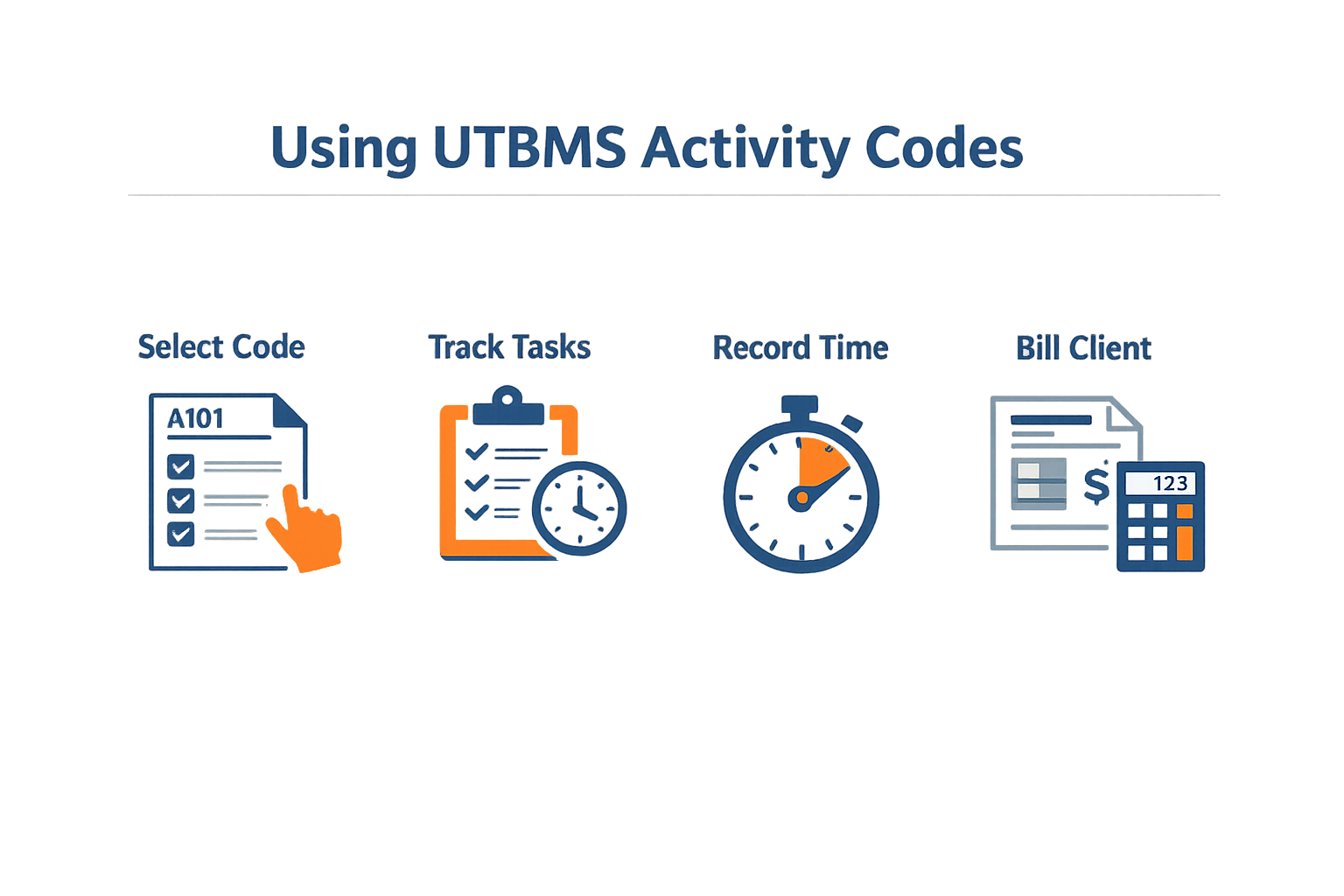
Applying UTBMS Activity Codes A101–A111 correctly requires a structured approach that aligns with LEDES file specifications and carrier expectations. The codes themselves are not optional decorations—they populate the task_activity field in LEDES XML E-Billing 2.1 submissions, and e-billing portals validate them against the published UTBMS standard. A single misapplied code can trigger a validation error or flag the line item for review, so the process begins before the timekeeper enters a narrative.
Step 1
Match the activity to the code definition before writing the narrative
Start with the published UTBMS Activity Code definitions. A101 covers planning and preparation associated with a matter, including budgeting and case assessment if the client permits those services. A102 is research. A103 is drafting or revising documents. A104 is review and analysis. A105 is communication within the firm, A106 is communication with the client, A107 is communication with other outside counsel, and A108 covers communication with external parties not specified elsewhere—by letter, fax, email, telephone, meetings or conferences. A109 is appearing for or attending events, A110 is managing data or files, and A111 is the catch-all for activities that do not fit A101 through A110. Choose the code that describes what the timekeeper actually did, not the code that sounds most impressive or the one used on the prior line item.
Step 2
Write a narrative that demonstrates the activity the code describes
The narrative must show the work the activity code claims. If the code is A103 (draft/revise), the narrative should name the document being drafted or revised. If the code is A108 (communicate with other external), the narrative should identify the external party and the subject of the communication. A vague entry like "research and draft motion, 4.2" paired with A102 creates an internal contradiction—research is A102, drafting is A103, and combining them in one line item is block billing. Portals do not always catch this at submission, but bill reviewers do, and the reduction code will cite both the block billing and the ambiguous activity code.
Step 3
Apply only one activity code per line item
The LEDES XML E-Billing 2.1 specification states that the task_activity field accepts only one code per line item. If a timekeeper performed two distinct activities in one time block, create two line items with two narratives and two activity codes. If the activities are genuinely inseparable—rare, but it happens—choose the code that describes the dominant activity and write a narrative that makes the subordinate activity incidental. Do not invent hybrid codes, do not leave the field blank, and do not submit "A102/A103" as a string—the portal will reject it or the bill reviewer will reduce it.
Step 4
Validate the code against the carrier guideline before submission
Some carriers publish lists of prohibited or restricted activity codes in their outside counsel guidelines. A105 (communicate in firm) is a common target—many guidelines state that intra-office conferences are not reimbursable unless the client pre-approved a specific conference for a specific reason. A111 (other) is another frequent restriction, because it is the code timekeepers use when they do not want to specify what they did. Before submitting an invoice with A105 or A111 line items, confirm that the guideline permits them and that the narrative satisfies any condition the guideline imposes. If the guideline is silent, the code is permissible, but silence is not the same as enthusiasm—expect scrutiny. For more on how portals handle validation errors at submission, see E-Billing Portal Invoice Rejections: Common Causes and Fixes.
Tips and Tricks for Efficient Billing with UTBMS Codes
Activity codes identify the specific service performed — whether you wrote something, spoke with someone, or researched something. Some clients do not require activity codes at all, while others expect them on every line item. The first rule is to consult with the client on how they want services classified, because a code that satisfies one carrier's guideline may trigger a rejection under another's.
Check the Client's Specification Before You Code
Not every matter requires activity codes. Before you apply A101 through A111 to a timekeeper's entries, confirm whether the client's outside counsel guidelines or the e-billing portal mandate them. If the guideline is silent and the portal does not validate the field, an activity code may be optional. Submitting one when it is not required rarely causes harm, but submitting the wrong one — or leaving the field blank when it is mandatory — will delay payment or trigger a rejection.
When the guideline does require activity codes, it may also specify which codes are permissible. Some carriers publish an approved list; others prohibit certain codes outright. Read the controlling document, and if it says A106 (Communicate with opposing counsel) is not reimbursable for routine discovery disputes, do not code that time as A106.
Align Task and Activity Codes
An activity code describes what the timekeeper did; the task code describes the phase or category of work. The two must be consistent. If the task code is L320 (Depositions), the activity code should reflect deposition-related work — A104 (Plan or prepare) or A102 (Analyze or review), for example. Pairing L320 with A110 (Travel) is defensible if the timekeeper traveled to the deposition; pairing it with A108 (Draft or revise) is harder to justify unless the timekeeper drafted deposition outlines or summaries.
Reviewers look for mismatches. A line coded L110 (Case assessment, development of case theory) with activity code A105 (Communicate with client) makes sense. The same task code with A111 (Wait or attend) does not, unless the narrative explains a client meeting where case theory was discussed. When task and activity codes do not align, the narrative must close the gap — and if it does not, the line is a candidate for reduction.
Build Informational Tools for Your Timekeepers
Designing a set of informational tools to educate timekeepers, billing administrators, and clients in the practical use of UTBMS enhances compliance and reduces rejections. A one-page reference sheet listing A101 through A111 with plain-English definitions and examples is more effective than a full code manual. Pin it to the firm's intranet, attach it to new-matter intake emails, and review it during timekeeper training.
Include examples that reflect the firm's practice areas. If the firm handles insurance defense, show how A104 (Plan or prepare) applies to preparing for a motion hearing, and how A107 (Conduct or attend) applies to the hearing itself. If the firm's clients prohibit certain activity codes, mark them clearly on the reference sheet and explain what to use instead. For more context on how coding errors lead to rejections, see our article on E-Billing Portal Invoice Rejections: Common Causes and Fixes.
Review Coded Entries Before Submission
Before the invoice leaves the firm, someone other than the timekeeper should review the coded entries for consistency. Look for activity codes that appear on prohibited lists, task-activity mismatches, and narratives that do not support the selected code. A line coded A103 (Research) with a narrative that says "telephone conference with client" will be flagged. Catching it before submission is cheaper than appealing a reduction after the fact.
If the e-billing portal validates activity codes at submission, it will reject the invoice immediately when a code is missing or invalid. If the portal does not validate them, the invoice will pass through to the bill reviewer, who will apply the carrier's guidelines manually. Either way, an incorrect activity code costs time — and in the second scenario, it may cost money too.
Conclusion and Future Considerations
UTBMS Activity Codes A101-A111 provide a standardised framework for categorising legal work in e-billing submissions. When timekeepers apply these codes consistently and bill reviewers interpret them according to the LEDES 1998B specification, the result is a transparent record of what work was performed and how much time it consumed. Accurate coding reduces rejection rates, supports defensible invoice narratives, and aligns firm billing practice with carrier outside counsel guidelines.
In my work with the Carrier Ready Knowledge Team, we often encounter these codes in the context of carrier outside counsel guidelines. Certain entries are frequently flagged — travel, intra-office conferences, and vague multi-activity narratives — because they either lack the detail a reviewer needs or bundle distinct activities into one line. These patterns highlight the importance of accurately applying UTBMS codes to avoid reductions or rejections during bill reviews. By aligning the use of these codes with the specifications set by the LEDES Oversight Committee, legal professionals can ensure their billing practices meet industry standards and avoid common pitfalls.
Looking Ahead: Education and Tooling
The 2007 UTBMS Litigation Code Set revision identified a need to establish a set of tools to inform and educate law firm timekeepers, billing administrators, and clients in the practical use of UTBMS. That need persists. Many firms still rely on informal training — a senior timekeeper shows a junior associate how to code a deposition, and the pattern propagates without reference to the published code definitions. Designing a set of informational tools to educate UTBMS users can enhance compliance and accuracy in legal billing.
Firms that invest in structured training — code-set reference cards, annotated examples, and periodic audits of submitted LEDES files — see fewer rejections and faster payment cycles. Carriers benefit too: when the data is clean, automated bill review can flag genuine outliers rather than spending cycles on formatting errors.
Practical Next Steps
If your firm submits invoices through an e-billing portal, review the last quarter's rejection codes. Where activity-code mismatches appear, compare the rejected line items to the UTBMS definitions and adjust your internal coding guide. If block billing is a recurring issue, consider whether your timekeepers are conflating multiple activity codes into one narrative — splitting those entries and assigning the correct A-code to each restores the granularity the system was designed to provide.
For more on how carriers evaluate submitted invoices and the mechanics of portal rejection workflows, see E-Billing Portal Invoice Rejections: Common Causes and Fixes. Understanding the full submission and review cycle makes it easier to prevent coding errors before they reach the portal.
UTBMS Activity Codes A101-A111 are not static. As litigation practice evolves and new work patterns emerge, the code set may be revised again. Staying current with published updates and maintaining open communication with your clients' billing departments will keep your invoices aligned with their expectations and the industry standard.
FAQ
What are UTBMS Activity Codes A101-A111?UTBMS Activity Codes A101-A111 are standardized codes that classify specific legal services in electronic invoice submissions. They identify the nature of the service performed, such as drafting (A103), researching (A102), or communicating with clients (A106).
Why do UTBMS Activity Codes A101-A111 matter for legal billing?Accurate application of UTBMS Activity Codes A101-A111 is essential for e-billing portal acceptance and compliance with carrier outside counsel guidelines. Misapplied codes trigger rejections and reductions.
Do all carriers require UTBMS Activity Codes A101-A111?No. Some carriers require activity codes in every line item, while others do not mandate them at all. Check the published outside counsel guidelines and the portal's validation rules to determine whether UTBMS Activity Codes A101-A111 are required for a given matter.
What is the difference between task codes and activity codes?Task codes describe what phase or category of work is being performed (such as discovery or motion practice). UTBMS Activity Codes A101-A111 describe how the work was done (such as researching, drafting, or communicating).
What happens if I use the wrong activity code?A line item with a misapplied activity code will draw a reduction code or a portal validation error. For example, pairing "research motion strategy" with A103 (Draft/revise) instead of A102 (Research) will be flagged during bill review.
Related reading
ABA Model Rule 1.5: Reasonable Attorney Fees & California Rule 1.5