


Paralegal Billing Cheat Sheet: What Carriers Pay For
Introduction
A Paralegal Billing Cheat Sheet clarifies which entries pass review and which trigger reductions. One entry reading "review file and prepare correspondence, 2.4" submitted under a PARALGL timekeeper code is enough to trigger a reduction under most panel guidelines. Carriers do not pay for block billing, and they do not pay clerical rates disguised as paralegal work. The difference between a line item that clears review and one that gets cut often comes down to three elements: the timekeeper classification in the LEDES file, the narrative detail in the line-item description, and whether the task matches what the carrier's outside counsel guidelines define as paralegal work.
Paralegals occupy a middle tier in the LEDES timekeeper classification structure. The LEDES Oversight Committee publishes a reference document that defines each classification by role and responsibility. A PARALGL classification denotes a non-attorney professional who performs substantive legal work under attorney supervision — drafting discovery, summarising depositions, organising exhibits for trial. A CLKSEC classification, by contrast, covers lower-level administrative staff: file clerks, copy staff, couriers, secretaries. When a firm submits a line item coded PARALGL but describing work that falls under CLKSEC, the carrier's bill reviewer applies a reduction or rejects the entry outright.
The challenge is not that carriers refuse to pay for paralegal time. The challenge is that they pay only for paralegal time that meets three tests: the task is substantive, the narrative is specific, and the timekeeper classification matches the work described. Most guideline prohibitions and most invoice rejections trace back to a mismatch on one of those three points. This Paralegal Billing Cheat Sheet walks through what passes review, what gets cut, and how to structure entries so they clear the portal on the first submission.
What Makes Paralegal Entries Fail Review?
A paralegal bills 2.7 hours for "review medical records and draft discovery responses," submits it under UTBMS task code L320 (Discovery), and three weeks later the line comes back with a fifty-percent reduction and a terse note: "block billing." The firm appeals, the carrier stands firm, and the paralegal is left wondering what went wrong — the work was real, the time was accurate, and the narrative seemed clear enough.
The trouble is not the work or the hours. The trouble is that most carrier outside counsel guidelines prohibit block billing outright, and a narrative that lumps two discrete activities into one entry triggers an automatic reduction regardless of how reasonable the time looks. One line reading "review records, draft responses" describes two tasks — review (A102 under the UTBMS activity code set) and drafting (A103) — and many bill reviewers will cut it in half on that basis alone. The paralegal did the work, but the invoice structure violated the guideline, and the reduction stands.
Why Paralegal Entries Draw Extra Scrutiny
Paralegal time is billed at a lower rate than attorney time, which makes it attractive for cost control — but that same rate differential makes it a frequent target for reduction when the narrative is vague or the task code does not match the described activity. Carriers expect paralegals to handle tasks that do not require attorney judgment: document review, exhibit preparation, docket monitoring, file organisation, and ministerial discovery work. When a paralegal entry strays into legal analysis, strategy, or substantive drafting — tasks that guidelines reserve for attorneys — the line is either reduced to zero or cut to reflect what a reviewer believes a paralegal should have done instead.
Timekeeper classification codes in the LEDES format are not decorative. A paralegal is typically coded as PRLGL in LEDES 1998B and later formats, and that code tells the e-billing portal what rate and what task codes are permissible for that timekeeper. If a PRLGL entry carries a task code that the guideline reserves for attorney-level work — L340 (Pleadings), L440 (Motions), or L610 (Trials) — the portal may reject the file on upload, or the bill reviewer may reduce the entry on the back end. Either way, the firm does not get paid for time that was billed under the wrong classification.
The Block-Billing Trap
Block billing is the most common structural violation in paralegal invoices, and it is the easiest to fix — but it persists because the definition is not intuitive. A block-billed entry is one that describes more than one discrete activity in a single line, making it impossible for a reviewer to assess whether each activity was necessary and reasonably performed. "Review correspondence, update client, prepare exhibit binder" is three activities: correspondence review (A102), client communication (A120), and exhibit preparation (A104). A guideline that prohibits block billing requires three separate entries, each with its own activity code and its own time allocation.
The problem is compounded when the paralegal records time contemporaneously but aggregates it at the end of the day. An entry reading "legal research and document review, 4.5" may reflect three hours of research and ninety minutes of review, but the reviewer sees a single block and applies a flat reduction — often fifty percent, sometimes more — because the narrative does not permit a line-by-line evaluation. The time was real, but the entry structure made it unreviewable, and unreviewable time is reduced time.
An entry that describes two activities will be reduced as if only one activity occurred, regardless of how many hours the timekeeper actually spent.
Billing increments add another layer of risk. Most carrier guidelines specify tenth-of-an-hour increments (six-minute intervals), and any entry that rounds to a quarter-hour or greater interval is flagged as non-compliant. A paralegal who records time in fifteen-minute blocks will see systematic reductions even when the narrative is clean, because the increment itself violates the guideline. The work was done, the time was accurate, but the rounding convention cost the firm fifteen to twenty percent of the invoice value before a human reviewer ever looked at the content.
For a deeper explanation of how task and activity codes interact with narrative detail requirements, see UTBMS Activity Codes A101-A111 for Legal Billing.
How Do You Bill Paralegal Time Correctly?
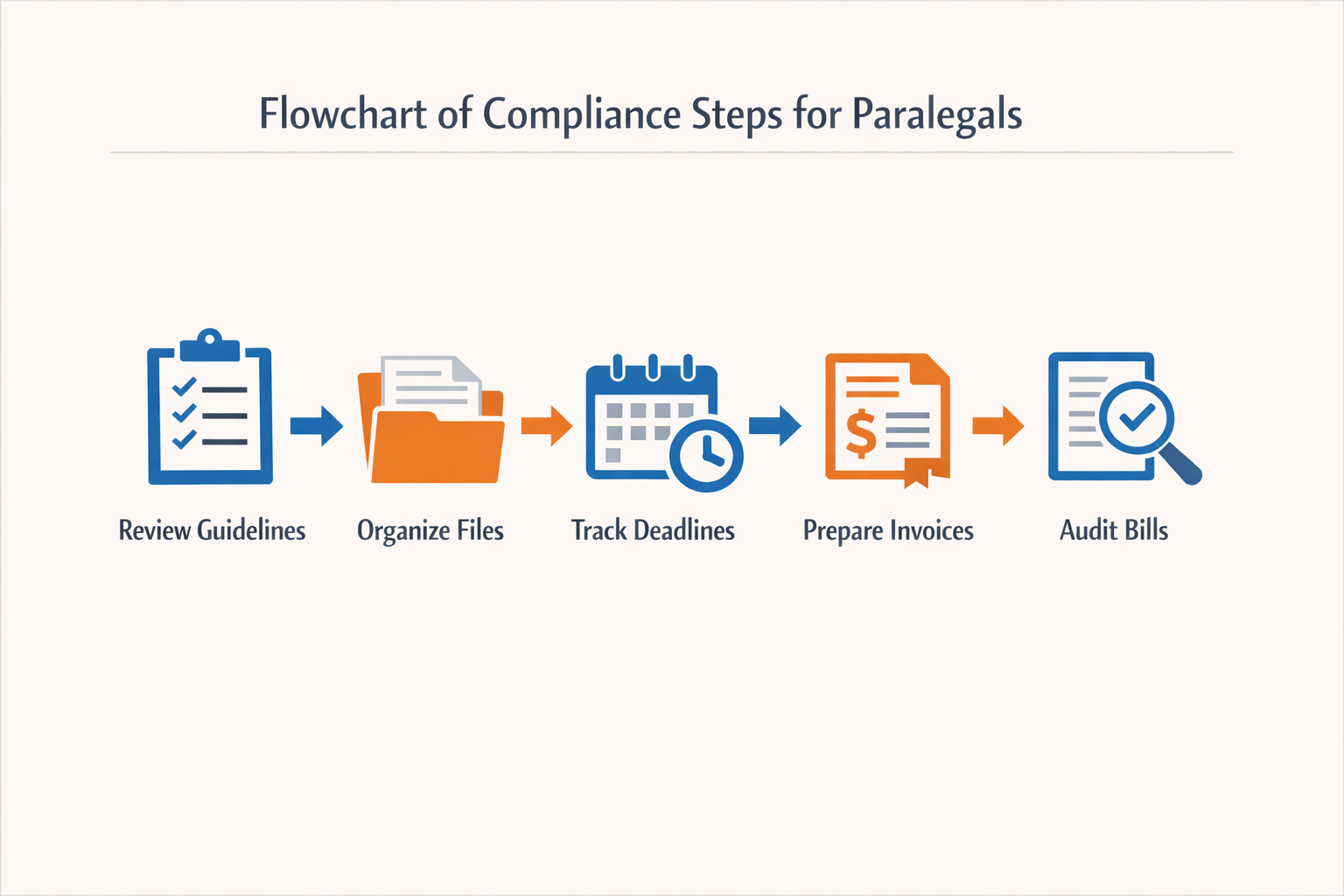
Carriers pay for work they can verify. Paralegals who follow a structured approach to time entry, classification and narrative detail reduce rejections and preserve billable hours through the review cycle.
Step 1: Classify Your Timekeeper Code Correctly
The LEDES Oversight Committee publishes a revised timekeeper classification reference that defines each code by role and scope. Paralegals typically appear under codes that describe non-attorney professional staff, and the classification you select determines the rate the carrier applies and the tasks the reviewer expects to see.
Step 1
Verify your classification with the firm's billing coordinator
Before you submit your first invoice on a panel matter, confirm which timekeeper classification code the firm uses for paralegals on that carrier's matters. Some firms distinguish junior and senior paralegals with separate codes; others use a single classification. The code drives the rate, and the rate must match the fee schedule in the carrier's outside counsel guidelines.
If your firm uses contract or temporary paralegals, those timekeepers fall under a separate classification. The LEDES reference document defines TEMPOS (Contract Other Staff) as any outsourced non-attorney timekeeper working on a temporary, contract or consulting basis who is not a regular employee of the firm. Mixing employee and contract classifications in the same invoice invites scrutiny.
Step 2: Record Time in the Smallest Permitted Increment
Most panel guidelines specify tenth-of-an-hour increments. A tenth is six minutes. If you round a four-minute task to 0.2, you are billing two extra minutes; if you round a seven-minute task to 0.2, you are writing off one minute. Both rounding directions create problems. The solution is to record time contemporaneously and use the increment the guideline permits.
When a guideline is silent on increments, tenth-of-an-hour is the prevailing standard. Billing in quarter-hours without express permission is a common reduction trigger.
Step 3: Write One Line Item Per Discrete Task
Block billing—combining multiple tasks in a single narrative—is prohibited under most carrier guidelines. One entry reading "review correspondence, draft discovery responses, confer with attorney, 3.5" is enough to trigger a reduction even if every task in that list is compensable.
The fix is simple: one task, one line item, one time entry. "Review carrier correspondence regarding medical authorization, 0.3" is a complete entry. "Draft responses to form interrogatories, set one, 1.8" is a complete entry. Combining them into a single line is not.
Step 2
Separate tasks by UTBMS activity code
If your e-billing portal requires UTBMS activity codes, use them to guide your line-item structure. Each activity code describes a single type of work. When your narrative covers two activity codes, split it into two entries.
For a detailed breakdown of how activity codes map to narrative structure, see UTBMS Activity Codes A101-A111 for Legal Billing.
Step 4: Include Enough Detail to Survive Review
A narrative must tell the reviewer what you did, not what you thought about or what the case involves. "Work on discovery" is insufficient. "Review plaintiff's responses to special interrogatories and highlight inconsistencies with deposition testimony, 1.2" is sufficient.
The reviewer is not on the case. The narrative is the only evidence that the time was spent on compensable work. If the narrative is vague, the reviewer applies a reduction code and moves to the next invoice.
Step 5: Submit Through the Correct Portal in the Required Format
Carriers specify an e-billing portal and a file format in their outside counsel guidelines. The two most common formats are LEDES 1998B and LEDES XML. If you submit the wrong format, the portal rejects the file before a human reviewer sees it.
Validation happens at submission. The portal checks field structure, timekeeper codes, UTBMS codes if required, and invoice metadata. A single malformed field stops the submission. The rejection message tells you which field failed; fix that field and resubmit.
For a complete explanation of the LEDES 1998B structure and all twenty-four fields, see LEDES 1998B File Format - All 24 Fields Explained. If your portal rejects the file with a format error, that article walks through every field and the validation rule it must satisfy.
Step 6: Track Reductions and Appeal When Justified
When the carrier reduces a line item, the bill review system assigns a reduction code. Common codes include "block billing," "vague narrative," "excessive time," and "task not pre-approved." The code tells you what the reviewer concluded.
If the reduction is wrong—if your narrative was not block-billed, if the time was reasonable, or if the task was expressly allowed—you appeal. The appeal goes back through the portal with the original line item, the reduction code, and a short explanation of why the reduction should be reversed.
Step 3
Document the guideline section that permits the task
When you appeal, cite the page and section number of the carrier's outside counsel guidelines that authorize the work. "Page 12, section 4.3 permits paralegal time for medical record review without pre-approval" is more persuasive than "this task is standard in workers' compensation defense."
Appeals succeed when the record is clear. If your narrative was detailed, your time was contemporaneous, and the guideline permits the task, the appeal path is open. If any of those elements is missing, the reduction stands.
Tips and Tricks
Billing entries that survive review share one characteristic: they document a task the reviewer can picture. "Research summary judgment standards, 0.6" tells the adjuster what happened; "Legal research, 2.4" does not. The difference is not sophistication — it is specificity.
Use the timekeeper classification the carrier expects
LEDES 1998B field 7 is not a courtesy label. Carriers match that code to a rate table, and misclassification triggers an automatic substitution or rejection. The LEDES Oversight Committee revised timekeeper classifications in June 2023 to clarify boundaries between roles. An associate is a lower-level professionally licensed attorney who does not hold an ownership interest in a law firm; a paralegal is a separate classification with a separate rate. If your firm submits paralegal time under the associate code to avoid a rate reduction, the e-billing portal will catch it — either at validation or during manual review — and the line item will be repriced or cut.
Write narratives that answer the reviewer's next question
A bill reviewer reads the narrative and asks: what deliverable came out of this time? If the answer is not obvious, the line item is a candidate for reduction. "Draft discovery responses" invites the question which ones? "Draft responses to form interrogatories, set one" closes the loop. "Review correspondence" invites from whom, about what? "Review adjuster email re: IME scheduling" closes it. The goal is not to write long entries — it is to write entries that require no follow-up.
Block billing — combining multiple discrete tasks in one line item — is prohibited under most panel guidelines. "Research and draft motion in limine, 4.2" is block billing. "Research motion in limine standards, 1.8" and "Draft motion in limine, 2.4" are not. The second format costs you nothing and survives review.
The cheapest time entry is the one the reviewer can approve without calling the adjuster to ask what it means.
Match your task code to the work you actually did
UTBMS task codes are not decoration. Reviewers filter invoices by task code to spot outliers, and a mismatch between the code and the narrative triggers a reduction even when the work itself is compensable. If you spent 1.2 hours summarising medical records, use task code L310 (fact investigation and development) or L320 (fact analysis and strategy), not A101 (plan and prepare for a court appearance). The narrative may describe legitimate work, but the wrong code tells the reviewer you do not know what you billed for — or that you are trying to bury a soft cost under a hard one.
For detailed guidance on matching activity codes to narrative content, see UTBMS Activity Codes A101-A111 for Legal Billing.
Record time in the increment the guideline specifies
Most carrier guidelines specify tenth-of-an-hour increments. If you round a 12-minute task to 0.25 (quarter-hour), the portal will either reject the file at validation or the reviewer will reduce the entry to 0.2 during manual review. The increment is not negotiable, and "we have always billed this way" is not a defence. Check the guideline version your matter is subject to, find the increment requirement, and configure your timekeeping system to match it before you generate the LEDES file.
Keep contemporaneous records even when you bill in batch
Many paralegals track time throughout the day and enter it in batch at day's end. That workflow is fine, but the underlying records must be contemporaneous — captured when the work happened, not reconstructed later. If a fee dispute reaches discovery, the carrier will request your time records, and a gap between the work date and the record date undermines your entire invoice. The safest practice is to timestamp each task as you complete it, even if you do not enter it into the billing system until later.
Conclusion
A single line item reading "legal research and review file, 3.8" is enough to trigger a reduction under most panel guidelines — and the paralegal who wrote it will never see the carrier's explanation unless the firm shares it. This Paralegal Billing Cheat Sheet has walked through the mechanics of what carriers pay for, what they cut, and how to document the work so it survives bill review. The difference between a clean invoice and one that comes back marked with reduction codes is not the quality of the work; it is the precision of the narrative, the accuracy of the UTBMS code, and the timekeeper's willingness to break compound entries into discrete line items.
Paralegals who familiarize themselves with the outside counsel guidelines that govern their matters — and who treat each fee entry as a standalone record that must justify itself without context — will see fewer rejections, faster payment, and less friction with both the carrier and the supervising attorney. The guidelines are published, the LEDES timekeeper classifications are standardized, and the e-billing portals return the same validation errors for the same mistakes. Read the controlling document, code the task correctly, write the narrative so a bill reviewer three states away understands what you did, and submit the invoice in the format the carrier specifies. That is the entire framework. Everything else is execution.
For a detailed explanation of how to structure and submit compliant invoices, see LEDES 1998B File Format - All 24 Fields Explained.
FAQ
What is the Paralegal Billing Cheat Sheet?The Paralegal Billing Cheat Sheet is a reference guide that explains which paralegal tasks carriers reimburse, which they reject, and how to structure time entries to pass bill review on the first submission.
How often should I use the focus keyword in my billing narratives?You should not insert the phrase "Paralegal Billing Cheat Sheet" into billing narratives. Instead, follow the structural rules this guide describes: use specific task descriptions, avoid block billing, and match your timekeeper classification to the work performed.
Why do carriers reject paralegal time entries?Carriers reject paralegal entries for block billing (combining multiple tasks in one line), vague narratives that do not describe a specific deliverable, misclassified timekeeper codes, and billing increments that violate guideline requirements.
What is the difference between PARALGL and CLKSEC classifications?PARALGL denotes a non-attorney professional who performs substantive legal work under attorney supervision. CLKSEC covers lower-level administrative staff such as file clerks, copy staff, and secretaries. Billing clerical work under a PARALGL code triggers reductions.
Can I bill paralegal time in quarter-hour increments?Most carrier guidelines require tenth-of-an-hour (six-minute) increments. Billing in quarter-hours without express guideline permission is a common reduction trigger.