


Outside Counsel Guidelines for Insurance Litigation
Introduction
One entry reading "research and draft motion in limine, 4.2" is enough to trigger a reduction under most panel guidelines. The difference between an approved invoice and a rejected one often comes down to whether the timekeeper read the carrier's outside counsel guidelines before drafting the narrative. These guidelines are not suggestions. They are contractual billing requirements that carriers enforce through e-billing portals, bill review teams, and reduction codes.
In my work with the Carrier Ready Knowledge Team, I've often explored the nuances between outside counsel guidelines and insurance litigation guidelines. When we look at block billing, a common point of contention, reading Arch 2025.5, Hartford's billing FAQ, and Sompo's guidelines together reveals that only one treats block billing as an outright prohibition rather than a reduction trigger. This indicates a significant divergence in how carriers approach billing transparency and accountability.
Outside counsel guidelines govern the relationship between insurance carriers and the law firms they retain to defend claims. These documents specify billing increments, narrative detail standards, staffing ratios, pre-approval thresholds, and prohibited billing practices. They are published by carriers, distributed to panel counsel, and updated periodically—sometimes with version numbers, sometimes with effective dates, sometimes with neither. The guidelines control what a carrier will pay, regardless of what the firm believes is reasonable or customary.
Insurance litigation guidelines operate within this framework but address the specific context of defending insureds under liability policies. These guidelines often reference pre-approval requirements for experts, discovery motions, and trial preparation. They specify when independent counsel must be appointed under Civil Code section 2860, how Cumis counsel invoices are reviewed, and what documentation is required when a conflict of interest arises. The structure and common provisions of outside counsel guidelines often require a thorough understanding of LEDES formats and UTBMS codes.
Why Compliance Matters
Carriers review every submitted invoice against the published guidelines. When a line item violates a guideline provision, the bill reviewer applies a reduction code, writes down the entry, and generates a rejection notice. The firm then faces a choice: accept the reduction or appeal it. Appeals require documentation, narrative justification, and often a reference to the specific guideline section the firm believes supports its position. Most appeals fail because the guideline language is clear and the line item does not comply.
E-billing portals enforce some guideline provisions automatically. A file submitted in the wrong LEDES format is rejected before a human reviewer sees it. A UTBMS task code that does not match the carrier's approved code set triggers a validation error. A narrative that exceeds the character limit is truncated, and the truncated version is what the reviewer reads. These technical rejections are preventable, but only if the timekeeper and billing staff understand the portal's requirements and the carrier's specifications.
The stakes are not academic. A rejected invoice delays payment by the time it takes to correct the errors, resubmit the file, and wait for the next review cycle. A write-down reduces the firm's revenue on the matter. A pattern of non-compliance can result in removal from the panel. For more detailed guidance on how carriers enforce these rules, see Block Billing: Reasons for Carrier Rejections and Solutions.
What This Article Covers
This article walks through the structure of outside counsel guidelines, the common provisions that appear across carriers, and the specific requirements that trigger the most frequent rejections. It explains how to read a guideline document, identify the controlling provisions for a given line item, and structure billing entries to comply. It addresses block billing, narrative detail, billing increments, UTBMS codes, and the pre-approval thresholds that apply to experts, motions, and appeals. It does not provide legal advice for a specific matter, firm, or invoice, and it does not recommend software vendors or purchasing decisions.
Problem Statement
Outside counsel submitting invoices to insurance carriers face a billing environment where guideline interpretation, invoice adjustment practice, and portal validation rules operate as three separate systems that rarely align. A line item that passes portal validation may still trigger a reduction code during manual review. A narrative that satisfies one carrier's block billing prohibition may violate another's contemporaneous-records requirement. The result is a submission process in which compliance is neither predictable nor consistent.
The Subjectivity Problem
Defense attorneys report that 76% view invoice adjustments as very subjective, a perception rooted in the fact that most carriers publish guidelines but do not publish their reduction-code mappings or the internal rubrics bill reviewers apply. When a reviewer marks a line item as "excessive" or "duplicative," the outside counsel receives a reduction code and a brief explanation, but no access to the standard the reviewer used to reach that conclusion. One carrier's "reasonable" is another's "reduction warranted."
The Payment-Timing Problem
The same defense attorneys scored the process for getting paid and being paid in a timely manner a 56 on a pain scale of 1 to 100, with 100 representing maximum pain. That score reflects not only the time between submission and payment, but also the uncertainty introduced by reduction cycles. When an invoice is reduced, the outside counsel must decide whether to accept the reduction, appeal it, or write it off. Each path consumes time, and none guarantees payment within the original billing cycle.
E-billing portals automate validation of LEDES file structure and UTBMS code syntax, but they do not automate the judgment calls that produce reductions. A file that clears portal validation enters a manual review queue, where a human reviewer applies the carrier's internal standards to each line item. The reviewer's decision — accept, reduce, or reject — determines whether the invoice moves to payment or back to the outside counsel for revision. For more on how portals handle validation and rejection, see E-Billing Portal Invoice Rejections: Common Causes and Fixes.
The Performance-Data Gap
Seventy-four percent of defense attorneys provide performance data only informally, sometimes, or never. Carriers request metrics — case outcomes, average time to resolution, cost per matter type — but outside counsel often lack the internal systems to extract and report those metrics in the format the carrier expects. The carrier's outside counsel guidelines may specify reporting requirements, but they rarely specify the data schema, the reporting frequency, or the consequences of non-compliance. The outside counsel submits what they can, the carrier requests clarification, and the cycle repeats.
Without structured performance data, the carrier cannot evaluate whether the outside counsel is meeting the efficiency and cost targets embedded in the guidelines. Without feedback from the carrier, the outside counsel cannot adjust their staffing, case strategy, or billing practices to align with those targets. The guidelines function as a compliance checklist rather than a performance framework, and both parties operate without a shared understanding of what "success" looks like.
A guideline document is not a performance contract — it sets boundaries, but it does not specify how close to those boundaries the outside counsel should operate.
Solution Steps
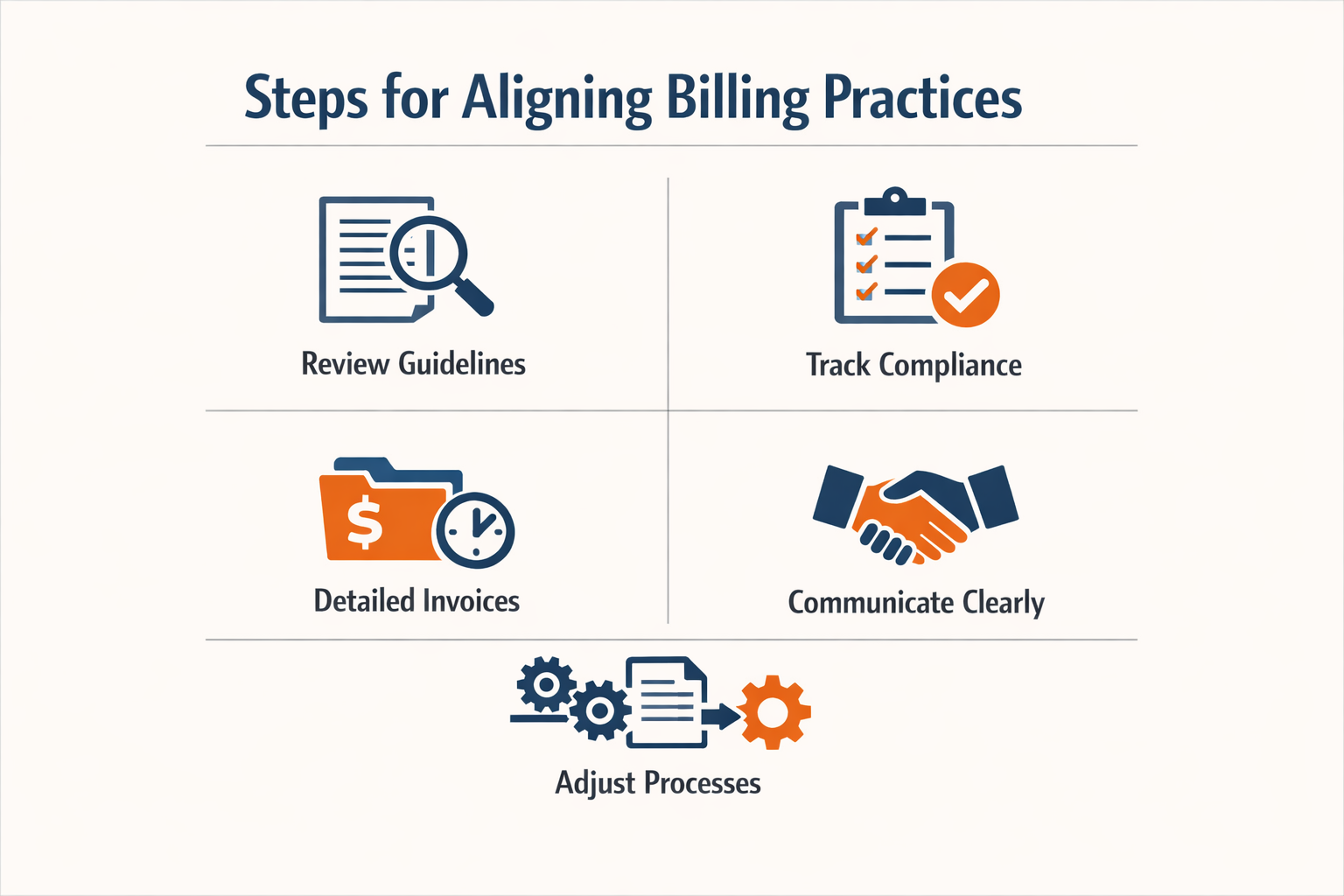
Aligning billing practices with carrier outside counsel guidelines requires methodical preparation before the first invoice reaches an e-billing portal. The steps below address the most common points of divergence between what firms submit and what guidelines permit.
Step 1: Obtain and Read the Controlling Guideline Document
Request the carrier's current outside counsel guidelines at engagement. Panel firms typically receive these at onboarding; non-panel counsel should ask the adjuster or claims attorney for the version in effect for the matter. Version numbers and effective dates matter — Arch 2025.5 differs from Arch 2024.3 in its treatment of block billing, and submitting invoices under the wrong version triggers rejections that slow payment.
Read the guideline cover to cover before the first time entry. Mark sections on billing increments, block billing prohibitions, narrative detail requirements, pre-approval thresholds and staffing ratios. If the guideline references a separate rate schedule or fee agreement, obtain that document as well.
Step 2: Configure Timekeeping to Match Guideline Requirements
Set your timekeeping system to enforce the carrier's billing increment before anyone records time. Three of the four carriers with published guidelines specify tenth-of-an-hour increments; the fourth is silent, which is not the same as permissive. If your system defaults to quarter-hour rounding, every entry will require manual adjustment before export, and manual adjustment introduces error.
Disable block billing at the entry level. One entry reading "research and draft motion in limine, 4.2" is enough to trigger a reduction under most panel guidelines. Train timekeepers to record discrete tasks in separate entries: "research motion in limine standard," "draft motion in limine," "revise motion in limine." Each entry should describe one activity that corresponds to a single UTBMS task and activity code pair.
For carriers that require contemporaneous narrative detail, configure the system to reject entries with fewer than a specified character count or entries that duplicate prior narratives. Reviewers read repetition as padding, and padding invites line-by-line scrutiny.
Step 1
Map UTBMS codes to common tasks
Before the first invoice, assign UTBMS task codes and activity codes to the work categories your team performs most often. For example, map "draft motion to compel" to task code L320 (Discovery motions) and activity code A103 (Draft pleading/discovery). Consistent mapping reduces the risk that the same work appears under different codes across invoices, which triggers bill review queries.
Step 3: Validate the LEDES 1998B File Format Before Submission
Export a test invoice in LEDES 1998B format and open it in a text editor. Verify that every required field contains a value and that date fields follow YYYYMMDD format without slashes or hyphens. The LEDES Oversight Committee's 98B format page precisely defines the field set, yet several e-billing portals accept files that omit fields marked as required by the specification. Do not assume the portal's validation catches every error — carriers reject invoices after portal acceptance when downstream bill review systems flag malformed data.
Check that timekeeper IDs, task codes and activity codes match the carrier's approved lists. Some carriers maintain their own code sets that differ from standard UTBMS; submitting a code the carrier does not recognise results in automatic rejection or a request for re-submission with compliant codes.
Step 4: Review Invoices Against the Guideline Checklist Before Upload
Before uploading to the e-billing portal, run the invoice through a checklist derived from the guideline's billing section. Common checklist items include:
- No block billing (one task per line item)
- Tenth-of-an-hour increments (or the increment specified in the guideline)
- Narrative detail sufficient to identify the work without reference to another document
- No charges for clerical or administrative tasks unless expressly permitted
- Pre-approval documentation attached for any line item or expense above the threshold
- Timekeeper rates match the engagement letter or rate schedule
- UTBMS codes populated for every line item
If any item fails, correct the invoice before submission. Submitting a non-compliant invoice and then appealing the reduction costs more time than fixing the entry at the source.
Step 5: Monitor Rejections and Adjust Entry Practices
When an invoice is rejected or reduced, read the reduction code and the reviewer's note. Reduction codes map to specific guideline violations; understanding which provision triggered the reduction allows you to prevent the same error in future invoices. For example, a reduction code indicating "insufficient narrative detail" points to entries that need more descriptive text, while a code for "block billing" points to entries that combine multiple tasks.
Document the reduction and the corrective action in a shared reference for the billing team. If the same reduction recurs across multiple invoices, the problem is systemic — address it in timekeeping training and system configuration, not invoice by invoice.
Tips and Tricks
Compliance with outside counsel guidelines is not a one-time exercise. It requires continuous attention to detail, clear communication, and a working knowledge of the specific requirements each carrier enforces. The difference between a clean invoice and a reduction often comes down to small, repeatable practices that prevent common errors before they reach the portal.
Build a Pre-Submission Checklist
Before any invoice leaves the firm, run it through a standardized checklist that mirrors the carrier's published guidelines. Check that every line item uses the correct UTBMS task and activity codes, that narratives contain enough detail to survive a bill reviewer's scrutiny, and that no entry violates the carrier's block billing prohibition. A checklist eliminates the guesswork and ensures that the same errors do not recur across multiple matters.
Specialize Your Team for High-Exposure Matters
Panel firms are more likely to have attorneys with specialized experience in the types of claims carriers assign. When defending high-exposure matters, insurance companies evaluate whether outside counsel has the depth of expertise required to manage complex litigation effectively. Firms that can demonstrate specialized knowledge in a particular area of insurance defense are better positioned to meet carrier expectations and avoid guideline violations that stem from unfamiliarity with the claim type.
Use E-Billing Functionality to Create Clear Rules
E-billing platforms offer validation rules that can flag non-compliant entries before submission. Configure the system to reject line items that exceed the carrier's billing increment, that lack required UTBMS codes, or that combine multiple tasks in a single narrative. These non-subjective rules improve the relationship between payers and law firms by removing ambiguity from the invoice review process. When the system enforces the guideline automatically, disputes over interpretation become less frequent.
Clear, non-subjective rules built into the e-billing workflow prevent the same reduction codes from appearing on every invoice.
Document Pre-Approval Requests in Real Time
Many guidelines require pre-approval for expenses above a stated threshold or for certain categories of work. Do not wait until the invoice is prepared to seek approval. Document the request, the carrier's response, and the date of approval in the matter file as soon as the need arises. If the approval is granted via email, attach a copy to the invoice submission. Bill reviewers will not assume approval was obtained; the burden is on the firm to prove it.
Review Reduction Codes and Appeal Strategically
When an invoice is reduced, the e-billing portal will assign a reduction code that identifies the reason. Review the code against the carrier's published list of reduction reasons, then compare the flagged line item to the guideline provision it allegedly violated. If the reduction is incorrect, prepare a concise appeal that quotes the guideline language and explains why the line item complies. Appeals that cite the carrier's own standards are more likely to succeed than appeals that argue general reasonableness.
For more detail on how carriers interpret block billing and what triggers a rejection, see Block Billing: Reasons for Carrier Rejections and Solutions.
Conclusion
Outside counsel guidelines are not suggestions. They are the contractual framework that determines whether an invoice clears the portal or triggers a reduction code. Arch 2025.5 prohibits block billing outright; Hartford's billing FAQ treats it as a reduction trigger; Sompo's guidelines sit somewhere in between. The difference is not semantic — it is the difference between a paid invoice and a write-down appeal that consumes more time than the original entry.
The LEDES Oversight Committee's 98B format page defines the field set with precision, yet several e-billing portals accept files that omit fields marked as required by the specification. This discrepancy does not excuse non-compliance. When a carrier's guideline references LEDES 1998B, it references the published standard, not the portal's validation logic. Submitting a file that passes validation but violates the standard is a bet that the bill reviewer will not notice. That bet fails more often than it wins.
In my work with the Carrier Ready Knowledge Team, I've examined how the structure and common provisions of outside counsel guidelines require a thorough understanding of LEDES formats and UTBMS codes. The gap between what a portal accepts and what a guideline requires is where rejections occur. Firms that treat the portal as the sole authority miss the controlling document — the guideline itself, with its version number and effective date.
Compliance is not achieved by reading one section of one guideline. It is achieved by reading the controlling guideline for the matter, cross-checking the LEDES specification, verifying the UTBMS code set, and ensuring that every line item satisfies all three. The firm that does this work before submission avoids the appeal process entirely. The firm that does not will spend more time writing appeal letters than it would have spent reading the guideline in the first place.
For a deeper look at how block billing triggers reductions and what narrative detail satisfies a reviewer, see Block Billing: Reasons for Carrier Rejections and Solutions. The controlling document is the one the carrier published, not the one the vendor summarized.