


Sample Attorney Billing Descriptions PDF That Pass Carrier Review
Top takeaways
- Carrier review standards reject vague or block-billed line items, requiring specific task and activity detail in every narrative
- Effective attorney billing descriptions include the action taken, the subject matter, and enough context for a non-lawyer reviewer to understand the work
- Panel guidelines specify formatting rules—billing increments, narrative length, and UTBMS codes—that override firm billing habits
- A compliant description passes automated validation and human review without triggering reduction codes or appeal cycles
Introduction
Attorney billing descriptions that pass carrier review share a common structure: they state the action taken, identify the subject matter, and provide enough context for a non-lawyer reviewer to verify the time was reasonable. One line item reading "research and draft motion, 4.2" will trigger a reduction under most carrier outside counsel guidelines. The narrative lacks the subject of the motion, combines multiple tasks without time allocation, and gives the reviewer no way to verify that 4.2 hours is reasonable for the work described.
Insurance defense billing operates under a different standard than general commercial litigation: the carrier paying the invoice was not the client who hired the firm, and the guidelines governing the relationship are published, specific, and enforced through automated rejection workflows in the e-billing portal.
Attorneys accustomed to billing corporate clients with established relationships often encounter their first guideline rejection when they begin panel work. The rejection notice arrives with a reduction code, a brief explanation, and instructions to resubmit or appeal. Understanding what passes review requires reading the controlling guideline, matching its requirements to the line-item structure, and writing narratives that satisfy both the automated validation rules and the human bill reviewer reading the invoice three weeks later.
Carrier guidelines are not suggestions. They are the terms under which the panel relationship exists, and they typically incorporate LEDES file format requirements, UTBMS task and activity codes, and narrative standards that differ from state bar billing ethics rules. A description that complies with ABA Model Rule 1.5 or California Rule of Professional Conduct 1.5 is not automatically compliant with a carrier guideline. The guideline is the higher standard for panel counsel, and where the two conflict, the guideline controls the invoice submission. Firms that treat guideline requirements as negotiable or aspirational will see their invoices reduced, their resubmissions rejected, and their panel status reviewed at the next evaluation cycle.
This article walks through the structure of compliant attorney billing descriptions, the common rejection patterns that trigger reductions, and the specific steps required to draft narratives that pass both automated and human review. The examples and standards discussed here reflect the requirements published in carrier outside counsel guidelines and the LEDES and UTBMS specifications that govern electronic invoice submission. Where a firm's internal billing practices conflict with a panel guideline, the guideline wins. For more detail on how block billing triggers rejections, see Block Billing: Reasons for Carrier Rejections and Solutions.
What Causes Attorney Billing Descriptions to Fail Carrier Review?
Billing descriptions that fail carrier review share a predictable set of defects. The first is block billing — a single line item that aggregates multiple tasks without separating them by type or time. Electronic invoice systems built on task-based coding expect discrete entries for each category of work performed, even when the work occurs on the same day. When a timekeeper writes "research case law, draft motion, confer with client, 4.2," the reviewer sees four tasks in one line and applies a reduction code before the invoice reaches the adjuster.
Vague or Conclusory Entries
A second defect is vagueness. Descriptions that omit the subject of the work — "legal research, 1.5" or "review documents, 2.3" — give the reviewer no way to assess whether the time was reasonable for the matter at hand. The question is not whether the attorney worked the hours represented, but whether the time billed was reasonable for the services described. A private-sector client paying hourly would expect to see what was researched, which documents were reviewed, and why the task was necessary at that stage of the case.
Missing Task Granularity
A third defect is the failure to separate entries by task code when multiple activities occur in sequence. UTBMS task-based coding was designed so that multiple time entries could result from the services performed in a single day on a matter. When a timekeeper drafts a discovery response, reviews incoming production, and attends a client call in one afternoon, the guideline expects three line items with three task codes — not one entry reading "discovery and client communication, 3.8."
Inconsistent Increment Rounding
Rounding inconsistencies also trigger rejection. Most panel guidelines specify tenth-of-an-hour increments; a line item recorded at 1.25 or 2.33 hours signals that the firm's timekeeping system is not configured to the carrier's standard. Even when the total is correct, the format mismatch flags the invoice for manual review and increases the likelihood of a write-down.
Carriers reduce the administrative burden around billing and collection when firms submit invoices that meet the published standards on the first pass. The alternative is a cycle of rejection, revision, and appeal that consumes adjuster time and delays payment. For more on how task codes interact with narrative detail, see UTBMS Activity Codes A101-A111 for Legal Billing.
How Do You Write Attorney Billing Descriptions That Pass Review?
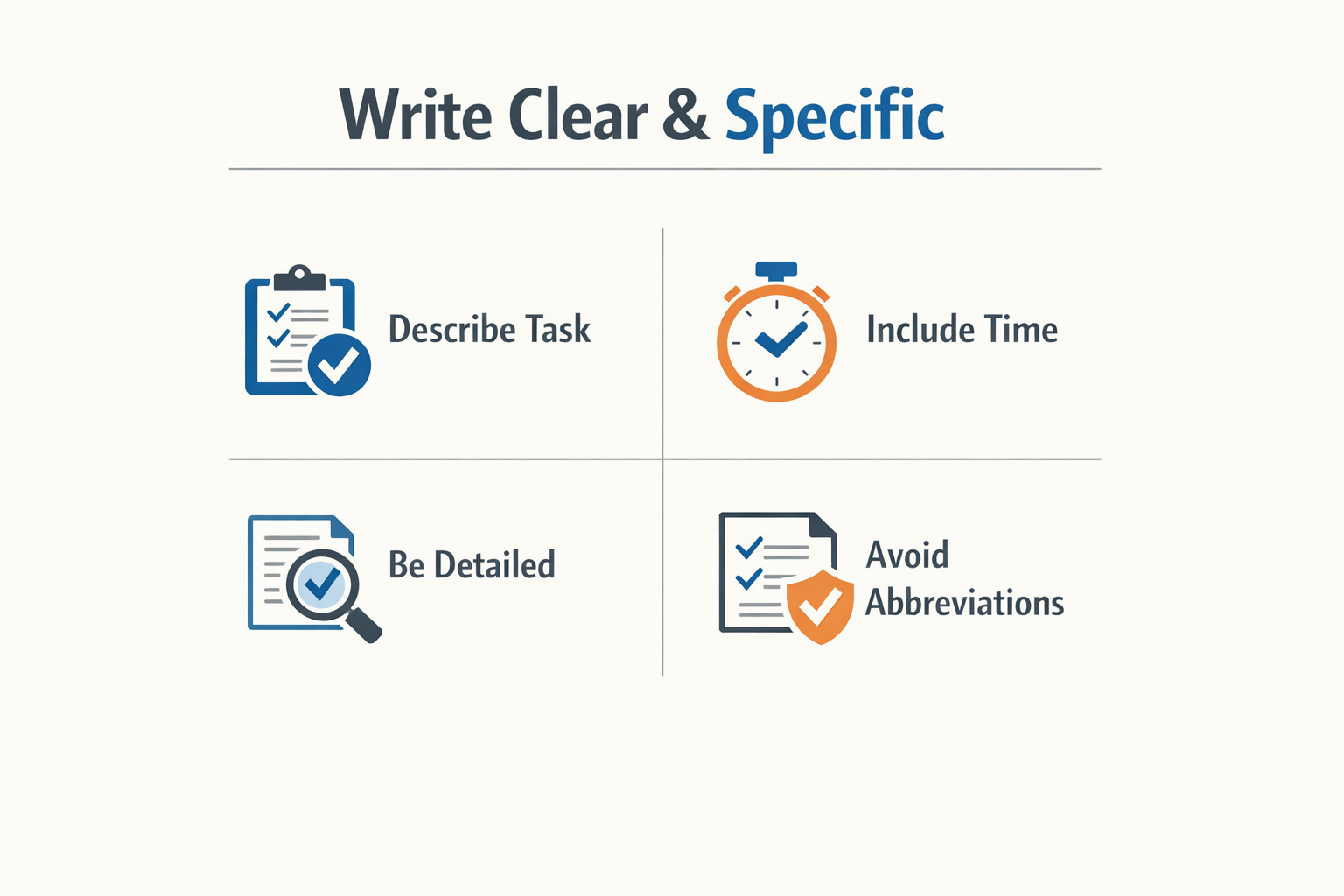
A billing description that passes carrier review starts with the task, not the activity. Electronic invoice time entries are task-based and aggregated by type of work performed, meaning a single day's work often produces multiple line items rather than one consolidated entry. The federal court standard offers useful guidance: describe the services provided in detail, including hours spent and total dollars billed, and remember that the question is whether the time billed was reasonable, not merely whether you worked those hours.
Step 1: Identify the Discrete Task
Step 1
Identify the discrete task
Before you open the time entry, decide what you did in terms a bill reviewer will recognize. "Legal research" is not a task — it is an activity. "Research statute of limitations for fraud claims under California law" is a task. The task is the objective; the activity is the verb. Start every entry by naming the objective in enough detail that a reviewer who has never seen the file understands what you accomplished.
A task-based entry isolates one piece of work. If you researched two unrelated issues in the same session, split them into two entries. If you drafted a motion and then revised it after a partner review, those are two tasks. Aggregation by type of work performed means grouping entries by what they achieve, not by when you did them.
Step 2: Select the Correct UTBMS Code Pair
Step 2
Select the correct UTBMS code pair
Every line item needs a task code and an activity code. The task code describes the phase or category of work — for example, L300 for motions practice or L400 for discovery. The activity code describes what you did within that task — A101 for plan and prepare, A102 for draft or revise, A103 for review. Choose the narrowest code that fits. If the code set offers a specific option and a general one, use the specific one.
Reviewers read UTBMS codes before they read narratives. A mismatch between the code and the description triggers scrutiny. If the task code is L310 (motions for summary judgment) and the narrative says "telephone conference with opposing counsel," the reviewer will flag it. For more detail on how UTBMS activity codes structure billing entries, consult the published code sets.
Step 3: Write a Narrative That Justifies the Time
Step 3
Write a narrative that justifies the time
The narrative must answer three questions: what did you do, why did you do it, and what did you produce or decide. "Review discovery responses" does not answer those questions. "Review defendant's responses to form interrogatories, set one; identify three incomplete answers regarding employment history; prepare meet-and-confer letter" does. The standard is what a client paying by the hour would expect to see as justification for the fee charged.
Short paragraphs and concrete nouns make narratives defensible. Avoid throat-clearing phrases like "continued work on" or "further attention to." If the entry is a revision, state what changed. If it is a review, state what you concluded. If it is a conference, state what you decided. The narrative is not a diary entry — it is a record that demonstrates the time was reasonable.
Step 4: Confirm the Increment and Avoid Block Billing
Step 4
Confirm the increment and avoid block billing
Most panel guidelines specify tenth-of-an-hour increments. Round each task to the nearest 0.1, not to the nearest quarter-hour. Block billing — combining multiple tasks in one narrative — is prohibited under most guidelines. If you drafted a motion, reviewed exhibits, and revised the caption in the same session, those are three entries, each with its own task code, activity code, narrative, and time increment.
Billing in tenths forces precision. If a task took six minutes, it is 0.1 hours. If it took twenty-three minutes, it is 0.4 hours. The increment discipline prevents the rounding errors that accumulate into write-downs.
Step 5: Review Against the Guideline Before Submission
Before the invoice leaves your system, compare every entry against the carrier's outside counsel guidelines. Check the narrative for prohibited block billing, confirm that task and activity codes align, verify that no single entry exceeds any stated pre-approval threshold, and ensure that the billing increment matches the guideline requirement. If the guideline is silent on increments, tenth-of-an-hour is the safer default.
Many rejections occur not because the work was unreasonable but because the description failed to demonstrate its necessity. The reviewer does not have your file, your emails, or your memory. The entry must stand alone.
Tips and Tricks for Successful Attorney Billing
Once you have mastered the mechanics of compliant attorney billing descriptions, a handful of additional practices will improve approval rates and reduce the administrative friction that frustrates both timekeepers and reviewers.
Prepare Quarterly Summaries Before Submission
Most panel counsel guidelines now require quarterly invoicing. Rather than reconstructing your work at the end of the quarter, maintain a running summary as you enter time. The C.D. Cal. CJA Panel Manual recommends describing services performed separately by month or by quarter, noting that the question is not whether you worked the hours but whether the time billed was reasonable. A private-sector client paying by the hour expects to see clear justification for the fee charged. A quarterly summary prepared contemporaneously meets that standard and simplifies final voucher preparation.
Frame Reasonableness from the Client's Perspective
Reviewers evaluate reasonableness, not just accuracy. Before submitting an invoice, read each narrative as though you were the client writing the check. Does the description explain what you accomplished and why it took the time it did? If a line item reads "legal research, 3.5," a claims professional has no basis to assess whether 3.5 hours was efficient or excessive. "Research California tolling statutes applicable to minor plaintiffs in construction defect actions, 3.5" gives the reviewer enough context to evaluate reasonableness and approve the entry without a reduction code.
Reduce Administrative Burden Through Process Alignment
The 2024 CLM Defense Counsel Study reports that subjective billing audits are the single most frustrating aspect of defense work, and that carriers should reduce the administrative burden around billing and collection. One recommendation is that panel selection and rate negotiation belong to claims or legal functions rather than separate vendor management teams. While individual timekeepers cannot restructure carrier operations, you can reduce your own administrative load by aligning your internal billing process with the carrier's requirements from the outset. Use the correct UTBMS codes, apply the specified increment, avoid block billing, and include sufficient narrative detail in the first submission. Each invoice that clears review on the first pass is one less appeal to draft and one less cycle of revision.
Maintain Contemporaneous Records
Many outside counsel guidelines require contemporaneous time records. Even where the guideline is silent, contemporaneous entries are more accurate and more defensible than reconstructed narratives. If you wait until the end of the week to enter time, you will aggregate tasks, forget details, and produce descriptions that look like block billing even when the work was sequential. Enter time daily, and your narratives will naturally contain the detail that satisfies reviewers.
Link Your Billing Software to LEDES and UTBMS Standards
Most e-billing portals validate LEDES 1998B file structure and flag invalid UTBMS codes before submission. Configure your time and billing system to enforce the LEDES 1998B file format and to restrict task and activity code entry to valid UTBMS values. Front-end validation prevents submission errors and reduces the cycle time between invoice generation and payment.
Conclusion
Compliant attorney billing descriptions are not a clerical formality. They are the difference between an invoice that clears review and one that triggers reductions, appeals, and the administrative burden that follows. The Carrier Ready Knowledge Team has reviewed hundreds of reduction codes and guideline versions; the pattern is consistent. Descriptions that state what was done, for how long, and to what end pass review. Descriptions that aggregate tasks, omit detail, or force the reviewer to guess do not.
The standards described in this article—task-by-task entries, contemporaneous detail, UTBMS alignment, and narrative sufficiency—are drawn from published carrier guidelines, court manual billing requirements, and the documented experience of panel counsel. They are not aspirational. They are the baseline expectation for any invoice submitted through an e-billing portal or presented for fee review. A firm that adopts these practices reduces its rejection rate, shortens its payment cycle, and avoids the friction that accompanies every appeal.
Carriers and their bill reviewers are not adversaries. They are partners with a shared interest in accurate, defensible invoices. The 2024 CLM Defense Counsel Study notes that carriers should reduce administrative burden and treat firms as partners rather than vendors. That partnership begins with billing descriptions that meet the stated standard. When a firm submits clean invoices, the reviewer's job becomes verification rather than investigation, and the relationship improves.
For firms seeking additional guidance on related topics, the article on block billing reasons for carrier rejections and solutions provides further detail on one of the most common causes of reduction. The principles are the same: specificity, transparency, and alignment with the guideline.
The path forward is straightforward. Review the carrier's outside counsel guidelines. Compare your current descriptions to the examples and standards in those guidelines. Identify the gaps. Train timekeepers on the requirements. Build the discipline into the firm's billing workflow. The result is fewer rejections, faster payment, and a reputation for professionalism that carries weight when panels are renewed and rates are negotiated. Compliant billing descriptions are not optional. They are the cost of doing business with carriers who expect accountability for every tenth of an hour billed.
FAQ
What are attorney billing descriptions?
Attorney billing descriptions are narrative explanations on legal invoices that detail the work performed, including the specific task, subject matter, time spent, and context needed for a reviewer to verify the work was reasonable and necessary.
How do I write attorney billing descriptions that pass carrier review?
Write attorney billing descriptions by stating the action taken, identifying the subject matter, separating each task into its own line item with the correct UTBMS code, using tenth-of-an-hour increments, and providing enough detail for a non-lawyer reviewer to understand and approve the work.
What makes attorney billing descriptions compliant with carrier guidelines?
Compliant attorney billing descriptions avoid block billing, include specific task details rather than vague phrases, match the assigned UTBMS task and activity codes, use the required billing increment format, and demonstrate that the time billed was reasonable for the services described.