


What Is Block Billing? A Plain-English Definition & Examples
Top takeaways
- Block billing assigns a single block of time to multiple tasks rather than itemizing each task separately
- Outside counsel guidelines from most carriers prohibit block billing in submitted invoices
- A single narrative reading "research and draft motion in limine, 4.2" combines distinct tasks into one entry
- Task-based time entries require separate line items for each discrete activity
- E-billing portals and bill reviewers flag block-billed entries for reduction or rejection
Introduction
One entry reading "review correspondence, draft response, confer with client, 3.5" is enough to trigger a reduction under most panel guidelines. Block billing occurs when a block of time is assigned to multiple tasks rather than itemizing the time spent on each task. The California Court of Appeal stated that definition in Mountjoy v. Bank of America at 245 Cal.App.4th 266, page 279, and it remains the controlling standard for identifying the practice.
The issue is not the total hours billed. The issue is whether a reviewer can see what portion of the 3.5 hours went to reviewing correspondence, what portion went to drafting, and what portion went to the client conference. When those three activities share one time entry and one total, the entry is block-billed.
Most carrier outside counsel guidelines require task-based entries. The UTBMS framework, published at utbms.com, specifies that electronic invoice time entries should be task-based and aggregated by type of work performed, resulting in the possibility that multiple time entries could result from the services performed in a single day on a matter. That structure is incompatible with block billing.
Understanding what constitutes block billing and how carriers respond to it is essential for any timekeeper submitting invoices through an e-billing portal. The remainder of this article walks through the definition, shows examples of compliant and non-compliant entries, and explains the mechanics of rejection and appeal.
Problem Statement
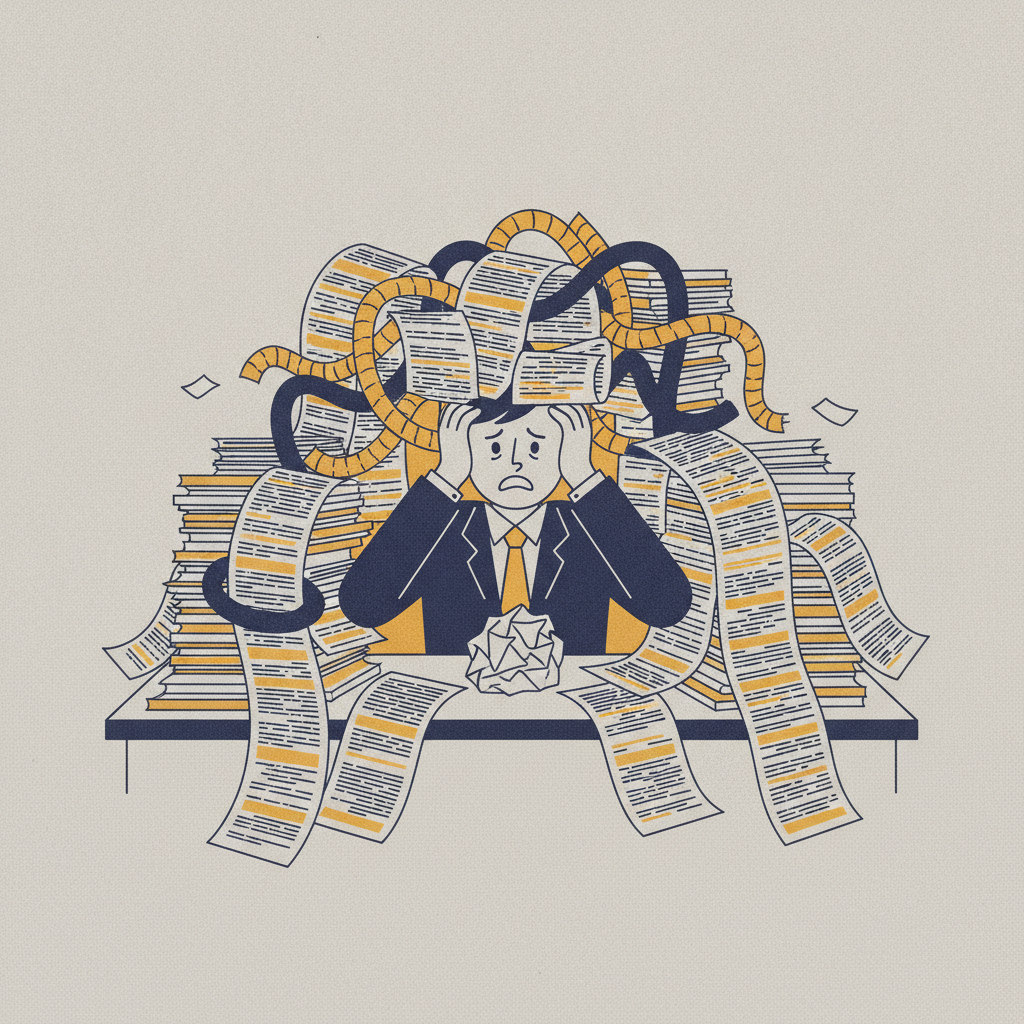
Block-billed time entries collapse multiple discrete tasks into a single line item with one aggregate time figure. That bundling makes it impossible to evaluate whether the hours claimed for each underlying task are reasonable. A court reviewing fee petitions cannot determine how much time went to legal research versus drafting versus telephone conferences when all three appear under one entry reading "Research case law, draft motion, confer with client; 6.8 hours." The opacity is not accidental—it is inherent in the format.
Why Block Billing Triggers Reductions
Bill reviewers and courts treat block billing as a red flag because the practice obscures the work actually performed. When a narrative lumps together tasks that differ in complexity, value and appropriate staffing, the reviewer has no way to verify that each component received the time it warranted. Block-billed entries make it difficult, if not impossible, to determine whether the number of hours spent on certain tasks were reasonable. Courts have applied across-the-board percentage reductions to fee requests whenever billing records contain block-billed entries, on the theory that the lawyer created the ambiguity and the client should not bear the cost of resolving it.
Carrier outside counsel guidelines typically prohibit block billing outright. The prohibition appears in the narrative-detail section of the guideline, often paired with a requirement that each line item describe one task and one task only. When an invoice arrives at an e-billing portal with entries that bundle multiple activities, the system flags them for manual review and the bill reviewer applies a reduction code. The timekeeper then faces a choice: accept the write-down or appeal with contemporaneous records that break out the time by task. If those records do not exist, the reduction stands.
Client and Court Concerns
Clients worry about over-billing when they see block entries, because there is no way to verify that the attorney spent the claimed time on each component. Attorneys may worry about under-billing their actual hours when forced to estimate allocations after the fact. Both concerns point to the same structural problem: block billing substitutes a single aggregate figure for the task-by-task accounting that makes fee review possible. The format shifts the burden of proof from the timekeeper, who has access to contemporaneous records, to the reviewer, who does not.
For more on how carriers evaluate and reject invoices with block-billed entries, see Block Billing: Reasons for Carrier Rejections and Solutions.
Solution Steps
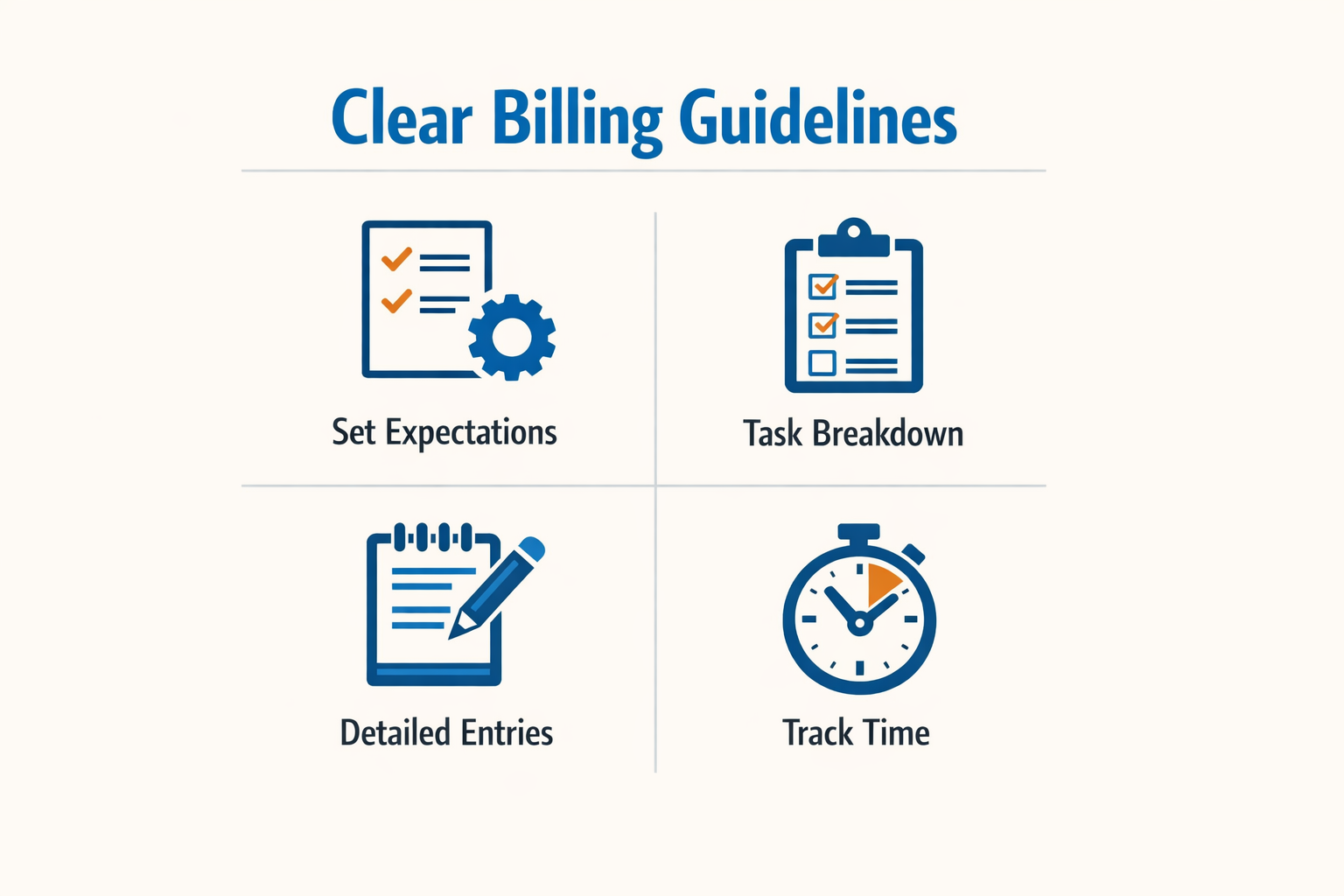
Avoiding block billing requires changing how timekeepers record their work. The goal is to create line items that describe one discrete task, not a series of unrelated activities lumped together. The following steps provide a practical framework for achieving that standard.
Separate Each Distinct Task
Every time a timekeeper shifts from one type of work to another, that shift should produce a new line item. Reviewing a deposition transcript is one task. Drafting interrogatory responses is another. Conferring with co-counsel is a third. Each of those activities goes on its own line, with its own time increment and its own narrative.
This approach aligns with the task-based structure adopted by electronic invoicing standards. The UTBMS code sets, for example, expect each line item to carry a single task code and a single activity code. When multiple unrelated tasks share one narrative, the invoice cannot be coded accurately, and the reviewer cannot verify that each task was necessary or reasonably priced.
Step 1
Record time contemporaneously
Capture each task as it occurs, not at the end of the day. Contemporaneous records make it easier to separate tasks naturally, because the timekeeper has not yet forgotten which activities were distinct. Reconstructing a day's work from memory invites the kind of lumping that produces block billing.
Step 2
Use one task code per line item
Assign a UTBMS task code to each entry as you create it. If you find yourself needing two task codes for one narrative, that narrative describes two tasks and should be split into two line items. The UTBMS Activity Codes A101-A111 for Legal Billing article explains how activity codes work within each task category.
Step 3
Write a narrative that describes one thing
The narrative should answer the question, "What did you do during this block of time?" If the answer contains the word "and" more than once, or if it lists multiple documents or multiple types of work, the entry is probably a block. Rewrite it as separate entries, each with its own time allocation.
Apply Billing Increments Consistently
Once tasks are separated, round each task's time to the billing increment required by the client or carrier. Most outside counsel guidelines specify tenth-of-an-hour increments, which means every line item must end in .0, .1, .2, and so on through .9. A task that took seven minutes becomes 0.1 hours. A task that took fourteen minutes becomes 0.2 hours.
Rounding to the nearest increment is not the same as inflating time. The timekeeper records the actual time spent, then rounds it according to the guideline. If the guideline permits quarter-hour increments, a nine-minute task rounds to 0.25 hours. If the guideline requires tenth-hour increments, the same task rounds to 0.2 hours. The key is consistency: every line item follows the same rounding rule, and no line item carries an impossible increment like 0.37 hours when the guideline prohibits it.
Review Entries Before Submission
Before an invoice leaves the firm, someone other than the timekeeper should read each narrative and confirm that it describes one task. This review catches block billing that the timekeeper did not recognise as such. It also catches vague narratives, missing task codes, and other issues that will trigger reductions or rejections downstream.
The reviewer should ask: Can I tell what the timekeeper did, and can I tell that it was one thing? If the answer to either question is no, the entry goes back to the timekeeper for revision. This step is not about second-guessing the work; it is about ensuring that the invoice can survive the bill review process without unnecessary reductions.
Tips and Tricks
Firms that want to avoid reductions and appeals can build billing transparency into their time-entry workflow before an invoice ever leaves the office. The following practices reduce the risk that a line item will be flagged as block billing during bill review.
Record tasks as they happen, not at day's end
Contemporaneous time entry is the single most effective defence against block billing. When a timekeeper logs work immediately after completing a task, the narrative naturally describes one discrete activity and one increment. Waiting until the end of the day invites the aggregation that triggers guideline prohibitions — an attorney who records all research, drafting and email in a single 4.2-hour entry has created a block-billed line item, whether or not that was the intent.
Separate each task code into its own line item
Most carrier guidelines and UTBMS activity codes expect one task code per line. A narrative that reads "research motion in limine; draft motion in limine; review opposing counsel email; telephone conference with client" spans multiple UTBMS codes — research (L310), drafting (L320), correspondence (L410) and client communication (L210). That entry will be rejected or reduced even if the time is reasonable, because the reviewer cannot verify the allocation across codes. The fix is to split the narrative into four line items, each with its own task code and time increment.
Step 1
Audit a sample week of time entries
Pull one week of invoices and highlight every narrative that contains a semicolon, "and," or a list of more than one verb. Each conjunction is a potential block-billing flag. Rewrite those entries as separate lines before the next submission cycle.
Use narrative detail that lets a reviewer reconstruct the work
A line item that reads "legal research, 2.4" tells the reviewer nothing about what was researched, why it took 2.4 hours, or whether the time was reasonable. A line item that reads "research California motion in limine standards for prior-acts evidence under Evidence Code section 1101, subdivision (b); review three published Court of Appeal decisions and update trial brief outline, 2.4" gives the reviewer enough context to evaluate the increment. The second entry is not block billing if it describes a single research session with a unified objective. The first entry invites a reduction because it provides no basis for verification.
The narrative must let a reviewer who was not in the room reconstruct what the timekeeper did and why it took the time billed.
When multiple timekeepers work the same task, coordinate before billing
Duplicative billing — two attorneys each billing for the same research, the same document review, or the same conference — is often mistaken for block billing, but the two issues compound one another. If three timekeepers each submit a block-billed entry for "case strategy conference, 1.5," the reviewer sees 4.5 hours of undifferentiated time and no way to verify that the work was not redundant. The solution is to assign one timekeeper as the lead for each task and require that any overlapping work be justified in the narrative. For example, "attend case strategy conference with senior partner and associate; discuss liability theory and motion schedule, 1.5" is acceptable if the firm can show that all three participants had distinct roles.
Conclusion
Block billing persists because it saves time at the keyboard. A single line reading "research case law, draft motion, conference with client, 6.8" takes thirty seconds to enter. The same work, broken into separate entries with discrete time allocations and UTBMS codes, takes five minutes. But that thirty-second shortcut creates a line item that no reviewer can verify, no client can challenge on the merits, and no court will credit at full value when fee disputes reach a hearing.
The cost of block billing is not hypothetical. Courts in fee-shifting matters routinely apply across-the-board reductions to invoices that group unrelated tasks, and carriers reject block-billed entries outright under published guidelines. A 10% haircut for vague entries, applied to a six-figure matter, is not a rounding error—it is lost revenue that the firm will never recover. The attorney who enters "review correspondence, telephone calls, emails regarding discovery, 4.5" has written a line item that invites reduction, because the reviewer cannot tell whether the 4.5 hours were reasonable for the work described or padded with administrative tasks that should have been written off.
Firms that bill insurance carriers, corporate clients with detailed outside counsel guidelines, or matters likely to end in fee litigation cannot afford to treat narrative detail as optional. The guideline that prohibits block billing is not a suggestion—it is a condition of payment. The solution is not complicated: one task, one time increment, one line. If the work took place, it can be described. If it cannot be described separately, it was not separately billable. For more detail on how carriers evaluate and reject invoices, see Block Billing: Reasons for Carrier Rejections and Solutions.
Understanding what block billing is, and why it triggers reductions, is the first step. The second step is changing the habit at the point of entry, before the invoice leaves the firm. The third step is never having to appeal a reduction that could have been avoided with forty-five seconds of additional detail.