


Legal Bill Review Services: Software vs. Managed Legal Bill Review
Introduction
Software vs managed legal bill review represent two distinct approaches to invoice validation. A single line item reading "research and draft motion in limine, 4.2" triggers different outcomes depending on whether it passes through software validation or a managed review desk. Software checks the LEDES 1998B field set and the UTBMS task code; a reviewer reads the narrative against the carrier's guideline prohibition on block billing and applies the reduction code the guideline specifies. Both methods enforce standards, but they enforce different layers of the same invoice.
The LEDES Oversight Committee's 98B format page provides a precise definition of the field set required for electronic billing submissions. However, several e-billing portals accept files that omit fields marked as required by the specification. This discrepancy highlights a key difference: software-based reviews rely on strict adherence to format specifications, while managed reviews involve a more nuanced interpretation of billing entries.
Organizations submit invoices to e-billing portals, and those portals run validation rules before the invoice reaches a claims professional or a bill reviewer. The validation catches malformed LEDES files, missing matter identifiers, and invalid UTBMS codes. What it does not catch — and cannot catch without human judgment — is whether the narrative "conference with client regarding settlement strategy, review correspondence, draft response" violates the carrier's block-billing prohibition. That determination requires someone to read the guideline, compare it to the entry, and decide whether the entry describes one activity or three. For a detailed explanation of how invoice rejections occur at the portal level, see E-Billing Portal Invoice Rejections: Common Causes and Fixes.
By comparing carriers' guidelines, such as those from Hartford and Sompo, we notice that while some carriers treat block billing as an outright prohibition, others see it as a trigger for reduction. This variability underscores the importance of understanding each carrier's specific requirements, which managed review services are particularly adept at navigating. Software offers efficiency and consistency; managed services provide flexibility and a deeper understanding of the context behind billing entries.
The choice between software and managed legal bill review is not binary. Many organizations use both: software validates the file and flags obvious violations, and a managed service reviews the flagged entries and applies carrier-specific reduction codes. The question is not which method is better, but which combination fits the volume, complexity, and risk profile of the invoices an organization receives.
Understanding the Invoice Review Challenge
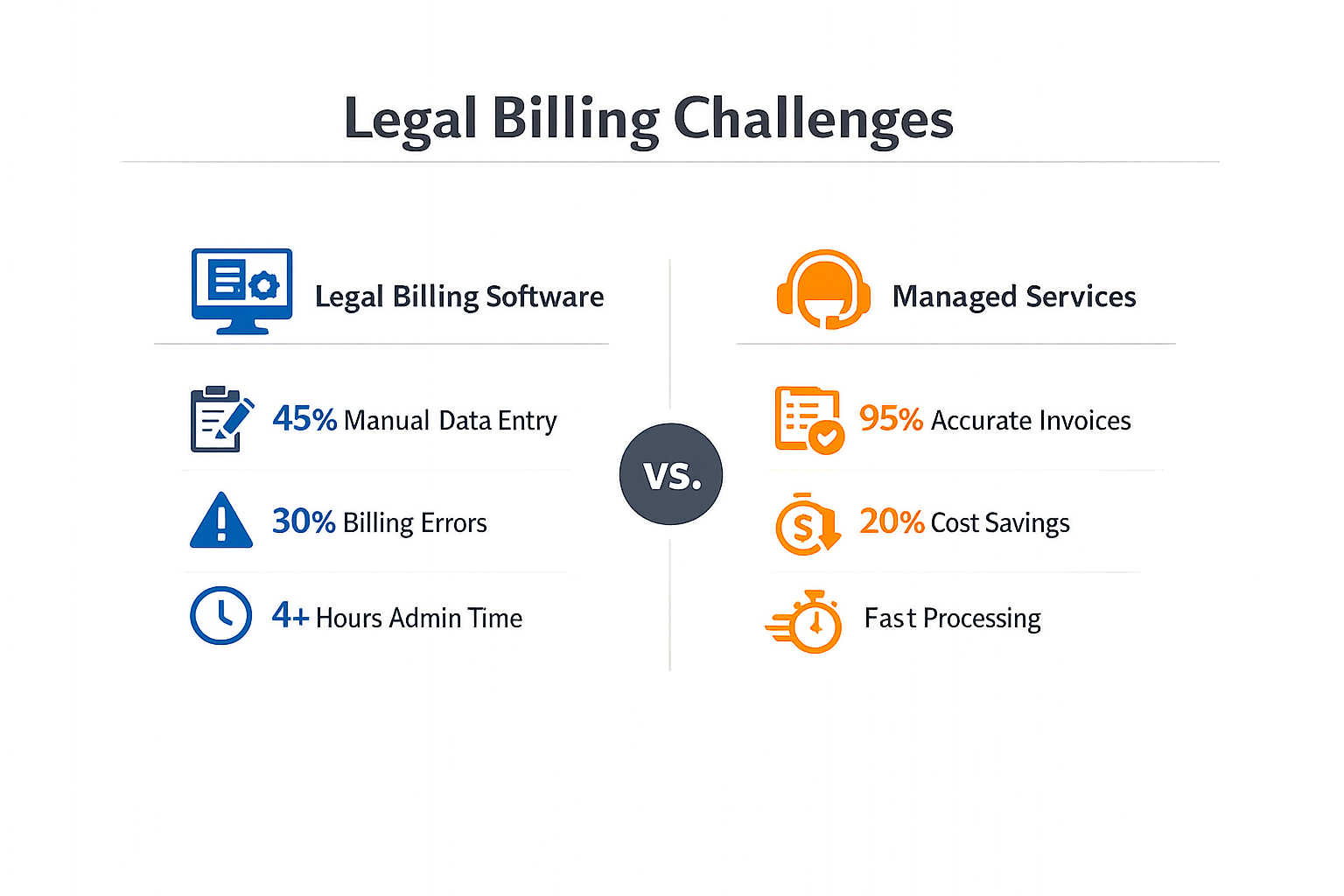
Organizations managing legal spend face a recurring problem: invoices arrive with line items that violate carrier guidelines, but the volume makes line-by-line review impractical. A single panel counsel firm may submit twenty invoices in a quarter, each containing fifty to two hundred line items. When multiplied across a portfolio of active matters, the manual workload becomes unsustainable. The result is either unreviewed invoices that pay for non-compliant work, or bottlenecks that delay payment and strain vendor relationships.
Carrier outside counsel guidelines specify what may be billed and how it must be presented. Block billing, for instance, appears in multiple carriers' prohibition lists, yet invoices containing "research and draft motion, 4.2" still reach reviewers. Tenth-of-an-hour increments are required by some carriers and silent in others, but invoices with quarter-hour rounding pass through portals that accept files missing fields marked as required by the LEDES 1998B specification. The gap between what guidelines prohibit and what e-billing portals validate creates a compliance problem that neither software alone nor manual review alone fully solves.
The Volume and Consistency Challenge
Software-based review applies rules uniformly across every invoice. A line item flagged for block billing will trigger the same reduction code whether it appears on the first invoice or the five hundredth. This consistency is valuable when the guideline prohibition is clear and the rule can be expressed as a pattern match. However, software cannot read context. A narrative reading "review correspondence from client" may be compliant if the correspondence was a detailed affidavit, or non-compliant if it was a scheduling email. The LEDES 1998B format does not carry enough semantic information to distinguish the two, and UTBMS task codes alone do not resolve the ambiguity.
Managed review services address context by assigning human reviewers who read narratives, compare them to the matter budget, and apply carrier-specific standards. This flexibility allows nuanced decisions, but it introduces variability. One reviewer may reduce a line item that another would approve, and the throughput is limited by how many invoices a reviewer can evaluate in a day. Organizations that need both speed and judgment find themselves choosing between consistency without context and context without scale.
Budget Approval and Workflow Friction
Carrier requirements extend beyond line-item review. Markel's vendor services page states that budgets must be submitted and approved by the claims professional before an invoice may be submitted, except for Workers Compensation matters. This pre-approval threshold creates a workflow dependency: if the budget is not in the system, the invoice cannot proceed, regardless of whether the line items themselves are compliant. Software can enforce the rule by blocking submission, but it cannot draft the budget or negotiate the approval. Managed services can coordinate the budget process, but they cannot eliminate the delay if the claims professional is unavailable.
The friction compounds when an invoice is rejected. Appeals must be submitted through the e-billing platform's appeal module within a specified window—Markel allows forty-five calendar days after payment. Software can track the deadline and generate a reminder, but it cannot write the appeal narrative or decide which reductions warrant challenge. A managed service can draft the appeal, but it cannot override the carrier's final decision. Organizations need both the enforcement that software provides and the judgment that managed review applies, but integrating the two without duplication or gaps remains a structural problem.
The Interpretation Gap
Some carriers treat block billing as an outright prohibition; others see it as a trigger for reduction. The distinction matters when a law firm submits an invoice that combines related activities in one line item. Software configured to reject all block billing will flag the entry, but if the carrier's guideline permits it with adequate detail, the rejection is incorrect. Managed reviewers who understand the carrier's interpretation can approve the line item, but if the reviewer is unfamiliar with that specific guideline version, the decision may be inconsistent with prior invoices from the same firm.
This interpretation gap is not limited to block billing. Billing increments, narrative sufficiency, and staffing ratios all require reading the controlling document and applying it to the specific line item. Block billing reasons for carrier rejections illustrate how the same entry can be compliant under one guideline and non-compliant under another. Organizations that rely solely on software risk over-reducing invoices when the rule is more permissive than the algorithm assumes. Organizations that rely solely on managed review risk under-reducing invoices when the reviewer does not have the carrier's current guideline in front of them.
How Software vs Managed Legal Bill Review Work
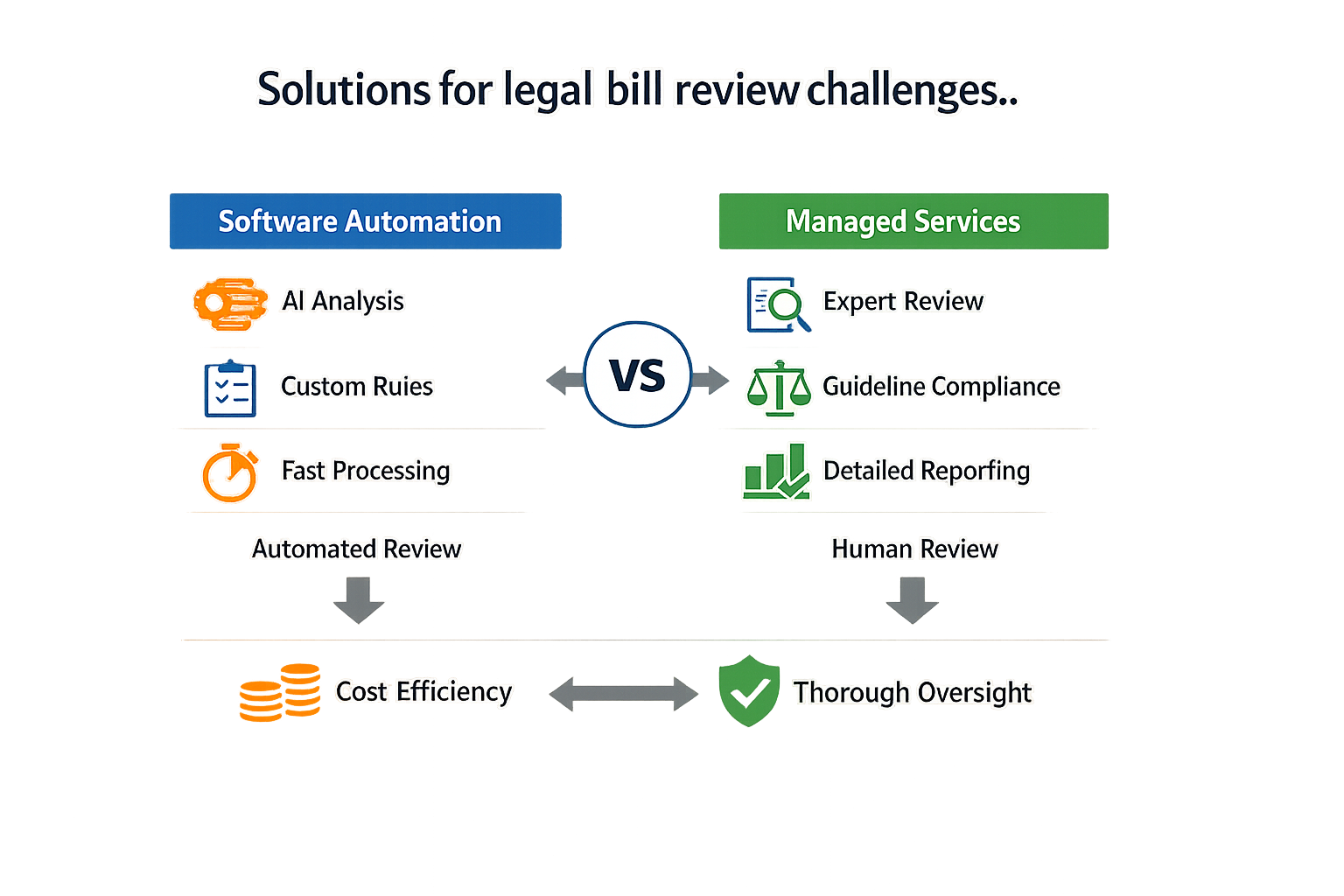
Software vs managed legal bill review each address billing challenges through distinct operational paths. Software solutions automate validation against format specifications and guideline rules, while managed services layer human judgment onto those automated checks. Neither approach eliminates the need for the other in every scenario, but understanding how each functions clarifies which fits a given organization's workflow.
How Software-Based Review Functions
Software platforms ingest electronic billing files — typically LEDES 1998B or XML — and apply a ruleset derived from carrier outside counsel guidelines and internal billing policies. The system flags line items that violate defined thresholds: block billing, missing UTBMS codes, narrative entries below a minimum character count, or billing increments that exceed the permitted fraction of an hour. Validation runs on submission, and the platform generates a rejection report or forwards the invoice to the next stage in the approval chain.
Step 1
Configure guideline rules in the platform
Enter the carrier's published prohibitions and thresholds — billing increment, staffing ratio limits, pre-approval thresholds for expenses, and block-billing definitions. The software checks every line item against these rules on upload.
Step 2
Upload the LEDES file
Submit the invoice file through the e-billing portal or directly into the review platform. The system parses each field, validates UTBMS task and activity codes, and cross-references timekeeper rates against the approved panel roster.
Step 3
Review flagged line items
The platform outputs a list of entries that triggered a rule. Each flag carries a reduction code or rejection reason. The submitter can appeal, revise the narrative, or accept the adjustment before resubmission.
Software enforces consistency: the same narrative pattern triggers the same flag every time. This repeatability supports high-volume workflows where hundreds of invoices arrive each month and manual review of every line item would exceed available staff hours. For a deeper look at how LEDES file structure and field requirements govern automated validation, the 1998B specification defines which fields the software must parse and which violations halt processing.
How Managed Review Services Function
Managed review services combine software validation with human analysts who interpret narrative detail, assess reasonableness in context, and apply carrier-specific judgment that no ruleset can encode. The analyst reviews each flagged line item, reads the full case file or matter summary, and determines whether the entry reflects work actually performed or an artifact of poor timekeeping. Where software stops at "this entry violates the block-billing rule," the analyst asks whether the work described was necessary, whether the time charged aligns with the complexity of the task, and whether the narrative supports the hours billed.
The managed service submits a recommendation to the carrier: approve as submitted, reduce by a specified amount with a reduction code, or reject the line item entirely. The carrier retains final approval authority, but the analyst's recommendation carries the weight of documented review and a written rationale. This structure allows carriers to outsource the labor-intensive middle step — reading narratives, comparing timekeeper qualifications to task codes, and drafting reduction justifications — without surrendering control over the final decision.
Workflow Integration and Approval Paths
Both software and managed services sit inside a broader invoice-to-payment workflow. The law firm submits a LEDES file to the e-billing portal. The portal runs format validation, confirms that required fields are populated, and checks that the matter number matches an open case. If the file passes format validation, it moves to the review stage — either automated rule application or handoff to a managed service analyst. Flagged items generate a rejection or reduction notice, and the firm can appeal within the timeframe specified by the carrier's guidelines.
| Stage | Software Approach | Managed Service Approach |
|---|---|---|
| Format validation | Automated on upload | Automated on upload |
| Guideline compliance check | Rule engine flags violations | Rule engine flags, analyst reviews context |
| Reduction decision | System applies reduction code | Analyst recommends, carrier approves |
| Appeal path | Firm resubmits revised file | Firm submits written appeal, analyst re-reviews |
Carriers using software alone rely on the submitting firm to self-correct flagged entries before resubmission. Carriers using managed services receive a vetted recommendation and a documented rationale that supports the reduction if the firm escalates the dispute. The choice between the two often hinges on the carrier's internal staffing: organizations with dedicated bill review teams may prefer software that surfaces issues for in-house resolution, while those without specialized staff may find managed services more efficient.
Budget Approval and Pre-Submission Requirements
Some carriers require budget approval before the first invoice submission. Markel, for example, requires budgets for all matter types except Workers Compensation claims, and the budget must be approved by the assigned claims professional before any invoice can be submitted. This requirement applies regardless of whether the carrier uses software or managed review — the budget sits upstream of the invoice workflow and gates submission at the portal level. Firms that submit invoices before budget approval receive an automatic rejection, and the invoice does not reach the review stage.
Budget enforcement through software is straightforward: the system checks whether a budget exists and whether cumulative invoiced amounts exceed the approved total. Managed services add a review of whether the budget itself was realistic given the case's progression — if the budget assumed summary judgment and the case went to trial, the analyst flags the discrepancy and asks whether the carrier approved a revised budget. This contextual check prevents firms from submitting invoices that comply with the original budget but ignore a material change in case scope.
Choosing Between Software and Managed Review
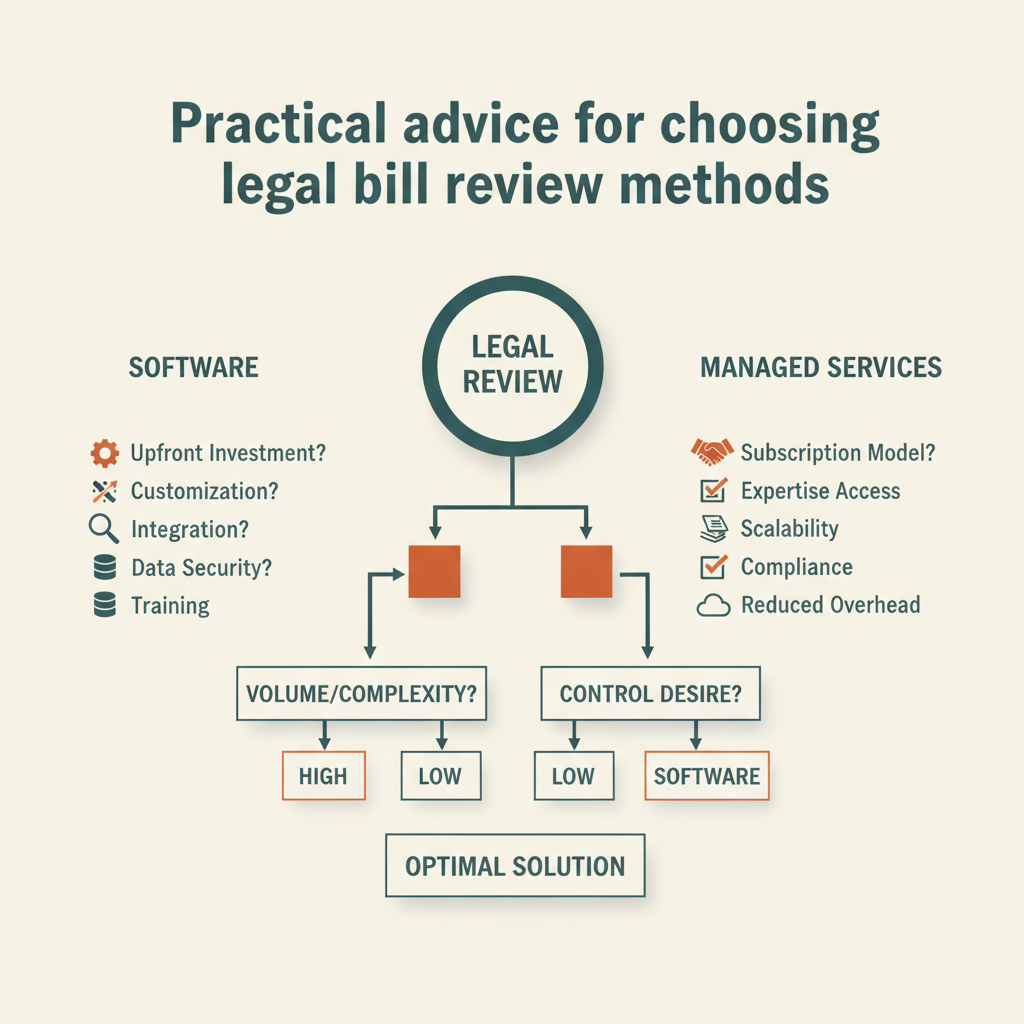
Selecting between software and managed legal bill review requires an honest assessment of your organization's capacity, the volume of invoices you process, and the complexity of the guidelines you enforce. A software platform excels when you have the internal staff to interpret reduction codes, respond to appeals, and maintain current knowledge of carrier-specific prohibitions. Managed services become essential when your team lacks the bandwidth to stay current on guideline changes or when the appeal volume demands dedicated expertise.
Evaluate Your Organization's Readiness
Before committing to a software-only approach, confirm that your staff can interpret the narrative detail standards in your carriers' outside counsel guidelines. Software flags a block-billed entry, but a human reviewer must determine whether the line item violates a specific guideline prohibition or merely triggers a reduction under that carrier's bill review practice. If your team cannot make that call consistently, the software will generate false positives that erode trust with panel counsel.
Managed services absorb that interpretive burden. The service provider reads the guideline, applies the reduction code, and drafts the explanation that goes back to the firm. Your role shifts from line-by-line review to exception handling—approving write-downs that exceed a threshold or adjudicating appeals that cite controlling authority.
Align Invoice Submission Cadence with Review Capacity
Quarterly invoice submission is common practice, but interim invoices that reach a threshold—often ten thousand dollars—may be submitted outside the regular cycle. If you use software alone, ensure your team can process those interim invoices within the same turnaround window you promise for quarterly submissions. A backlog at the interim stage signals that your review capacity does not match your invoice volume, and that mismatch is a strong indicator that managed services would improve throughput.
Managed services scale with volume. The provider staffs to your invoice flow, and you pay for the review work performed rather than carrying fixed headcount. That model works when your invoice volume fluctuates by matter type or when a large case generates weekly submissions that overwhelm an in-house team.
Establish a Clear Appeal Path
Whether you use software or managed services, panel counsel must know how to appeal a reduction and when that appeal window closes. A forty-five-day deadline from payment is typical, but the clock starts when the payment posts, not when the firm receives the remittance advice. Software can automate the deadline notice; managed services can draft the appeal response and route it to the appropriate claims professional for final decision.
Document your appeal process in writing and link it from every invoice rejection notice. Firms that understand the process file fewer meritless appeals, and reviewers spend less time on disputes that hinge on a misreading of the guideline. For more on how narrative standards and guideline prohibitions interact, see Block Billing: Reasons for Carrier Rejections and Solutions.
Step 1
Audit your guideline library
Collect every carrier outside counsel guideline that governs your panel work. Note the version number and effective date for each. If a guideline is undated or lacks a version identifier, request clarification from the carrier's vendor management office. Reviewers cannot apply a guideline consistently if they do not know which edition controls.
Step 2
Test your software against known edge cases
Submit a test invoice that includes a block-billed entry, a line item in quarter-hour increments, and an expense without a UTBMS code. Confirm that your software flags each issue and that the rejection message cites the correct guideline provision. If the software passes a prohibited entry, your validation rules need tightening.
Step 3
Define escalation thresholds for managed services
If you use a managed service, specify the dollar amount or reduction percentage that triggers escalation to your internal team. The service provider handles routine reductions; you review only the high-value disputes or the appeals that cite case law. That division of labor keeps your team focused on exceptions rather than volume processing.
Monitor Rejection and Appeal Rates as Performance Indicators
Track the percentage of invoices that clear review on first submission and the percentage of reductions that generate an appeal. A high rejection rate suggests that panel counsel do not understand your guidelines or that your software validation is too strict. A high appeal rate suggests that your reductions are inconsistent or that the explanations you provide do not cite the controlling guideline provision.
Managed services typically report these metrics as part of the engagement. Software platforms may require you to extract the data from the e-billing portal and calculate the rates manually. Either way, the metrics tell you whether your review process is functioning as a quality gate or as a friction point that delays payment without improving compliance.
Conclusion
The choice between software vs managed legal bill review is not a binary decision but a strategic calculation rooted in your organization's capacity, volume, and tolerance for variance. Software-based solutions deliver speed and consistency, enforcing LEDES 1998B field requirements and UTBMS code validation with mechanical precision. Managed services bring human judgment to the table, interpreting narrative detail, assessing staffing ratios, and navigating the nuances of carrier-specific guidelines that no algorithm can fully replicate.
Our team at Carrier Ready has observed that several e-billing portals accept files that omit fields marked as required by the LEDES Oversight Committee's 98B format specification. This discrepancy underscores a fundamental tension: software enforces what the specification says, while managed reviewers often work within what the portal and the carrier actually enforce. Both approaches have their merits — software offers efficiency and consistency, while managed services provide flexibility and a deeper understanding of the context behind billing entries.
When evaluating your options, consider the full lifecycle of an invoice: submission, validation, review, reduction, and appeal. Software excels at the first two stages, catching format errors and code mismatches before a human reviewer sees the file. Managed review dominates the latter stages, where reduction codes, write-down justifications, and appeal workflows demand contextual reasoning and carrier relationship knowledge. The strongest programs often layer both: software as the first gate, managed review as the second.
Ultimately, the right approach is the one that aligns with your organization's risk profile and operational constraints. If your panel counsel submit clean LEDES files and adhere to published guidelines, software may suffice. If your invoices routinely trigger reductions, or if your carriers enforce unpublished interpretations of their own guidelines, managed review becomes indispensable. For a deeper understanding of the technical standards that underpin both approaches, see our guide to the LEDES 1998B file format and all 24 fields.
FAQ
What is the main difference between software and managed legal bill review?Software vs managed legal bill review differ primarily in automation versus human judgment. Software validates LEDES file formats, UTBMS codes, and applies rule-based checks for violations like block billing. Managed services add human reviewers who interpret narratives, apply carrier-specific guidelines, and make contextual decisions that software cannot.
When should an organization choose software over managed review?Organizations with high invoice volume, clean LEDES submissions, and internal staff who understand carrier guidelines benefit most from software-based review. Software provides consistent, scalable validation when the rules are clear and can be expressed as automated checks.
What advantages do managed review services offer?Managed services excel at interpreting ambiguous narratives, applying carrier-specific guideline variations, and handling complex appeals. They provide contextual judgment for billing entries that require understanding of case strategy, staffing decisions, and nuanced carrier requirements that software cannot encode.
Can software and managed review be used together?Yes. Many organizations layer both approaches: software performs initial format validation and flags obvious violations, then managed services review flagged entries and apply carrier-specific reduction codes. This combination provides both efficiency and contextual judgment.
How do e-billing portals validate LEDES files?E-billing portals run automated checks for file format, required fields, matter identifiers, and UTBMS code validity. However, several portals accept files missing fields marked as required by the LEDES 1998B specification, creating a gap between published standards and actual enforcement.