


Attorney Billing Increments: 0.1 vs. 0.25 Requirements
Introduction
Attorney billing increments are the smallest unit of time an attorney may bill—typically 0.1 hours (six minutes) or 0.25 hours (fifteen minutes). One entry reading "conference with client, 0.3" tells the reviewer that the timekeeper tracked time to the tenth of an hour. One reading "conference with client, 0.5" in a matter governed by a tenth-of-an-hour guideline raises an immediate question: did the conference last exactly thirty minutes, or was a shorter call rounded up to the quarter-hour? When examining attorney billing increments, the choice between 0.1 and 0.25 hour increments often comes under scrutiny, and our team frequently encounters this topic when reviewing carrier outside counsel guidelines.
Billing increments are not a matter of firm preference or software default. They are a compliance requirement, stated in the controlling guideline or fee schedule, and enforceable through invoice rejection or post-payment reduction. The Central District of California CJA Panel Manual, revised December 2022, states at page 13 that time spent must be billed to the nearest tenth of an hour. That is a mandatory standard for CJA panel attorneys in that district, and it is typical of the precision carriers expect when they publish a billing increment requirement.
Carriers specify billing increments to ensure that fee entries reflect actual time spent, not time rounded to a convenient block. A tenth of an hour is six minutes; a quarter of an hour is fifteen. The difference compounds across hundreds of line items, and reviewers know it. By reading several carriers' published guidelines side by side, we can identify which carriers have specific preferences or requirements, and this comparison helps us understand the broader landscape of billing practices and the expectations set forth by carriers.
Understanding what a guideline requires—and what your time records must show to support it—is the first step in submitting an invoice that clears the portal without reduction. For more detail on how time entries map to standardized task and activity codes, see UTBMS Activity Codes A101-A111 for Legal Billing.
What Happens When Attorney Billing Increments Don't Match Carrier Guidelines?
Three of the four carriers with published guidelines specify tenth-of-an-hour increments. The fourth is silent, which is not the same as permissive. Attorneys who bill in quarter-hour increments face systematic reductions when the controlling guideline requires tenths, yet many firms continue to submit invoices in 0.25-hour blocks because their timekeeping systems default to that standard. The mismatch triggers rejections at the portal validation stage or line-item write-downs during bill review, and the attorney learns of the problem only after the invoice has been processed.
The Increment Mismatch and Its Consequences
When a carrier guideline states that time must be billed to the nearest tenth of an hour, a line entry reading "review correspondence, 0.25" violates the standard even if the work took exactly fifteen minutes. The guideline does not permit rounding to quarters; it requires a tenth-of-an-hour entry. A task that consumed twelve minutes must appear as 0.2 hours, not 0.25. The difference compounds across dozens of line items, inflating the submitted total and creating an audit trail that suggests the timekeeper rounded up habitually.
Block billing in quarter-hour increments presents a second compliance risk. An entry that reads "review correspondence, draft response, telephone call with client, 0.75" fails on two grounds: it aggregates distinct activities into a single narrative, and it uses a 0.25-hour increment three times over. Even if the attorney spent exactly forty-five minutes on those tasks, the entry does not satisfy the narrative detail and increment requirements that most panel guidelines impose. The reviewer cannot verify that each discrete activity warranted the time billed, and the 0.75 total invites the inference that the timekeeper rounded three separate quarter-hour blocks rather than recording actual time to the tenth.
Contemporaneous Records and the Increment Standard
Carrier guidelines and federal court rules require attorneys to maintain contemporaneous time and attendance records. The Central District of California's CJA Panel Manual states that time spent must be billed to the nearest tenth of an hour and that these records are subject to audit and must be maintained for three years after approval of the final voucher. When the underlying time record shows tenths but the submitted invoice shows quarters, the discrepancy becomes evidence of post-hoc rounding, not contemporaneous capture. The attorney cannot credibly argue that the work naturally fell into fifteen-minute blocks when the source document reflects six-minute intervals.
Firms that bill multiple carriers face a operational problem: one carrier requires 0.1-hour increments, another accepts 0.25, and the timekeeping system produces only one format. The attorney must either maintain separate time entries for each matter or convert the invoice after the fact, and both approaches introduce error. Manual conversion from quarters to tenths produces rounding artifacts that auditors recognise immediately. A line item showing 0.3 hours (eighteen minutes) when the underlying quarter-hour entry was 0.25 (fifteen minutes) exposes the conversion and raises questions about every other line in the invoice.
Guideline Silence and the Default Rule
When a carrier guideline does not specify a billing increment, attorneys often assume that any reasonable standard is acceptable. That assumption is incorrect. In the absence of an express increment requirement, reviewers apply the more restrictive standard—tenths—because it provides greater transparency and aligns with the contemporaneous-record rule that most jurisdictions impose. A guideline that is silent on increments is not permissive; it defers to the baseline expectation that time will be recorded and billed in the smallest practical unit.
The problem is not limited to panel counsel. Independent counsel appointed under California Civil Code section 2860 must comply with the carrier's billing guidelines to the extent those guidelines do not interfere with the attorney's professional judgment. The increment standard is a ministerial requirement, not a constraint on case strategy, and courts have consistently held that the insurer may impose reasonable billing protocols even when independent counsel has been appointed. An attorney who bills in quarter-hour increments because "that's how we've always done it" will not prevail on appeal when the guideline required tenths and the attorney made no effort to comply.
For more detail on how block billing compounds increment violations, see Block Billing: Reasons for Carrier Rejections and Solutions.
How Do You Comply with Attorney Billing Increment Requirements?
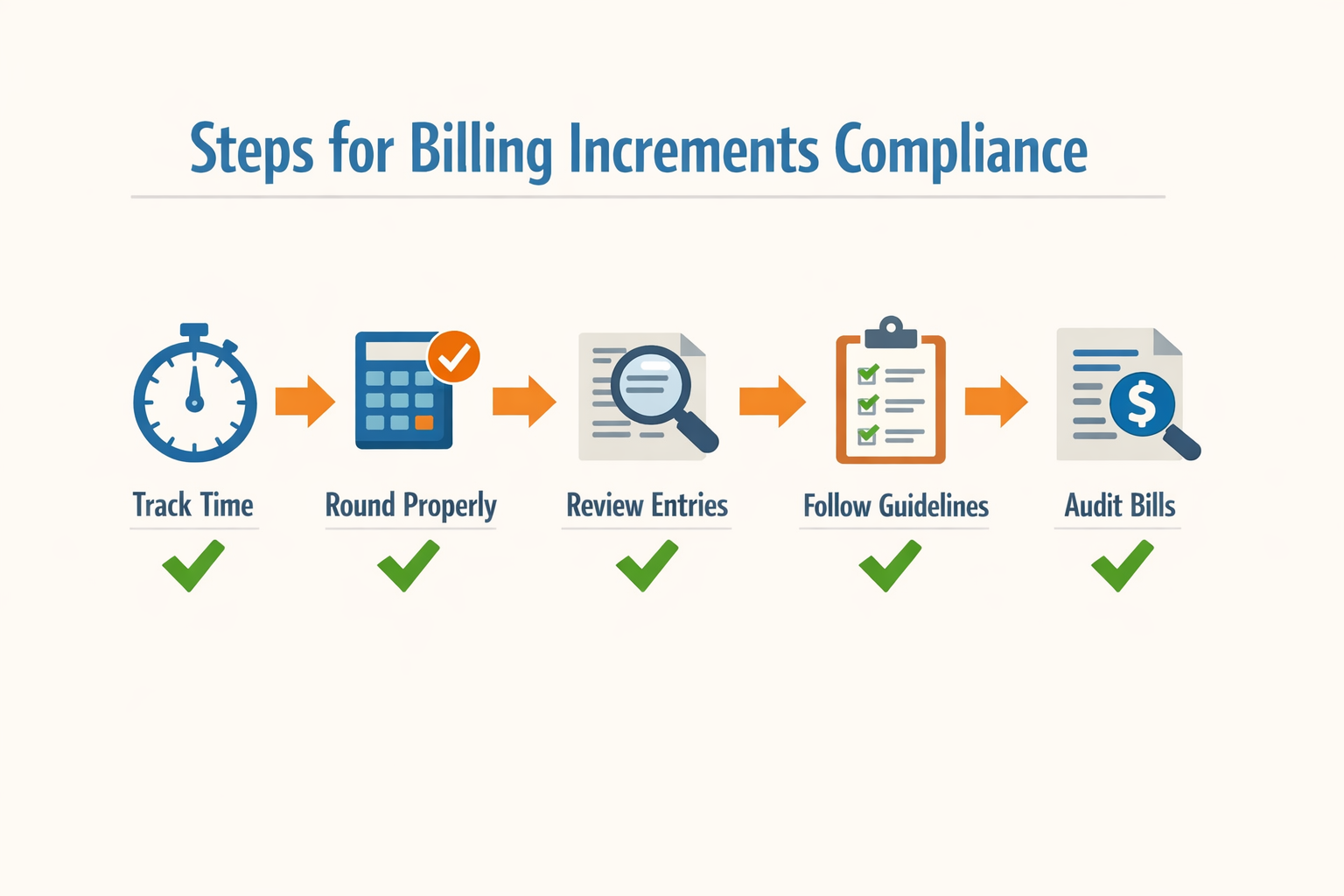
Navigating attorney billing increments requires a methodical approach to ensure compliance with carrier guidelines and court rules. The following steps provide a framework for attorneys to adopt the correct increment standard, document time accurately, and avoid invoice rejections.
Step 1
Identify the controlling guideline or court rule
Before submitting any invoice, locate the document that governs your billing. For panel counsel, this is typically the carrier's outside counsel guidelines, identified by carrier name and version number. For court-appointed matters, consult the relevant court manual. The C.D. Cal. CJA Panel Manual (rev. Dec. 2022), for example, states at page 13 that "Time spent must be billed to the nearest tenth of an hour." Never assume a default increment — read the controlling document and note the exact requirement.
Step 2
Configure timekeeping systems to match the required increment
Once the increment is confirmed, configure your timekeeping software to enforce that standard. If the guideline specifies 0.1 hours (six-minute increments), set your system to round or record entries in tenths. If 0.25 hours (fifteen-minute increments) is permitted, adjust accordingly. Mismatched system settings are a common source of invoice rejections — a single entry recorded in quarter-hours when the guideline requires tenths will trigger a validation error in most e-billing portals.
Step 3
Maintain contemporaneous records at the specified increment
Record time as work is performed, not at the end of the day or week. The C.D. Cal. CJA Panel Manual (rev. Dec. 2022) requires that attorneys "maintain contemporaneous time and attendance records" for all work performed, and these records are subject to audit for three years after approval of the final voucher. Contemporaneous records captured in the correct increment provide the documentation needed to defend a fee entry during bill review or an audit. Reconstructed time entries, even if accurate in total hours, lack the credibility of real-time records.
Step 4
Prorate shared time correctly and avoid double-billing
When time is spent on multiple matters simultaneously, prorate the entry across those matters in the required increment. The C.D. Cal. CJA Panel Manual (rev. Dec. 2022) states that attorneys "must prorate any time spent in common on two or more cases" and cross-reference all cases on supporting materials. Critically, the manual also provides that "you must not prorate time in such a way that you have billed a larger amount than you would have billed if all the time was assigned to one representation." This means the sum of prorated entries cannot exceed the actual time spent. Time exclusive to one matter must be charged only to that matter, and boilerplate language can be billed to only one client — updating and tailoring it for a later matter is a separate billable event.
Step 5
Bill only reasonable time, not actual time
The requirement to bill in a specific increment does not mean every increment spent is compensable. Federal law and many carrier guidelines require that you bill only the amount of time reasonably spent on a task, even if you actually spent more. The C.D. Cal. CJA Panel Manual (rev. Dec. 2022) states that attorneys "may bill only for the amount of time reasonably spent on a particular matter, even if you actually spent more time." This principle applies regardless of increment. If a task reasonably requires 0.3 hours but you spent 0.5 hours due to inefficiency, bill 0.3 hours. Carriers and courts expect counsel to exercise judgment in determining what is reasonable, and over-billing invites reductions.
Step 6
Validate entries before submission
Before uploading an invoice to an e-billing portal, review every line item to confirm that the increment matches the guideline, that narrative detail is sufficient, and that no entry violates a guideline prohibition such as block billing or secretarial tasks. The C.D. Cal. CJA Panel Manual (rev. Dec. 2022) explicitly states that attorneys "may not bill for secretarial services — whether performed by you or other personnel." A pre-submission checklist reduces the risk of rejection and the need to appeal reductions later. For more on common rejection causes, see E-Billing Portal Invoice Rejections: Common Causes and Fixes.
Practical Tips for Managing Attorney Billing Increments
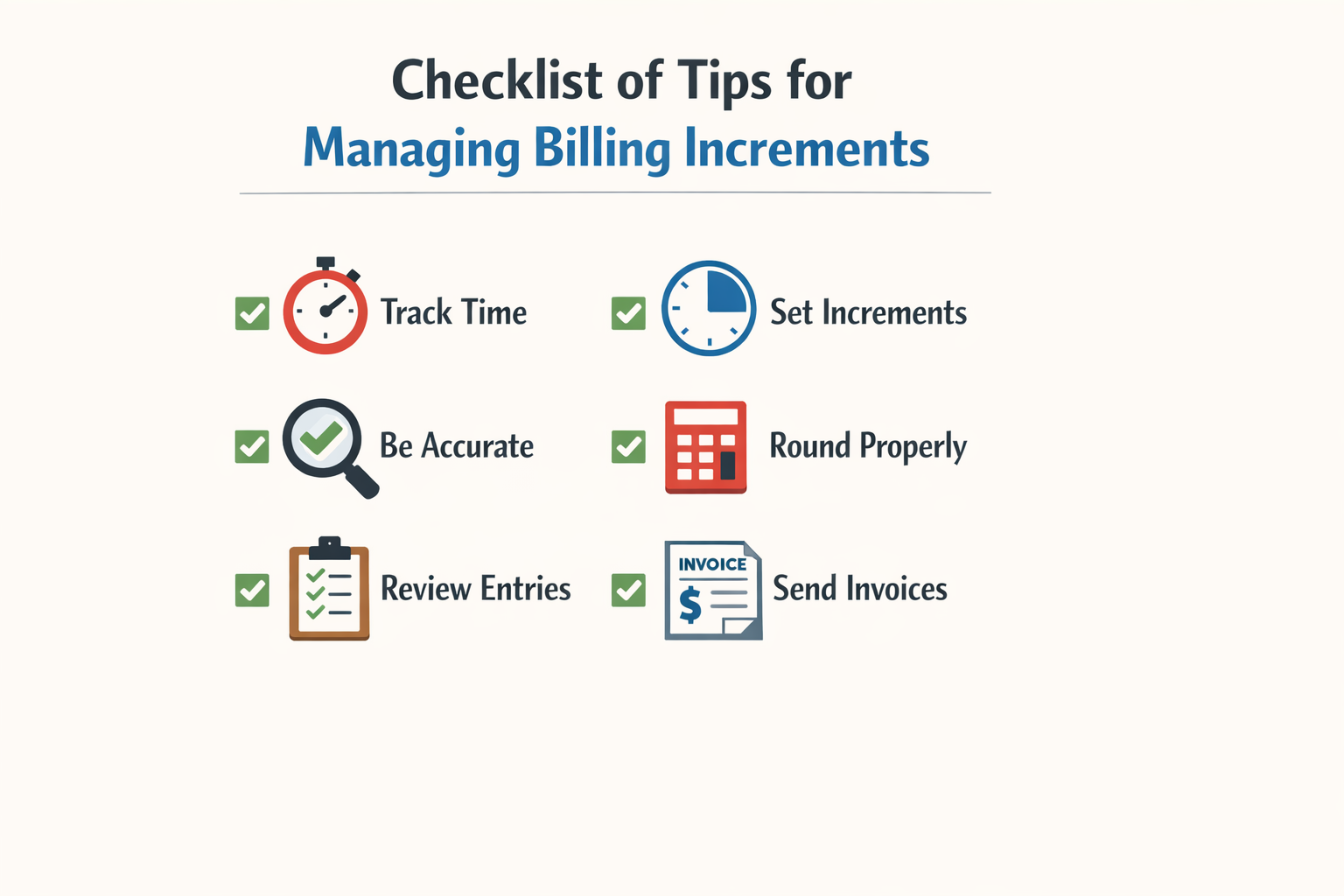
Maintain contemporaneous time and attendance records for every task performed. The Central District of California CJA Panel Manual requires these records to be kept for three years after approval of the final voucher, and they remain subject to audit. Recording time as you work eliminates the risk of rounding errors and ensures each entry reflects the actual duration of the task. When you reconstruct time after the fact, you introduce guesswork that can inflate or deflate billed hours and trigger scrutiny during review.
Round each discrete task to the nearest tenth of an hour immediately after completing it. The C.D. Cal. CJA Panel Manual states at page 13, list item 7, that time spent must be billed to the nearest tenth of an hour. A five-minute phone call rounds to 0.1; a seven-minute email review also rounds to 0.1. A thirteen-minute document review rounds to 0.2. Rounding at the end of the day or the end of the week compounds small errors into large discrepancies and makes it harder to defend the total when a reviewer compares your narrative to the hours claimed.
Prorate time spent on multiple matters during a single work session, and cross-reference every case on the supporting materials. If you spend two hours in a hearing that involves three clients, divide the time proportionally and note the other case numbers on each voucher. The C.D. Cal. CJA Panel Manual requires this cross-referencing at page 12, list item 3, and prohibits billing the full two hours to each case. Time spent researching or drafting boilerplate language—such as standard sentencing factors or procedural motions—can be billed to only one client; reusing that language in a later matter is not a billable event unless you update and tailor it to the new case.
Segment tasks by type and keep narratives specific to avoid block billing. Entries like "research and draft motion, 4.2" combine multiple activities into one line and obscure what you actually did. Instead, separate the research (with a citation to the authority you reviewed) from the drafting (with a note of the section or argument you wrote). Carriers reject block billing because it prevents them from verifying that each component of the entry was necessary and reasonably performed. For more on how carriers define and reject block billing, see Block Billing: Reasons for Carrier Rejections and Solutions.
You may bill only for the amount of time reasonably spent on a particular matter, even if you actually spent more time.
Do not bill for secretarial services, whether you performed them yourself or delegated them to staff. The C.D. Cal. CJA Panel Manual states at page 13, list item 9, that secretarial services are not compensable under the CJA. Tasks like formatting documents, filing courtesy copies, or updating a case calendar fall into this category. If you spend attorney time on work that a paralegal, law clerk, or investigator could perform, bill only what that non-attorney professional would charge, or submit the work on a separate form for non-attorney services.
Report any amounts received from the client to the court before submitting your voucher. Under 18 U.S.C. § 3006A and the C.D. Cal. CJA Panel Manual at page 14, list item 12, you may not accept payment from a represented person without court authorization, and any amounts received must be deducted from the fee approved by the court. If you obtain information that the client is financially able to pay for services—and that information is not privileged—you must advise the court immediately.
FAQ
What is the difference between 0.1 and 0.25 attorney billing increments?
A 0.1-hour increment equals six minutes, while a 0.25-hour increment equals fifteen minutes. The 0.1 standard captures time more precisely and is required by most carrier guidelines and federal court rules. Billing in 0.25-hour blocks when the guideline requires 0.1 will result in invoice reductions or rejections.
Do all carriers require 0.1-hour billing increments?
Most carriers with published outside counsel guidelines specify 0.1-hour (tenth-of-an-hour) increments. When a guideline is silent on the increment standard, reviewers typically apply the more restrictive 0.1 requirement because it aligns with contemporaneous-record rules and provides greater transparency.
Can I round up to the next increment if I spent slightly less time?
No. You must bill only the amount of time reasonably spent on a task, rounded to the nearest required increment. The C.D. Cal. CJA Panel Manual states that attorneys may bill only for the amount of time reasonably spent, even if they actually spent more. Systematic rounding up creates an audit trail that suggests over-billing.
What happens if my timekeeping software only supports quarter-hour increments?
You must reconfigure your software or manually convert entries to match the guideline's required increment before submission. Submitting an invoice in 0.25-hour blocks when the guideline requires 0.1 will trigger portal rejections or line-item reductions. Manual conversion introduces rounding artifacts that auditors recognize, so system-level configuration is the preferred solution.
Are attorney billing increments the same across all jurisdictions?
No. Each carrier, court, and client may specify a different increment standard in their guidelines or engagement letter. Always consult the controlling document for the specific matter before preparing an invoice. The Central District of California CJA Panel Manual, for example, requires tenth-of-an-hour billing, and that requirement is mandatory for panel attorneys in that district.
Conclusion
The distinction between 0.1 and 0.25 hour billing increments is not a matter of attorney preference — it is a compliance requirement set by the carrier, the court, or the client paying the invoice. When examining attorney billing increments, the choice between these two standards often comes under scrutiny. Our team frequently encounters this topic when reviewing carrier outside counsel guidelines, and the pattern is consistent: where a guideline specifies an increment, that specification is mandatory.
The Central District of California's CJA Panel Manual states explicitly that time spent must be billed to the nearest tenth of an hour. That is a 0.1 increment requirement, not a suggestion. Other carriers and clients publish similar mandates in their outside counsel guidelines, and those mandates control the format of every line item submitted under that engagement. An invoice prepared in quarter-hour increments when the guideline requires tenths will be rejected at the portal, reduced by the bill reviewer, or both.
Adherence Is the Standard
Compliance with billing increment requirements protects the invoice from reduction and appeal cycles. It also protects the timekeeper's contemporaneous records from audit findings, because the increment used in the final invoice must match the increment captured in the underlying time entry. A firm that bills in tenths for one carrier and quarters for another must maintain systems that apply the correct increment to each matter at the point of entry, not at the point of invoice generation.
By reading several carriers' published guidelines side by side, we can identify which carriers have specific preferences or requirements, and that comparison reveals the broader expectation: precision in time reporting is not optional. For additional guidance on structuring compliant invoices and avoiding common rejection triggers, see Block Billing: Reasons for Carrier Rejections and Solutions and ABA Model Rule 1.5: Reasonable Attorney Fees & California Rule 1.5.
The increment used is a line-item decision, repeated hundreds of times per invoice. Getting it right once is not enough; getting it right on every entry, for every matter, under every guideline, is the standard.