


Travel Time Billing Attorney: Insurance Defense Rules & Guidelines
Top takeaways
- Travel time billing insurance defense compensates attorneys for time spent traveling to case-related destinations, subject to carrier-specific guidelines and billing increment requirements
- Billing increments vary by jurisdiction and guideline: some require tenth-of-an-hour precision, others mandate six-minute increments
- Travel time is typically billed at standard rates, not premium rates, and personal detours or non-case-related extensions are not compensable
- Compliance with carrier outside counsel guidelines determines whether travel time entries survive bill review and avoid reduction codes
Introduction
What Is Travel Time Billing Insurance Defense?
Travel time billing insurance defense is the compensation an attorney receives for time spent traveling to and from a destination related to case work. In insurance defense, this line item appears when counsel travels to depositions, court appearances, site inspections, or client meetings outside the office. The practice is governed by carrier outside counsel guidelines, which specify how travel time must be recorded, what increments apply, and which activities qualify for reimbursement.
Most panel guidelines treat travel time as compensable but unproductive time. The C.D. Cal. CJA Panel Manual states that "an attorney or expert may be compensated for travel time spent in travel status to and from the travel destination. However since this unproductive travel time is foreseeable, every effort should be made to work on existing matters. Compensation for other than travel time while in travel status will be paid only for actual services rendered." This principle carries over to carrier guidelines: travel time is billable, but it is not premium time, and it must be distinguished from productive work performed during the trip.
Billing increments for travel time vary by guideline. The C.D. Cal. CJA Panel Manual requires that "time spent must be billed to the nearest tenth of an hour." Florida's Division of Risk Management guidelines specify that "billing shall be in six minute increments," which is functionally equivalent to tenth-of-an-hour billing. Rounding practices matter: a 23-minute drive rounded to 0.4 hours under a tenth-of-an-hour rule may trigger a reduction if the reviewer expects 0.3 or contemporaneous support for the extra six minutes.
For more on how activity codes interact with travel entries, see UTBMS Activity Codes A101-A111 for Legal Billing.
Why Travel Time Billing Matters
Travel time entries are frequent targets in bill review. A vague narrative like "travel, 2.5" gives the reviewer no way to verify the destination, the purpose, or whether the time claimed matches the distance. A detailed entry — "travel to deposition of Jane Doe, 123 Main St., Los Angeles, 1.2" — survives scrutiny because it ties the time to a specific case activity and a verifiable location.
Carrier guidelines prohibit premium rates for travel time. The Florida guideline states that "premium rates will not be paid for overtime work," a provision that extends to travel: if an attorney bills travel at an elevated rate because it occurred after hours, the increment above the standard rate will be reduced. Travel time is billed at the timekeeper's standard hourly rate, period.
Understanding these rules prevents rejections at the e-billing portal and reduces write-downs during bill review. When travel time is billed in the correct increment, supported by a clear narrative, and tied to a legitimate case activity, it passes through the validation engine and reaches the reviewer as a defensible line item.
Problem Statement
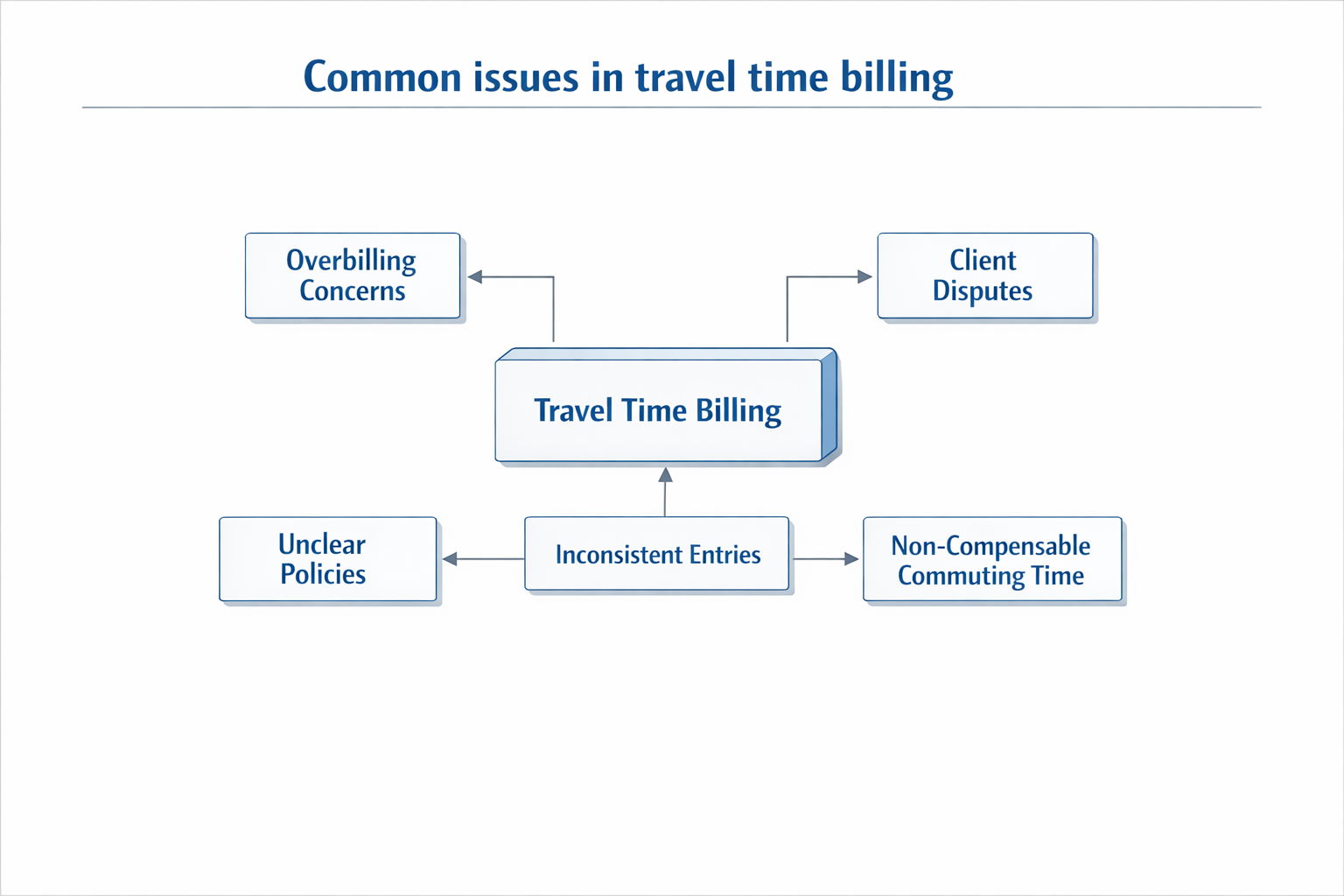
Travel time billing insurance defense creates friction at every layer of the invoice workflow. A line reading "travel to deposition, 2.4" lands in the e-billing portal, passes validation, and triggers a reduction two weeks later with no explanation beyond a cryptic code. The timekeeper believed the entry complied; the carrier's bill reviewer applied a guideline the firm never saw or misread. The invoice goes back for correction, the appeal consumes more non-billable hours, and the cycle repeats on the next matter.
The 2026 CLM Litigation Management Study reports that managing divergent billing and file-handling guidelines across multiple carriers and divisions imposes a compliance burden that pulls talented attorneys away from case work. The study identifies guidelines as a direct driver of talent attrition from insurance defense. When a firm panels with six carriers, each publishing its own outside counsel guidelines with different travel-time rules, the administrative overhead compounds. One carrier may permit travel time at full rate with a narrative and a UTBMS activity code; another may cap it at half rate and require pre-approval above thirty minutes; a third may disallow local travel entirely and define "local" as a radius the guideline never specifies.
How Do Carrier Guidelines Vary for Travel Time Billing?
Carrier guidelines vary in how they define compensable travel. Some distinguish between travel to court, travel to a client site, and travel to a third-party location. Others draw the line at intracity versus intercity travel, or apply a mileage threshold that appears nowhere in the LEDES file. The timekeeper codes the entry with UTBMS activity code A101 (travel time) and submits it through the portal, but the guideline required activity code A102 (wait time) for any travel under one hour, or prohibited A101 altogether for matters within the metropolitan area.
Block billing exacerbates the problem. An entry reading "travel to and attend hearing, 3.7" combines travel time with a substantive task, making it impossible for the bill reviewer to parse the compensable portion under the guideline's travel rules. The reviewer reduces the entire entry or rejects the invoice, and the firm must re-submit with separate line items and risk a duplicate-entry flag.
Narrative detail standards differ by carrier. One guideline requires the destination, the purpose, and the distance; another requires only the purpose and prohibits distance unless the travel exceeds fifty miles; a third requires contemporaneous documentation of departure and arrival times, which the timekeeper did not preserve because no prior matter on that panel demanded it. The firm discovers the gap only after submission, when the reduction notice cites insufficient detail and offers no appeal path.
Billing increment rules intersect with travel time in ways that guidelines address inconsistently. A carrier that mandates tenth-of-an-hour increments may still apply a separate rounding rule to travel, or may require travel time to be billed in quarter-hour blocks while all other time uses tenths. The timekeeper bills 0.3 hours for a seventeen-minute drive under the standard increment rule, and the entry is reduced because the guideline's travel section specified 0.25-hour minimums. The guideline's travel provisions and its general billing-increment section did not cross-reference each other, and the conflict went unnoticed until the rejection arrived.
Staffing decisions create travel-time disputes when a partner and an associate both travel to the same event. Some guidelines permit travel time for one timekeeper only; others permit it for all attendees but apply a reduced rate to the junior timekeeper; still others permit full billing for all attendees if the travel time was used for case-related work, which the narrative must substantiate. The firm bills both timekeepers at full rate with no work-product detail, and both entries are reduced. The appeal requires the firm to produce contemporaneous records showing that the associate reviewed documents or conferred with the partner en route, records the firm did not create because the guideline's work-product exception was buried in a footnote the billing coordinator never saw.
For additional context on how block billing triggers carrier rejections and how to resolve them, see the related discussion of narrative sufficiency and line-item separation requirements. Understanding LEDES 1998B file format requirements also helps prevent portal validation failures that delay invoice submission.
The result is a cycle of submission, reduction, appeal, and re-work that consumes non-billable time, delays payment, and drives experienced insurance defense attorneys toward practice areas with simpler billing rules. The problem is not that travel time is uncompensable; the problem is that compensability depends on guideline provisions that vary by carrier, by matter type, and sometimes by the bill reviewer's interpretation of ambiguous language the guideline never clarified.
Solution Steps
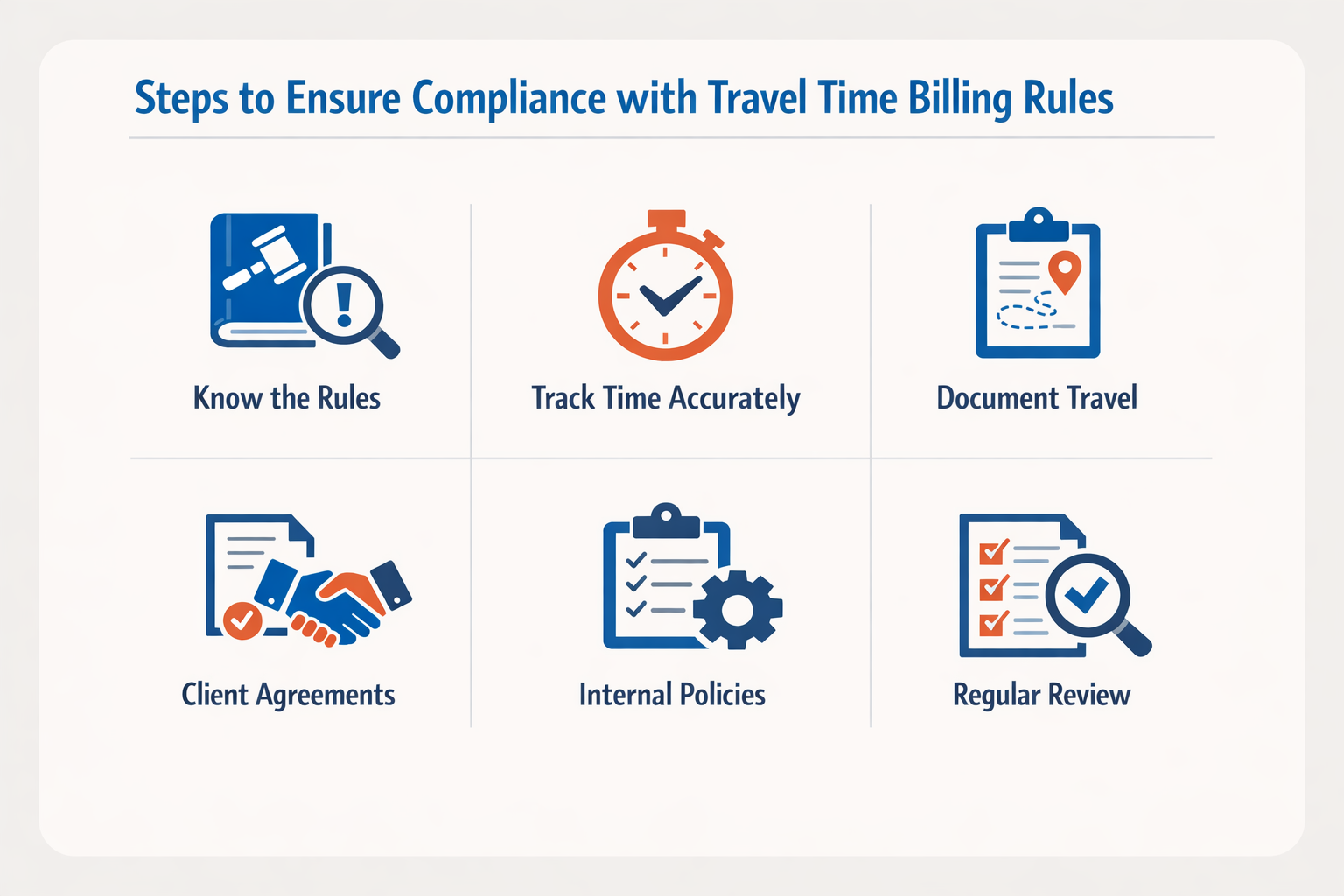
Compliance with travel time billing insurance defense rules requires deliberate attention to carrier guidelines, invoice structure, and documentation practices. The steps below outline a workflow that reduces rejections and supports clean submission through e-billing portals.
Step 1: Consult the Controlling Guideline Before Travel
Step 1
Consult the controlling guideline before travel
Before incurring any out-of-state travel expense, consult the adjuster and the carrier's outside counsel guidelines. Louisiana Division of Administration, Office of Risk Management, Attachment C: Case Handling Guidelines and Billing Procedures (Revised 07/01/19, effective 07/01/19), PDF, p. 11, § I. Travel, ¶ 1, states that the billing attorney must consult with the adjuster prior to incurring any out-of-state travel expenses. This pre-approval step is not optional — it determines whether the expense is reimbursable at all.
Carrier guidelines often specify travel class, booking windows, and receipt requirements. The same Louisiana guideline prohibits first-class travel and requires the lowest logical airfare, with receipts for reimbursement. If a guideline is silent on travel billing, that silence is not permission — it means the carrier has not published a standard, and the invoice may be rejected on narrative or reasonableness grounds.
Step 2: Bill Travel Time Separately from the Task
Step 2
Bill travel time separately from the task
OCSO, WC Defense Counsel Reporting and Billing Guidelines (RFP #217-25, 2026), PDF, p. 54, § BILLING FORMAT, list items 1–8, states that travel time is to be billed separately from the task performed as a result of the travel. This means one line item for travel and a second line item for the hearing, deposition, or mediation that followed.
Block billing — combining travel and the event into a single narrative — is a common cause of reduction. A line reading "travel to and attend mediation, 5.4" does not tell the reviewer how much time was spent on the road versus in the room. Separate entries allow the reviewer to assess each component against the guideline's travel and appearance standards.
Step 3: Use UTBMS Activity Code A112 for Travel
Step 3
Use UTBMS activity code A112 for travel
DRI, Updates to the UTBMS for Insurance Litigation (May 23, 2007), p. 8, § Attend Mediation, list item 4, states that some clients require a separate time entry for travel to and from events, which is distinguishable from the actual appearance time, and that the Insurance Litigation Codes include an activity code for this purpose: A112. The same instruction appears in the commentary for task codes L510 and L530.
Activity code A112 is the standard UTBMS code for travel time. When the LEDES 1998B file reaches the e-billing portal, the validator reads field 9 (ACTIVITY_CODE). If the narrative describes travel but the activity code is blank or set to a non-travel code, the portal may flag the line for manual review or reject it outright. For more on how activity codes structure the invoice, see UTBMS Activity Codes A101-A111 for Legal Billing.
Step 4: Bill in Tenth-of-an-Hour Increments
Step 4
Bill in tenth-of-an-hour increments
OCSO, WC Defense Counsel Reporting and Billing Guidelines (RFP #217-25, 2026), PDF, p. 53, § BILLING INCREMENTS, ¶ 1, states that counsel shall bill time in one-tenth (0.10) of an hour increments. The same guideline repeats this instruction in the billing format section.
Tenth-of-an-hour increments are the industry convention for insurance defense billing. A travel entry reading "1.25" is acceptable; an entry reading "1.3" or "1 hour 20 minutes" is not. Rounding practices vary by firm, but the submitted LEDES file must express every line item as a decimal in tenths.
Step 5: Provide a Specific Narrative for Each Travel Entry
The narrative for a travel line item must state the origin, destination, and purpose. A line reading "travel, 2.4" does not satisfy the detail requirement. A line reading "travel from downtown office to federal courthouse, motion hearing" does. The reviewer needs enough information to assess whether the distance and duration are reasonable.
If the guideline requires contemporaneous records, the narrative should match the detail captured at the time of travel. Reconstructing travel narratives weeks later from calendar entries invites inconsistency and increases the risk of reduction.
Step 6: Separate the Billing Attorney's Travel from Paralegal or Co-Counsel Travel
When multiple timekeepers travel to the same event, each timekeeper's travel is a separate line item. The LEDES file includes a TIMEKEEPER_ID field (field 5) and a TIMEKEEPER_NAME field (field 6). The portal groups line items by timekeeper, and the reviewer evaluates staffing ratio and duplication across those groups.
If two partners bill travel to the same deposition, the reviewer will ask whether two partners were necessary. The answer may be yes — but the invoice must support that answer with separate, specific narratives that explain each timekeeper's role.
Step 7: Review the Guideline's Pre-Approval Threshold
Many carrier guidelines set a dollar threshold above which travel expenses require pre-approval. If the guideline states that any single expense over five hundred dollars requires adjuster approval, and the airfare is six hundred dollars, the invoice must include documentation of that approval — typically a reference to the adjuster's email or claim note.
Without that reference, the line item may be reduced to the threshold or rejected entirely. The reduction code will cite "lack of pre-approval," and the appeal will require proof that approval was obtained before the expense was incurred.
Tips and Tricks
Three entries reading "travel to deposition, 3.7" without documentation of work performed will trigger a fifty-percent reduction under most panel guidelines. The Hartford's billing guidelines, revised April 20, 2026, state that travel time is reimbursed at fifty percent of the attorney's rate unless reasonable and necessary legal work is properly documented and performed during travel. That means the narrative must describe the work, not just the movement.
Document Work Performed During Travel
When an attorney reviews pleadings, drafts correspondence, or prepares for a hearing while traveling, those activities must appear in the line-item narrative. The C.D. Cal. CJA Panel Manual, revised December 2022, makes clear that compensation for other than travel time while in travel status will be paid only for actual services rendered. A compliant entry reads "travel to mediation and review settlement demand, draft counter-offer, 2.4" — the narrative separates travel from work, and the time reflects both.
If travel time is spent working on another matter, for another client, or on firm business, that time must be billed exclusively to the other matter or client or absorbed by the firm. The Hartford guideline is explicit: time spent on unrelated work is not chargeable to the carrier. Reviewers cross-check narratives against matter numbers and timekeeper calendars; a mismatch triggers a reduction code and an appeal cycle that delays payment.
Bill to the Nearest Tenth of an Hour
The C.D. Cal. CJA Panel Manual, page thirteen, requires that time spent must be billed to the nearest tenth of an hour. Most carrier guidelines adopt the same increment. An entry reading "travel, 3.75" will be rejected or rounded down. An entry reading "travel, 3.7" is compliant. Rounding up from 3.74 to 3.8 is permissible; rounding 3.2 to 4.0 is not.
Separate Local Travel from Compensable Travel
The Hartford guideline excludes local travel from the fifty-percent rule. Local travel — courthouse trips within the attorney's metropolitan area — is billed at full rate only when accompanied by documented work. A thirty-minute drive to a hearing followed by a two-hour hearing is billed as "attend hearing, 2.5" if the drive is local. The travel component is absorbed unless the guideline explicitly permits it. When the destination is outside the local area, the fifty-percent rule applies to the passive travel portion, and the narrative must state the destination to establish that the trip was non-local.
For guidance on structuring time entries and avoiding block billing, see Block Billing: Reasons for Carrier Rejections and Solutions. Additional detail on e-billing portal validation and common rejection causes helps prevent submission delays.
Conclusion
Travel time billing insurance defense turns on three principles: itemize separately, pro-rate mixed-purpose trips, and never bill both travel time and work performed during that travel. The Sompo International Legal Services Guidelines state that counsel may bill travel time at the full hourly rate or bill for actual work done during the trip, but not both. PRISM and ACCEL defense counsel guidelines require pro-rating when travel includes non-client business. These are not suggestions—they are the baseline for invoice acceptance.
Most reductions stem from narrative failures rather than rate disputes. A line reading "travel to deposition, 2.4" tells the reviewer nothing about destination, purpose, or whether the trip served multiple matters. The same entry reading "travel from San Francisco office to Sacramento for plaintiff deposition, Jones v. Smith, 2.4" survives review because it gives the bill reviewer what the guideline demands: itemized detail, clear purpose, and a single-matter allocation.
Pro-rating is non-negotiable when a trip serves more than one client or matter. If a three-hour drive includes a courthouse stop for one client and a witness interview for another, the invoice must split the time proportionally and state the allocation method in the narrative. Silence on allocation invites a reduction code, and the appeal path is narrow once the invoice has been rejected for insufficient detail.
Carriers do not publish travel time guidelines to create billing obstacles—they publish them because aggregated travel costs across a panel add up quickly, and unexplained charges draw regulatory scrutiny during claims audits. Block billing and vague narratives make it impossible to verify that a charge is reasonable, necessary, and allocable to the matter. The guideline exists to make verification possible, and compliance is the price of panel participation.
Read the controlling guideline, quote what it prohibits, and build your time entries to survive the first review. That discipline—applied consistently across every travel entry—is what keeps an invoice out of the rejection queue and a firm on the panel.
Frequently asked questions
What is travel time billing in insurance defense?
Travel time billing insurance defense is compensation for time an attorney spends traveling to depositions, court appearances, site inspections, or client meetings. Carrier guidelines specify how travel time must be recorded, what billing increments apply, and which activities qualify for reimbursement.
How should travel time be coded in LEDES files?
Use UTBMS activity code A112 for travel time entries. The LEDES 1998B file validator reads field 9 (ACTIVITY_CODE), and missing or incorrect codes trigger portal rejections or manual review flags.
Can attorneys bill premium rates for travel time?
No. Carrier guidelines prohibit premium rates for travel time. Travel is billed at the timekeeper's standard hourly rate, even if it occurs after hours or on weekends.
What narrative detail do carriers require for travel entries?
Most guidelines require origin, destination, and purpose. A compliant entry reads "travel from downtown office to federal courthouse, motion hearing, 1.2" rather than "travel, 1.2."
How do billing increments apply to travel time?
Travel time must be billed in tenth-of-an-hour (0.1) increments under most carrier guidelines. A 23-minute drive is billed as 0.4 hours, not 0.3 or 0.5, unless the guideline specifies a different rounding rule.