


Aetna Insurance Credentialing and Billing Compliance Checklist
Introduction
Aetna credentialing and billing compliance begins with understanding that each carrier's guidelines define the financial relationship between the insurer and defense counsel. As part of the Carrier Ready Knowledge Team, our work often involves navigating the complex landscape of insurance credentialing and billing compliance. When it comes to Aetna insurance, understanding the nuances of billing practices is crucial. One area we frequently examine is how different carriers, including Aetna, interpret and apply guidelines related to billing practices.
Managing divergent billing and file-handling guidelines can create a compliance burden across multiple carriers and divisions. The 2026 CLM Litigation Management Study reports that administrative overhead from compliance issues is seen as pulling talented attorneys away from case work, which can impact overall productivity. This administrative burden is not unique to Aetna, but it underscores why a systematic approach to credentialing and billing compliance matters for any insurance defense practice.
Failure to follow guidelines and billing practices—excessive billing, overbilling, and billing disputes—ranks among the most commonly mentioned problems in carrier-counsel relationships. The same CLM study identifies non-compliance with litigation guidelines and billing practices as a recurring friction point. These issues are avoidable when firms implement a structured compliance checklist that addresses credentialing requirements, billing increment conventions, narrative detail standards, and submission workflows.
The sections that follow outline the common problems providers face, the solution steps for achieving compliance, and practical tips for successful credentialing and billing with Aetna and similar carriers. Each step is grounded in the principle that compliance begins with reading the controlling document, quoting what it says, and telling the reader exactly what that means for a line item.
What Are the Most Common Aetna Credentialing and Billing Compliance Failures?
Non-compliance with billing guidelines results in nonpayment. That is the first line in most carrier relationships, and it applies whether the carrier is Aetna, another national payer, or a regional insurer. When a firm submits an invoice that does not conform to the carrier's published requirements, the invoice is rejected, reduced, or held pending clarification. The financial relationship between the insurer and defense counsel is defined by the guidelines, and noncompliance triggers the consequence the guidelines specify.
The most commonly mentioned billing issue across carriers is failure to follow guidelines and billing practices. Excessive billing, overbilling, inflexibility on cost, billing disputes, and unethical billing practices appear in carrier feedback as recurring problems. These are not abstract concerns — they are the reasons invoices are written down, firms are removed from panels, and relationships terminate. Billing statements must be detailed and must adequately describe the services provided. When a line item reads "research and draft motion in limine, 4.2," that entry is block billing, and most carriers treat it as a reduction trigger.
Administrative overhead from compliance issues pulls talented attorneys away from case work. Managing divergent billing and file-handling guidelines across multiple carriers and divisions creates overhead that is cited as a direct driver of talent attrition from insurance defense. The burden is not limited to the billing department — it affects timekeepers, case handlers, and firm management. When a firm cannot reliably predict which entries will clear review and which will be reduced, the result is both revenue uncertainty and morale erosion.
Billing guidelines should never interfere with any duties, obligations, or responsibilities owed to a client, nor should they diminish the quality of the defense the insurer's outside counsel will provide the insured. That precatory language appears in many carrier documents, but it does not eliminate the requirement to comply with the billing provisions. The guideline may state that it is "for billing purposes only," but the consequence of non-compliance remains the same: the invoice is not paid as submitted.
Updated billing and handling guidelines, expanded alternative fee arrangement usage, flat fee arrangements, and AI billing guideline updates are among the most interesting or innovative presentations by law firms in the past year. Carriers are revising their requirements, and firms that do not track those revisions find themselves submitting invoices under outdated assumptions. Auto-approval of AI-adjusted invoices is now mentioned in carrier literature, which means the review process itself is changing. A firm that does not understand how the current guideline differs from the prior version cannot predict which line items will survive review.
For more on what specific billing practices carriers prohibit, see Outside Counsel Guidelines for Insurance Litigation.
How Do You Achieve Aetna Credentialing and Billing Compliance?
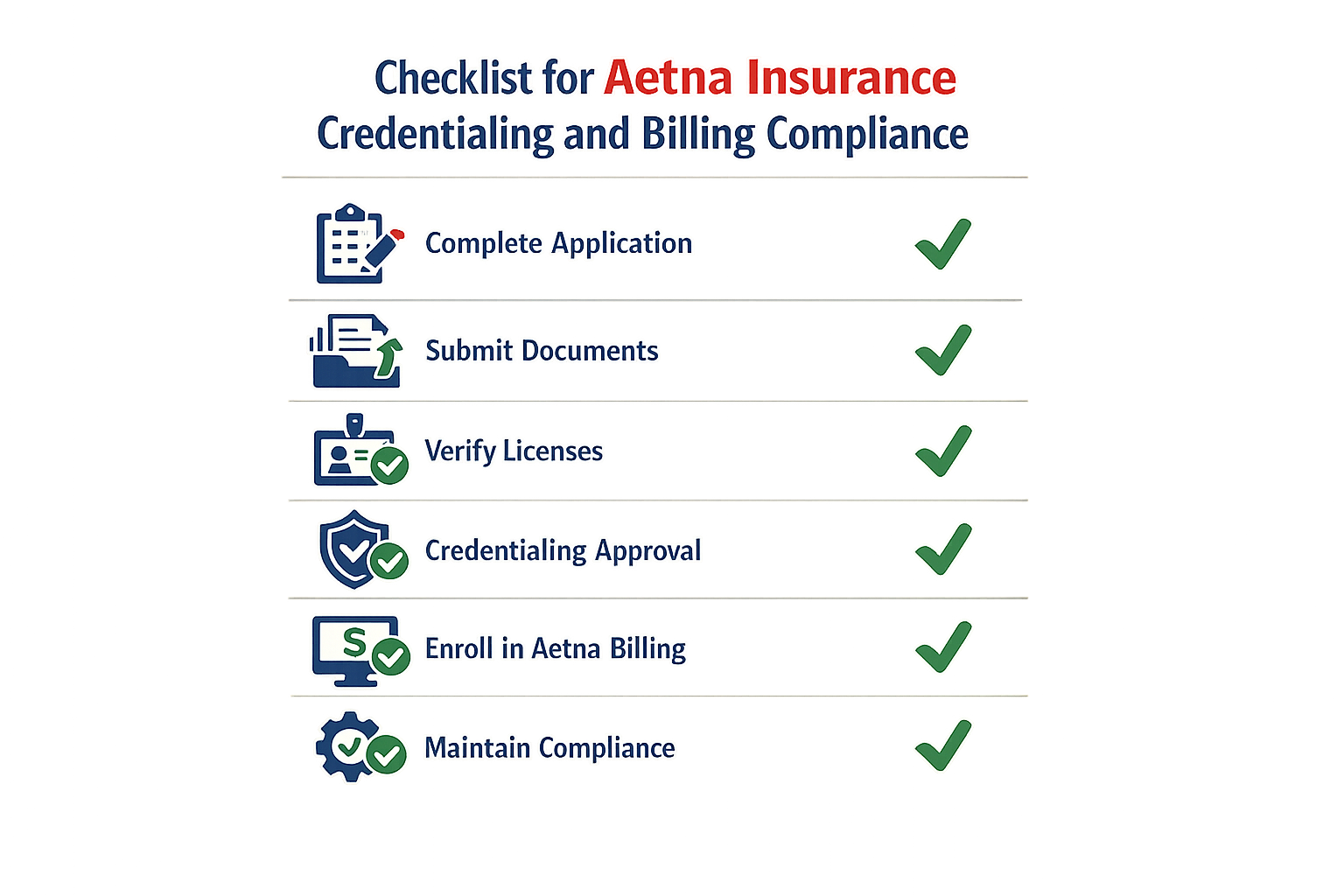
Achieving Aetna credentialing and billing compliance requires a structured approach to documentation, invoice formatting, and guideline adherence. The following checklist provides a framework for meeting carrier expectations and reducing the risk of invoice rejection or write-down.
Step 1: Review Applicable Billing Guidelines
Step 1
Identify controlling billing standards
Before submitting any invoice, confirm which billing guidelines govern the matter. Carriers publish outside counsel guidelines that specify billing increments, narrative requirements, staffing ratios, and non-reimbursable expenses. Georgia Institute of Technology's Outside Counsel Guidelines, for example, address Alternative Fee Arrangements, rates, billing procedures, invoice format, and non-reimbursable expenses and overhead charges. While this is not an Aetna document, it illustrates the structure common to carrier guidelines: each section defines what the payer will accept and what triggers rejection.
Where multiple carriers are involved, note that divergent billing and file-handling guidelines across carriers and divisions create administrative overhead. The 2026 CLM Litigation Management Study reports that managing these divergent requirements is cited as a direct driver of talent attrition from insurance defense. Treat each carrier's guidelines as a distinct ruleset; do not assume uniformity.
Step 2: Structure Invoices to Meet Format Requirements
Step 2
Prepare compliant invoice files
Most carriers require electronic submission in LEDES 1998B format, with UTBMS task and activity codes for each line item. The LEDES Oversight Committee's 98B format page provides the required field set, though several portals accept files that omit fields marked as required by the specification. Do not rely on portal leniency; submit files that include all required fields to avoid downstream rejection.
Invoice format compliance extends beyond file structure. Each line item must include a timekeeper identifier, a billing increment (typically tenth of an hour), a UTBMS task code, a UTBMS activity code, and a narrative description. The 2013 LOC Revised UTBMS Activity Codes define code A115 as "Medical Record and Medical Bill Management: Any services associated with the review, compilation, digesting, summary or processing of medical records or bills when performed in-house only." Use the code set that matches the carrier's specified version; do not substitute codes from a different year or vendor-specific taxonomy.
Step 3: Avoid Common Billing Prohibitions
Step 3
Eliminate reduction triggers before submission
Carriers identify specific billing practices as reduction triggers. The 2026 CLM Litigation Management Study lists failure to follow guidelines and billing abuse—including non-compliance with litigation guidelines and billing practices, excessive billing, overbilling, and billing disputes—as commonly mentioned issues. Block billing, clerical-task billing, and vague narratives are frequent causes of line-item reduction.
To prevent these issues, review each entry against the carrier's stated prohibitions. For example, if the guideline specifies that block billing is not permitted, separate multi-task entries into discrete line items with distinct activity codes. If the guideline caps paralegal time for a given task, ensure the billed amount does not exceed that cap. If the guideline requires contemporaneous time records, confirm that each narrative reflects work performed on the date shown, not a summary compiled days later.
Step 4: Maintain Documentation to Support Each Line Item
Every billed entry must be supported by contemporaneous records. If a carrier or bill reviewer challenges a line item, the timekeeper's contemporaneous notes are the first line of defense. Where the guideline requires pre-approval for expenses above a stated threshold, retain the approval correspondence and reference it in the invoice narrative.
Alternative Fee Arrangements may alter the documentation burden. The 2026 CLM Litigation Management Study notes that carriers are expanding AFA usage, including flat fee arrangements and auto-approval of AI-adjusted invoices. Where an AFA is in place, confirm that the invoice format reflects the agreed arrangement and that any variance from the AFA terms is disclosed and supported.
Step 5: Submit Through the Designated E-Billing Portal
Most carriers require submission through a named e-billing portal. The portal validates the file format, checks for required fields, and applies the carrier's reduction rules before the invoice reaches a human reviewer. If the portal rejects the file, the rejection message will specify the field or rule that failed. Correct the error and resubmit; do not bypass the portal by sending the invoice via email unless the carrier's guidelines explicitly permit it.
Where the portal accepts the file but a human reviewer later reduces a line item, the carrier will issue a reduction code. The reduction code corresponds to a specific guideline provision. To appeal the reduction, cite the guideline provision and provide the supporting documentation that shows the line item complies.
What Practical Steps Ensure Successful Aetna Credentialing and Billing Compliance?
Billing guidelines establish the financial relationship between the insurer and defense counsel. Noncompliance with the guidelines results in nonpayment. Certain guidelines identify reimbursable expenses, hourly rate schedules for counsel and for support staff, permitted legal services for which compensation will be made, and activities for which compensation will not be made. To the extent that these provisions merely define the financial relationship between the insurer and defense counsel, they do not present ethical concerns under the Rules.
Obtain Pre-Approval for External Professional Services
Billing attorney must consult the adjuster before hiring experts, consultants, investigators, or other external professionals. Complete the carrier's request form and submit it along with a fee schedule and curriculum vitae to the adjuster before approval will be given. Once approval is granted, the adjuster will notify counsel who will then engage the expert as directed. This pre-approval requirement appears in multiple carrier guidelines and is non-negotiable — an invoice line for an unapproved expert is a reduction trigger, not a negotiation point.
Submit Detailed Billing Statements That Adequately Describe Services
Billing statements must be detailed and must adequately describe the services provided. The phrase "adequately describe" is not a suggestion — it is the standard by which the bill reviewer determines whether a line item is compensable. A narrative reading "research and draft motion, 4.2" does not meet that standard under most panel guidelines. Break the entry into discrete tasks: "research motion in limine re expert testimony, 1.8; draft motion in limine re expert testimony, 2.4." The second version survives the first-pass review; the first does not.
For more on narrative structure that passes carrier review, see Sample Attorney Billing Descriptions PDF That Pass Carrier Review. For specific guidance on paralegal entries, review Paralegal Billing Cheat Sheet: What Carriers Pay For.
Billing statements must be detailed and must adequately describe the services provided.
Understand That Guidelines Should Never Interfere With Duties to the Client
The guidelines under consideration contain precatory language relating to counsel's responsibilities to the insured. One carrier's guideline provides: "The following billing requirements have been compiled and adopted by the [insurer] office of claims in order to provide guidelines for billing purposes only. These guidelines should never interfere with any duties, obligations, or responsibilities owed to a client nor should they diminish the quality of the defense [insurer's] outside counsel will provide the [insurer's] insured." That language is not an invitation to disregard the guideline — it is a reminder that the guideline governs reimbursement, not the scope of representation. If a task is necessary for the defense but not reimbursable under the guideline, counsel must perform the task and either seek pre-approval or absorb the cost.
Manage Administrative Overhead to Preserve Case-Work Time
Managing divergent billing and file-handling guidelines across multiple carriers and divisions creates administrative overhead. That overhead is seen as pulling talented attorneys away from case work, and guidelines are cited as a direct driver of talent attrition from insurance defense. The practical response is to systematize compliance: maintain a guideline matrix, use billing software that validates UTBMS codes and narrative length, and assign one timekeeper per firm to monitor guideline updates. The alternative — ad hoc compliance on a per-invoice basis — multiplies the overhead and increases the rejection rate.
Treat Billing Requirements as a Checklist, Not a Substitute for the Underlying Rules
A billing-requirements document highlights the billing issues you will likely be applying on a regular basis, but is no substitute for thorough and complete review of the underlying statute, guidelines, and carrier policy. All vouchers must comply with the highlighted requirements and with the other requirements described in the statute, guidelines, and carrier policy. When a portal accepts a file that omits a field marked as required by the LEDES 98B specification, that acceptance does not mean the field was optional — it means the portal's validation is incomplete. The bill reviewer may still reduce the invoice for a missing or malformed field that the portal did not catch.
Conclusion
Noncompliance with billing guidelines results in nonpayment — a straightforward consequence that underscores the importance of the compliance checklist presented in this article. As the R.I. Sup. Ct. Ethics Advisory Panel observed, billing guidelines establish the financial relationship between the insurer and defense counsel, and failure to follow those guidelines triggers rejection at the portal or reduction during review. The checklist approach — verifying credentialing status, confirming guideline compliance, validating invoice format and reviewing narrative detail before submission — converts abstract requirements into a repeatable workflow that reduces billing disputes and accelerates payment.
As part of the Carrier Ready Knowledge Team, our work often involves navigating the complex landscape of insurance credentialing and billing compliance. Managing divergent billing and file-handling guidelines across multiple carriers creates a real compliance burden, yet the solution is not to ignore the guidelines but to systematize adherence. Attorneys must be familiar with statutory and contractual requirements for billing submissions, and that familiarity begins with the kind of structured review this checklist provides. When you treat compliance as a checklist rather than an afterthought, you reduce the administrative overhead that pulls talented attorneys away from case work and you build a billing practice that survives carrier scrutiny.
The guidelines under consideration contain precatory language reminding counsel that billing requirements should never interfere with duties owed to the client nor diminish the quality of the defense provided to the insured. That language is not a loophole — it is a reminder that compliance and quality are not mutually exclusive. A well-prepared invoice, submitted through the correct portal with the correct codes and sufficient narrative detail, demonstrates both professional competence and respect for the financial relationship that funds the defense. For a deeper look at how specific billing practices interact with carrier review standards, see our guide to attorney billing descriptions that pass carrier review.
Proactive compliance management means reviewing the checklist before the invoice goes out, not after the reduction notice arrives. Repeated failures to submit billings that comport with contractual requirements constitute good cause for termination of panel status — a consequence that no firm can afford. Use the checklist, document your compliance steps, and treat every submission as an opportunity to reinforce your reliability as panel counsel.
FAQ
What is Aetna credentialing and billing compliance?Aetna credentialing and billing compliance is the process of meeting Aetna's published billing guidelines, credentialing requirements, and invoice format standards to ensure timely reimbursement and avoid rejection or write-downs.
Why do Aetna invoices get rejected?Invoices are rejected when they fail to conform to Aetna's published requirements, including block billing, missing UTBMS codes, vague narratives, unapproved expenses, or incorrect file formats.
How often should I review Aetna's billing guidelines?Review guidelines at the start of each new matter and whenever the carrier issues an update. Carriers revise their requirements regularly, and outdated assumptions lead to rejections.
Can I bill for clerical work under Aetna credentialing and billing compliance rules?Most carriers, including Aetna, prohibit billing for clerical tasks. For detailed guidance, see Can Attorneys Bill for Clerical Work? Insurance Carrier Rules.