


Can Attorneys Bill for Clerical Work? Insurance Carrier Rules
Top takeaways
- Most insurance carriers prohibit billing for clerical work, regardless of who performs it
- Guidelines distinguish between non-billable administrative tasks and billable legal work
- Proper UTBMS coding and narrative detail determine whether a line item survives bill review
- Attorney time spent on secretarial functions triggers reductions even when the work was necessary
- Understanding carrier-specific prohibitions prevents invoice rejections and write-downs
Introduction
Can lawyers bill for clerical work? Insurance carriers publish outside counsel guidelines that draw bright lines around what constitutes billable legal work, and clerical tasks fall on the wrong side of that line in nearly every published version. The answer is no—most carriers prohibit billing for administrative tasks performed by attorneys, paralegals, or support staff.
One line reading "file organization and document management, 2.3" can cost a panel firm thousands in reductions across a year of submitted invoices. The question of whether lawyers bill for clerical work has a straightforward answer in carrier guidelines: no. The harder question is what counts as clerical work when an attorney performs it. Scanning exhibits into a trial binder, updating a spreadsheet of deposition dates, or reformatting a brief for e-filing all feel like necessary case tasks, but bill reviewers read them as secretarial services dressed in attorney time. The Central District of California's CJA Panel Manual states plainly, "you may not bill for secretarial services - whether performed by you or other personnel." That prohibition appears in some form across carrier guidelines, federal billing standards, and state bar ethics opinions.
Carriers enforce these prohibitions through UTBMS activity codes and narrative review. A line item coded to A101 (plan and prepare for) with a narrative describing filing or calendaring will be flagged for reduction even if the timekeeper is a partner. The 2024 CLM Defense Counsel Study noted that some insurance providers limit the types of work attorneys can bill for, and defense counsel report confusion over why certain tasks performed by attorneys are treated as non-billable. The confusion stems from a mismatch between what feels like legal work and what guidelines define as compensable attorney time.
This article walks through the carrier rules on clerical billing, the task categories that trigger reductions, and the narrative and coding practices that keep invoices clean. It does not offer legal advice or predict the outcome of any fee dispute. It presents the controlling documents, quotes what they say, and explains what those provisions mean for a line item submitted through an e-billing portal.
Can Lawyers Bill for Clerical Work Under Insurance Guidelines?
A line item reading "organize files, prepare binders for deposition, 2.5" can trigger a reduction before it reaches the reviewer's desk. The confusion lies not in whether the work was performed, but in whether an attorney's time is the appropriate billing vehicle for tasks that carriers classify as clerical overhead.
Insurance carriers and corporate law departments have spent three decades refining the boundary between compensable legal work and administrative support that firms are expected to absorb. In the mid-1990s, major US law departments and insurers sought to better understand the services provided by outside counsel, in part because paper bills often included descriptions that ran for multiple paragraphs without distinguishing substantive analysis from file management. That scrutiny has never relaxed.
The Attorney-Paralegal-Clerical Divide
The 2024 CLM Defense Counsel Study captures the tension directly: "Some insurance providers cut the work of attorneys that only attorneys can bill for. There needs to be a better understanding of why an attorney or paralegal need to do work versus a secretary." The problem is not that carriers reject all administrative entries outright. The problem is that many invoices present clerical tasks under attorney rates without explaining why an attorney performed them, and reviewers apply the simplest rule: if a secretary could have done it, the attorney rate does not apply.
Carriers distinguish three tiers: work only an attorney can perform, work a paralegal may perform under supervision, and work that belongs in firm overhead. Filing, copying, courier runs, calendar management, and routine correspondence formatting typically fall into the third tier. When an attorney performs a third-tier task, the burden shifts to the narrative: the entry must explain why no support staff was available or why the task required immediate legal judgment that could not be delegated.
Implications for Legal Billing Practice
The confusion compounds when firms conflate "work an attorney did" with "work an attorney may bill for." Outside counsel guidelines do not prohibit attorneys from organizing files or scanning exhibits. They prohibit billing those tasks at attorney rates unless the circumstances justify the staffing choice. A narrative that states only the task performed—without addressing why an attorney performed it—invites the reviewer to apply the default rule: clerical work is overhead.
This creates two risks. First, invoices that routinely include clerical entries under attorney time codes signal poor internal controls, which can trigger broader scrutiny of the firm's billing practices. Second, when a carrier reduces or writes down clerical entries, the firm's appeal options narrow quickly, because the guideline prohibition is usually explicit and the narrative gap is difficult to cure after submission.
The solution is not to avoid performing administrative tasks when the matter requires them. The solution is to staff them appropriately, document the staffing rationale when an attorney must step in, and ensure that the UTBMS codes and narrative detail align with what the controlling guideline permits.
Solution Steps
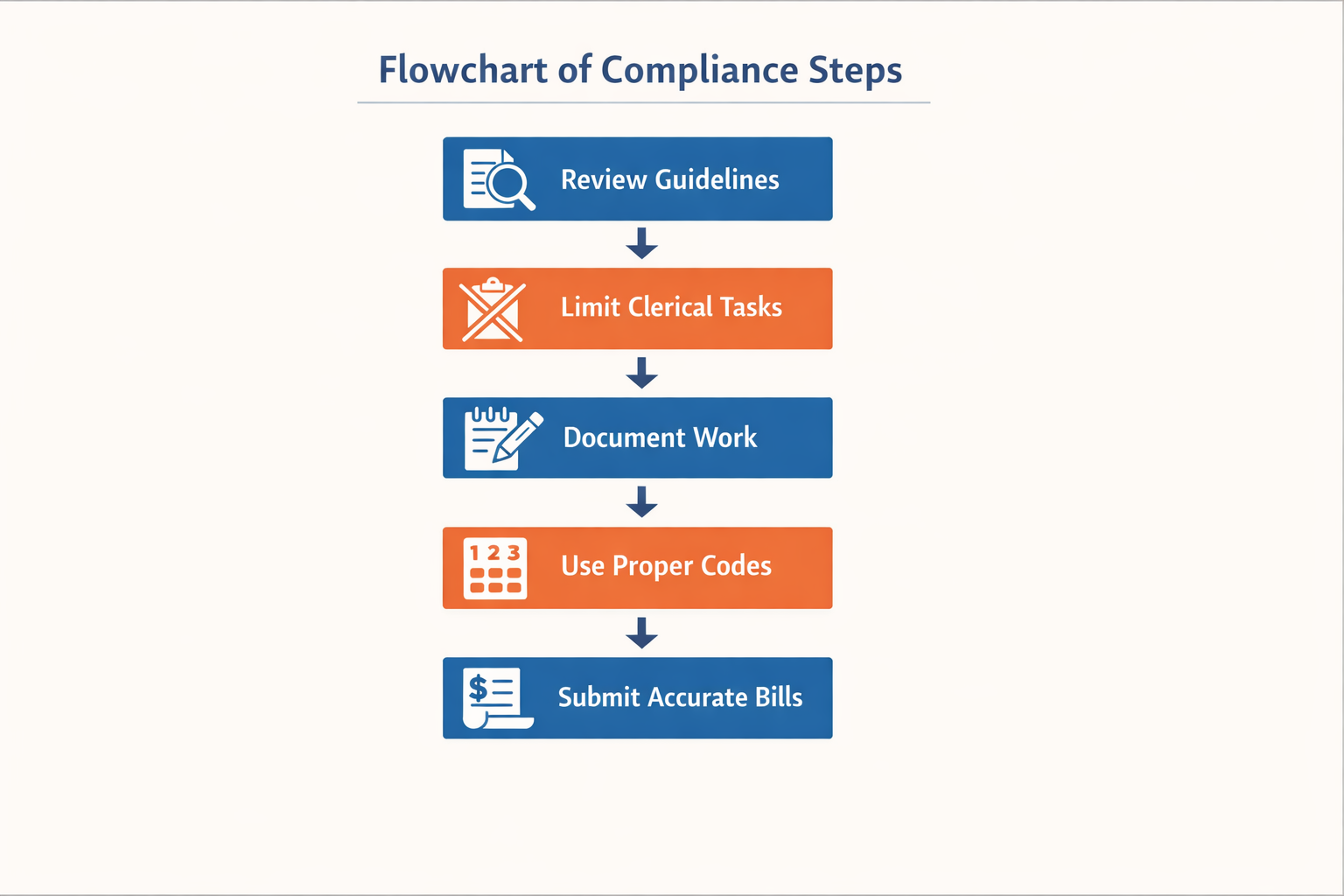
Panel counsel who bill insurance carriers face a recurring question: can lawyers bill for clerical work, and if so, how should those entries appear in a submitted invoice? The answer depends on what the controlling outside counsel guidelines say, what UTBMS code the timekeeper assigns, and whether the narrative demonstrates that the task required legal judgment rather than administrative execution.
Step 1: Read the Controlling Guideline
Step 1
Identify the prohibition language
Every carrier guideline has a non-reimbursable expenses or non-billable tasks section. Locate the version you are bound by—Arch 2025.5, Chubb's panel letter, or the client-specific addendum—and read what it says about clerical, administrative, secretarial, or overhead tasks. Where the guideline states that clerical work is not reimbursable, that prohibition is non-negotiable. If the guideline is silent, the carrier's bill reviewer will still apply a reasonableness standard, and entries that read as purely administrative routinely trigger reductions.
When a guideline uses the phrase "clerical tasks are not billable," it means tasks that any trained office employee could perform without legal education or bar admission. Photocopying, filing, calendaring, routine data entry, and mail distribution fall into this category. The guideline does not prohibit billing for legal work that happens to involve a physical task—drafting a certificate of service is legal work; walking it to the mailbox is not.
Step 2: Code the Entry with the Correct UTBMS Task and Activity
LEDES 1998B invoices require a UTBMS task code in field 7 and an activity code in field 9. Bill reviewers read these codes before they read the narrative. An entry coded L310 (Document/File Management) with activity A103 (Organize files) will be flagged as clerical regardless of what the narrative says. An entry coded L110 (Case Assessment, Development and Administration) with activity A102 (Communicate with client) signals attorney work, and the narrative can then demonstrate why the communication required legal judgment.
When the task involved both legal and clerical components, code the legal component and describe only that component in the narrative. For a detailed explanation of how activity codes map to reimbursable and non-reimbursable work, see UTBMS Activity Codes A101-A111 for Legal Billing. If you cannot identify a legal component, the entry does not belong on the invoice.
Step 3: Write a Narrative That Demonstrates Legal Judgment
The narrative must show that the timekeeper applied legal knowledge, exercised discretion, or made a decision that required bar admission. "Prepare certificate of service" is ambiguous—it could mean drafting the certificate (legal) or printing and mailing it (clerical). "Draft certificate of service for motion in limine, confirm service list against local rule 5-1" is unambiguously legal work. The second narrative identifies the document, the procedural context, and the rule the timekeeper consulted.
Step 2
Separate legal work from administrative execution
When a task has both components, bill only the legal component and omit the administrative steps. A timekeeper who reviews a subpoena, determines the response deadline under Code of Civil Procedure section 2020.410, drafts the objection, and then prints and mails it should bill for reviewing, determining, and drafting. The printing and mailing are overhead. The narrative should read: "Review subpoena, research response deadline, draft objections." It should not read: "Review subpoena, research response deadline, draft objections, print and mail."
Bill reviewers are trained to spot block billing and administrative padding. In the mid-1990s, major insurers and law departments began demanding structured billing because paper invoices often included multi-paragraph descriptions of a single day's work, making it virtually impossible to separate legal services from overhead. That history explains why modern guidelines require task-level coding and why a narrative that blends legal and clerical work will be reduced even when the legal component is legitimate.
Step 4: Confirm That the Timekeeper's Rate Matches the Task
Most panel guidelines include a staffing-ratio provision or a rate-by-role schedule. An entry billed at a partner's rate must reflect work that required a partner's judgment. If the task could have been performed by an associate, a paralegal, or clerical staff, the reviewer will either disallow the entry or reduce it to the lower rate. When a partner performs a task that the guideline assigns to a paralegal—such as updating a service list or preparing a routine notice—the entry will be reduced to the paralegal rate, and the partner's time will be written off.
The solution is to assign clerical and administrative tasks to the lowest-cost timekeeper who can perform them competently, and to bill attorney time only for work that required attorney judgment. Where a partner must personally perform an administrative task because no other timekeeper is available, the better practice is to write the time off rather than submit it and invite a reduction.
Step 5: Pre-Approve Unusual Entries Before Submission
When an attorney must bill time for a task that reads as administrative but involved genuine legal complexity, request pre-approval from the carrier or the client before submitting the invoice. A brief email explaining the context—"Associate reviewed 1,200 pages of medical records to identify entries relevant to plaintiff's claimed injury date, coded each entry by treatment category, and prepared a chronology"—will prevent the entry from being reduced as clerical data entry. Without that context, the reviewer sees only "review and organize medical records, 8.0" and applies the non-reimbursable overhead rule.
Pre-approval is not required for routine legal work, but it is the only reliable way to protect an entry that will otherwise be misread. The carrier's bill reviewer does not have access to the case file, does not know what made the task complex, and will not infer legal judgment from a vague narrative. If the work was necessary and the time was reasonable, document it in advance.
How Do Lawyers Bill for Clerical Work Without Triggering Reductions?

Documenting clerical work in a way that satisfies carrier expectations starts with separating legal judgment from administrative execution. When a task involves both—for example, selecting documents for production after reviewing them for privilege—break the entry into two lines: one for the substantive review, coded and billed at attorney rates, and one for the mechanical assembly, coded as clerical and billed accordingly or written off entirely. Carriers read the narrative and the UTBMS code together; when they match and the narrative is specific, the line survives review. When they conflict or the narrative is vague, the line gets flagged.
Write Narrow, Time-Stamped Narratives
A narrative reading "file management and document organization, 2.4" will trigger a reduction under most panel guidelines, even if the work included substantive analysis. The phrase "file management" signals clerical work to a bill reviewer, and the 2.4-hour block suggests multiple tasks bundled without detail. Replace it with entries that specify what was reviewed, why, and what decision followed: "review correspondence file to identify missing exhibits for motion in limine, .3" passes muster because it describes a legal task with a clear outcome. The time increment matches the task's scope, and the narrative ties to a litigation milestone that the adjuster can verify in the case file.
Contemporaneous records matter more than polished summaries. If you delegate document assembly to a paralegal, the paralegal's time entry should describe the assembly work and carry a paralegal rate or activity code. Your own entry, if any, should describe only the supervision or quality control you performed. Mixing the two into one attorney entry creates an ambiguity that reviewers resolve against the billing party. When an entry shows an attorney performing work that a guideline assigns to non-attorney staff, the reviewer applies the lower rate or disallows the time entirely, regardless of who actually did the work.
Map Tasks to UTBMS Codes Before You Bill
Most e-billing portals validate UTBMS task and activity codes at submission. If you bill an administrative task under a litigation task code, the portal may accept the file but flag the line for manual review. Reviewers compare the narrative to the code's definition; a mismatch is evidence of imprecise timekeeping, which carriers treat as a billing-practice issue rather than a one-time error. Study the UTBMS Activity Codes A101-A111 for Legal Billing definitions and match your narrative to the code before the invoice goes out. If the task does not fit a billable code, it belongs in a non-billable or administrative category, not forced into a code that half-fits.
When a carrier guideline lists prohibited tasks by name, those tasks are prohibited whether or not they appear in UTBMS. A guideline stating "no billing for file organization, calendaring, or docketing" means exactly that, even if you believe the work required legal judgment. The time to negotiate that standard is during panel selection or engagement-letter review, not after the invoice is submitted. If you performed work that a guideline prohibits, your options are to write it off, to seek pre-approval if the guideline allows exceptions, or to appeal the reduction with documentation showing that the work was substantive and that the narrative was misleading. The third path succeeds only when the record supports it; a post-hoc re-characterization of clerical work as legal work does not.
Separate Billing Entries by Timekeeper and Task Type
When an attorney and a paralegal both work on a task, submit separate entries with separate rates and codes. When a single timekeeper performs both legal and administrative work in one session, split the entry if the administrative portion is significant. A line reading "research statute of limitations, draft memo, organize research files, 3.8" bundles billable and non-billable work into one block, and the reviewer will reduce the entire entry rather than parse it. Three entries—"research statute of limitations, 2.1," "draft memo re statute of limitations, 1.4," and "organize research files, .3" (written off or billed at a clerical rate)—survive review because each is independently verifiable and coded to match its content.
Bill review is not an audit in the accounting sense; it is a contract-compliance check. The guideline is the contract, the LEDES file is your claim under that contract, and the narrative is your evidence. When the narrative is clear, the code is accurate, and the time is reasonable, the line passes. When any of those elements is missing or inconsistent, the line is reduced, and the reduction notice cites the guideline provision you violated. Reading the reduction code and the guideline together tells you what to fix before the next invoice. Ignoring the reduction and submitting the same entry again in the next billing cycle is how firms end up removed from panels.
Conclusion
The question of whether lawyers bill for clerical work has a clear answer when insurance carriers control the engagement: most do not permit it. Panel guidelines, e-billing portal validation rules, and bill review protocols all converge on the same standard — administrative tasks performed by attorneys or paralegals are not compensable at professional rates, and in many cases are not compensable at all. The prohibition is not a suggestion; it is a condition of panel membership and a frequent trigger for invoice reduction.
The research from the mid-1990s that led to UTBMS and LEDES standardisation was driven by carriers and law departments seeking transparency in what they were paying for. That scrutiny has only intensified. Today's e-billing systems flag clerical entries automatically, and reviewers apply reduction codes the moment a narrative describes work that should have been absorbed as overhead. Attorneys who continue to bill for filing, calendaring, document organisation or correspondence routing will see those line items written down or rejected outright, regardless of who performed the task.
The path forward is straightforward: read the controlling guideline, match your entries to the permitted task and activity codes, and ensure that every billed increment reflects work that required professional skill. When a task falls into the clerical category, do not bill for it. When a task combines legal and administrative components, separate them in your narrative and bill only the legal portion. Carriers have published the rules; compliance is a matter of reading them and applying them consistently.
For firms new to carrier work or adjusting to updated guidelines, the adjustment can feel restrictive. But the standard is not arbitrary — it reflects the same principle that governs reasonableness under state bar rules: clients pay for legal expertise, not for work that any competent assistant could perform. Block billing and narrative ambiguity compound the problem, because reviewers cannot tell where the legal work ends and the clerical work begins. The solution is specificity, accurate coding, and a billing practice that treats the guideline as the floor, not a negotiating position.
If your invoices are being reduced for clerical entries, the reduction is telling you that your billing practice does not match the carrier's published standard. Read the guideline again, compare it to your entries, and adjust. The rules are in writing, and they are enforced.
Frequently asked questions
Can lawyers bill for clerical work under insurance carrier guidelines?
No. Most insurance carriers prohibit billing for clerical tasks regardless of who performs them. Carrier guidelines define clerical work as tasks that do not require legal education or bar admission—filing, copying, calendaring, routine data entry, and mail distribution. When an attorney performs these tasks, the time is considered firm overhead and is not reimbursable at attorney rates.
What happens if an attorney bills for clerical work?
The line item will be flagged for reduction or rejection during bill review. Reviewers compare the narrative and UTBMS code to the carrier's outside counsel guidelines. If the entry describes work that the guideline assigns to non-billable overhead, the time is written down or disallowed entirely, and the reduction notice cites the specific guideline provision.
How do carriers distinguish between legal work and clerical work?
Carriers use three tiers: work only an attorney can perform, work a paralegal may perform under supervision, and work that belongs in firm overhead. The narrative must demonstrate that the timekeeper applied legal knowledge, exercised discretion, or made a decision requiring bar admission. Tasks that any trained office employee could perform fall into the clerical category.
Can an attorney bill for organizing files if the work required legal judgment?
Only if the narrative explains why legal judgment was required and the guideline permits an exception. A narrative reading "organize files, 2.5" will be reduced as clerical work. A narrative reading "review correspondence file to identify missing exhibits for motion in limine, .3" describes a legal task and will survive review if the UTBMS code matches.
What UTBMS codes should lawyers avoid for clerical tasks?
Avoid coding clerical tasks under attorney time codes. An entry coded L310 (Document/File Management) with activity A103 (Organize files) will be flagged as clerical regardless of the narrative. If the task involved legal analysis, code the legal component—such as L110 (Case Assessment) with A102 (Communicate with client)—and describe only the legal work in the narrative.