


What Is Insurance Defense? The Tripartite Relationship Explained
Introduction
Insurance defense is the practice area in which an insurer retains and pays for legal counsel to defend the insured against a claim brought by a third party. The insurer steps in because the policy of insurance imposes a duty to defend—a contractual obligation separate from the duty to indemnify. The insurer selects and compensates counsel, the insured receives the benefit of that representation, and the attorney owes professional duties to the insured as the client. This arrangement forms what practitioners call the tripartite relationship: insurer, insured, and defense counsel, each with a stake in the outcome and each subject to rules that govern their conduct.
The tripartite relationship shapes every invoice, every narrative entry, and every billing dispute in insurance defense work. Defense counsel submits time to the insurer for payment, but the legal work is performed on behalf of the insured. When a conflict of interest arises—for example, when the insurer reserves rights on a coverage issue that counsel's strategy might affect—California Civil Code section 2860, subdivision (a) may require the insurer to provide independent counsel, often called Cumis counsel. Independent counsel is selected by the insured, paid by the insurer, and operates under billing rules that differ in some respects from standard panel counsel arrangements.
Understanding what insurance defense is requires recognizing that it is not a single attorney-client relationship with incidental funding. It is a three-party structure in which the insurer's financial interest, the insured's legal exposure, and counsel's professional obligations intersect. That intersection determines which UTBMS activity codes are appropriate, what level of narrative detail satisfies the guideline, and when a reduction code will be applied to a line item that looks routine but implicates a reserved issue.
California Civil Code section 2860, subdivision (b) clarifies that a conflict of interest does not exist solely because the insured is sued for an amount exceeding policy limits, nor does it exist as to allegations for which the insurer denies coverage outright. But when the insurer reserves its rights on an issue and the outcome of that issue can be controlled by counsel retained by the insurer, a conflict may exist, and the insured may be entitled to independent counsel. Once independent counsel is appointed, subdivision (d) imposes a duty on that counsel and the insured to disclose all information concerning the action to the insurer, except privileged materials relevant to coverage disputes. Subdivision (f) provides that both insurer-provided counsel and independent counsel shall be allowed to participate in all aspects of the litigation and shall cooperate fully in the exchange of information, consistent with each counsel's ethical and legal obligations to the insured.
These statutory duties affect billing practice in concrete ways. Independent counsel invoices are reviewed under the same outside counsel guidelines as panel counsel, but the guideline's staffing and approval provisions may be applied differently when the insured, not the insurer, selected the firm. Narrative entries must be detailed enough to inform the insurer of the work performed, yet privilege rules prevent disclosure of certain attorney-client communications when a coverage dispute is in play. The result is a billing environment in which the usual standards—tenth-of-an-hour increments, UTBMS task and activity codes, block billing prohibitions—are enforced alongside section 2860's disclosure and cooperation mandates.
Both the counsel provided by the insurer and independent counsel selected by the insured shall be allowed to participate in all aspects of the litigation.
The tripartite relationship is not an abstract concept. It is the reason a reduction code appears on an invoice when a narrative fails to distinguish work on a covered claim from work on a reserved issue. It is the reason a carrier's outside counsel guidelines specify pre-approval thresholds for experts and require contemporaneous time records. It is the reason a bill reviewer will flag a block entry that combines research on damages with research on an excluded cause of action. Every participant in the relationship—insurer, insured, and counsel—has an interest in accurate, compliant billing, and the guidelines are written to protect all three.
Understanding the Problem Statement
The tripartite relationship in insurance defense creates structural tensions that no guideline can entirely eliminate. The insurer pays for the defense, the insured faces the liability, and defense counsel owes professional duties to the insured while the insurer controls the purse. When those interests align, the arrangement works. When they diverge, the relationship fractures along predictable fault lines.
Conflict Triggers and the Reservation of Rights
A conflict of interest arises when the insurer reserves its rights on a coverage issue and the outcome of that issue can be controlled by counsel the insurer retained. Cal. Civ. Code § 2860, subd. (b) states that a conflict does not exist as to allegations for which the insurer denies coverage outright, but when an insurer reserves rights and the facts developed in the defense affect the coverage determination, a conflict may exist. The statute clarifies that no conflict is deemed to exist solely because the insured is sued for an amount exceeding policy limits or because punitive damages are alleged.
The seminal San Diego Navy Federal Credit Union v. Cumis Insurance Society decision, 162 Cal.App.3d 358, held that when an insurer provides counsel under a reservation of rights, the insured has a right to independent counsel paid for by the insurer. The court reasoned that what defense counsel does in the third-party case impacts the coverage case, because coverage questions depend on the development of facts in the underlying litigation. Defense counsel retained and paid by the carrier faces an inherent tension: zealously defend the insured or shape the record in ways that preserve the carrier's coverage defenses.
The Scope Problem: Who Controls the Defense?
Once independent counsel is retained under § 2860, the statute imposes reciprocal duties. The insured and independent counsel must disclose to the insurer all information concerning the action except privileged materials relevant to coverage disputes, and they must timely inform and consult with the insurer on all matters relating to the action. Cal. Civ. Code § 2860, subd. (d). Both insurer-provided counsel and independent counsel are allowed to participate in all aspects of the litigation, and they must cooperate fully in the exchange of information consistent with ethical obligations. Cal. Civ. Code § 2860, subd. (f).
In practice, this dual-counsel structure creates coordination costs and disputes over strategy. The insurer may authorize a settlement offer below the claimant's demand without consulting the insured, as occurred in the Cumis litigation at 162 Cal.App.3d 358, page 363, paragraph 8. The insured, facing personal exposure above policy limits, may prefer a different settlement posture. Independent counsel must navigate those competing interests while maintaining professional independence.
Billing Disputes as a Proxy for Control
Fee disputes in the tripartite relationship are rarely about the tenth of an hour. They are about who controls the scope, pace, and cost of the defense. Carriers impose outside counsel guidelines that specify billing increments, prohibit block billing, and limit compensable activities. When independent counsel submits invoices that the carrier reduces or rejects, the insured may be left to cover the difference or renegotiate the fee arrangement. The statute does not specify the rate or manner of compensation for independent counsel, leaving that question to negotiation, guideline, or subsequent dispute.
What the defense attorney in the third party case does impacts the coverage case, in that, the questions of coverage depends on the development of facts in the third party case.
Solution Steps for Navigating Insurance Defense
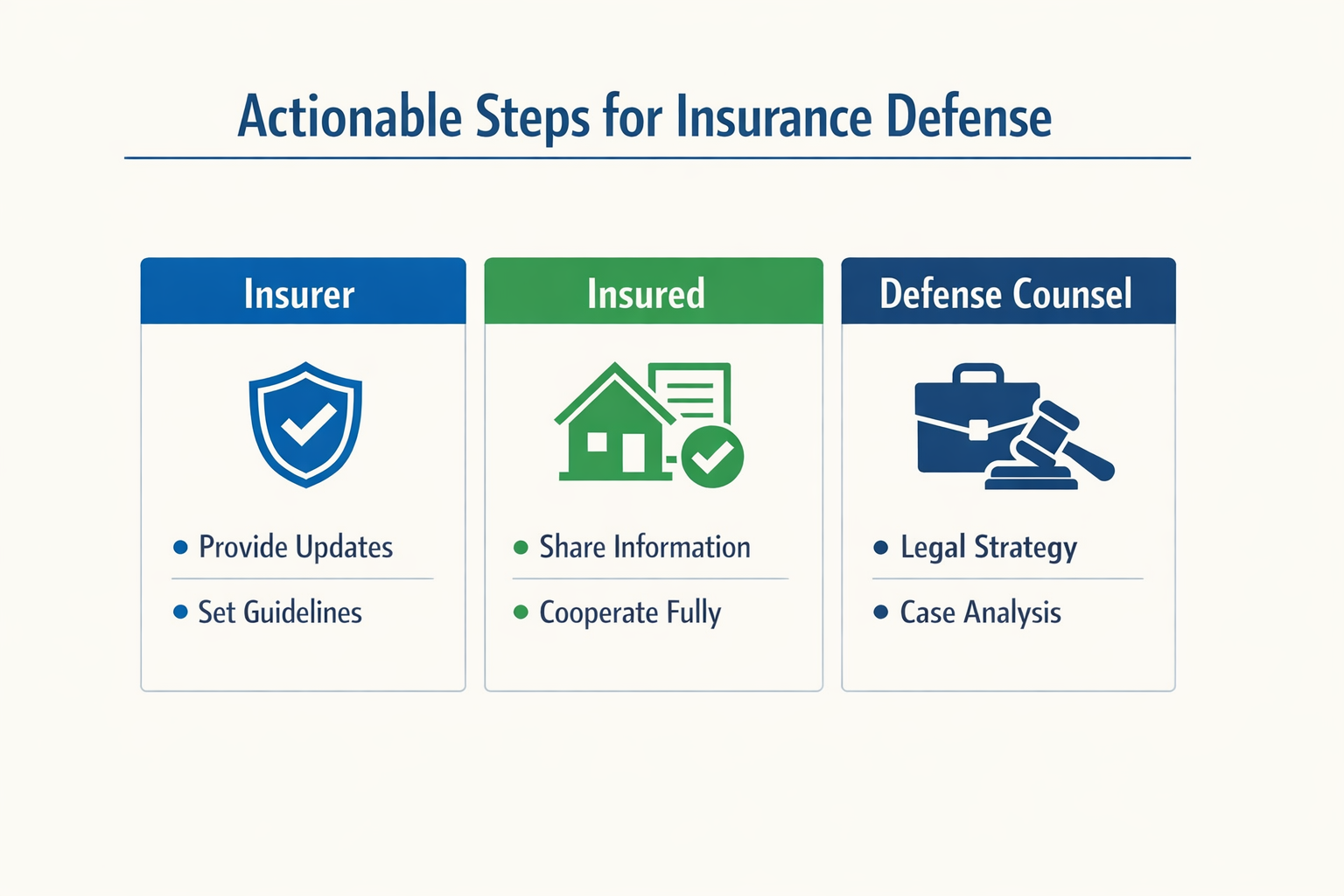
Managing the tripartite relationship in insurance defense requires clear protocols at each stage of representation. The insurer, the insured, and defense counsel each hold distinct responsibilities, and the relationship functions smoothly only when all three parties understand their obligations and communicate effectively. These steps outline the practical mechanics of that coordination.
Step 1: Establish the Scope of the Defense Obligation
The insurer's duty to defend arises from the policy language and the allegations in the complaint. Before appointing counsel, the insurer reviews the claim to determine whether the policy provisions impose a duty to defend. If coverage is clear and no conflict of interest exists, the insurer assigns panel counsel to represent the insured. The insured receives notice of the appointment and the name of the assigned attorney.
When the insurer reserves rights on a coverage issue, the analysis shifts. Cal. Civ. Code § 2860, subd. (b) states that a conflict of interest may exist when the insurer reserves its rights on a given issue and the outcome of that coverage issue can be controlled by counsel first retained by the insurer. In that circumstance, the insurer must evaluate whether independent counsel is required under subdivision (a).
Step 2: Determine Whether Independent Counsel Is Required
If a conflict of interest arises that creates a duty to provide independent counsel, the insurer must offer that option to the insured. Cal. Civ. Code § 2860, subd. (a) requires the insurer to provide independent counsel unless the insured expressly waives, in writing, the right to independent counsel at the time the insured is informed that a possible conflict may arise or does exist. The insurance contract may set forth the method of selecting that counsel, but the selection process must be consistent with the statute.
The insured who selects independent counsel takes an active role in choosing the attorney. The insurer typically provides a list of qualified counsel or approves the insured's proposed choice. Once independent counsel is retained, that attorney owes undivided loyalty to the insured, not to the insurer.
Step 1
Notify the insured of the conflict
The insurer must inform the insured in writing that a conflict of interest exists or may exist, and that the insured has the right to select independent counsel. The notice should specify the nature of the conflict and the insured's options.
Step 2
Obtain the insured's written response
The insured either selects independent counsel or waives the right to independent counsel in writing. The waiver must be express and knowing. If the insured selects independent counsel, the insurer and the insured agree on the selection method and the chosen attorney.
Step 3: Coordinate Information Sharing and Litigation Strategy
Once counsel is appointed — whether panel counsel or independent counsel — the tripartite relationship requires ongoing coordination. Cal. Civ. Code § 2860, subd. (d) imposes a duty on independent counsel and the insured to disclose to the insurer all information concerning the action except privileged materials relevant to coverage disputes, and to timely inform and consult with the insurer on all matters relating to the action. This disclosure obligation ensures the insurer remains informed of the litigation's progress and can fulfill its own obligations under the policy.
When both insurer-provided counsel and independent counsel are involved, subdivision (f) requires that both counsel be allowed to participate in all aspects of the litigation. The two counsel must cooperate fully in the exchange of information, consistent with each counsel's ethical and legal obligation to the insured. The statute does not relieve the insured of the duty to cooperate with the insurer under the terms of the insurance contract.
Counsel shall cooperate fully in the exchange of information that is consistent with each counsel's ethical and legal obligation to the insured.
Practically, this means regular case updates, shared discovery, and joint strategy discussions. Defense counsel — whether panel or independent — submits invoices through the insurer's e-billing portal, adhering to the carrier's outside counsel guidelines. The insured monitors the defense and communicates with both counsel and the insurer about settlement authority, trial strategy, and any developments that could affect coverage.
Step 4: Manage Billing and Fee Disputes
The insurer pays the fees of defense counsel, subject to the policy limits and the reasonableness standard. When independent counsel is retained under section 2860, the insurer remains responsible for the fees, but the insured's selection of counsel may affect the billing review process. The insurer applies its outside counsel guidelines to the invoices, and any reductions or disputes are addressed through the appeal path established by the carrier.
Defense counsel must submit time entries that comply with billing increment requirements, avoid block billing, and provide narrative detail sufficient for the bill reviewer to understand the work performed. The insured has an interest in ensuring that fee disputes do not delay or compromise the defense, and may intervene if the insurer's billing reductions create a conflict with counsel's ability to provide an adequate defense.
Tips and Tricks for Effective Insurance Defense
The tripartite relationship works smoothly when each party understands its obligations and the friction points that routinely emerge. Panel counsel, independent counsel and insureds who anticipate common issues avoid the disputes that delay settlements and trigger reduction codes.
Cooperation Between Counsel Is Not Optional
Cal. Civ. Code § 2860, subd. (f) states that where the insured selects independent counsel, both the counsel provided by the insurer and independent counsel selected by the insured shall be allowed to participate in all aspects of the litigation. Counsel shall cooperate fully in the exchange of information that is consistent with each counsel's ethical and legal obligation to the insured. The statute does not make cooperation a courtesy — it is a duty.
Panel counsel and independent counsel often clash over discovery strategy, motion practice and settlement posture. The insurer pays both, but each lawyer owes undivided loyalty to the insured. That structure invites parallel work, duplicated billing and inconsistent positions unless the attorneys coordinate early and often.
Disclosure Duties Run to the Insurer
Cal. Civ. Code § 2860, subd. (d) imposes a duty on independent counsel and the insured to disclose to the insurer all information concerning the action except privileged materials relevant to coverage disputes, and timely to inform and consult with the insurer on all matters relating to the action. Any claim of privilege asserted is subject to in camera review in the appropriate law and motion department of the superior court.
Independent counsel who withhold case developments from the carrier risk a coverage dispute over whether the insured breached the cooperation clause. The insured who believes disclosure will harm a coverage position may assert privilege, but that assertion is reviewable. The safer course is to disclose facts and reserve privilege claims for true attorney-client communications that bear on coverage, not liability.
Any information disclosed by the insured or by independent counsel is not a waiver of the privilege as to any other party.
Settlement Authority and Communication Breakdowns
In the Cumis case, the insurer authorized panel counsel to make an offer at the settlement conference in an amount lower than the plaintiff's demand. Panel counsel did not contact the insured before or during the settlement conference, but informed the insured about the conference afterward. That sequence — settlement negotiation without real-time insured input — is a recurring source of bad-faith claims.
When the insurer reserves rights or the claim exceeds policy limits, the insured has a direct financial interest in the settlement figure. Defense counsel who negotiate without clearing authority from both the carrier and the insured create exposure for everyone. Best practice: confirm settlement parameters in writing with both parties before any conference, and update both parties immediately if the demand or offer changes.
Billing Practices That Reduce Friction
Carrier outside counsel guidelines govern narrative detail, billing increments and block billing prohibitions. Independent counsel are not exempt from these requirements simply because Civil Code section 2860 entitles them to reasonable fees. Carriers review independent counsel invoices with the same reduction codes they apply to panel counsel, and block billing triggers the same write-downs.
Timekeepers should enter fees contemporaneously, use separate line items for distinct tasks, and include enough factual detail that a bill reviewer can match the entry to a document or a hearing without guessing. The fact that the insurer must pay reasonable fees does not eliminate the carrier's right to verify that the billed work was reasonable.
Conclusion
The tripartite relationship in insurance defense — insurer, insured, and defense counsel — creates a structure that serves all three parties when each understands its role and obligations. The insurer funds the defense and selects counsel, the insured receives representation without direct cost, and defense counsel owes undivided loyalty to the insured while the insurer pays the bill. That arrangement works cleanly when coverage is undisputed and the insurer's interests align with the insured's.
Conflicts emerge when those interests diverge. A reservation of rights, a coverage dispute over punitive damages, or a claim that falls partly outside the policy can place counsel in the position of serving an insured whose best defense might undermine the insurer's coverage position. California recognised this tension in San Diego Navy Federal Credit Union v. Cumis Insurance Society, holding that when an insurer reserves rights, the insured is entitled to independent counsel paid by the insurer. The development of facts in the underlying action affects the coverage question, and an attorney paid by the insurer cannot be expected to develop those facts against the insurer's interest.
Understanding these dynamics matters for every participant. Insurers must recognise when a conflict requires independent counsel and must structure their outside counsel guidelines to accommodate that arrangement. Insureds must know when to assert the right to independent counsel and how to document the conflict. Defense counsel must identify conflicts early, communicate them clearly, and withdraw or seek guidance when loyalty to the insured cannot be reconciled with the insurer's interests. For more on how billing requirements apply when independent counsel submits invoices, see Block Billing: Reasons for Carrier Rejections and Solutions.
The tripartite relationship is not a formality. It is a legal structure with defined duties, enforceable rights, and real consequences when any party missteps. Treat it that way, and the arrangement serves everyone. Ignore it, and the conflicts that were always latent become disputes that no one benefits from fighting.