


What Is Insurance Defense? Understanding the Tripartite Relationship
Introduction to Insurance Defense
Insurance defense exists at the intersection of contract, tort, and professional responsibility. When an insured party faces a lawsuit alleging conduct potentially covered by a liability policy, the insurer steps in to provide a defense. That defense obligation — rooted in the insurance contract — creates a three-party arrangement unlike any other attorney-client relationship in practice.
The insured is the defendant in the underlying lawsuit and the named client of defense counsel. The insurer pays for that defense and retains the right to select counsel, subject to the insured's approval. Defense counsel owes professional duties to the insured but submits invoices to the insurer and follows the insurer's outside counsel guidelines. When the insurer accepts the defense without reservation, this arrangement functions smoothly. When the insurer reserves its rights to later deny coverage, the structure fractures.
The 1987 California Court of Appeal decision in San Diego Navy Federal Credit Union v. Cumis Insurance Society, 162 Cal.App.3d 358, established that a reservation of rights creates a conflict requiring independent counsel paid by the insurer. The court rejected the insurer's argument that no conflict exists merely because the coverage question is not adjudicated in the underlying lawsuit. Defense counsel's conduct in the third-party case — how facts are developed, what admissions are made, which theories are pursued — directly affects the later coverage dispute. That dual impact is the conflict.
Under section 2860, subdivision (f), both insurer-provided counsel and independent counsel may participate in all aspects of the litigation, and both must cooperate fully in exchanging information consistent with their ethical obligations to the insured. The insured retains the duty to cooperate with the insurer under the insurance contract, and independent counsel must disclose all non-privileged information relevant to the action. This structure preserves the insurer's financial interest while protecting the insured's right to conflict-free representation.
The tripartite relationship shapes every invoice submitted in insurance defense work. Panel counsel must follow the carrier's outside counsel guidelines on block billing, narrative detail, and billing increments. Independent counsel — often called Cumis counsel in California — submits invoices under the same guidelines but answers to the insured on strategy and the insurer only on reasonableness of fees. When a line item states "research and draft motion in limine, 4.2," the carrier's bill reviewer reads it through the lens of guideline compliance, not trial tactics. The attorney's duty runs to the insured; the fee obligation runs to the insurer. That split defines insurance defense billing.
Understanding the Tripartite Relationship
The tripartite relationship in insurance defense involves three parties: the insured, the insurer, and defense counsel. Each party has distinct obligations and interests that must align during litigation, yet inherent tensions arise when those interests diverge. The insured wants full protection from liability. The insurer wants to minimize exposure and preserve coverage defenses. Defense counsel owes a duty of loyalty to the insured while the insurer pays the bills.
When Conflicts of Interest Emerge
A conflict of interest arises when the insurer reserves its rights to deny coverage while simultaneously directing the defense. Under Cal. Civ. Code § 2860, subd. (b), a conflict exists when the insurer reserves rights on an issue and the outcome of that coverage issue can be controlled by counsel first retained by the insurer. The statute clarifies that a conflict does not exist solely because the insured is sued for an amount exceeding policy limits, nor does it exist as to allegations for which the insurer denies coverage outright.
In San Diego Navy Federal Credit Union v. Cumis Insurance Society, 162 Cal.App.3d 358, page 363, paragraph 10, part 1, the court recognized that what defense attorney does in the third-party suit impacts the coverage case, because coverage depends on the development of facts in the underlying action. The insurer-selected attorney, paid by the carrier, controls that fact development. The court held that this presents a conflict requiring independent counsel paid by the insurer.
The Independent Counsel Right
When a conflict of interest exists, Cal. Civ. Code § 2860, subd. (a) requires the insurer to provide independent counsel to represent the insured, unless the insured expressly waives that right in writing. Independent counsel—often called Cumis counsel—is selected by the insured but paid by the insurer. This arrangement preserves the insured's right to counsel whose loyalty is undivided.
Once independent counsel is retained, Cal. Civ. Code § 2860, subd. (d) imposes a duty on that counsel and the insured to disclose all information concerning the action to the insurer, except privileged materials relevant to coverage disputes. The insured and independent counsel must inform and consult with the insurer on all matters relating to the action. Any claim of privilege is subject to in camera review.
Both the counsel provided by the insurer and independent counsel selected by the insured shall be allowed to participate in all aspects of the litigation.
Under Cal. Civ. Code § 2860, subd. (f), both insurer-provided counsel and independent counsel participate in all aspects of the litigation. Counsel must cooperate fully in exchanging information consistent with each counsel's ethical and legal obligations to the insured. The insured retains the duty to cooperate with the insurer under the insurance contract.
Reservation of Rights and Its Practical Effect
When an insurer sends a reservation-of-rights letter, it signals that coverage may not exist for some or all claims. The insurer agrees to defend under a reservation, meaning it will pay defense costs now but may later disclaim coverage and refuse to pay a judgment. This creates immediate friction: the insured needs a defense that protects against personal liability, while the insurer's coverage counsel may prefer a defense strategy that narrows the factual record to support a later coverage denial.
For billing and outside counsel guidelines, this dynamic matters. If independent counsel is retained, the insurer remains obligated to pay reasonable fees, but the carrier will scrutinize invoices under its panel guidelines. Disputes over block billing and narrative detail often intensify when independent counsel submits invoices, because the insurer has less direct oversight of the defense and may be more aggressive in exercising bill review.
Cooperation Duties and Information Flow
The tripartite relationship depends on information flow. The insurer needs timely notice of developments in the underlying case to evaluate coverage and reserve accurately. Defense counsel needs direction on settlement authority and coverage positions to advise the insured. The insured needs transparent communication about what the policy covers and what personal exposure remains.
Cal. Civ. Code § 2860, subd. (d) codifies these duties when independent counsel is involved, but the same principles apply in standard panel-counsel representations. Counsel must keep the insurer informed, and the insurer must provide the insured with clear guidance on coverage and defense strategy. When any party withholds information or acts solely in its own interest, the relationship breaks down and disputes follow.
Steps to Navigate the Tripartite Relationship
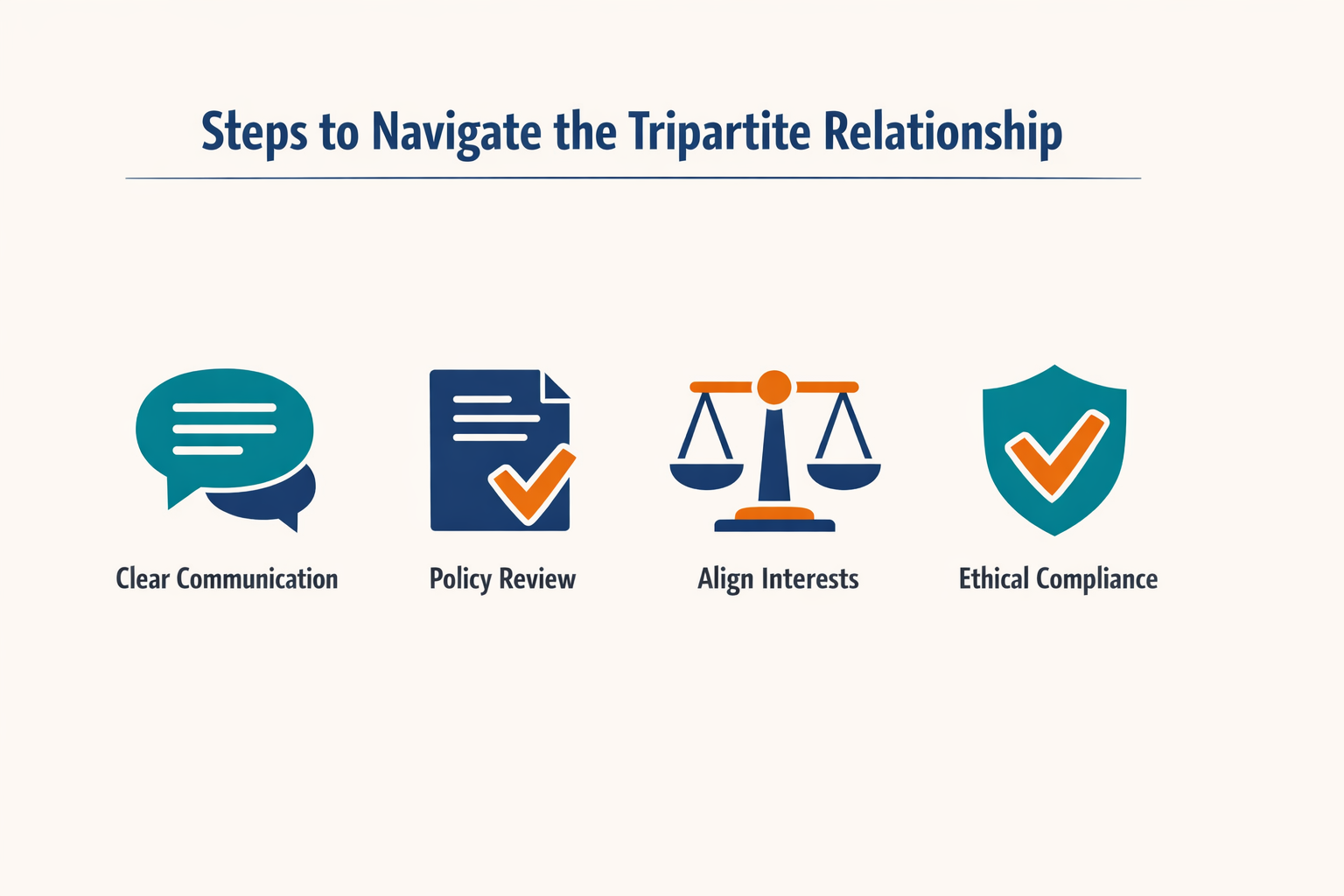
Managing the tripartite relationship in insurance defense requires deliberate coordination at each stage of a claim. The insured, the insurer, and defense counsel each hold distinct responsibilities, and the relationship functions only when all three parties fulfill their obligations and communicate effectively. The steps below outline the procedural framework that keeps the relationship intact and reduces the risk of ethical conflicts or coverage disputes.
Step 1: Establish the Scope of Representation and Confirm Coverage Positions
Step 1
Establish the Scope of Representation and Confirm Coverage Positions
When the insurer accepts the defense, it must state whether it is defending under a reservation of rights. If the insurer reserves its right to deny coverage at a later date, a conflict of interest may arise that triggers the insured's right to independent counsel. Cal. Civ. Code § 2860, subd. (b) provides that a conflict exists when the insurer reserves its rights on a given issue and the outcome of that coverage issue can be controlled by counsel first retained by the insurer. Defense counsel must understand the coverage position from the outset, and the insured must be informed in writing of any reservation of rights and the option to select independent counsel.
The insurer's reservation-of-rights letter is not a formality. It defines whether the insured may select independent counsel at the insurer's expense. Under Cal. Civ. Code § 2860, subd. (a), the insurer must provide independent counsel when a conflict of interest arises, unless the insured expressly waives that right in writing. The waiver must conform to the language specified in subdivision (e), and the insured must be advised and informed of the right to select independent counsel before signing.
Step 2: Coordinate Counsel Participation and Information Sharing
Step 2
Coordinate Counsel Participation and Information Sharing
When independent counsel is selected, both the counsel provided by the insurer and the independent counsel selected by the insured are allowed to participate in all aspects of the litigation. Cal. Civ. Code § 2860, subd. (f) requires that counsel cooperate fully in the exchange of information consistent with each counsel's ethical and legal obligations to the insured. The insured retains the duty to cooperate with the insurer under the terms of the insurance contract, and that duty is not relieved by the involvement of independent counsel.
Defense counsel and independent counsel must establish a working protocol early in the case. This includes joint participation in discovery, motion practice, and settlement discussions. The statute does not assign one counsel a superior role; both participate fully, and both owe their loyalty to the insured. Information sharing must respect privilege, but the insured and independent counsel have a statutory duty under subdivision (d) to disclose to the insurer all information concerning the action except privileged materials relevant to coverage disputes.
Step 3: Disclose Information and Preserve Privilege on Coverage Issues
Step 3
Disclose Information and Preserve Privilege on Coverage Issues
Cal. Civ. Code § 2860, subd. (d) requires the insured and independent counsel to disclose to the insurer all information concerning the action except privileged materials relevant to coverage disputes. Any claim of privilege is subject to in camera review in the appropriate law and motion department of the superior court. Information disclosed by the insured or by independent counsel does not waive the privilege as to any other party. This framework allows the insured to protect coverage-related communications while still fulfilling the duty to keep the insurer informed about the litigation.
The disclosure obligation is not optional. Independent counsel must timely inform and consult with the insurer on all matters relating to the action, and the insured must cooperate in providing facts, documents, and case updates. The privilege carve-out is narrow: it applies only to materials relevant to coverage disputes. Everything else must be shared. If the insurer believes information is being improperly withheld, it may seek in camera review, and the court will determine whether the privilege applies.
Step 4: Manage Settlement Authority and Policy-Limit Exposure
Settlement decisions in insurance defense involve all three parties, and the insurer's financial interest in staying within policy limits does not eliminate the insured's exposure to excess liability. When the insurer reserves rights or denies coverage for certain claims, the insured faces the risk that a judgment will exceed the policy limits or fall outside coverage altogether. Defense counsel must communicate settlement offers to both the insurer and the insured, and the insured must be consulted before the insurer rejects a demand within policy limits.
In San Diego Navy Federal Credit Union v. Cumis Insurance Society, 162 Cal.App.3d 358, page 363, the insurer authorized defense counsel to make a settlement offer lower than the plaintiff's demand without contacting the insured before or during the settlement conference. The court found that this created a conflict of interest, because the insurer's decision to settle or proceed to trial could affect coverage and expose the insured to excess liability. The insured's participation in settlement discussions is not a courtesy; it is a structural requirement of the tripartite relationship.
For detailed guidance on how billing practices intersect with outside counsel guidelines in insurance defense, see Block Billing: Reasons for Carrier Rejections and Solutions.
Tips for Effective Insurance Defense Management
Managing the tripartite relationship requires discipline at every stage. The insurer pays for the defense, the insured faces the exposure, and counsel owes duties to both — but those duties are not identical. Effective management means keeping all three parties aligned on the facts, the strategy, and the budget without blurring the lines that statute and ethics draw between them.
Establish Clear Communication Protocols Early
Cal. Civ. Code section 2860, subdivision (d) requires independent counsel and the insured to disclose all information concerning the action to the insurer, except privileged materials relevant to coverage disputes. That disclosure obligation runs both ways: counsel must inform and consult with the insurer on all matters relating to the action. Set up a regular reporting cadence — weekly status emails, monthly narrative summaries, immediate notice of any settlement demand or coverage-relevant development. When the insurer knows what is happening in real time, disputes over billing or strategy are less likely to escalate.
Coordinate When Both Panel and Independent Counsel Are Involved
Cal. Civ. Code section 2860, subdivision (f) provides that where the insured selects independent counsel, both the counsel provided by the insurer and independent counsel shall be allowed to participate in all aspects of the litigation. Counsel must cooperate fully in the exchange of information consistent with each counsel's ethical and legal obligation to the insured. In practice, this means joint case conferences, shared work product where no privilege conflict exists, and advance notice before filing any motion or making any offer. The statute does not relieve the insured of the duty to cooperate with the insurer under the terms of the insurance contract, so counsel cannot use the conflict as a reason to withhold non-privileged case developments.
Monitor Billing Practices to Avoid Unnecessary Reductions
Panel counsel and independent counsel alike must comply with the carrier's outside counsel guidelines. Most guidelines prohibit block billing, require tenth-of-an-hour increments, and demand narrative detail sufficient to let a reviewer understand what work was done and why it was necessary. When independent counsel submits invoices that violate those standards, the insurer will reduce the bill — and the insured may face a coverage dispute over whether the full amount was reasonable. Review every invoice before submission, compare it to the guideline, and fix any block entries or vague narratives before the portal flags them.
It is the duty of independent counsel and the insured to disclose to the insurer all information concerning the action except privileged materials relevant to coverage disputes.
Separate Coverage Analysis from Liability Defense
In San Diego Navy Federal Credit Union v. Cumis Insurance Society, 162 Cal.App.3d 358, page 363, the court noted that what the defense attorney does in the third party case impacts the coverage case, because the questions of coverage depend on the development of facts in the third party case. When counsel is handling both the defense and advising on coverage, the risk of a conflict is high. Best practice: assign coverage analysis to separate coverage counsel or to the insurer's in-house team, and keep defense counsel focused on the merits of the underlying claim. If defense counsel must address a coverage issue, document the potential conflict and obtain the insured's informed written consent.
Preserve the Insured's Right to Participate in Settlement
The Cumis decision describes a settlement conference in which the insurer authorized defense counsel to make an offer lower than the claimant's demand, but counsel did not contact the insured before or during the conference. That failure to consult can expose both the insurer and counsel to bad faith claims if the case later settles above policy limits. Before any settlement discussion, confirm in writing that the insured has been informed of the demand, the offer, and the risks of non-settlement. If the insured wants to contribute personal funds to settle within limits, document that offer and the insurer's response.
Conclusion on Insurance Defense and Its Importance
The tripartite relationship is not a theoretical construct. It shapes every invoice submitted, every guideline applied, and every fee dispute that reaches a coverage declaration. When an insurer provides counsel under a reservation of rights, the insured's interests and the carrier's coverage position do not always align, and the billing record becomes part of the coverage record.
Understanding insurance defense means recognizing that the relationship is governed by statute, case law, and contract. In California, Civil Code section 2860 codifies the insured's right to independent counsel when a conflict of interest arises, and it imposes disclosure obligations on that counsel that do not exist in a standard attorney-client engagement. The duty to inform and consult with the insurer under Cal. Civ. Code § 2860, subd. (d) runs parallel to the duty of loyalty to the insured, and navigating that dual obligation requires precision in both litigation conduct and fee documentation.
Panel counsel, independent counsel, and bill reviewers all operate within the same framework. The insurer funds the defense, the insured directs strategy on covered claims, and defense counsel must serve the insured's interests while meeting the carrier's documentation and cost-control requirements. When those requirements conflict with the insured's litigation needs, the conflict must be disclosed and managed, not papered over in a narrative or buried in a block entry.
For timekeepers submitting invoices under outside counsel guidelines, the lesson is straightforward: the guideline is part of the retention agreement, and compliance is not optional. A reduction for block billing or an increment violation is not a bill-review error—it is the enforcement of a term the firm accepted when it took the assignment. For more on how carriers evaluate and reject invoices, see our guide to block billing and carrier rejections.
The tripartite relationship endures because it balances competing interests under a duty to defend. Understanding it means understanding the limits of each party's authority, the disclosure obligations that accompany a reservation of rights, and the documentation standards that make a defense both defensible and auditable. That understanding is not ancillary to insurance defense practice—it is the foundation.