


What Is Insurance Defense? The Tripartite Relationship Explained
Introduction
When an insurer agrees to defend a liability claim, three parties enter a relationship that shapes every aspect of the defense, from strategy to billing increments and narrative detail. The insurer pays for the defense and controls the purse strings. The insured faces the lawsuit and potential personal exposure. Defense counsel represents the insured but takes direction and payment from the insurer. This arrangement, known as the tripartite relationship, works smoothly when all three parties' interests align — but that alignment is not guaranteed.
California Civil Code section 2860, subdivision (a) requires the insurer to provide independent counsel to the insured when a conflict of interest arises, unless the insured waives that right in writing. A conflict does not exist solely because the insured is sued for an amount exceeding policy limits, nor does it exist as to allegations for which the insurer denies coverage outright. However, when an insurer reserves its rights on a coverage issue and the outcome of that issue can be controlled by counsel the insurer first retained, a conflict may exist.
The mechanics of this relationship govern not only who directs the defense, but also how invoices are submitted, what outside counsel guidelines apply, and whether a reduction code will attach to a given line item. When independent counsel is selected under section 2860, subdivision (d), that counsel and the insured must disclose all non-privileged information to the insurer and consult on all matters relating to the action. Subdivision (f) permits both insurer-provided counsel and independent counsel to participate in all aspects of the litigation, and it preserves the insured's duty to cooperate under the insurance contract.
Understanding these obligations is not academic. A timekeeper who fails to grasp the distinction between insurer-directed defense and independent-counsel defense may submit invoices to the wrong portal, cite the wrong matter number, or apply a staffing ratio that does not match the retention letter. The tripartite relationship is the framework within which every LEDES file, every UTBMS task code, and every appeal of a write-down operates.
Problem Statement
The tripartite relationship in insurance defense creates structural conflicts that no procedural rule fully resolves. The insurer pays for the defense, the insured faces personal exposure above policy limits, and defense counsel owes undivided loyalty to the insured while the insurer controls the purse. When the insurer reserves its right to deny coverage, the arrangement fractures — counsel retained and paid by the carrier must defend claims the carrier may later refuse to cover.
Cal. Civ. Code § 2860, subd. (b) states that a conflict of interest may exist "when an insurer reserves its rights on a given issue and the outcome of that coverage issue can be controlled by counsel first retained by the insurer for the defense of the claim." The statute carves out punitive damages and excess exposure as non-conflicts, but reservation letters routinely invoke coverage defenses tied to the merits: intentional conduct exclusions, scope-of-employment disputes, and policy-period questions that turn on facts developed during discovery. Counsel's strategic choices — which witnesses to depose, which defenses to plead, how aggressively to contest liability — can foreclose or preserve the insurer's coverage position.
The Cumis Conflict
In San Diego Navy Federal Credit Union v. Cumis Insurance Society, 162 Cal.App.3d 358, page 363, the court rejected the insurer's argument that no conflict exists because the third-party lawsuit does not adjudicate coverage. The court reasoned that "what the defense attorney in the third party case does impacts the coverage case, in that, the questions of coverage depends on the development of facts in the third party case and their proper development is left to the attorney paid for by the Carrier." When the carrier reserves rights and appoints counsel, that counsel faces divided incentives: vigorous defense of the insured may generate facts that trigger coverage, while a more cautious strategy may preserve the insurer's denial.
Disclosure and Privilege Tensions
Cal. Civ. Code § 2860, subd. (d) requires independent counsel and the insured to "disclose to the insurer all information concerning the action except privileged materials relevant to coverage disputes." The statute creates a carve-out for privilege, but determining what is "relevant to coverage disputes" in real time is a judgment call. Defense counsel must share work product and case strategy with the insurer to justify billing, yet the insurer may later use that same information to deny coverage based on facts counsel developed. The insured's cooperation duty under the policy runs in parallel, creating overlapping but not identical disclosure obligations.
The statutory framework attempts to manage these tensions through independent counsel rights, but it does not eliminate them. For more on how billing detail requirements interact with these disclosure duties, see Block Billing: Reasons for Carrier Rejections and Solutions. The insurer funds the defense, reviews the invoices, and evaluates the case for settlement or coverage denial — all while counsel's ethical duty runs exclusively to the insured. That triangle does not resolve itself; it requires active management at every decision point.
Solution Steps
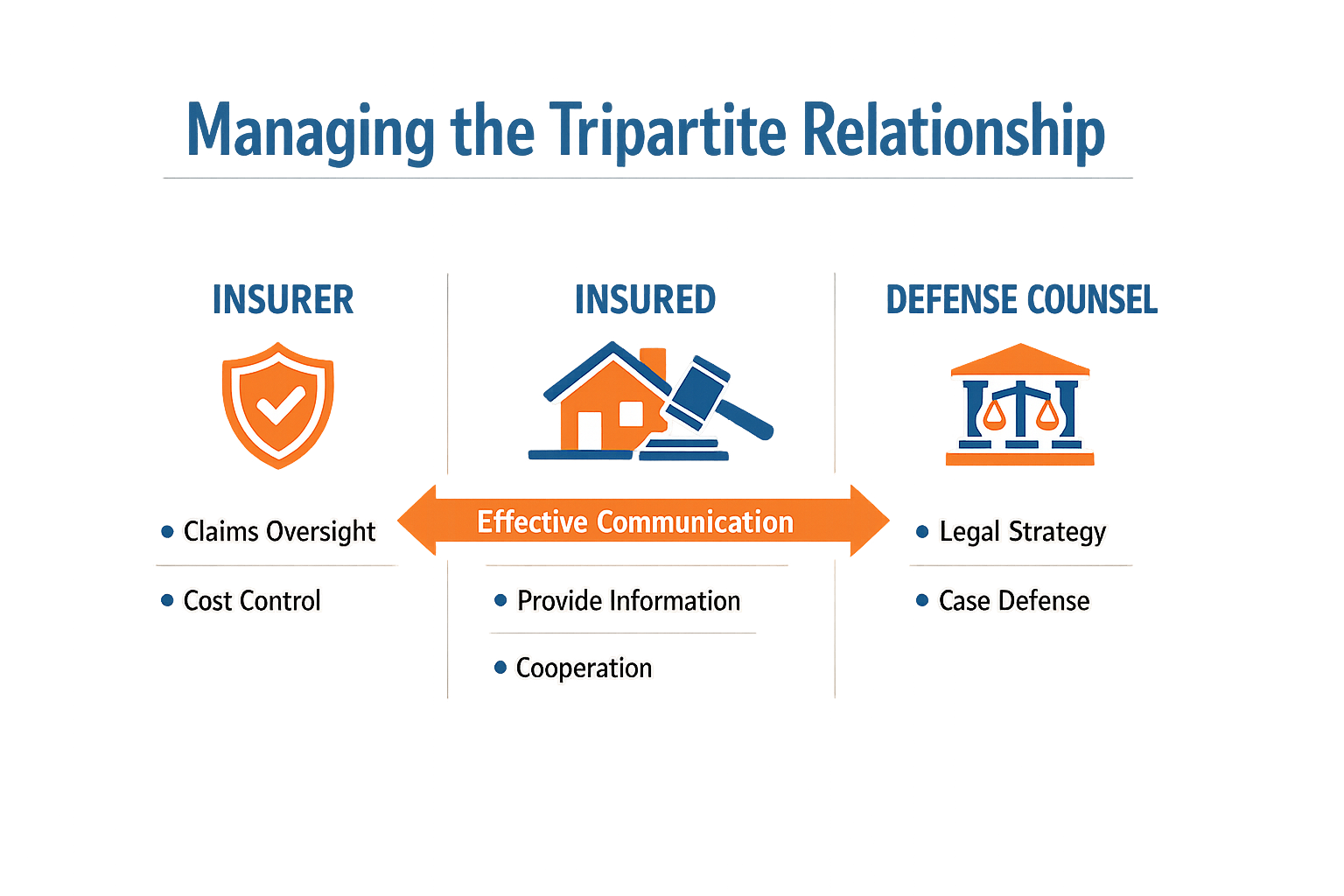
Managing the tripartite relationship requires structured procedures that align the insurer's duty to defend, the insured's right to control the defense, and counsel's ethical obligations. The following steps address the mechanics of that alignment when a conflict of interest arises or when the insurer reserves rights on coverage.
Step 1
Identify whether a conflict of interest exists
Cal. Civ. Code § 2860, subd. (b) states that a conflict of interest may exist when an insurer reserves its rights on a given issue and the outcome of that coverage issue can be controlled by counsel first retained by the insurer for the defense of the claim. The statute also provides that no conflict shall be deemed to exist solely because an insured is sued for an amount in excess of policy limits. When the insurer denies coverage for certain allegations or facts, no conflict exists as to those allegations. Evaluate the reservation letter and the complaint together to determine whether counsel's tactical decisions could influence a coverage determination.
Step 2
Inform the insured of the right to independent counsel
When a conflict of interest arises, Cal. Civ. Code § 2860, subd. (a) requires the insurer to provide independent counsel to represent the insured unless the insured expressly waives that right in writing at the time the insured is informed that a possible conflict may arise or does exist. The notice must be clear and contemporaneous with the conflict disclosure. The waiver, if executed, must follow the statutory form set out in subdivision (e): "I have been advised and informed of my right to select independent counsel to represent me in this lawsuit. I have considered this matter fully and freely waive my right to select independent counsel at this time. I authorize my insurer to select a defense attorney to represent me in this lawsuit." Anything short of that language does not satisfy the statute.
Step 3
Select independent counsel or accept the insurer's panel counsel
If the insured does not waive the right to independent counsel, the insured selects counsel. The insurance contract may contain a provision setting forth the method of selecting that counsel, but the ultimate choice rests with the insured when a conflict exists. Once independent counsel is selected, that counsel and the insured must disclose to the insurer all information concerning the action except privileged materials relevant to coverage disputes, and must timely inform and consult with the insurer on all matters relating to the action, per Cal. Civ. Code § 2860, subd. (d). Any claim of privilege asserted is subject to in camera review. Information disclosed by the insured or by independent counsel does not waive the privilege as to any other party.
Step 4
Coordinate participation of both counsel when independent counsel is retained
When the insured selects independent counsel, both the counsel provided by the insurer and independent counsel selected by the insured are allowed to participate in all aspects of the litigation, according to Cal. Civ. Code § 2860, subd. (f). Counsel must cooperate fully in the exchange of information that is consistent with each counsel's ethical and legal obligation to the insured. The insured remains obligated to cooperate with the insurer under the terms of the insurance contract. This dual-counsel arrangement requires clear communication protocols, shared access to discovery and pleadings, and advance notice of settlement conferences and strategic decisions.
Practical application in a reservation-of-rights scenario
The decision in San Diego Navy Federal Credit Union v. Cumis Insurance Society, 162 Cal.App.3d 358, illustrates the conflict that arises when an insurer reserves rights. In that case, the insurer accepted the defense and retained counsel for the insureds but reserved the right to deny coverage and disclaimed any coverage for punitive damages. The insurer's associate counsel informed the retained law firm that it was to represent the insureds as to all claims, including punitive damages, but that the policies did not cover punitive damages. The court concluded that under these circumstances there is a conflict of interest between the insurer and the insured, and therefore the insured has a right to independent counsel paid for by the insurer.
When an insurer authorizes panel counsel to make a settlement offer below the claimant's demand without consulting the insured, as occurred in the Cumis case, the insured's exposure to excess liability becomes a live issue. The insured's independent counsel can advocate for a higher settlement offer within policy limits, while the insurer's counsel may be constrained by the insurer's coverage position. Coordination between both counsel ensures that the insured's interests are protected and that the insurer receives the cooperation and information to which it is entitled under the policy.
For outside counsel navigating these steps, the billing and reporting obligations remain subject to the insurer's outside counsel guidelines. Block billing and vague narratives that obscure the work performed by independent counsel versus panel counsel will trigger reductions, even when the underlying representation is sound.
Tips and Tricks
The tripartite relationship functions smoothly when all three parties understand their obligations and communicate openly. Outside counsel and insurers who treat the structure as a compliance checklist miss the point — the arrangement exists to protect the insured while managing the claim efficiently. The following practices keep the relationship healthy and reduce friction before it becomes a dispute.
Disclose Coverage Issues Early
When an insurer identifies a potential coverage defense, immediate disclosure to the insured prevents later allegations of surprise or concealment. Cal. Civ. Code § 2860, subd. (b) states that a conflict of interest may exist when an insurer reserves its rights on a given issue and the outcome of that coverage issue can be controlled by counsel first retained by the insurer for the defense of the claim. Sending a reservation-of-rights letter at the outset establishes the record and triggers the insured's right to select independent counsel if a conflict arises. Waiting until discovery closes or settlement negotiations begin invites bad-faith claims and undermines the defense.
Maintain Open Lines of Communication
Counsel selected by the insured under section 2860 has a statutory duty to disclose to the insurer all information concerning the action except privileged materials relevant to coverage disputes, and to timely inform and consult with the insurer on all matters relating to the action. This is not a courtesy; it is a requirement. Regular status reports, advance notice of depositions and motions, and consultation before major litigation decisions keep the insurer informed without waiving privilege. When independent counsel withholds case updates or makes strategic choices without input, the insurer loses visibility into the claim and the insured's cooperation obligation suffers.
Any information disclosed by the insured or by independent counsel is not a waiver of the privilege as to any other party.
That statutory protection allows counsel to share case developments with the insurer without opening the door to third-party discovery. Use it.
Coordinate When Both Panel and Independent Counsel Are Involved
Section 2860, subdivision (f) requires that both the counsel provided by the insurer and independent counsel selected by the insured be allowed to participate in all aspects of the litigation, and that counsel cooperate fully in the exchange of information consistent with each counsel's ethical and legal obligation to the insured. In practice, this means joint defense meetings, shared work product where privilege permits, and a division of labor that avoids duplicative billing. One lawyer attends the deposition; the other reviews the transcript. One drafts the motion; the other reviews and edits. The insurer pays for the defense once, not twice.
Failure to coordinate creates tension and inflates costs. If panel counsel and independent counsel both attend every hearing and duplicate every task, the insurer will reduce invoices and the insured will question whether anyone is managing the case efficiently. A case-management plan agreed upon at the outset — who handles discovery, who takes depositions, who drafts dispositive motions — prevents overlap and keeps the defense on track. For more on billing practices that support this coordination, see Block Billing: Reasons for Carrier Rejections and Solutions.
Document the Insured's Waiver if One Is Given
An insured may waive the right to select independent counsel, but the waiver must be in writing and must follow the form specified in section 2860, subdivision (e). A verbal agreement or an email saying "go ahead and appoint someone" does not satisfy the statute. The insured must sign a statement that includes the language: "I have been advised and informed of my right to select independent counsel to represent me in this lawsuit. I have considered this matter fully and freely waive my right to select independent counsel at this time. I authorize my insurer to select a defense attorney to represent me in this lawsuit." Anything short of that exact formulation leaves the waiver open to challenge.
When an insurer secures a compliant waiver, it should be filed with the claim file and referenced in the engagement letter to panel counsel. If the insured later asserts a conflict, the signed waiver is the insurer's first line of defense.
Conclusion
The tripartite relationship in insurance defense places distinct responsibilities on each party while binding them to a common objective: the defense of the claim. The insurer funds the defense and selects counsel, the insured cooperates and provides information, and defense counsel owes undivided loyalty to the insured. When all three parties understand their roles and communicate openly, the relationship functions as intended.
Conflicts arise when coverage issues overlap with the factual development of the underlying case. Cal. Civ. Code § 2860 addresses this by requiring the insurer to provide independent counsel when a conflict of interest exists, ensuring the insured receives representation aligned solely with their interests. The statute also imposes disclosure obligations on both independent counsel and the insured, preserving the insurer's ability to monitor the defense while protecting privileged materials relevant to coverage disputes.
Outside counsel must navigate these dynamics carefully, particularly when billing for services. Carriers expect contemporaneous, detailed narratives and compliance with their outside counsel guidelines. A single block-billed entry or an unsupported activity code can trigger a reduction, regardless of the quality of the underlying work. Understanding the billing standards carriers enforce is as essential to the relationship as understanding the substantive law.
The tripartite relationship is not self-executing. It requires deliberate coordination, respect for each party's role, and adherence to the rules—statutory, ethical, and contractual—that govern the defense. Where those elements are present, the relationship delivers what it promises: a defense that protects the insured while allowing the insurer to fulfill its contractual obligations.