


Insurance Defense Billing Guidelines: What Carriers Cut
Top takeaways
- Insurance carriers enforce outside counsel guidelines that specify billing format, narrative detail, and prohibited practices, with block billing flagged as a common reduction trigger.
- Understanding what carriers cut—such as administrative time billed at attorney rates, intra-office conferences, and travel entries—helps legal professionals craft compliant invoices.
- Transparent billing practices and precise time entries billed to the nearest tenth of an hour increase the likelihood of approval and reduce write-downs.
- E-billing portals validate submissions against carrier-specific rules; entries that violate guidelines face rejection or reduction at the bill review stage.
- Navigating multiple carrier guidelines requires attention to each insurer's published version, as requirements vary across panel counsel programs.
Introduction
Outside counsel guidelines govern how insurance defense firms submit invoices, what level of narrative detail is required, and which billing practices trigger automatic reductions. Block billing—combining multiple tasks into a single time entry—is one of the most frequent causes of carrier reductions. One entry reading "research and draft motion in limine, 4.2" is enough to trigger a reduction under most panel guidelines. Carriers publish these guidelines to standardize billing across their panel counsel networks, and bill reviewers apply them line by line during invoice review.
Navigating insurance defense billing guidelines can be a complex task, especially when it comes to understanding what carriers typically cut and how to craft entries that are likely to be approved. When comparing guidelines from different carriers, such as Arch 2025.5, Hartford's billing FAQ, and Sompo's guidelines, it's evident that only one treats block billing as an outright prohibition rather than a reduction trigger. A recurring pattern across many published guidelines is the scrutiny of entries related to travel, intra-office conferences, and administrative time billed at attorney rates.
Transparency in billing practices is essential to avoid negative perceptions and ensure successful payments. The 2026 CLM Litigation Management Study emphasizes the importance of transparency and avoiding the perception of milking files for billable hours, orienting work toward resolution rather than quota billing. Legal professionals who align their entries with carrier-specific expectations reduce the risk of reductions and increase the likelihood that their invoices will be paid as submitted.
This guide explains what insurance defense billing guidelines are, why they matter, and what carriers cut most often. It covers block billing and other common violations, narrative detail requirements, e-billing portal submission workflows, and how to appeal reductions when they occur. Each section cites specific carrier guidelines and published standards, so readers can verify the requirements that apply to their own panel assignments.
Explore insurance defense billing guidelines, block billing violations, and what carriers cut. Learn how to write compliant entries for successful payments.
What Are Insurance Defense Billing Guidelines?
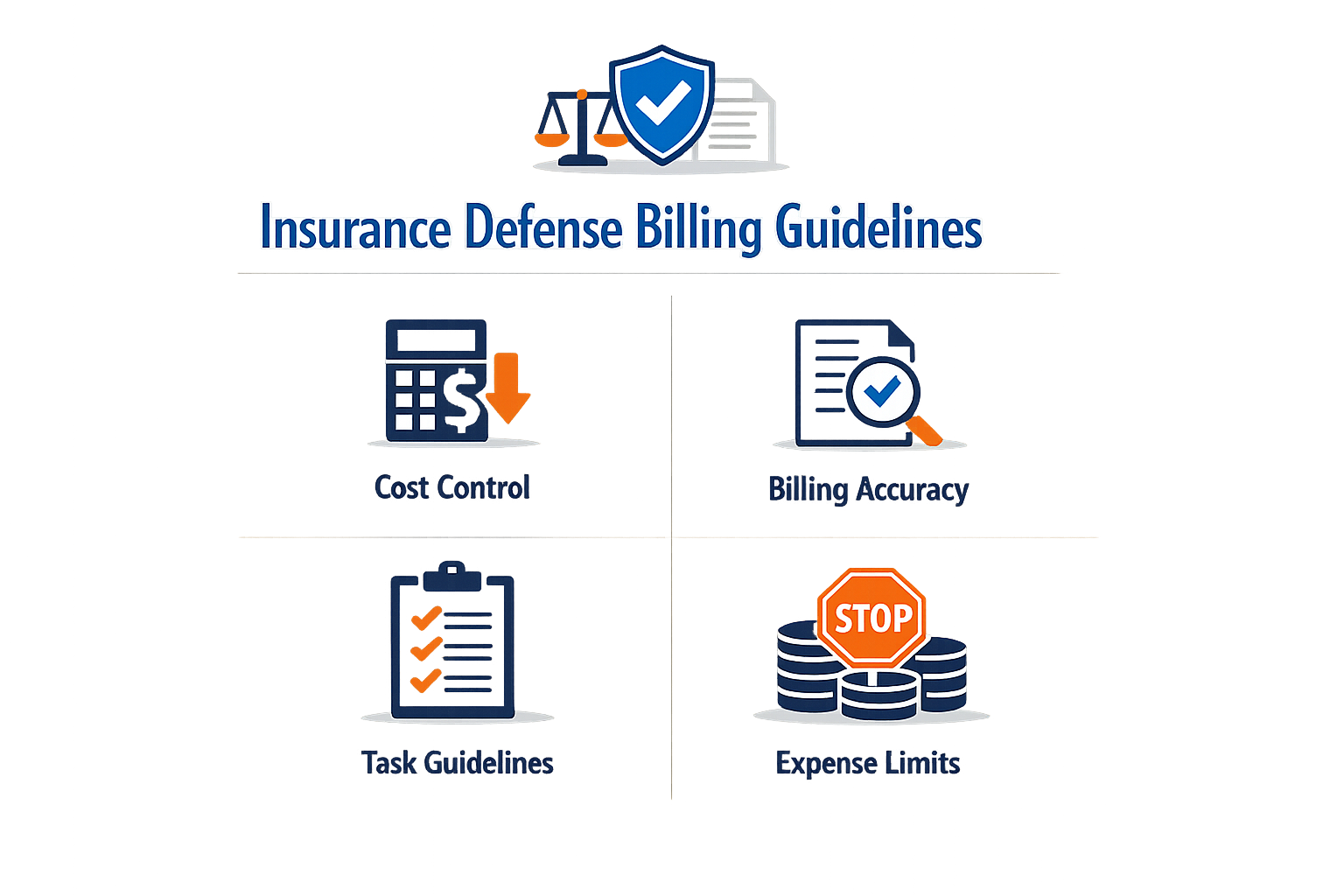
Insurance defense billing guidelines are written requirements issued by insurance carriers to law firms on their panel counsel rosters. These guidelines specify how outside counsel must prepare, format, and submit invoices for legal work performed on behalf of the carrier's insureds. The guidelines address billing increments, narrative detail standards, prohibited entries, staffing ratios, pre-approval thresholds, and the technical format for electronic submission. A carrier publishes its guidelines to establish uniform expectations across all panel firms and to reduce the volume of invoice disputes that arise from ambiguous or inconsistent billing practices.
The purpose of these guidelines is twofold: to control legal spend and to ensure that submitted invoices contain enough detail for the carrier's bill review team to evaluate each line item against the carrier's coverage obligations and litigation strategy. When a guideline states that block billing is not permitted, it is directing the firm to itemize each discrete task on a separate line rather than combining multiple activities into a single narrative. When a guideline sets a pre-approval threshold for expert fees or depositions, it is requiring the firm to obtain written consent before incurring the expense. These provisions are not suggestions; they are contractual terms that the firm accepts when it joins the panel or accepts an assignment.
Why Carriers Issue Guidelines
Carriers issue outside counsel guidelines to standardize billing conduct across a large and geographically dispersed panel. Without published guidelines, each firm would apply its own internal conventions for time entry, narrative detail, and expense documentation, making it difficult for the carrier to compare invoices or to audit compliance with the carrier's litigation budget. Guidelines also serve as a reference document during fee disputes: when a carrier reduces or rejects a line item, the guideline provides the written basis for that action, and the firm can appeal the reduction by demonstrating that the entry complies with the stated standard.
Guidelines typically address billing increments (such as tenth-of-an-hour rounding), block billing prohibitions, narrative sufficiency, UTBMS task and activity code usage, and the technical format for LEDES file submission. Some carriers publish a single comprehensive document; others issue a core guideline supplemented by matter-specific budgets or litigation management protocols. The firm is responsible for obtaining the current version of the guideline at the outset of the representation and for monitoring any updates that the carrier publishes during the life of the matter.
What Guidelines Cover
Most carrier guidelines include sections on timekeeping standards, expense reimbursement, staffing and rate approval, budgeting and pre-approval thresholds, invoice format and submission, and the appeal process for disputed reductions. The timekeeping section specifies the minimum billing increment (often one-tenth of an hour), prohibits or discourages block billing, and sets narrative detail requirements. The expense section lists reimbursable and non-reimbursable categories, establishes documentation thresholds, and may cap certain expenses such as mileage or photocopying. The staffing section addresses timekeeper roles, rate schedules, and the circumstances under which the carrier will approve multiple attorneys on a single task. The invoice format section mandates LEDES 1998B or LEDES XML submission, specifies required UTBMS codes, and provides portal login instructions or file transmission protocols.
Guidelines also address pre-approval requirements. A carrier may require written approval before retaining an expert, filing a dispositive motion, or scheduling a deposition. The guideline will state the dollar threshold or the procedural event that triggers the pre-approval obligation, the form of the approval request, and the turnaround time the firm should expect. Failure to obtain pre-approval can result in the carrier's refusal to reimburse the expense or pay the associated attorney time, even if the work was substantively reasonable and advanced the defense.
The guideline is the controlling document. When an invoice reduction cites a guideline provision, the firm's appeal must address that provision directly, not rely on general billing custom or the firm's internal policies.
Why Insurance Defense Billing Guidelines Matter
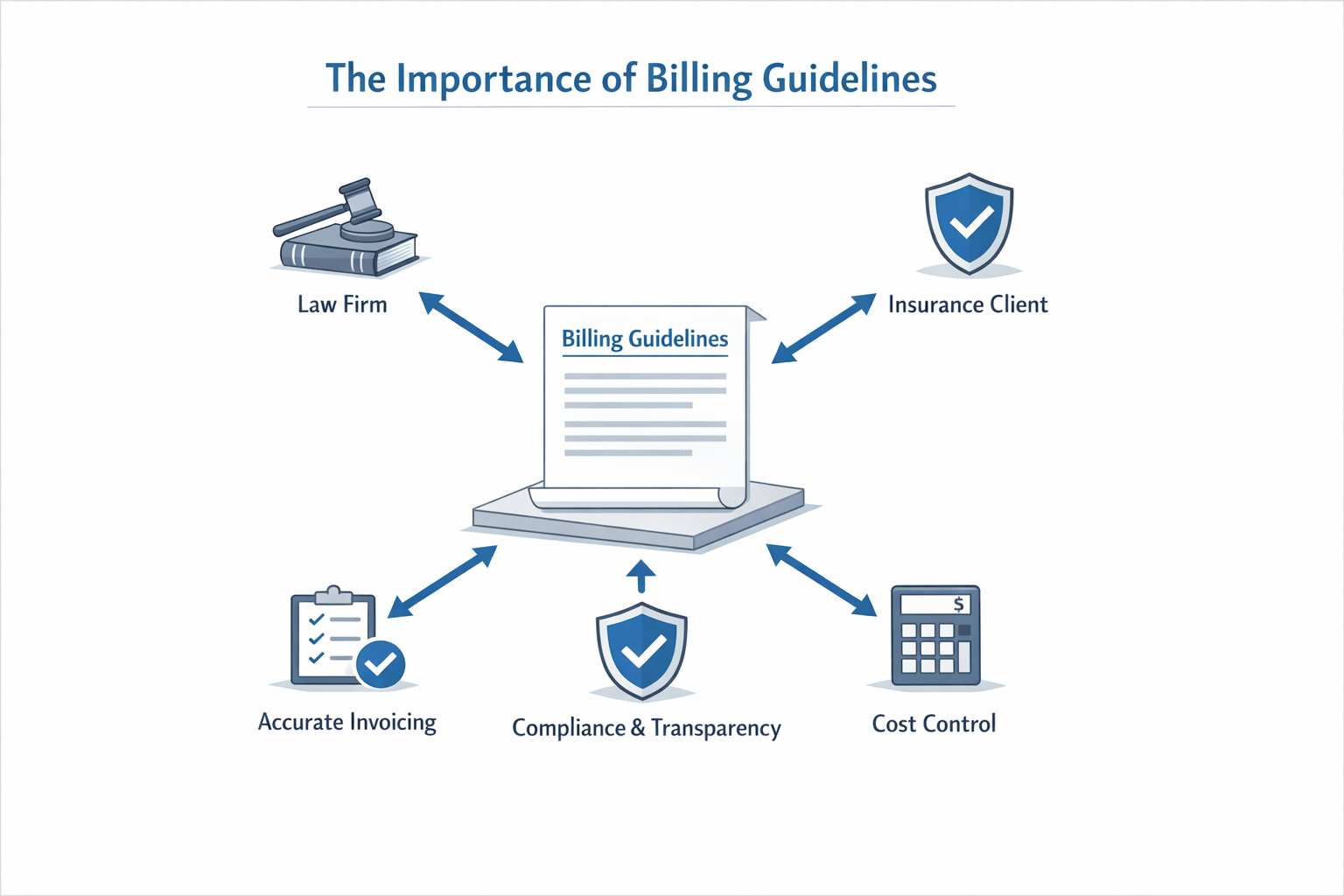
Outside counsel guidelines are not suggestions. They are contractual billing requirements that carriers enforce through systematic bill review. A single line item that violates a guideline prohibition triggers a reduction code, a write-down, or a full rejection at the e-billing portal. For law firms, compliance determines whether an invoice is paid as submitted or returned with cuts that erode profitability. For clients — the insurers and self-insured entities that retain panel counsel — guidelines provide a uniform standard for evaluating reasonableness across hundreds of matters and dozens of firms.
The significance of adhering to these guidelines extends beyond individual invoices. Patterns of non-compliance appear in aggregate reports that carriers review when renewing panel assignments. A firm that repeatedly submits entries flagged for block billing or inadequate narrative detail signals to the carrier that it either does not understand the guidelines or does not prioritize compliance. Either conclusion jeopardizes the firm's position on the panel. Conversely, firms that consistently meet guideline requirements reduce friction in the bill review process, accelerate payment cycles, and preserve the trust that sustains long-term panel relationships.
The Cost of Non-Compliance
Block billing is a frequent trigger for reductions because it obscures the time spent on each discrete task. When a timekeeper combines multiple activities into a single narrative — for example, "research case law, draft motion, and confer with client, 4.5" — the bill reviewer cannot determine whether each component consumed a reasonable amount of time. Block-billed time entries are inadequate as they do not accurately indicate the time expended on each separate task, making it difficult to assess whether the hours billed are reasonable. The result is a reduction applied to the entire entry, even if portions of the work were legitimate and necessary.
Carriers expect contemporaneous records that break down activity into discrete increments, each with its own UTBMS task code, activity code, and narrative. This level of detail allows the bill reviewer to evaluate each task against the guideline's pre-approval thresholds, staffing ratios, and prohibited-activity lists. When the detail is missing, the reviewer applies a conservative standard: if the reasonableness of the time cannot be verified from the face of the entry, the time is reduced. For more on how to structure compliant entries, see Block Billing: Reasons for Carrier Rejections and Solutions.
Transparency and Client Expectations
Clients now expect to be informed of how much time a lawyer spent on each task within a billing period. The practice of block billing obscures that information, creating an opacity that conflicts with the client's contractual right to review and approve fees. This expectation is not limited to fee disputes or audits — it is embedded in the structure of the e-billing portal itself, which requires each line item to carry a single task code and a single activity code. An entry that describes multiple tasks cannot be mapped to a single code pair without misrepresenting the work performed.
Guidelines codify this expectation by prohibiting block billing outright or by instructing bill reviewers to reduce entries that combine tasks. The prohibition is not arbitrary. It reflects the carrier's determination that transparency in billing is a condition of the retention, and that a firm's failure to provide that transparency is a material breach of the billing protocol. For firms, the lesson is straightforward: write entries that describe one task, assign one code pair, and record one increment of time. Anything else invites a reduction.
Common Guidelines and Prohibitions
Insurance carriers and courts publish billing guidelines that establish clear boundaries for compensable time and acceptable narrative structure. These guidelines typically address billing increments, task delegation, and the prohibition of certain administrative activities at attorney rates. Understanding what carriers commonly disallow helps firms structure entries to survive the first round of bill review.
Billing Increment Standards
Time spent must be billed to the nearest tenth of an hour. This standard appears across federal court CJA panels and many carrier guidelines, and it sets the floor for acceptable precision. Rounding to quarter-hour or half-hour blocks invites automatic reduction, as does any entry that implies estimation rather than contemporaneous recording. The tenth-of-an-hour increment is the baseline expectation, not a suggestion.
Task Delegation and Staffing Prohibitions
Appointed counsel and panel counsel will not be compensated for work performed by attorneys that could or should be performed by less expensive authorized staff. Court filings, service of papers, file organization, and photocopying are examples of tasks that should not appear on an attorney timekeeper line. When these tasks are billed at attorney rates, reviewers apply reduction codes or reject the entry outright. The principle is efficiency: the least expensive competent staff member authorized by the court or carrier should perform the work.
Block Billing as a Reduction Trigger
Block billing—submitting an invoice entry that combines multiple tasks in a single narrative—remains one of the most common triggers for reduction. An entry reading "2.5 hours – Review documents; Speak with opposing counsel; Draft memo; Conduct follow-up call" prevents the reviewer from assessing the reasonableness of time spent on each task. Carriers cannot verify whether the time allocated to each component was necessary, so they reduce the entry or request a breakdown. While one published guideline treats block billing as an outright prohibition, most carriers treat it as a reduction trigger rather than an automatic rejection. The practical result is the same: the entry will not be paid as submitted.
Administrative Time and Overhead
Carriers scrutinize entries for time billed at attorney rates that should be absorbed as firm overhead. Intra-office conferences about scheduling, internal file management, and routine administrative correspondence are frequent targets for reduction. If the narrative does not demonstrate that the task advanced the matter substantively, the reviewer will question whether it should be compensated at all. The distinction is not always obvious, but the burden is on the billing timekeeper to show that the time was case-specific and necessary.
Best Practices for Writing Entries That Get Paid

Writing compliant billing entries requires discipline, specificity, and an understanding of what reviewers are trained to flag. The goal is not to satisfy an internal timekeeping system — it is to produce a narrative that survives scrutiny at the carrier level, where reduction codes are applied by staff who have never met you and who follow a checklist.
Break Entries Into Discrete Tasks
Each line item should describe one activity. When you draft a motion, review discovery, and confer with co-counsel in the same billing period, those are three entries, not one. Combining them into a single narrative is block billing, and it is the most common reason for reductions. Carriers cannot verify the reasonableness of time spent when multiple tasks are bundled.
When multiple attorneys attend the same conference, each attorney's entry must reflect what that attorney contributed, not simply that the conference occurred. A senior partner who leads the discussion and a junior associate who takes notes are performing different functions. The narrative should make that distinction visible. Entries that read identically across timekeepers signal that no unique work was performed, and reviewers will reduce one or both.
Use the Carrier's Preferred Increment
Most carriers specify tenth-of-an-hour increments. Rounding to the nearest quarter-hour inflates the invoice and triggers automatic adjustments. If your timekeeping system defaults to six-minute increments, configure it that way. If it does not, convert manually before submission. A 0.3-hour entry that should have been 0.2 will be reduced, and the reduction will apply to every similar entry in the invoice.
Write Narratives That Answer the Reviewer's Questions
A bill reviewer is asking: What was done? Why was it necessary? Was the time reasonable? A narrative that states "research" without identifying the issue researched, or "draft motion" without naming the motion, leaves those questions unanswered. The reviewer will assume the entry is padding and reduce it.
Include enough detail to demonstrate necessity, but avoid internal jargon or case-strategy commentary. "Research California law on successor liability for purposes of opposition to summary judgment" is sufficient. "Research potential arguments" is not. The first tells the reviewer what you did and why. The second tells them nothing.
Proactively proposing alternative fee arrangements and orienting work toward resolution rather than quota billing builds trust and reduces the perception of milking files for billable hours.
Avoid Administrative Time Billed at Attorney Rates
Carriers expect clerical tasks to be billed at clerical rates, or not billed at all. Entries for filing documents, calendaring deadlines, or organizing exhibits should not appear under an attorney timekeeper unless the task required legal judgment. If your firm bills these activities, assign them to a paralegal or administrative timekeeper. Billing them at attorney rates invites reductions and damages your credibility with the reviewer.
Align UTBMS Codes With the Narrative
The task and activity codes you select must match the work described in the narrative. A mismatch signals either carelessness or an attempt to obscure the nature of the work. If the narrative describes drafting a discovery response, the task code should reflect discovery, not motion practice. Reviewers cross-check codes against narratives, and inconsistencies are flagged. For more on how task and activity codes are structured and interpreted, see UTBMS Activity Codes A101-A111 for Legal Billing.
Document Contemporaneously
Entries written days or weeks after the work was performed are less precise and more vulnerable to challenge. Contemporaneous records allow you to describe the work accurately and to defend the entry if it is questioned. Reconstructed entries often contain vague language or block multiple tasks together because the timekeeper cannot remember the details. That vagueness is exactly what reviewers are trained to reduce.
Review the Invoice Before Submission
Before submitting an invoice through an e-billing portal, review it line by line for compliance with the carrier's guidelines. Look for block billing, vague narratives, administrative tasks billed at attorney rates, and entries that exceed pre-approval thresholds without documentation. Most rejections can be avoided by catching these issues before the invoice leaves your firm.
Common Mistakes to Avoid in Insurance Defense Billing
Several recurring errors trigger reductions across carrier panels. One attorney recorded all tasks performed in a single day as one entry without specifying time spent on each separate task, while another lumped together all emails and calls over several months into a single line item. Both practices produced reductions because the reviewer could not determine how much time each discrete activity consumed.
Block Billing Multiple Tasks in One Entry
Block-billed time entries are inadequate because they do not accurately indicate the time expended on each separate task. When an entry reads "draft motion, review discovery, email client, 3.5," the reviewer cannot tell whether the motion consumed three hours and the email consumed thirty minutes, or the reverse. In one reported matter with fifteen instances of block billing, the court imposed a ten percent across-the-board reduction due to excessive time and duplicative work.
Some panels define block billing as two or more distinct activities in one narrative; others apply the label only when the combined entry spans multiple days. Read the controlling guideline to know which standard governs your submission. For more on how carriers interpret combined entries, see Block Billing: Reasons for Carrier Rejections and Solutions.
Vague or Generic Narrative Language
Entries that read "legal research, 2.0" or "case preparation, 4.5" do not tell the reviewer what legal issue was researched or what aspect of the case was prepared. Carriers expect the narrative to identify the subject matter with enough detail that someone unfamiliar with the file can understand what work occurred. An entry reading "research California statute of limitations for professional negligence claims" survives review; "research, 1.5" does not.
Duplicative Work Across Multiple Timekeepers
When three attorneys each bill for attending the same conference call and each records the identical duration, reviewers flag the entries as duplicative unless the narrative explains why all three were necessary. Similarly, when two timekeepers both bill for reviewing the same document on the same day, the second entry is vulnerable unless the narrative states a reason—for example, "senior associate review of associate's draft motion for accuracy."
Billing Administrative Tasks at Attorney Rates
Many published guidelines prohibit billing clerical or administrative work at attorney rates. Entries for filing documents, calendaring deadlines, or organizing files are reduction targets when the timekeeper code indicates an attorney rather than a paralegal or secretary. One carrier's guideline states that any task a non-lawyer could perform must be billed at non-lawyer rates or written off entirely.
Exceeding Pre-Approval Thresholds Without Prior Authorization
Carriers set dollar or hour thresholds above which certain activities require advance approval—commonly expert fees, travel, or depositions outside the forum jurisdiction. An entry for a full-day deposition in another state, billed at twelve hours plus travel time, will be reduced to the guideline's default cap if no pre-approval was obtained. The fact that the deposition occurred does not cure the absence of authorization.
Inconsistent or Missing UTBMS Codes
When the LEDES file assigns task code L320 (depositions) but the narrative describes drafting a motion, the validation engine flags a mismatch and the entry goes to manual review. Reviewers confronted with a mismatch often reduce the entry rather than guess which code was correct. Similarly, an entry with no task code at all—or a code outside the carrier's accepted set—will be rejected at the portal before any human sees it.
Narrative Detail Requirements in Billing
Carriers expect a narrative that tells them what the timekeeper did, for which aspect of the case, and why the work was necessary. A single line reading "research and draft motion, 4.2" does not meet that standard. The narrative must break out what was researched, what was drafted, and whether those tasks advanced separate issues or a single theory.
What Narrative Detail Means in Practice
Narrative detail is the difference between an entry that survives review and one that triggers a reduction code. When a timekeeper combines multiple tasks into one time entry, the reviewer cannot assess whether each component was reasonable or necessary. That opacity is the definition of block billing, and it is the reason carriers flag entries for write-down even when the total time is defensible.
Clients increasingly expect detailed billing entries that break out individual tasks rather than using block billing, which combines multiple tasks into a single time entry. Where a guideline requires contemporaneous records, the carrier is instructing the firm to capture the narrative at the time the work is performed, not to reconstruct it days later when the invoice is due.
Breaking Out Tasks Within an Entry
When a single session involves multiple activities, the narrative must identify each one and assign time proportionally. An entry reading "review correspondence from opposing counsel regarding discovery dispute, draft response outlining objections to request for production, confer with client regarding document production timeline, 2.1" combines at least three tasks. A compliant entry would separate them:
- Review correspondence from opposing counsel regarding discovery dispute, 0.3
- Draft response outlining objections to request for production, 1.2
- Confer with client regarding document production timeline, 0.6
The total is the same. The difference is that the reviewer can now assess whether 1.2 hours to draft a response was reasonable, whether the conference with the client was necessary, and whether the time increments align with the guideline's requirements.
The practice of block billing can effectively obscure how much time the lawyer spent on each of those tasks, which is something clients now expect to be informed of.
Contemporaneous Records and the Reconstruction Problem
Many guidelines require contemporaneous records. That phrase means the timekeeper must document the work at or near the time it is performed, not reconstruct it from memory when the invoice is prepared. A narrative written three weeks after the fact will lack the specificity that a reviewer expects, and the absence of that specificity becomes evidence that the firm's timekeeping system does not produce contemporaneous records.
Block billing complicates the assessment of the reasonableness of time spent on tasks, prompting courts to conduct closer reviews. Where a guideline states that entries must be contemporaneous, the carrier is signaling that reconstructed narratives will not be accepted as compliant, even if the total time is accurate.
E-Billing Portals and the Submission Process
E-billing portals are the submission destinations for insurance defense invoices. Each carrier operates its own platform or contracts with a third-party vendor to receive LEDES 1998B files, validate them against the carrier's outside counsel guidelines, and route them for bill review. The portal is not a passive mailbox — it enforces file format rules, checks UTBMS task and activity codes, and flags entries that violate guideline prohibitions before a human reviewer opens the invoice. Understanding how the portal validates submissions is the difference between an invoice that enters the review queue and one that bounces back with a rejection code.
Most portals perform three layers of validation. The first is file-structure validation: the LEDES file must parse cleanly, with all 24 required fields present and formatted correctly. The second is guideline-rule validation: the portal checks billing increments, flags block billing patterns, and scans narratives for prohibited language. The third is budget and threshold validation: the portal compares the submitted amount to the matter budget and any pre-approval thresholds set by the carrier. An invoice that fails any of these checks generates a rejection notice, often with a reduction code that identifies the specific violation.
Common Causes of Portal Rejection
Rejections fall into predictable categories. File-format errors — missing fields, incorrect date formats, or invalid UTBMS codes — account for a significant share of initial rejections. Some estimates indicate that between 10-30% of legal bills are rejected by clients, often due to non-compliance with billing requirements. Guideline violations are the second major cause: entries that exceed the permitted billing increment, narratives that combine multiple tasks without separating them by line item, and timekeepers whose rates exceed the carrier's approved schedule. Budget overruns trigger rejections when the cumulative invoice total exceeds the matter budget without prior approval from the carrier. Each of these failures is preventable if the firm validates the invoice internally before submission.
Block billing is a frequent rejection trigger. A single line item reading "research case law, draft motion, confer with client, 5.5" will fail guideline-rule validation at most carriers, even if the LEDES file itself is structurally sound. The portal's automated scanner detects the pattern — multiple tasks described in one narrative — and flags the entry for reduction or outright rejection. The firm receives a notice stating that the entry violates the carrier's outside counsel guidelines, and the invoice is returned unprocessed. The appeal path begins only after the firm corrects the entry and resubmits.
How to Avoid Rejection
Validate the LEDES file before submission. Run the file through a LEDES validator to confirm that all required fields are present, that dates follow the CCYYMMDD format, and that UTBMS codes are drawn from the current code set. Check that each line item uses the carrier's specified billing increment — typically one-tenth of an hour — and that no entry rounds to a larger unit. Review narratives for block billing patterns: if a single line describes more than one discrete task, split it into separate entries with individual time allocations.
Confirm that timekeeper rates match the carrier's approved schedule. Most portals reject invoices where a timekeeper's rate exceeds the guideline maximum, even if the timekeeper is listed on the firm's panel roster. If the carrier has approved a higher rate for a specific timekeeper or matter, ensure that the approval documentation is attached to the invoice or referenced in the submission notes. Without that documentation, the portal treats the rate as an unapproved deviation and reduces the entry to the guideline maximum.
Monitor the matter budget throughout the life of the case. The portal compares each invoice to the cumulative total billed to date and flags any submission that would push the matter over budget. If the case requires additional fees beyond the original budget, request a budget increase from the carrier before submitting the invoice. A pre-approved budget increase clears the portal's threshold check; an unapproved overage triggers an automatic rejection.
Step 1
Run pre-submission validation
Before uploading the LEDES file, run it through a validator that checks file structure, date formats, and UTBMS code validity. Address any errors flagged by the validator before proceeding to the portal.
Step 2
Review narratives for guideline compliance
Scan each line item narrative for block billing, vague task descriptions, and prohibited activities. Split combined tasks into separate entries and confirm that each narrative provides sufficient detail to satisfy the carrier's requirements.
Step 3
Verify timekeeper rates and budget status
Check that all timekeeper rates match the carrier's approved schedule and that the invoice total does not exceed the matter budget. If either condition fails, resolve the discrepancy before submission.
Portal Workflow After Submission
Once the invoice passes automated validation, it enters the bill review queue. The carrier's bill reviewer opens the invoice, applies the reduction codes specified in the outside counsel guidelines, and generates a reduction report. The firm receives a notice listing each reduced entry, the reduction code applied, and the amount written down. The firm may accept the reductions and receive payment for the approved amount, or it may appeal the reductions by submitting additional documentation or clarification to the carrier. The appeal process is covered in the next section, but the key point is that the portal's automated validation is a gatekeeper — an invoice that fails validation never reaches the bill reviewer, and the firm must correct and resubmit before any human review occurs.
For more detail on how portals flag and reject specific entry patterns, see E-Billing Portal Invoice Rejections: Common Causes and Fixes.
How to Appeal Reductions and Rejections
When a carrier reduces or rejects a line item, the appeal path is not a negotiation — it is a documentation exercise. The reviewer applied a reduction code to a specific entry because that entry appeared to violate a stated guideline or fell outside the scope of reasonable attorney fees. Your appeal succeeds when you show, with contemporaneous records and cited authority, that the entry complies with the guideline and the time was necessary.
Understand the Reduction Code
Most e-billing portals attach a reduction code to each adjusted line item. Common codes include references to block billing, vague narrative, duplicative work, or time billed in excess of a pre-approval threshold. Read the code's definition in the carrier's published guidelines or the portal's reduction-code glossary. If the code states "block billing," the reviewer concluded that the entry combined multiple tasks in a way that made the reasonableness of each task impossible to assess.
In Bird v. Sumter County School District, the court applied a 10 percent fee reduction only to entries where block billing rendered the reasonableness of the time expended impossible to discern. The decision did not penalize every entry with multiple tasks — it penalized entries where the aggregation prevented meaningful review. When appealing a block-billing reduction, isolate the portion of the entry that the reviewer could not evaluate and show that the time for that discrete task was both necessary and reasonable.
Gather Contemporaneous Records
The appeal requires proof that the work occurred as described and that the time was recorded when the work was performed. Contemporaneous records include the timekeeper's daily time entries, calendar appointments, email timestamps, court docket entries, and discovery logs. If the narrative states "reviewed 47 pages of medical records," the appeal should reference the production date, the Bates range, and the timekeeper's notes from that day.
When an entry is reduced for vagueness, the appeal must add the missing detail without changing the substance of what was billed. You cannot transform "research" into "research motion to compel discovery re: plaintiff's employment records" if the timekeeper's notes do not support that level of specificity. The appeal clarifies what the original entry meant; it does not rewrite history.
Draft the Appeal Letter
The appeal letter should be one to two pages, addressed to the carrier's bill review contact or submitted through the portal's appeal workflow. Structure it as follows:
Step 1
Identify the entry and the reduction
State the invoice number, line-item number, timekeeper, date, original narrative, and the reduction code or explanation provided by the reviewer.
Step 2
Cite the controlling guideline
Quote the relevant section of the carrier's outside counsel guidelines or the fee agreement. If the reduction code references a specific prohibition, state what that prohibition requires and how the entry complies.
Step 3
Provide the missing detail
Attach or describe the contemporaneous record that supports the entry. If the reduction was for block billing, break out the tasks and the time for each. If the reduction was for vagueness, add the case name, document title, or procedural context that makes the work identifiable.
Step 4
Request reinstatement
State the amount you are asking the carrier to reinstate and confirm that the timekeeper is available to provide additional records if needed.
In Pierce v. Atlantic Specialty Insurance Co., an attorney billed 115.25 hours in only 13 entries, and the court reduced the fee award due to block billing. The decision illustrates that when entries are so aggregated that a reviewer cannot assess the reasonableness of each task, the reduction stands unless the timekeeper can produce a breakdown that was recorded at the time the work was performed.
Submit Through the Correct Channel
Some carriers require appeals to be submitted through the e-billing portal's dispute-resolution module; others accept appeals by email to a designated bill-review contact. Check the carrier's guidelines or the portal's help documentation for the correct procedure. If the guideline specifies a deadline — typically 30 to 60 days from the date of the reduction — calendar it and submit the appeal before the deadline expires. Late appeals are often rejected without review.
Follow Up and Escalate if Necessary
If the carrier denies the appeal or does not respond within the stated review period, follow up with the claims adjuster or the panel counsel coordinator. Some carriers permit a second-level appeal to a senior bill reviewer or an outside fee arbitrator. The guideline will state whether that option exists and what the procedure requires. Document every communication, including the date, the recipient's name, and the substance of the discussion.
For more guidance on common rejection triggers and how to avoid them, see Block Billing: Reasons for Carrier Rejections and Solutions.
Conclusion
Insurance defense billing guidelines exist to enforce transparency, prevent overbilling, and ensure that submitted invoices reflect actual work performed at reasonable rates. Throughout this guide, the recurring pattern is clear: carriers reduce or reject entries that lack narrative detail, combine multiple tasks into a single line item, or bill administrative work at attorney rates. The prohibition on block billing — whether enforced as an outright rejection or a reduction trigger — appears in nearly every published guideline, and compliance begins with contemporaneous time records that capture discrete tasks with sufficient detail for independent review.
Navigating insurance defense billing guidelines can be a complex task, especially when it comes to understanding what carriers typically cut and how to craft entries that are likely to be approved. When comparing guidelines from different carriers, such as Arch 2025.5, Hartford's billing FAQ, and Sompo's guidelines, it's evident that only one treats block billing as an outright prohibition rather than a reduction trigger. This highlights the importance of understanding each carrier's specific requirements and reading the controlling document before submitting an invoice.
Transparency and Accurate Timekeeping
Transparency in billing practices is essential to avoid negative perceptions and ensure successful payments. Keeping accurate records of billed time contemporaneously helps ensure that bills reflect the actual work done, reducing errors and write-offs. A recurring pattern across many published guidelines is the scrutiny of entries related to travel, intra-office conferences, and administrative time billed at attorney rates — these are often flagged for reductions, making it precise narrative detail a practical necessity rather than a suggestion.
Firms that invest in training timekeepers on UTBMS task and activity codes, tenth-of-an-hour increments, and narrative sufficiency reduce their exposure to write-downs and appeals. E-billing portals validate submissions against the carrier's published rules, and rejections at the validation stage are easier to correct than reductions discovered weeks later during bill review. When a reduction does occur, the appeal path is documented in the guideline or the portal's help resources — following that path with supporting contemporaneous records and a citation to the controlling provision improves the likelihood of recovery.
For more guidance on common rejection causes and how to address them, see E-Billing Portal Invoice Rejections: Common Causes and Fixes.
Adherence to insurance defense billing guidelines protects the firm's relationship with the carrier, preserves panel counsel status, and ensures that the work performed is compensated without unnecessary delay or dispute. The controlling document is the guideline version named in the engagement letter or the panel agreement — read it, follow it, and cite it when the bill reviewer questions a line item.
FAQ
What is block billing?
Block billing is the practice of combining multiple discrete tasks into a single time entry without specifying the time spent on each task. For example, an entry reading "research case law, draft motion, and confer with client, 4.5" combines three separate activities in one narrative, making it impossible for a bill reviewer to assess whether the time allocated to each component was reasonable.
Why do carriers reject block-billed entries?
Carriers reject or reduce block-billed entries because they cannot verify the reasonableness of time spent on each discrete task. When multiple activities are bundled into one line item, the reviewer cannot determine whether each component consumed an appropriate amount of time or whether the total reflects padding or inefficiency.
How should I structure my time entries to avoid block billing reductions?
Write one line item per discrete task. If you draft a motion, review discovery, and confer with a client in the same billing period, create three separate entries with individual time allocations. Each entry should include a specific narrative, a single UTBMS task code, and time billed to the nearest tenth of an hour.
What are the most common billing mistakes that trigger carrier reductions?
The most common mistakes include block billing multiple tasks in one entry, using vague or generic narrative language, billing administrative tasks at attorney rates, exceeding pre-approval thresholds without authorization, and submitting entries with inconsistent or missing UTBMS codes.
How can I appeal a reduction or rejection?
To appeal a reduction, identify the specific entry and reduction code, cite the controlling guideline provision, provide contemporaneous records that support the entry, and submit your appeal through the carrier's designated channel within the stated deadline. The appeal should clarify the work performed and demonstrate compliance with the guideline.