


Panel Counsel: How Insurers Select and Manage Defense Firms
Top takeaways
- Panel counsel are defense firms selected by insurers to handle claims litigation under specified terms and billing requirements
- Assignment to panel counsel follows documented procedures controlled by the insurer's litigation manager or claims department
- Understanding the selection and management framework helps defense firms meet carrier expectations and avoid billing rejections
- Compliance with outside counsel guidelines, LEDES file formats and UTBMS codes is central to maintaining panel status
Introduction
Panel counsel refers to the roster of defense firms an insurer designates to represent its interests in claims litigation. These firms operate under outside counsel guidelines that govern everything from billing increments to narrative detail requirements. Assignment to a panel is not automatic; it follows a structured evaluation process in which the carrier assesses the firm's experience, rates, geographic coverage and willingness to comply with the insurer's billing and case-management protocols.
As a member of the Carrier Ready Knowledge Team, I often examine how insurers select and manage defense firms through these panel programs. Our research is grounded in a careful review of carrier outside counsel guidelines, which outline the criteria and expectations for firms seeking to join these panels. One pattern that emerges across published guidelines is the emphasis on cost control and efficiency: entries such as travel, intra-office conferences and administrative time billed at attorney rates are frequently flagged for reduction. This pattern underscores the importance insurers place on managing expenses while maintaining quality legal representation.
Understanding the mechanics of panel counsel selection and management is essential for defense firms that wish to secure and retain panel appointments. The process involves more than competitive pricing. Carriers evaluate a firm's ability to submit invoices in LEDES 1998B file format, use correct UTBMS task and activity codes, comply with narrative and block-billing standards, and respond constructively to invoice reductions and guideline changes. Firms that master these requirements position themselves as reliable partners in the insurer's litigation-management program.
The following sections examine the challenges insurers and defense firms face in the panel selection and management process, the steps firms can take to meet carrier standards, and practical tips for maintaining compliance and panel status over time.
Problem Statement
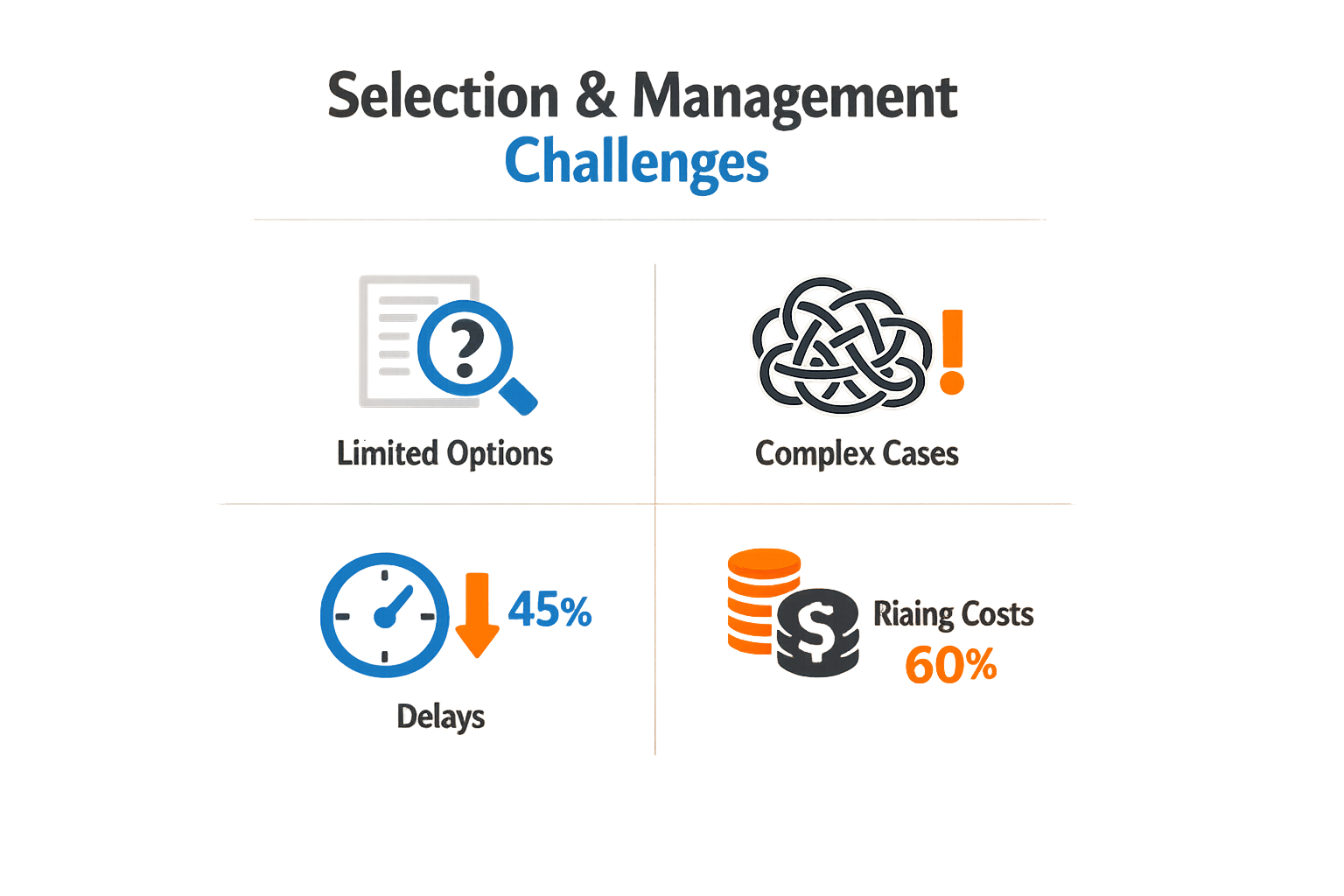
Insurers managing panel counsel programs face a persistent tension: they need consistent, cost-effective defense representation across multiple jurisdictions and lines of business, but the traditional approach of maintaining broad, static panels produces uneven results. Carriers often discover that a firm performing well in one region or practice area delivers mediocre outcomes in another, yet the panel structure treats all approved firms as interchangeable. This mismatch between panel design and actual performance creates inefficiency and risk.
The consolidation dilemma
Panel consolidation has emerged as a common response to these inefficiencies. Recent industry surveys identify panel consolidation and line-of-business specific panel review groups as recurring themes in litigation management innovation. Carriers reduce the number of approved firms, hoping to concentrate volume with higher-performing counsel and gain leverage in fee negotiations. The challenge is execution: consolidation without rigorous, line-specific evaluation simply narrows the pool of mediocrity rather than elevating quality.
A consolidated panel built on outdated criteria or subjective relationships does not solve the underlying problem. Insurers need objective performance data, segmented by practice area and claim type, to make consolidation decisions that actually improve outcomes. Firms that excel in employment defense may struggle with product liability; a consolidated panel that ignores these distinctions trades one set of problems for another.
Independent counsel and disclosure obligations
When a conflict of interest requires the insured to select independent counsel, the management challenge intensifies. In California, Civil Code section 2860, subdivision (d) imposes specific disclosure duties: independent counsel and the insured must disclose to the insurer all information concerning the action, except privileged materials relevant to coverage disputes, and must timely inform and consult with the insurer on all matters relating to the action. Any claim of privilege is subject to in camera review.
This statutory framework creates friction. Independent counsel operates outside the panel structure, yet the insurer retains a right to information and consultation. Carriers accustomed to panel counsel who follow outside counsel guidelines and submit to routine bill review find that independent counsel arrangements demand a different posture: less directive control, more collaborative oversight, and careful attention to what falls within or outside the coverage-dispute privilege.
Scorecard and survey limitations
Many carriers deploy scorecards and surveys to evaluate panel performance, but these tools often measure the wrong things or measure the right things poorly. A scorecard that tracks only aggregate defense costs and indemnity outcomes misses the nuances that distinguish strong counsel from weak. Did the firm achieve a favorable result because of skilled advocacy, or because the claim was weak from the start? Did low defense costs reflect efficiency, or under-investment in case development that will surface as a larger indemnity payment later?
Survey programs that solicit client feedback face their own pitfalls. Adjusters may rate responsiveness and courtesy highly but lack the expertise to evaluate legal strategy or motion practice. A firm that returns calls promptly and writes polite emails can score well on a survey while delivering substandard work product. Without structured criteria tied to measurable litigation outcomes, scorecards and surveys become popularity contests rather than performance assessments.
Analytics-driven assignment and the data gap
Analytics-driven attorney assignment is an appealing concept: match each new claim to the firm whose historical performance in similar matters predicts the best outcome. The obstacle is data quality. Insurers often lack granular, structured data on case characteristics, defense strategies employed, and intermediate litigation events. Without that detail, the analytics reduce to crude correlations between firm identity and final settlement amount, which may reflect case mix rather than firm skill.
Building an analytics capability requires carriers to capture and code information that many claims systems do not track: motion outcomes, discovery disputes, expert retention timing, and the specific legal theories advanced. Firms must report this information in a standardized format, which means integrating it into outside counsel guidelines and e-billing workflows. The gap between the promise of analytics-driven assignment and the current state of claims data is wide, and closing it demands investment in both technology and process redesign.
Solution Steps
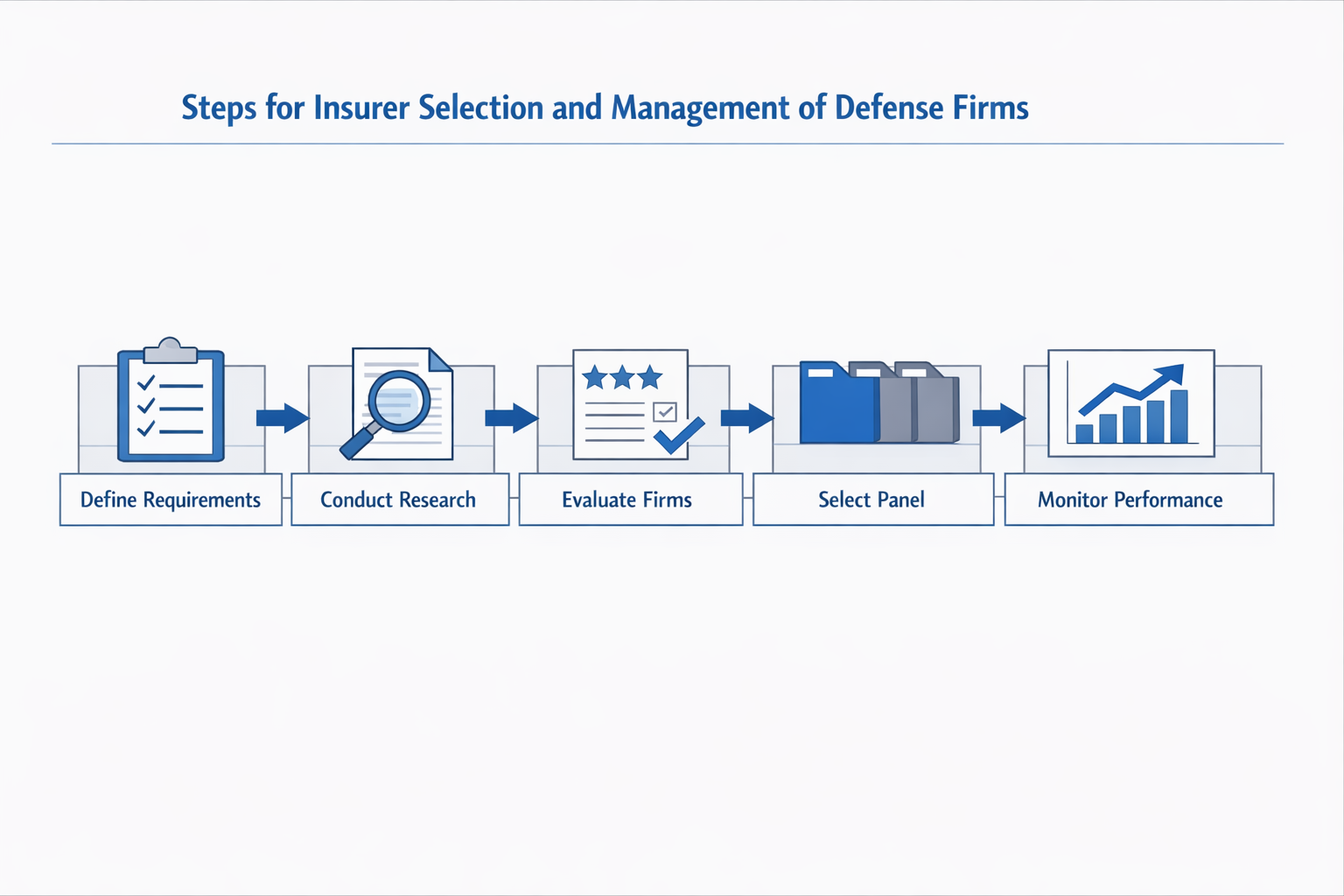
Establishing a functional panel counsel program requires a sequence of deliberate actions, not a single policy document. The steps below describe a framework that addresses assignment, communication and compliance expectations.
Step 1: Define Assignment and Reassignment Protocols
Cases must be assigned to specific attorneys within the defense counsel firm, and those assignments should not be reassigned without prior written approval from the person responsible for overseeing defense counsel at the insurer or member entity. This requirement appears in published standards and serves two purposes: it preserves continuity for the insured, and it prevents firms from shifting work to timekeepers the carrier has not evaluated.
Step 1
Assign to named timekeepers
When a matter is opened, the assignment letter should name the attorney who will handle the file. If the firm later proposes a substitution—whether for staffing, caseload or expertise reasons—the carrier's claims representative must approve the change in writing before the new timekeeper bills any time to the matter.
Upon receipt of a new case assignment, defense counsel must send an acknowledgement of the assignment to the overseeing person at the insurer. That acknowledgement creates a record of the handoff and starts the clock on any initial-report deadlines the guidelines impose.
Step 2: Establish Communication Standards for Independent Counsel
When a conflict of interest triggers the insured's right to select independent counsel under California Civil Code section 2860, the communication obligations shift but do not disappear. Independent counsel and the insured must disclose to the insurer all information concerning the action except privileged materials relevant to coverage disputes, and they must timely inform and consult with the insurer on all matters relating to the action. Any claim of privilege is subject to in camera review in the superior court.
This statutory duty means that panel counsel guidelines should specify the frequency and format of status reports, the threshold for pre-approval of experts or motions, and the procedure for privilege logs when coverage-related materials are withheld. The insurer cannot direct the defence, but it retains the right to be informed.
Step 3: Implement Billing Compliance and Validation Checkpoints
Panel counsel must submit invoices in the format and increment the carrier specifies—most commonly LEDES 1998B with tenth-of-an-hour billing. The carrier's outside counsel guidelines will list prohibited entries: administrative time billed at attorney rates, intra-office conferences without explanation, travel time at full rate, and block billing that combines multiple tasks in a single line item all appear frequently on the prohibited list.
Step 2
Validate before submission
Before uploading an invoice to the e-billing portal, the firm should run an internal audit against the guideline's prohibited-entry list. One line reading "research and draft motion in limine, 4.2" will trigger a reduction for block billing; splitting it into separate entries for research (with citation to authority) and drafting (with document name) will pass validation.
When an invoice is rejected or reduced, the firm has a defined appeal path. The reduction code on the portal will cite the guideline section that the entry violated. The firm's response must address that section directly, either by clarifying the narrative or by citing a pre-approval that overrides the guideline prohibition.
Step 4: Monitor Performance Metrics and Adjust Panel Composition
Panel counsel programs are not static. Insurers track outcomes, cycle time, legal spend per matter and guideline compliance rates across the panel. Firms that consistently submit clean invoices, resolve matters within budget and communicate proactively will receive more assignments; firms that generate high rejection rates or exceed budgets without explanation will see their matter flow decline.
The insurer should conduct a formal panel review at least annually, using quantitative metrics (average cost per matter, percentage of invoices requiring revision, case disposition rates) and qualitative feedback from claims staff. Firms that fall below threshold performance on multiple metrics should be placed on notice and given a remediation period; firms that do not improve should be removed from the panel.
Step 5: Document Expectations in a Written Agreement
Every panel counsel relationship should be governed by a written agreement that incorporates the outside counsel guidelines by reference, specifies the billing format and increment, sets the pre-approval thresholds for experts and motions, and defines the term and termination provisions. The agreement should state that the guidelines may be updated during the term and that the firm will be notified of updates with a reasonable lead time before they take effect.
The agreement should also address confidentiality, conflicts clearance, insurance requirements and the carrier's audit rights. When a dispute arises over a reduced invoice or a guideline interpretation, the written agreement provides the framework for resolution.
Tips and Tricks
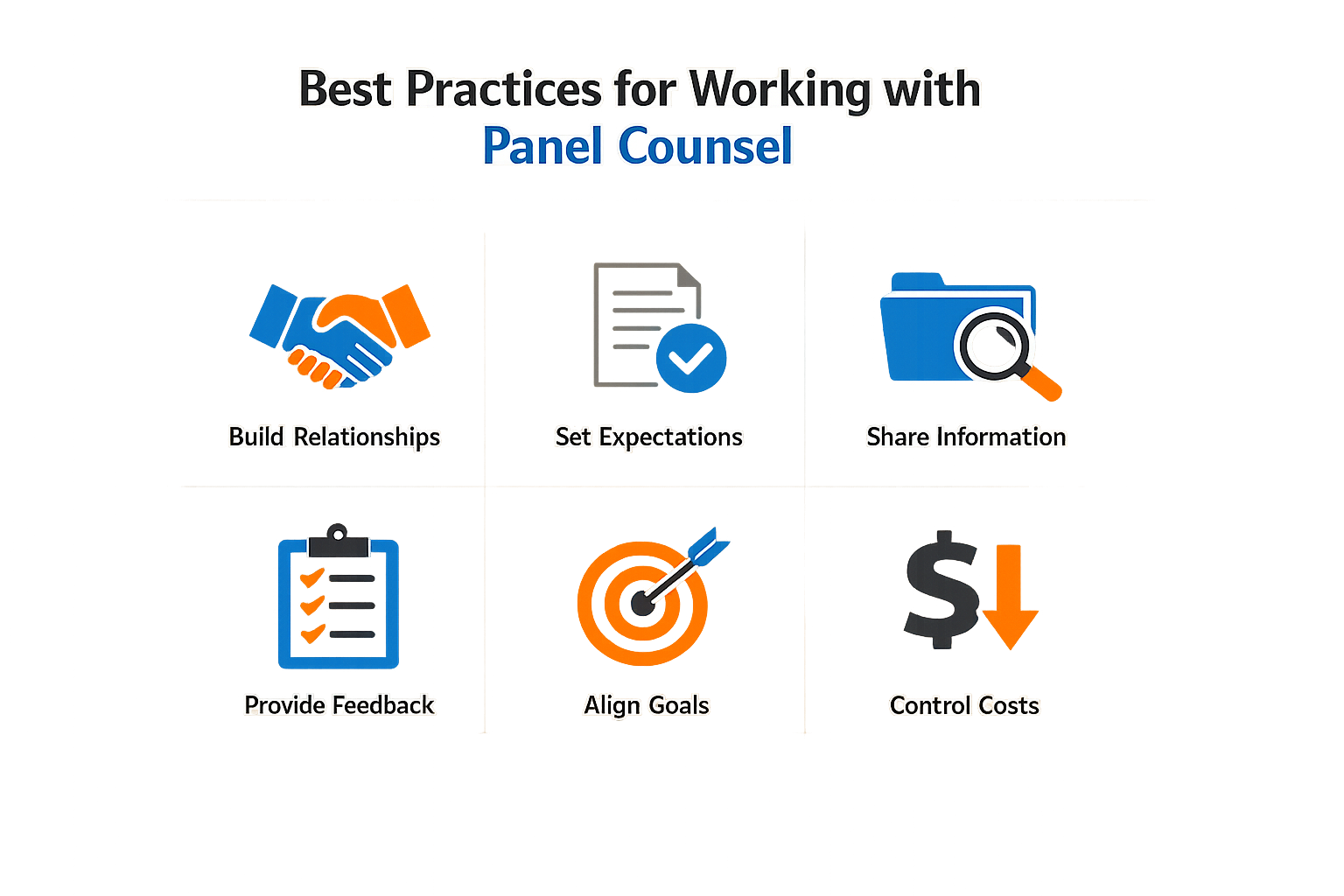
Working effectively within a panel counsel arrangement requires attention to both the insurer's operational expectations and the statutory duties that apply when independent counsel is retained. Firms that understand these dual obligations position themselves to avoid billing disputes, maintain panel status, and deliver representation that satisfies both the insured and the carrier.
Maintain Transparent Communication with the Carrier
California Civil Code section 2860, subdivision (d) imposes a disclosure duty on independent counsel selected by the insured: counsel must "disclose to the insurer all information concerning the action except privileged materials relevant to coverage disputes" and "timely inform and consult with the insurer on all matters relating to the action." This is not a courtesy—it is a statutory requirement. Firms that treat the carrier as an afterthought or withhold case developments invite friction and potential disputes over fees.
The statute also provides that any claim of privilege is subject to in camera review by the superior court, and that information disclosed to the insurer does not waive privilege as to any other party. This framework allows counsel to share case information without compromising the insured's position in the underlying litigation.
Structure Billing Entries to Meet Guideline Standards
Most carrier guidelines prohibit block billing and require narrative detail sufficient to allow line-by-line review. An entry reading "research and draft motion in limine, 4.2" will trigger a reduction under nearly every panel guideline. Break the work into discrete tasks, each with its own line item and UTBMS activity code.
Step 1
Draft with specificity
Describe what you researched, what you drafted, and what legal issue the work addressed. "Research California hearsay exceptions for business records, Vehicle Code section 40600, 1.5" is defensible. "Legal research, 1.5" is not.
Step 2
Use tenth-of-an-hour increments
Three of the four major carriers with published guidelines specify tenth-of-an-hour billing. The fourth is silent, which is not the same as permissive. Round to the nearest tenth, and never bill in quarter-hour blocks unless the guideline explicitly permits it.
Step 3
Flag pre-approval items before submission
If the guideline requires pre-approval for expert fees, travel outside a specified radius, or co-counsel, obtain written approval before incurring the expense. Submitting the invoice first and seeking approval during the appeal is a losing strategy.
Understand the Reduction and Appeal Process
When an invoice is reduced, the e-billing portal typically assigns a reduction code and a brief explanation. Common codes include "block billing," "excessive time," "clerical task billed at attorney rate," and "travel not pre-approved." Each code corresponds to a specific guideline provision. Read the guideline section cited in the reduction notice, compare it to the line item, and determine whether the reduction is supported.
If the reduction is not supported—for example, the guideline permits intra-office conferences but the reviewer reduced one anyway—submit a written appeal through the portal, cite the guideline section that permits the entry, and attach the relevant page. Reviewers correct clear errors when the appeal is specific and the guideline language is unambiguous.
The cheapest invoice is the one the reviewer can audit in ten minutes without flagging a single line.
Coordinate Early on Staffing and Budget
Panel guidelines often specify staffing ratios, limit the number of timekeepers who may attend a deposition or hearing, and cap total fees for certain case phases. If the guideline states that only one attorney may attend a mediation, sending two without prior approval will result in a reduction of the second attorney's time. If a matter budget has been set, monitor it weekly and notify the carrier before you approach the limit. Requesting a budget increase after the work is complete is far less effective than requesting it in advance with a clear explanation of why the additional work is necessary.
Conclusion
Panel counsel programs define the relationship between insurers and the defense firms they retain to handle claims. Understanding how these programs operate — from initial selection through ongoing case assignment and oversight — equips both carriers and law firms to manage expectations, reduce friction, and maintain compliance with published guidelines. The selection criteria, assignment protocols, and billing standards described in the preceding sections are not abstract principles; they are the mechanics that determine which firms receive work, which invoices clear review, and which relationships endure over multiple policy years.
As a member of the Carrier Ready Knowledge Team, I often delve into the intricacies of how insurers select and manage defense firms through panel counsel programs. Our research is grounded in a careful examination of carrier outside counsel guidelines, which outline the criteria and expectations for law firms seeking to join these panels. One of the recurring patterns we observe in our reviews is the emphasis on cost control and efficiency — entries such as travel, intra-office conferences, and administrative time billed at attorney rates are frequently flagged for reduction. This pattern underscores the importance insurers place on managing expenses while maintaining quality legal representation.
Firms that treat panel membership as a static credential rather than an ongoing performance contract risk removal at the next evaluation cycle. Carriers monitor not only case outcomes but also billing discipline, narrative detail, adherence to staffing ratios, and responsiveness to assignment protocols. A firm that consistently submits invoices with block billing or exceeds pre-approval thresholds without prior authorization signals operational risk to the carrier's litigation manager, regardless of trial skill. The panel is a managed roster, not a referral list.
Case assignment procedures vary by program, but the principle is consistent: assignment authority rests with the carrier or its designated litigation manager, and reassignment within the firm requires prior written approval. Defense counsel must acknowledge receipt of each new matter, confirm the assigned attorney, and notify the carrier immediately if circumstances require a substitution. These procedural requirements protect the carrier's ability to track staffing, maintain continuity, and enforce the guidelines that govern the representation.
For firms seeking panel membership or working to maintain their position, the path forward is straightforward: read the published guidelines, implement the billing and reporting standards they specify, and document compliance at every invoice cycle. The guidelines are not suggestions. They are the terms of the engagement, and they supersede general billing customs or the firm's internal practices. Firms that align their timekeeping, narrative protocols, and invoice formats with the carrier's requirements before the first submission avoid the reduction-and-appeal cycle that consumes time and damages the relationship.
The panel counsel model serves the carrier's interest in predictable cost, consistent quality, and administrative efficiency. It serves the defense firm's interest in a steady flow of referred work under known terms. Both parties benefit when the selection criteria, assignment protocols, and billing standards are transparent, documented, and enforced. The alternative — ad hoc retention, inconsistent oversight, and post-invoice disputes — wastes resources and erodes trust. The panel structure, properly managed, prevents that outcome.