


Billable vs Non-Billable Hours in Insurance Defense
Top takeaways
- Billable hours are time entries submitted for payment under an insurance defense matter; non-billable hours are written off before invoicing or reduced during bill review
- Carrier outside counsel guidelines and UTBMS task codes define which activities are compensable and which fall outside the scope of reimbursable work
- Misclassifying time as billable when the guideline prohibits it triggers invoice rejections, write-downs, and appeals that cost more than the disputed line item
- Insurance defense attorneys report that the majority of their caseload involves representing carriers' policyholders or self-insured organizations under hourly billing arrangements
- Understanding the boundary between billable and non-billable work is essential for clean invoice submission and maintaining panel status
Introduction
Billable vs non-billable hours are time entries that determine whether an insurance defense attorney gets paid for work performed. Billable hours are submitted for payment under a matter; non-billable hours are written off before invoicing or reduced during bill review because carrier outside counsel guidelines prohibit them.
The distinction between billable and non-billable hours governs every line item on an insurance defense invoice. A billable hour is one the timekeeper submits for payment; a non-billable hour is one the firm absorbs, either because the guideline prohibits it or because the timekeeper chooses not to bill it. The 2024 CLM Defense Counsel Study defines insurance defense as representing an insurance carrier's policyholder or a self-insured organization, and almost all study participants reported that their caseloads meet that definition. Those same attorneys work under outside counsel guidelines that specify billing increments, task and activity codes, and narrative detail standards—and every one of those specifications determines whether a time entry clears the e-billing portal or triggers a reduction.
Carrier guidelines treat certain activities as categorically non-billable. Administrative tasks, clerical work, and intra-firm conferences typically fall into that category, as do revisions to correct the firm's own errors. Other activities are conditionally billable: legal research is compensable when it addresses a novel issue, but not when it covers settled law the timekeeper should already know. The guideline draws the line; the bill reviewer enforces it. When a timekeeper codes 4.2 hours to "research and draft motion" without breaking out the research component and without a UTBMS activity code, the reviewer sees block billing and applies a reduction. The firm can appeal, but the appeal costs attorney time—non-billable time—and the outcome is rarely favorable when the guideline language is clear.
The practical impact of the billable versus non-billable distinction shows up in three places: the timekeeper's daily entry decisions, the firm's pre-submission invoice review, and the carrier's post-submission bill review. At each stage, someone applies a rule to a time entry and decides whether it survives. The timekeeper who codes administrative work to a billable task code creates a problem the firm's billing coordinator must catch before submission. If the coordinator misses it, the e-billing portal flags it as a guideline violation, or the bill reviewer reduces it and issues a reduction code. Either way, the firm writes off the time. The only question is how much additional non-billable effort the firm expends defending an entry that should never have been submitted.
Understanding which hours are billable and which are not requires reading the controlling guideline, matching time entries to the permitted task and activity codes, and writing narratives that show the work falls within the compensable scope. That understanding is not optional for attorneys practicing in the insurance defense space, where the median respondent reports that the entirety of their practice meets the definition of insurance defense work.
What Makes Billable vs Non-Billable Hours Difficult to Track?
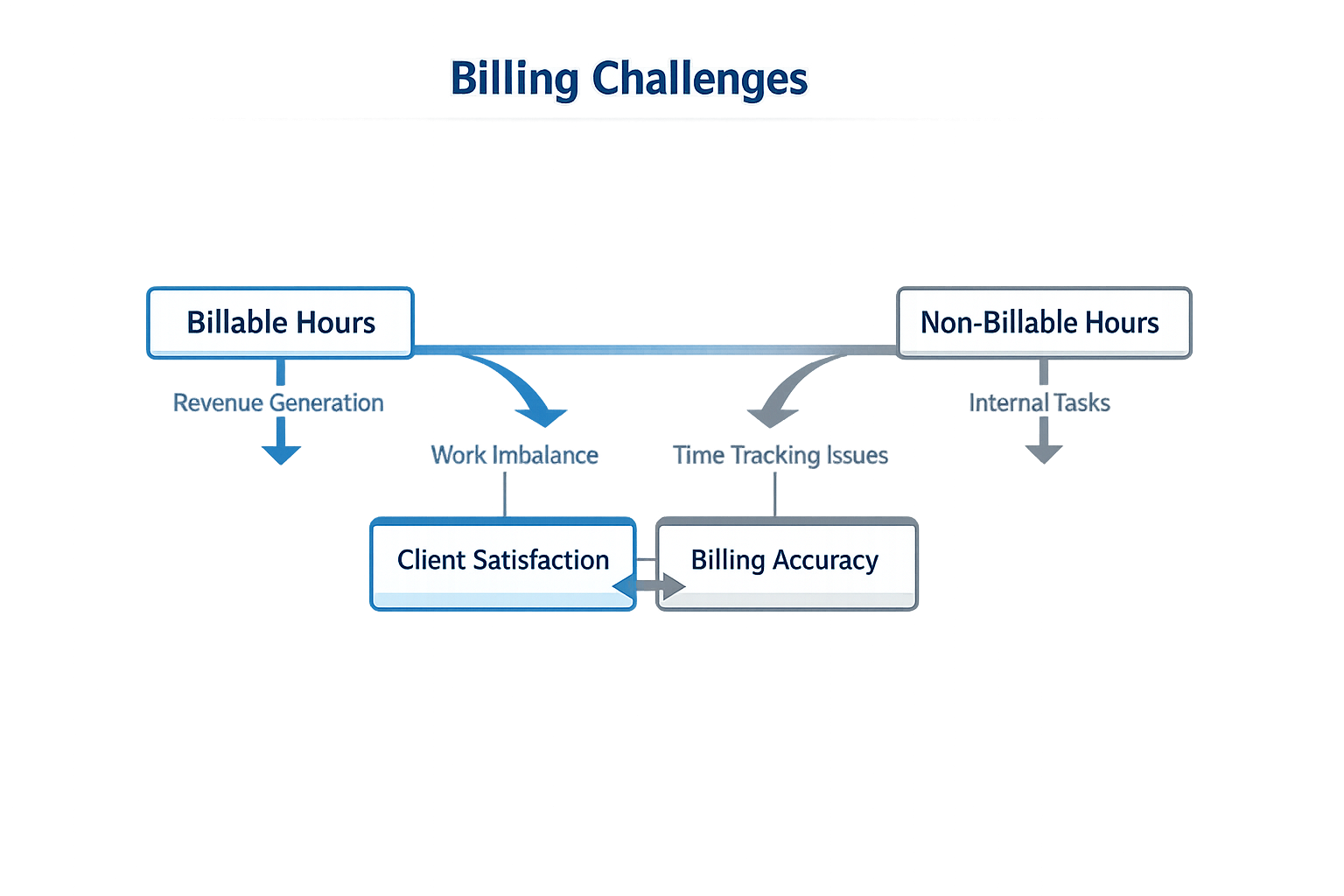
The hourly billing model creates an inherent misalignment between law firm revenue and carrier cost control. More than one in three claims professionals now believe that defense spending can positively affect indemnity outcomes — a meaningful departure from a core industry assumption that held for over a decade. That shift puts pressure on every line item: if defense work can move the needle on settlement value, then distinguishing work that advances the case from work that does not becomes a live question on every invoice.
Traditional time-plus-expense billing does not resolve that question. The model records hours but does not classify them by strategic value, and it offers no mechanism to separate activities that directly benefit the insured from activities that serve firm administration, professional development, or billing compliance. When a timekeeper logs 0.3 hours for "review carrier guidelines," the entry is contemporaneous and the increment is compliant, but the activity contributed nothing to the defence. Carriers do not pay for that work, and outside counsel guidelines say so — but the line still appears, triggering a reduction code and an appeal cycle that consumes more non-billable time.
Confusion Over What Qualifies as Billable Work
Insurance defense work is defined narrowly: representing a carrier's policyholder, a self-insured organisation in liability or workers compensation litigation, or providing coverage opinions and coverage defence for carriers. Almost all defence counsel caseloads meet these criteria, yet the boundary between compensable and non-compensable time remains contested. A partner spends an hour training an associate on LEDES file structure. The associate later submits an invoice with fewer formatting errors, which reduces the carrier's bill review cost — but the training hour itself is not billable under any published guideline. The same partner spends thirty minutes reviewing the firm's own invoice before submission to catch block billing violations. That review prevents a rejection, but it is administrative overhead, not case work.
The confusion deepens when timekeepers conflate billing increment compliance with billing category compliance. An entry reading "administrative tasks, 0.1" is recorded in tenths of an hour, but the narrative flags it as non-billable work. The e-billing portal accepts the file format, then the bill reviewer applies a reduction code because the task itself was never compensable. The timekeeper appeals, citing the increment standard, and the appeal is denied because the increment was never the issue.
Impact on Billing Accuracy and Carrier Relations
When non-billable hours appear on submitted invoices, the result is a predictable cycle: the carrier's bill review team applies a write-down, the firm appeals, the carrier sustains the reduction, and the relationship absorbs the friction. The 2026 CLM Litigation Management Study reports that carriers are re-examining whether hourly billing aligns law firm interests with their own. That re-examination is not abstract. It shows up as tighter pre-approval thresholds, more granular reduction codes, and a willingness to remove firms from panel rosters when billing disputes become routine.
Billing accuracy suffers because timekeepers do not receive clear, enforceable definitions of what counts as case work. A guideline might state that "administrative time is not compensable," but it will not define administrative. One timekeeper codes a coverage analysis as a billable task; another codes the same work as a non-billable coverage opinion because the carrier already paid for that opinion under a separate engagement. Both timekeepers believe they are compliant, and both are wrong in different directions. The carrier reduces both invoices, and the firm's billing coordinator spends non-billable time reconciling the reduction codes with the original time entries.
The cycle persists because the hourly model treats all recorded time as presumptively billable unless a guideline explicitly prohibits it. That presumption is backward. In insurance defense, time is presumptively non-billable unless the activity directly advances the matter for which the firm was retained. Reversing that presumption would eliminate most of the confusion, but it would also require timekeepers to justify every entry before recording it — a discipline that the billable hour, by design, does not reward.
How Do You Distinguish Billable vs Non-Billable Hours?
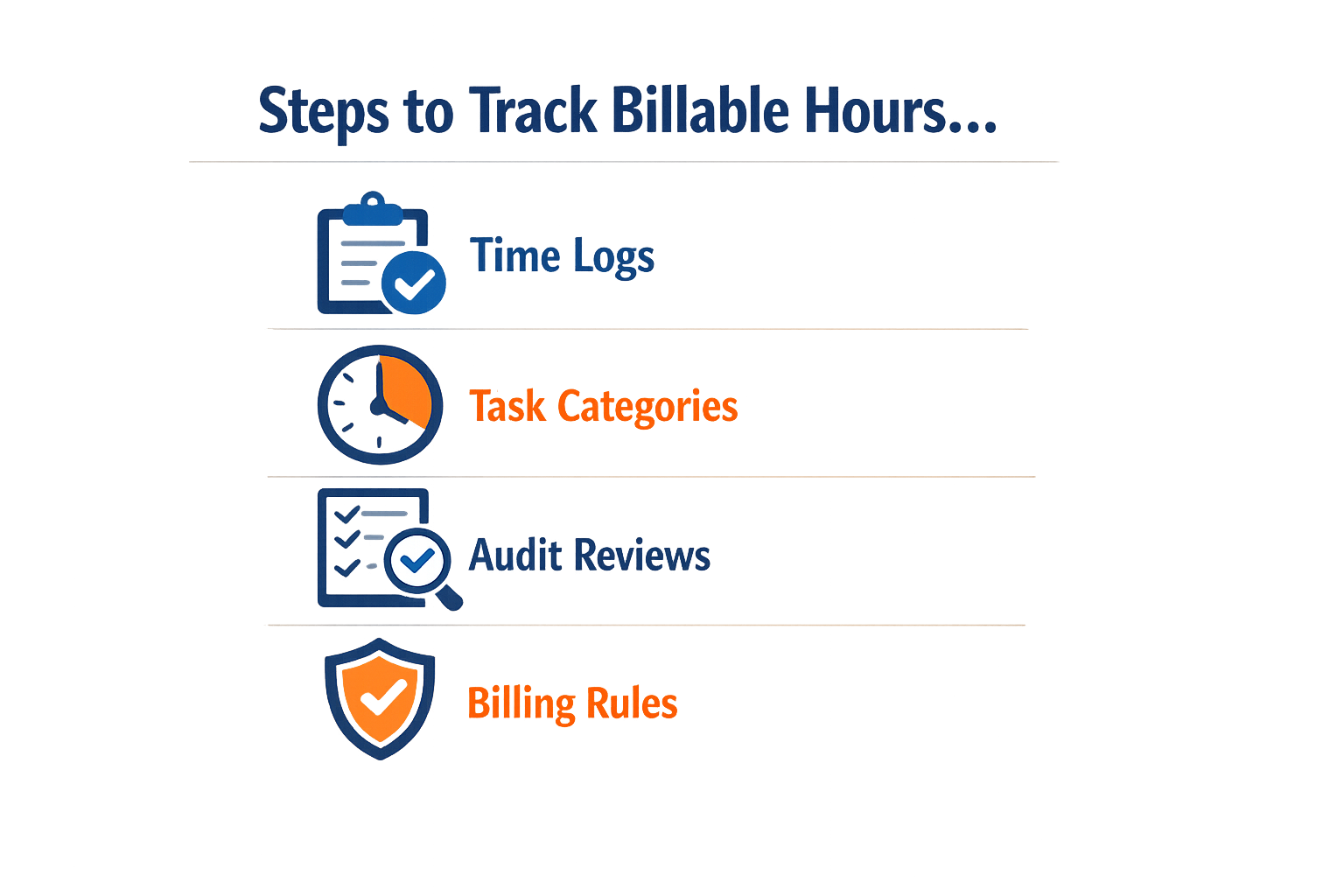
Accurate time tracking starts with a clear understanding of what the carrier will pay for. Most panel guidelines define billable work as tasks directly advancing the defense of the insured, while administrative overhead, firm management, and duplicative efforts fall outside that boundary. The line is not always obvious, and the carrier's published guideline is the only authoritative reference.
Step 1: Read the controlling outside counsel guideline
Step 1
Read the controlling outside counsel guideline
Before entering a single line item, locate the carrier's current outside counsel guideline for the matter. The guideline specifies which activities are compensable and which are not. If the guideline prohibits billing for intra-office conferences or travel time, those hours are non-billable regardless of how much time they consumed. The guideline version number and effective date control — older versions do not.
Step 2: Assign the correct UTBMS task and activity codes at the time of entry
Step 2
Assign the correct UTBMS task and activity codes at the time of entry
Every fee entry submitted in a LEDES file must carry a task code and an activity code. The task code identifies the phase of the case (discovery, motions, trial preparation); the activity code identifies the specific action taken within that phase. Reviewers read these codes first, and a mismatch between the narrative and the code triggers a reduction. If the narrative describes legal research but the activity code is A101 (plan and prepare for issue or claim), the entry will be flagged. Assign codes contemporaneously, when the work is fresh, not days later when memory has faded.
For a detailed breakdown of activity codes and their definitions, see UTBMS Activity Codes A101-A111 for Legal Billing.
Step 3: Separate billable and non-billable time in real time
Step 3
Separate billable and non-billable time in real time
Do not wait until the invoice is due to decide whether an entry is billable. If a task is administrative (updating the firm's conflict database, attending a firm retreat, general continuing legal education not specific to the case), mark it non-billable immediately. If a task is duplicative (two partners attending the same deposition when the guideline permits only one timekeeper per event), the second timekeeper's entry is non-billable. Contemporaneous classification prevents the temptation to reclassify non-billable work as billable when the month's total looks low.
Step 4: Document the narrative with sufficient detail to survive review
A one-line entry reading "legal research, 3.5" will be reduced or rejected under most panel guidelines. The narrative must specify the issue researched, the authority consulted, and the work product produced. "Research California summary judgment standards for premises liability; review Rowland v. Christian and progeny; draft memorandum to file" is billable. "Legal research" is not. The narrative must also align with the activity code: if the code is A102 (identify and analyze factual issues), the narrative must describe factual analysis, not legal research.
Step 5: Apply the guideline's billing increment and avoid block billing
Most carrier guidelines specify tenth-of-an-hour increments (six-minute blocks). Rounding every task up to the nearest tenth inflates the invoice and invites scrutiny. If a task took four minutes, record 0.1 hours; if it took twelve minutes, record 0.2 hours. Block billing — lumping multiple tasks into a single narrative and time entry — is prohibited under most guidelines. "Review complaint, draft answer, confer with client, 4.2" is block billing. Each task must be a separate line item with its own time entry, task code, and activity code.
The guideline is not a suggestion. Where it says a task is non-billable, that task is non-billable, and no amount of narrative detail will change the outcome.
Step 6: Pre-screen the invoice before submission
Before uploading the LEDES file to the e-billing portal, run an internal screen against the guideline's prohibited-activity list. Common reductions include billing for more than one timekeeper at a hearing, billing for travel time when the guideline caps it at zero, and billing for clerical tasks that the guideline assigns to overhead. If the guideline prohibits billing for intra-office email, remove those entries before submission. A pre-screened invoice reduces the rejection rate and shortens the payment cycle.
Step 7: Track non-billable hours separately for firm management purposes
Non-billable hours are not wasted hours. They include business development, firm administration, mentoring junior attorneys, and pro bono work. Track them in a separate category so that firm management can assess total time investment per matter and per timekeeper. A matter with high non-billable hours may still be profitable if it generates repeat business or strengthens the firm's panel relationship, but that analysis requires accurate data.
Tips and Tricks

Tracking time accurately starts with capturing it at the moment the work happens. Waiting until the end of the day to reconstruct your entries introduces error and invites block billing. Contemporary time records — entries made within an hour of the work — produce line items that survive bill review. When you draft a discovery response at 10:15 and enter it at 10:30, the narrative writes itself. When you reconstruct six tasks at 5:00 p.m., you produce the kind of aggregated entry that triggers a reduction code.
Build habits that produce clean line items
Set a timer for every task and record the entry before you move to the next one. Use your billing system's mobile app or a stopwatch widget to capture time in real increments, not rounded guesses. If the work takes four minutes, enter 0.1 hours and move on. If it takes twelve minutes, enter 0.2 hours. Rounding every entry up to the next tenth costs you nothing on a single line item, but across two hundred entries in a month it creates an invoice that looks padded.
Separate administrative work from case work in your calendar and your billing system. Time spent on firm management, business development, or continuing legal education is non-billable, and mixing it with client work creates confusion at submission. If you attend a seminar on insurance coverage law in the morning and draft a coverage analysis in the afternoon, those are two separate entries with two separate billing codes — or one entry and one internal write-off. Label non-billable time clearly in your system so that it never reaches the invoice stage.
Use task and activity codes to guide your entries
UTBMS task and activity codes are not decoration. They structure your narrative and signal to the reviewer what kind of work you performed. When you select L320 (Depositions) and A102 (Plan and prepare for), the reviewer expects a line item about deposition preparation, not a mixed entry that also covers a phone call and a document review. Choosing the correct code forces you to separate the work into discrete entries, which is exactly what the guideline requires. If your entry legitimately spans two activities, write two line items. The UTBMS Activity Codes A101-A111 for Legal Billing resource explains how reviewers read these codes and what they expect to see in the narrative.
Step 1
Record time immediately after completing the task
Open your billing system, select the matter, enter the time in tenths, choose the task and activity code, and write one sentence describing what you did. Do this before you check email or start the next task.
Step 2
Review your draft invoice before submission
Read every line item as if you were the bill reviewer. If an entry describes more than one task, split it. If the narrative is vague, rewrite it. If the time seems high for the work described, double-check your timer log.
Step 3
Track non-billable time in a separate category
Use your billing system's non-billable or administrative codes for firm meetings, training, and business development. This keeps non-billable work out of the client invoice and gives you an accurate picture of where your day goes.
Manage your day to protect billable time
Batch administrative tasks into a single block rather than scattering them across the day. Respond to internal emails once in the morning and once in the afternoon. Schedule client calls and depositions in adjacent time slots to reduce transition overhead. Every context switch costs you ten minutes of non-billable time while you reorient to the new task. Protect your billable blocks by treating them as you would a court appearance — non-negotiable and free from interruption.
When a task legitimately requires more time than the guideline's pre-approval threshold, document the reason contemporaneously. If a motion requires 8.0 hours and the threshold is 5.0, write a short explanation of the additional work and seek pre-approval before you perform it. Submitting the invoice without that approval guarantees a reduction. Seeking it in advance and receiving it in writing turns a likely write-down into a clean line item.
The cheapest invoice is the one that clears bill review without a reduction code.
The 2026 CLM Litigation Management Study reports that more than one in three respondents now believe defense spending can positively affect indemnity outcomes, a shift from a long-held industry view. That shift does not eliminate the scrutiny applied to each line item. Carriers expect efficient billing even when they value the work. An invoice that demonstrates careful time tracking and narrative discipline signals competence. An invoice filled with block entries and vague descriptions signals carelessness, regardless of the quality of the underlying legal work.
Conclusion
The line between billable and non-billable hours in insurance defense is not a matter of preference or internal firm convention — it is drawn by the carrier guideline, the UTBMS code set, and the e-billing portal that enforces both. A timekeeper who treats administrative overhead, duplicative conferences, or unilateral legal research as compensable work invites reduction codes, appeal cycles, and the erosion of panel standing. The invoice that survives review is the one built from contemporaneous entries, coded to the controlling task and activity, and supported by narrative detail sufficient to answer the question: what did this accomplish for the insured and the claim?
Carriers now state openly that the traditional hourly model misaligns incentives, and more than one in three claims professionals believe targeted defense spending improves indemnity outcomes. That shift in perspective does not make non-billable time disappear, but it does mean the scrutiny applied to each line item will only intensify. Firms that document the distinction clearly, staff matters within guideline ratios, and submit invoices that require no translation will spend less time appealing reductions and more time defending cases.
For a detailed breakdown of the activity codes that govern fee entries, see UTBMS Activity Codes A101-A111 for Legal Billing. The guideline is the rulebook, the LEDES file is the scorecard, and the bill reviewer is keeping both in front of them when your invoice arrives. Read the controlling document, code the entry correctly, and write a narrative that shows your work — that is the practice that keeps the invoice out of the rejection queue.
FAQ
What are billable vs non-billable hours in insurance defense?Billable hours are time entries submitted for payment under a matter; non-billable hours are written off before invoicing or reduced during bill review because carrier guidelines prohibit them.
How do carrier guidelines determine billable vs non-billable hours?Carrier outside counsel guidelines specify which activities are compensable (legal research on novel issues, depositions, motion practice) and which are not (administrative tasks, clerical work, intra-firm conferences, travel time beyond caps).
Why do e-billing portals reject time entries?Portals reject entries when task codes are prohibited by the guideline, narratives contain block billing, increments violate the guideline's rounding rules, or the activity described is categorically non-billable.
Can I bill for time spent reviewing the carrier's billing guidelines?No. Time spent learning the carrier's billing requirements is administrative overhead and is non-billable under all published panel guidelines.
What happens if I submit non-billable hours on an invoice?The carrier's bill review team applies a write-down, issues a reduction code, and the firm absorbs the cost. Repeated violations can lead to removal from the panel roster.
How should I track non-billable hours?Use your billing system's non-billable or administrative codes to record firm meetings, training, business development, and pro bono work separately from client matters.