


VSP Insurance Billing for Vision Services: Compliance Essentials
Introduction
VSP Insurance Billing for Vision Services is the process by which optometry and ophthalmology practices submit claims to VSP for reimbursement of covered vision care services. Navigating this process requires a clear understanding of the guidelines and specifications that govern claim submission. As part of the Carrier Ready Knowledge Team, we focus on ensuring that practices adhere to the correct billing formats and codes. The LEDES 1998B format is a key specification that we often refer to, and understanding the UTBMS task, activity, and expense code sets is crucial, as these codes are integral to how reviewers interpret and process billing entries.
Vision care billing shares a common thread with other professional billing disciplines: the more detailed the description of the services, and the more closely providers adhere to the guidance provided as to appropriate billing and voucher submission, the more likely they are to have their invoices approved as submitted. This principle applies whether the submission is for a vision exam, contact lens fitting, or refractive surgery follow-up. Reviewers expect to see what was done, when it was done, and why the time or charge was necessary.
For optometry and ophthalmology practices, compliance is not an abstract concept. It translates directly into whether a claim is paid in full, reduced, or rejected outright. Attorney billing increments, narrative detail standards, and the prohibition against block billing are concepts that have direct parallels in vision care billing. A single line reading "office visit, exam, contact lens fitting, 1.5 hours" is the vision-billing equivalent of block billing — it bundles multiple services without sufficient detail, and reviewers cannot verify the reasonableness of the charge.
VSP and other vision insurance carriers publish guidelines that specify what they will pay for, what they will not pay for, and what level of detail they require in a submitted claim. These guidelines are not suggestions. They are the terms under which the carrier agrees to reimburse the provider. When a practice submits a claim that does not meet the guideline requirements, the carrier is within its rights to reduce or deny the claim, and the practice must either appeal the reduction or absorb the write-down.
Why Vision Care Billing Is Different
Vision care billing differs from general medical billing in several respects. Vision services often include both medical and optical components — for example, a comprehensive eye exam may be billed to medical insurance if it is medically necessary, while the refraction and optical dispensing are billed separately to vision insurance. VSP Insurance Billing for Vision Services requires providers to distinguish between these components and to submit each to the appropriate plan with the appropriate codes and supporting documentation.
Furthermore, vision care billing frequently involves multiple service dates within a single billing period, especially for contact lens fittings, follow-up visits, and vision therapy. Each service date must be documented separately, with a narrative that explains what was done on that date and why. Quarterly billing summaries, when required, must describe the services performed separately by month or by quarter, so that the reviewer can understand the progression of care without having access to previous invoices.
By aligning with these established standards, optometry and ophthalmology practices can ensure compliance and minimize the risk of billing rejections or reductions. The remainder of this article will walk through the common problems that arise in VSP Insurance Billing for Vision Services, the solution steps that practices can take to address those problems, and the tips and tricks that make the billing process more efficient and more likely to result in full reimbursement.
What Challenges Do Providers Face with VSP Insurance Billing for Vision Services?

Vision service providers face recurring obstacles when submitting claims under VSP insurance, many of which stem from misalignment between the provider's billing practices and the carrier's expectations. A line item reading "exam and materials, 1.5" may accurately reflect the time spent, but it fails the narrative-detail standard that most e-billing portals enforce. The result is a rejection at validation, a reduction during bill review, or both. According to the 2024 CLM Defense Counsel Study, 68% of surveyed firms reported billing guideline compliance as a significant operational challenge, and vision care practices encounter similar friction when their entries do not match carrier specifications.
Misunderstanding Coverage and Eligibility
Providers often bill for services that fall outside the member's plan coverage or that require pre-authorization the provider did not obtain. When the submitted claim references a procedure code the plan does not cover, the portal flags the entry and returns it unpaid. Verifying eligibility and covered services before the appointment is a step many practices skip, assuming that VSP membership alone guarantees reimbursement. It does not. Each plan tier defines a different set of covered services, copayment structures, and frequency limits, and the provider is expected to confirm these details in advance.
Billing Errors and Incomplete Documentation
Block billing — the practice of combining multiple distinct tasks into a single narrative — is a common cause of reduction. An entry that reads "consultation, frame selection, lens fitting, adjustment, 2.0" may represent four separate activities, but the reviewer cannot verify the time allocation for each. Carriers expect contemporaneous records that break out each service with its own start time, duration, and description. When the documentation does not support the billed time, the reviewer applies a reduction code, and the provider receives a lower payment than submitted.
Incomplete or inconsistent documentation compounds the problem. A claim form that lists one procedure code while the clinical notes describe a different service creates a discrepancy the reviewer cannot resolve in the provider's favor. The safer course is to write the claim off or reduce it to the lower-value service, and that is what happens.
Compliance Gaps and Transparency Failures
Transparency in billing helps avoid the perception of overcharging or unnecessary billing for hours worked. When a provider submits multiple claims in a short period without clear justification for the frequency, the carrier's fraud-detection algorithms flag the pattern for manual review. Even if the services were medically necessary, the lack of supporting narrative and the appearance of quota billing invite scrutiny and delay payment.
Orienting work toward resolution rather than quota billing can lead to more effective and ethical billing practices. Providers who document the clinical rationale for each service, who submit claims promptly with complete supporting records, and who respond to reduction notices with specific evidence rather than general objections recover more of their billed amounts and maintain better relationships with the carrier's review team. The alternative — submitting high volumes of under-documented claims and hoping most pass through — results in higher rejection rates, more write-downs, and eventual removal from the panel.
For detailed guidance on narrative standards and how to avoid block billing rejections, providers should review the carrier's published guidelines and compare their entries to the required format before submission. Understanding paralegal billing entry examples can also illustrate how granular task descriptions improve approval rates across professional billing contexts.
Solution Steps for VSP Insurance Billing Compliance
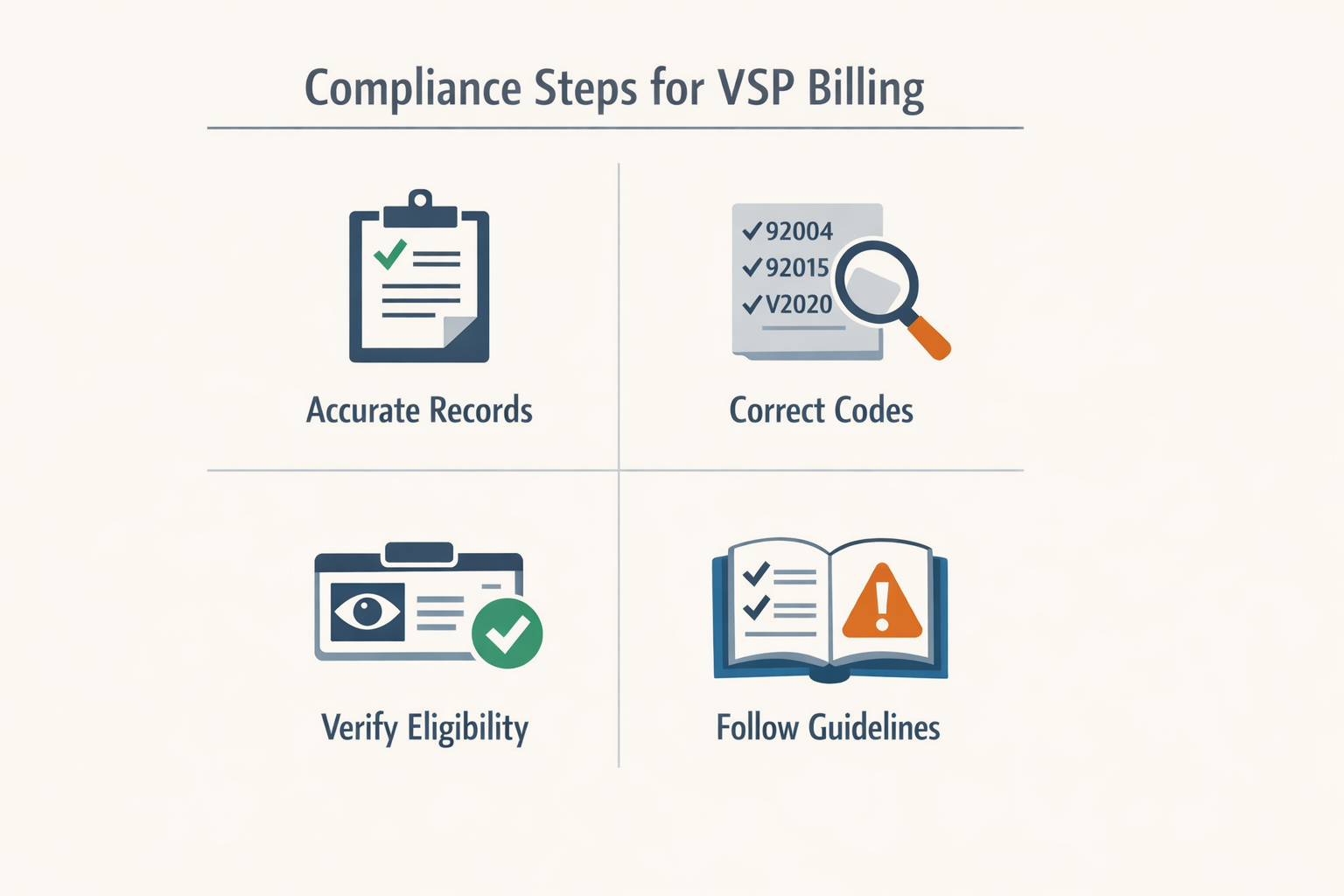
Vision service providers can reduce rejection rates and reimbursement delays by following a structured approach to invoice preparation and submission. The steps below translate general billing compliance principles into concrete actions that apply to carrier-submitted invoices.
Step 1: Document Services in Granular Detail
Describe each service provided separately, with the date, the procedure performed, and the time or units involved. A single line reading "exam and refraction, 1.5 hours" is less defensible than two lines: "comprehensive eye exam, 0.8" and "refraction, 0.7." The C.D. Cal. CJA Panel Manual (rev. Dec. 2022), p. 24, § IV. Ninth Circuit Practice, ¶ 5, states: "Describe in a reasonable amount of detail the services provided, as well as the number of hours spent and the total dollars billed." That same principle governs carrier review — the more detailed the description, the more likely the invoice is approved as submitted.
Step 1
Break down compound entries
When a single visit involves multiple services, itemize them. List the examination, any diagnostic imaging, refraction, and dispensing activities as separate line items with their own timestamps and procedure codes. Reviewers expect to see what happened, not a summary of the appointment.
Step 2: Prepare Quarterly Summaries for Recurring Submissions
If your practice submits invoices on a recurring cycle, maintain a running summary of services performed each quarter. The C.D. Cal. CJA Panel Manual (rev. Dec. 2022), p. 24, § IV. Ninth Circuit Practice, ¶ 5, advises: "It is most helpful if you describe the services performed separately by month or by quarter. As quarterly billing is now required, it would seem most efficient to prepare a summary when you submit your vouchers every quarter and maintain it in your files for submission." This approach keeps contemporaneous records organized and ready for any subsequent inquiry.
Step 2
Maintain a quarterly log
Create a simple spreadsheet or log that tracks each patient visit, the services rendered, the codes used, and the amounts billed. Update it weekly. When the quarter closes, the summary is already built, and you can attach it to the invoice without scrambling for records.
Step 3: Verify Phrasing and Rate Approval Before Submission
Before you transmit an invoice, confirm that every narrative description uses language the carrier permits and that every rate matches the approved schedule. The ledes.org LEDES Error Codes page, paragraph 21, lists a common rejection reason: "It does not meet a specific requirement (bulk billing, prior approval is required, contains phrasing not allowed by client, unapproved rate, etc.)." A single disallowed phrase or an outdated rate triggers a rejection that could have been caught in pre-submission review.
Step 4: Use Approved Codes and Formats Consistently
If the carrier specifies a file format or a code set, use it exactly as published. For example, LEDES 1998B defines a fixed field structure; omitting a mandatory field may pass validation at one portal but fail at another. Similarly, UTBMS task and activity codes carry specific meanings that reviewers rely on to interpret your entries. Consistency across submissions builds a track record of compliance and reduces the likelihood of ad hoc reductions.
Step 3
Validate file structure and codes
Before final submission, run your invoice through a format validator if one is available, or manually verify that required fields are populated and that task codes match the services described. For related guidance on billing increments and narrative detail, see Attorney Billing Increments: 0.1 vs. 0.25 Requirements.
Step 5: Retain Documentation for the Full Review Period
Keep copies of submitted invoices, supporting records, and any correspondence with the carrier for the period specified in your agreement. If a line item is questioned months after submission, you need to produce the contemporaneous record that justifies it. Organized files turn a potential dispute into a quick resolution.
Step 4
Archive invoices and backup records
Store each submitted invoice with its supporting documentation in a dated folder. Include the carrier's acknowledgment or confirmation email, the guideline version you referenced, and any pre-approval correspondence. Label the folder with the submission date and the invoice number.
Tips and Tricks for Efficient VSP Billing
Efficient billing is not only about submitting invoices on time — it is about reducing administrative friction at every stage of the process. Vision service providers who treat billing as a workflow rather than a monthly task see fewer rejections, faster reimbursement cycles, and clearer communication with payers. The following strategies address common pain points and help practices maintain consistency in their VSP insurance billing for vision services.
Reduce Administrative Burden Through Standardized Entry
Administrative burdens around billing and collection slow down reimbursement and increase the risk of errors. Standardizing how timekeepers and billing staff enter line items — using consistent task descriptions, uniform increments, and pre-approved narrative templates — eliminates the need for manual review of every entry before submission. When billing staff do not have to guess whether a description will pass review, they spend less time editing and more time processing.
Many practices find that defining a short list of acceptable narrative patterns for routine services (examinations, fittings, follow-up consultations) reduces the volume of entries flagged during internal quality control. This approach does not eliminate the need for detail — it ensures that the detail provided is the detail the payer expects.
Treat the Payer as a Partner, Not a Vendor
Carriers should view firms as partners rather than vendors to enhance collaboration in billing and collection processes. Vision service providers benefit from the same principle: approaching VSP as a collaborative payer rather than an adversarial reviewer changes how practices respond to feedback. When a line item is reduced or rejected, the instinct is often to appeal immediately. A more productive first step is to ask why the reduction occurred and whether the practice's standard entry format needs adjustment.
Regular communication with the payer — whether through a dedicated account representative or periodic billing reviews — surfaces guideline changes before they trigger widespread reductions. Practices that wait until a pattern of rejections emerges have already lost revenue and created rework. Practices that check in quarterly, review recent reduction codes, and adjust their templates proactively avoid that cycle.
The cheapest billing error is the one you catch before the invoice leaves your office.
Align Rate Negotiation with the Claims Function
Panel selection and rate negotiation should be handled by claims or legal functions instead of separate vendor management teams. For vision service providers, this means ensuring that the individuals who understand the clinical and administrative realities of delivering care are involved in any conversation about reimbursement rates, billing increments, or documentation requirements. When rate negotiation is separated from the people who actually submit invoices, the negotiated terms often conflict with the practice's operational capacity.
If a contract specifies tenth-of-an-hour increments but the practice's time-tracking system rounds to quarter hours, every invoice will require manual adjustment. If a guideline prohibits block billing but the practice's standard workflow groups related tasks into single entries, compliance becomes a post-hoc editing exercise rather than a built-in feature of the billing process. Involving billing and clinical staff in contract review prevents these mismatches.
Build a Pre-Submission Checklist
A pre-submission checklist tailored to VSP's requirements catches errors before they reach the payer. The checklist should include:
- Verification that all line items use the specified billing increment
- Confirmation that narrative detail identifies the service, the patient interaction, and the outcome
- Review of task codes (if applicable) to ensure they align with the service described
- Check that any pre-approval thresholds have been met and documented
- Validation that the invoice file format matches the payer's specification
Practices that use e-billing portals should also verify that the portal's validation rules match the payer's published guidelines. Some portals accept files that omit fields the specification marks as mandatory, which means the file passes portal validation but fails payer review. Running a test submission with a small sample invoice before processing a full month's billing reveals these discrepancies early.
For more on how to structure billing descriptions that meet payer expectations, see Sample Attorney Billing Descriptions PDF That Pass Carrier Review and review Outside Counsel Guidelines for Insurance Litigation for parallel compliance frameworks.
Track Reduction Codes and Adjust Templates
Every reduction notice includes a reduction code explaining why the line item was adjusted. Practices that track these codes over time identify patterns: certain narrative structures trigger reductions, specific task descriptions are flagged as vague, or particular increments are rejected as inconsistent with the guideline. Once a pattern emerges, the practice can revise its templates to eliminate the trigger.
For example, if multiple line items described as "patient consultation" are reduced with a code indicating insufficient detail, the practice can update its template to require staff to specify whether the consultation addressed a new concern, a follow-up to prior treatment, or a pre-operative evaluation. The next month's submissions avoid the same reduction.
This feedback loop turns reduction notices from frustrations into process improvements. Practices that treat reductions as isolated errors continue to submit the same problematic entries. Practices that treat reductions as data adjust their workflow and reduce their error rate.
Conclusion
Accurate VSP insurance billing for vision services depends on three elements: detailed narratives that justify the time spent, adherence to the billing increments and code sets the carrier expects, and submission through the correct portal with the correct file format. The more specific the description of services rendered, and the more closely practices follow published billing guidance, the more likely invoices are to be approved as submitted. This principle applies equally to optometry practices submitting claims for routine examinations and to ophthalmology offices billing for surgical procedures — the standard is reasonableness, not just technical compliance.
Navigating VSP insurance billing for vision services requires a clear understanding of the guidelines and specifications that govern the process. As part of the Carrier Ready Knowledge Team, we focus on ensuring that practices adhere to the correct billing formats and codes. For instance, the LEDES 1998B format is a key specification that we often refer to, and understanding the UTBMS task, activity, and expense code sets is crucial, as these codes are integral to how reviewers interpret and process billing entries. By aligning with these established standards, optometry and ophthalmology practices can ensure compliance and minimize the risk of billing rejections or reductions.
VSP and other vision-care insurers operate within a framework that values transparency and accountability. Practices that invest time in training staff on narrative detail, billing increments, and code selection will see fewer write-downs and faster reimbursement cycles. For broader guidance on structuring billing entries that satisfy carrier review standards, see Sample Attorney Billing Descriptions PDF That Pass Carrier Review. The same principles — specificity, contemporaneous documentation, and adherence to published guidelines — apply across insurance defense billing, whether the service is legal or clinical.
FAQ
What is VSP Insurance Billing for Vision Services?VSP Insurance Billing for Vision Services is the process by which optometry and ophthalmology practices submit claims to VSP for reimbursement of covered vision care services, following specific billing formats and narrative detail standards.
How can I avoid block billing rejections in VSP claims?Break down compound entries into separate line items, each with its own timestamp, procedure code, and description. Reviewers need to see what was done, when, and why — not a summary of multiple tasks.
What documentation does VSP require for claim approval?VSP requires contemporaneous records that detail each service date, the procedure performed, the time or units involved, and the clinical rationale. Quarterly summaries must describe services separately by month or quarter.
Why was my VSP claim reduced or denied?Common reasons include block billing, insufficient narrative detail, unapproved rates, disallowed phrasing, missing pre-authorization, or procedure codes not covered under the member's plan tier.
How do I verify VSP coverage before submitting a claim?Confirm the member's plan tier, covered services, copayment structure, and frequency limits through VSP's provider portal or eligibility verification system before the appointment.