


Anthem Insurance: How to Prevent Insurance Claim Denials in Medical
Introduction
To prevent insurance claim denials in medical billing, healthcare practices must implement three core disciplines: verify patient eligibility before service delivery, apply precise diagnostic and procedure codes at the point of entry, and maintain documentation that supports every billed item. Each denied claim triggers a review cycle that consumes staff time, delays payment, and in some cases results in write-offs when the appeal window closes. The administrative burden extends beyond the billing department: clinical staff must retrieve records, verify services, and reconstruct documentation that should have been captured at the point of care.
Denials fall into two categories: technical rejections that occur during electronic submission, and post-adjudication denials issued after the carrier reviews the claim. Technical rejections often stem from formatting errors, missing required fields, or eligibility mismatches that automated systems flag before a human reviewer sees the file. Post-adjudication denials, by contrast, reflect the carrier's determination that the service was not covered, not medically necessary, or not supported by the submitted documentation. Both types are preventable when the practice implements verification protocols, applies codes correctly, and submits complete narratives with each claim.
In examining the nuances of insurance claim denials, it is crucial to understand the patterns that influence these outcomes. One recurring pattern visible across various published guidelines is the frequent flagging of entries such as travel, intra-office conferences, and administrative time billed at attorney rates—principles that extend to medical billing when non-clinical or duplicative charges appear on a claim. By being aware of common pitfalls, healthcare practices can better prepare their billing submissions to avoid unnecessary denials.
The financial impact of denials compounds over time. A practice that recovers seventy percent of denied claims through appeals still absorbs the cost of the remaining thirty percent, plus the labor invested in every appeal. Preventing denials at the front end eliminates that cost entirely and accelerates the revenue cycle. The strategies that follow address eligibility verification, coding accuracy, documentation standards, and submission protocols—each a checkpoint where a preventable denial can be stopped before it reaches the carrier.
Understanding the Problem of Insurance Claim Denials
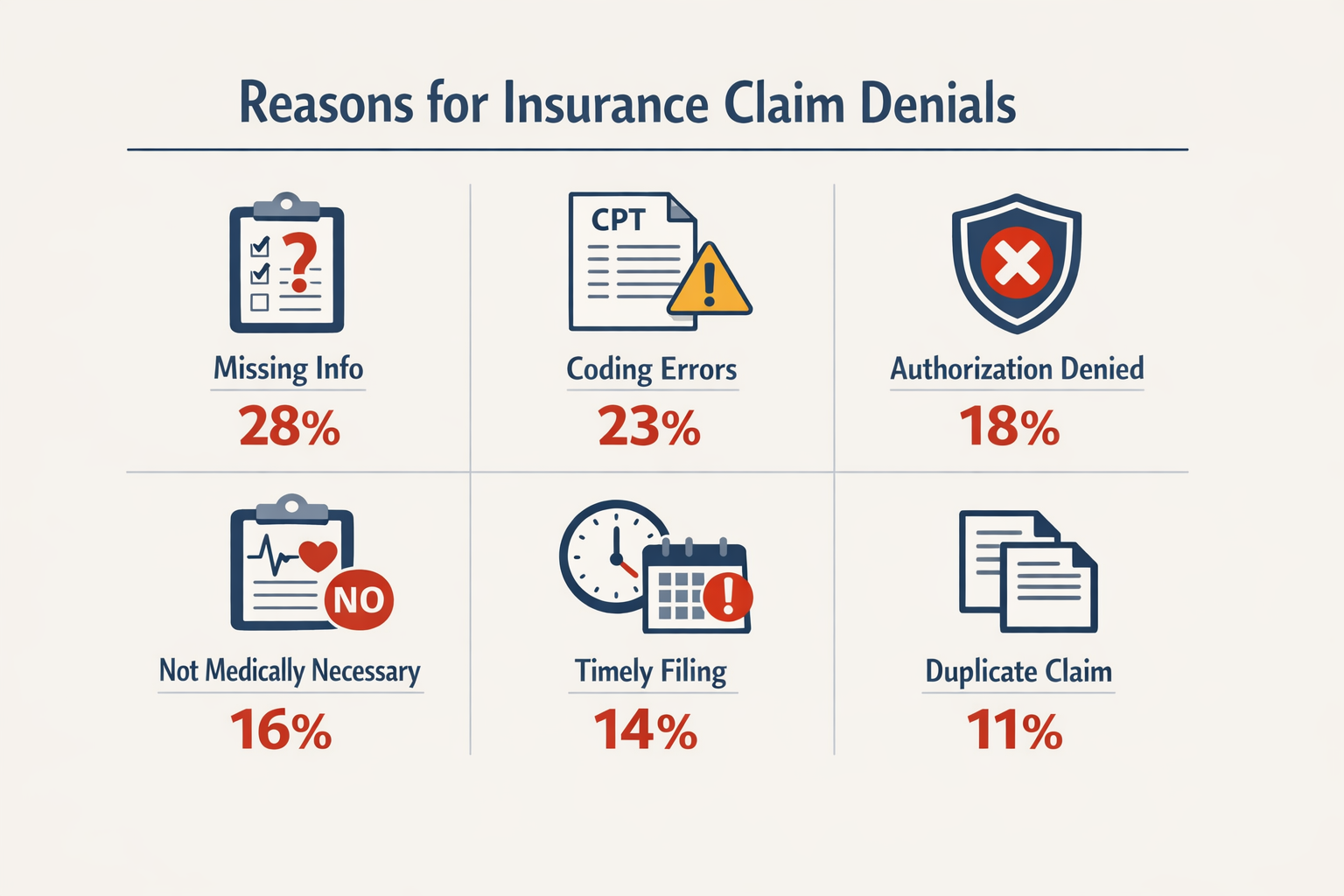
Insurance claim denials cost healthcare providers time, revenue, and administrative effort. A denied claim is not simply delayed payment — it triggers a review cycle, demands staff hours to investigate and resubmit, and in many cases results in permanent write-offs when the appeal window closes. The financial impact compounds when denials cluster around preventable errors: incorrect codes, missing documentation, or eligibility issues that a front-end check would have caught.
The reasons for denials fall into predictable categories. Coding errors — wrong diagnosis codes, outdated procedure codes, or mismatched modifiers — account for a significant share. Eligibility and coverage lapses, often discoverable before the claim is filed, generate denials that could have been avoided with a verification step at intake. Documentation deficiencies, where the medical record does not support the billed service or the insurer questions the necessity of care, create friction even when the service was appropriate and delivered.
Common Denial Triggers in Medical Billing
Certain claim characteristics attract closer scrutiny. Allegations of subjective complaints — such as traumatic brain injury diagnoses supported only by patient-reported symptoms rather than objective imaging — can prompt insurers to question medical necessity. When a life-care plan recommends surgery without evidence that conservative treatment options were explored or failed, the claim may be flagged for review. These patterns, documented in claims management studies, reflect insurer concern about injury exaggeration and the pressure of medical inflation on overall claim costs.
The downstream consequences extend beyond the individual claim. Repeated denials signal process gaps — inadequate training, outdated coding references, or weak communication between clinical and billing staff. High denial rates erode cash flow, increase days in accounts receivable, and divert resources from patient care to rework. Practices that do not track denial reasons systematically often repeat the same mistakes, missing the opportunity to correct upstream workflows.
Understanding these denial drivers is the foundation for prevention. Once a practice knows where claims fail, it can implement targeted controls: eligibility checks before service, real-time coding validation, and documentation standards that align clinical notes with billing requirements. The goal is not to eliminate every denial — some are unavoidable — but to prevent insurance claim denials that stem from correctable internal errors.
How Do You Prevent Insurance Claim Denials in Medical Billing?
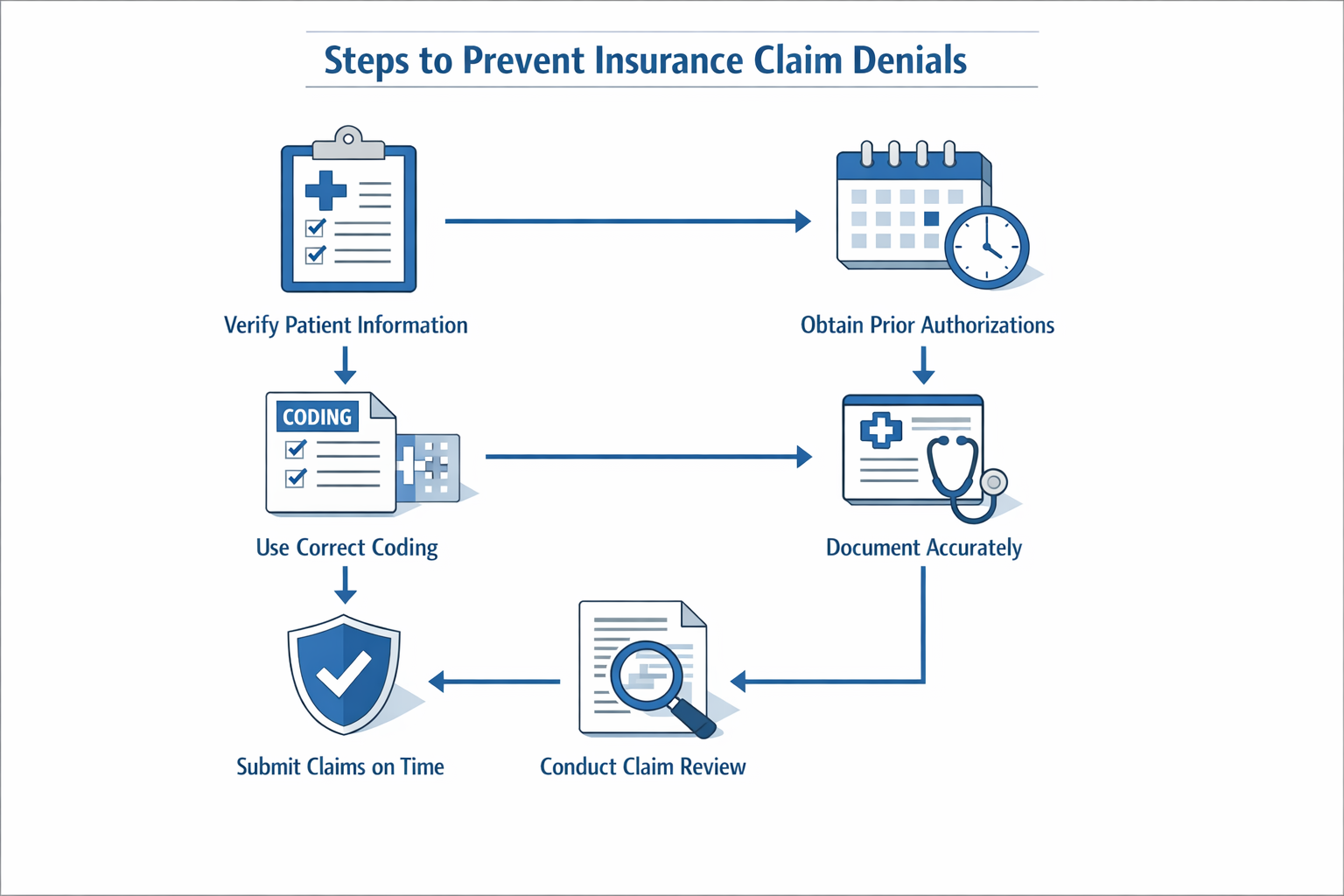
Preventing claim denials requires a structured approach that addresses documentation, submission timing, and third-party review protocols. The following steps are drawn from carrier practices and industry reporting on billing workflows.
Step 1: Establish Consent for Third-Party Invoice Review
Step 1
Obtain client consent before third-party review
Before any billing invoice is submitted to a third-party reviewer, secure documented consent from the insured or client. Virginia Legal Ethics Opinion 1723 states that detailed billing invoices may be reviewed by a third party only with the insured or client's consent or knowledge. Submitting invoices without this step can lead to ethical challenges and downstream claim denials when carriers question the validity of the billing process.
Document the consent in writing and store it with the claim file. This practice protects both the provider and the carrier from disputes over confidentiality and billing transparency.
Step 2: Follow Carrier-Specific Procedures for Discovery and Vendor Use
Step 2
Adhere to carrier restrictions on discovery and vendors
Liability insurance companies publish procedures that restrict discovery methods and the use of third-party vendors. Failure to follow these procedures is a common trigger for claim denials. Review the carrier's outside counsel guidelines or claims manual before initiating any third-party service, whether for medical record retrieval, imaging analysis, or billing review.
Carriers flag non-compliance with these restrictions during invoice review. One entry that deviates from the published guideline can result in a reduction or rejection of the entire invoice. Understanding attorney billing increments and narrative requirements is part of this compliance discipline.
Step 3: Perform Medical Record and Bill Management In-House
Step 3
Keep record review and bill processing internal
UTBMS Activity Code A115 defines medical record and bill management as services performed in-house only: review, compilation, digesting, summary, or processing of medical records or bills. Outsourcing these tasks without explicit carrier approval introduces a denial risk, as carriers may refuse to reimburse vendor charges or question the accuracy of externally processed documentation.
If a carrier permits third-party services, confirm that permission in writing and retain it with the claim file.
Step 4: Submit Claims Promptly and Accurately
Step 4
Avoid delays caused by understaffing or process gaps
The 2024 CLM Defense Counsel Study reports that understaffing in claims departments creates delays that hinder effective case handling. These delays can push submissions past filing deadlines or result in incomplete documentation. Establish internal deadlines that allow for review and correction before the carrier's submission window closes.
Accuracy at submission is non-negotiable. A claim submitted with missing fields, incorrect codes, or unsupported charges will be rejected or reduced. Double-check every line item against the carrier's published requirements before transmission.
Step 5: Use Historical Diagnostic Imaging as Supporting Evidence
Step 5
Attach historical imaging to support medical necessity
The 2026 CLM Litigation Management Study identifies historical diagnostic imaging as a defense tool that can substantiate the medical necessity of services billed. When a claim includes imaging studies, attach the historical images and the radiologist's report to the submission. This documentation reduces the carrier's need to request additional information and lowers the risk of a denial based on insufficient evidence.
Real-time loss reporting integrated from the scene into claims systems is another innovation mentioned in the same study. Where available, use it to create a contemporaneous record that supports the billing narrative.
Common Pitfalls to Avoid
Carriers frequently flag certain billing patterns during invoice review. Travel time, intra-office conferences, and administrative tasks billed at attorney rates are common reduction targets. Block billing — consolidating multiple tasks into a single narrative entry — is prohibited under most panel guidelines. Each task must be described separately with its own time entry. For a detailed explanation of what constitutes block billing and how to avoid it, see what is block billing and how to prevent it.
Understanding the LEDES 1998B format and its field requirements is also essential. Some e-billing portals accept files that omit fields marked as required by the specification, but carriers may reject those files during secondary review. Ensure that every required field is populated before submission.
What Strategies Prevent Insurance Claim Denials Most Effectively?
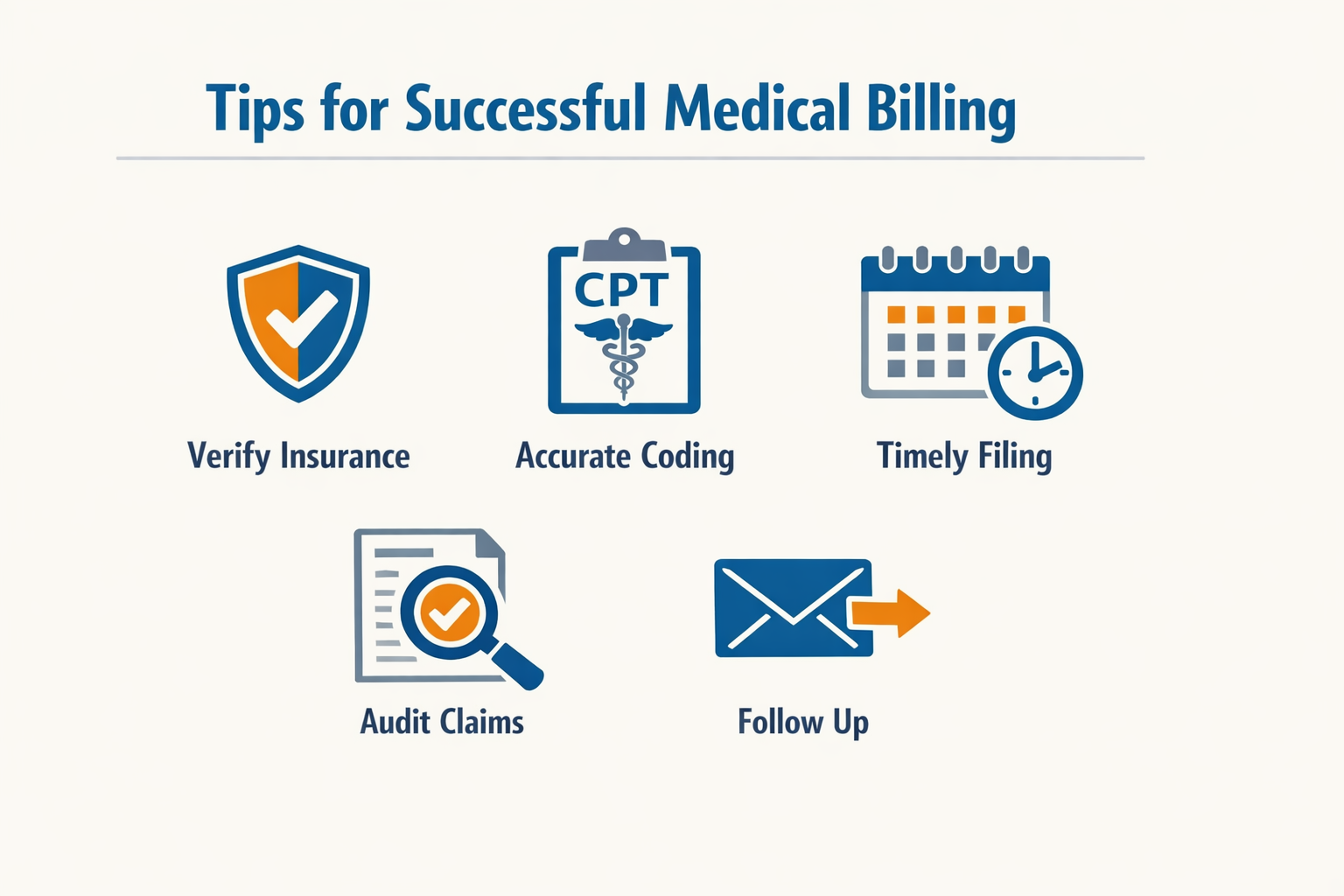
Successful medical billing depends on consistent practices that reduce friction between submission and payment. The patterns visible across carrier bill review suggest that attention to narrative detail, code selection, and submission timing pays measurable dividends.
Maintain In-House Control of Medical Record Management
Medical record and medical bill management — defined in the 2013 LOC Revised UTBMS Activity Codes as "any services associated with the review, compilation, digesting, summary or processing of medical records or bills when performed in-house only" — is one area where keeping work internal often prevents downstream denials. When records are compiled, summarized, and cross-checked before they leave your practice, you control the accuracy of what the carrier sees. External vendors introduce handoffs, and handoffs introduce error.
Understand How Billing Review Companies Operate
The 2024 CLM Defense Counsel Study reports that "the use of outside billing review companies has substantially impacted Firms in a negative way. The billing review rarely comes back without reductions and the reductions are based on archaic and arbitrary word choice." While this observation comes from the defense-counsel side, the underlying mechanism applies equally to medical billing: automated review engines flag entries that deviate from expected narrative patterns, regardless of whether the work was necessary or the charge appropriate.
Knowing this, draft time entries and charge descriptions to match the conventions the review engine expects. Avoid block billing — grouping multiple tasks into one narrative — because it gives the reviewer no way to validate each component. Use consistent terminology for recurring tasks. If the carrier's published guidelines specify a narrative format or a prohibited phrase, follow that specification exactly.
Billing review engines flag entries that deviate from expected patterns, not necessarily entries that are wrong.
Reduce Administrative Burden Through Process Discipline
The same CLM study notes that "carriers should reduce the administrative burden around billing and collection" and that understaffing "often times creates delays in case handling and makes it more difficult to represent our clients effectively and efficiently." These observations point to a broader truth: the less manual intervention required to process a claim, the faster it clears and the lower the denial rate.
Standardize your charge-entry workflow so that every timekeeper or billing clerk follows the same steps. Use templates for common procedures. Pre-populate fields that rarely change. Submit claims on a fixed schedule rather than in ad hoc batches. Consistency reduces the cognitive load on the carrier's intake staff and the likelihood that a claim sits in a queue long enough to age out or trigger a follow-up request.
Align Narrative Detail With Carrier Expectations
Carriers that do not use third-party billing review companies tend to apply their own internal standards, which are often more forgiving of narrative variation. Carriers that do use external reviewers enforce stricter pattern-matching. Either way, the safest approach is to write narratives that state who did what, when, and for what specific purpose — without filler, without block billing, and without ambiguity.
For guidance on narrative structure that passes carrier review, see Sample Attorney Billing Descriptions PDF That Pass Carrier Review, which illustrates the level of detail and specificity that reduces reduction risk. Understanding what carriers pay for in paralegal billing also clarifies which tasks warrant separate line items and which do not.
Monitor Submission Timeliness
Delays caused by understaffing or process bottlenecks increase the chance that a claim is denied for late filing or that supporting documentation is no longer available when the carrier requests it. Track the interval between service date and submission date for every claim. If that interval grows beyond your carrier's published threshold, investigate the cause and fix the workflow step that introduced the delay.
| Practice | Risk of Denial | Administrative Cost |
|---|---|---|
| In-house record management | Lower | Moderate |
| External vendor handoff | Higher | Lower upfront, higher on rework |
| Ad hoc submission schedule | Higher | Higher |
| Fixed submission schedule | Lower | Lower |
Conclusion
To prevent insurance claim denials in medical billing, healthcare practices must apply three core disciplines consistently: eligibility verification before service, precise coding at the point of entry, and documentation that supports every billed item. Each of these steps addresses a distinct category of denial — coverage failures, code mismatches, and medical necessity disputes — and together they form a defense-in-depth approach that reduces rejection rates and accelerates payment cycles.
The patterns visible in carrier billing guidelines apply with equal force to medical billing: administrative tasks billed at professional rates, bundled entries that obscure individual services, and missing or delayed pre-authorizations trigger denials at predictable rates. Practices that treat these common pitfalls as checklist items rather than occasional oversights see measurably lower denial volumes. Clean claims are not the result of luck; they are the product of workflow discipline and staff training that aligns submission practice with payer requirements.
Real-time eligibility checks, regular coding audits, and contemporaneous documentation are not administrative overhead — they are revenue protection. A claim denied for lack of pre-authorization or an incorrect modifier costs more to appeal than it would have cost to prevent, and some denials cannot be appealed at all once the filing window closes. The return on investment for proactive denial prevention is immediate and recurring: fewer write-offs, shorter days in accounts receivable, and staff time redirected from appeals to new patient revenue.
For practices seeking to refine their billing workflows further, understanding how outside counsel guidelines structure billing requirements offers transferable lessons in narrative clarity, task categorization, and pre-approval thresholds that apply across professional services billing. Denial prevention is not a one-time project; it is an operational standard that compounds in value with every clean claim submitted and every appeal avoided.
FAQ
What is the most common reason for insurance claim denials in medical billing?The most common reason is eligibility verification failure. When a practice does not confirm active coverage before service delivery, the claim is denied because the patient's policy was inactive, terminated, or did not cover the service location or provider type.
How can I prevent insurance claim denials related to coding errors?To prevent insurance claim denials from coding errors, implement real-time code validation at the point of entry, use the current year's code sets, and cross-reference diagnosis codes with procedure codes to ensure medical necessity is supported. Regular staff training on code updates reduces mismatches.
What documentation prevents medical necessity denials?Contemporaneous clinical notes that document the decision-making process, objective findings, and the rationale for the service at the time of care prevent medical necessity denials. Retrospective documentation rarely overcomes a denial once issued.
How do carrier-specific submission requirements affect denial rates?Carriers publish guidelines that specify required fields, narrative formats, and prohibited billing practices. Claims that deviate from these requirements are flagged during automated review and either rejected immediately or reduced after adjudication. Adhering to carrier-specific rules lowers denial rates.
What role does submission timing play in preventing denials?Timely submission ensures that supporting documentation is available when the carrier requests it and that the claim is filed within the policy's timely filing limit. Delays increase the risk of late-filing denials and missing records, both of which are difficult to appeal successfully.