


Insurance Broker: Insurance Billing Compliance Guide for Healthcare
Introduction to Insurance Billing Compliance
Healthcare providers submit millions of insurance claims each month. Every claim carries documentation, procedure codes, diagnosis codes, and narrative detail that must satisfy the requirements of the receiving payer. When a claim meets those requirements, it processes. When it does not, it rejects, suspends, or triggers a review that delays payment and consumes staff time.
Insurance billing compliance is the discipline of preparing claims that satisfy regulatory standards, contractual obligations, and payer-specific guidelines. It is not optional. Federal and state law impose documentation and coding requirements on providers who bill government and commercial payers. Payer contracts add submission rules, prior authorization thresholds, and audit protocols. Industry coding standards—ICD, CPT, HCPCS—define how services translate into billable line items. A compliant claim honors all three layers.
The stakes are concrete. A denied claim delays revenue. A pattern of coding errors invites a payer audit. Systematic non-compliance can trigger federal investigation, repayment demands, and exclusion from participation in government programs. Compliance protects cash flow, reduces administrative burden, and keeps the provider eligible to serve patients covered by every major payer. Just as attorney billing increments dictate how law firms record time to satisfy carrier review, healthcare billing compliance dictates how providers document care to satisfy payer validation.
This guide walks through the regulatory landscape, the mechanics of compliant claim preparation, the errors that trigger denials and audits, and the workflows that prevent them. It is written for billing managers, compliance officers, practice administrators, and providers who need to understand what compliance requires and how to deliver it consistently.
Explore comprehensive insurance billing compliance guidelines for healthcare providers, ensuring adherence and efficiency in your practice.
What is Insurance Billing Compliance?
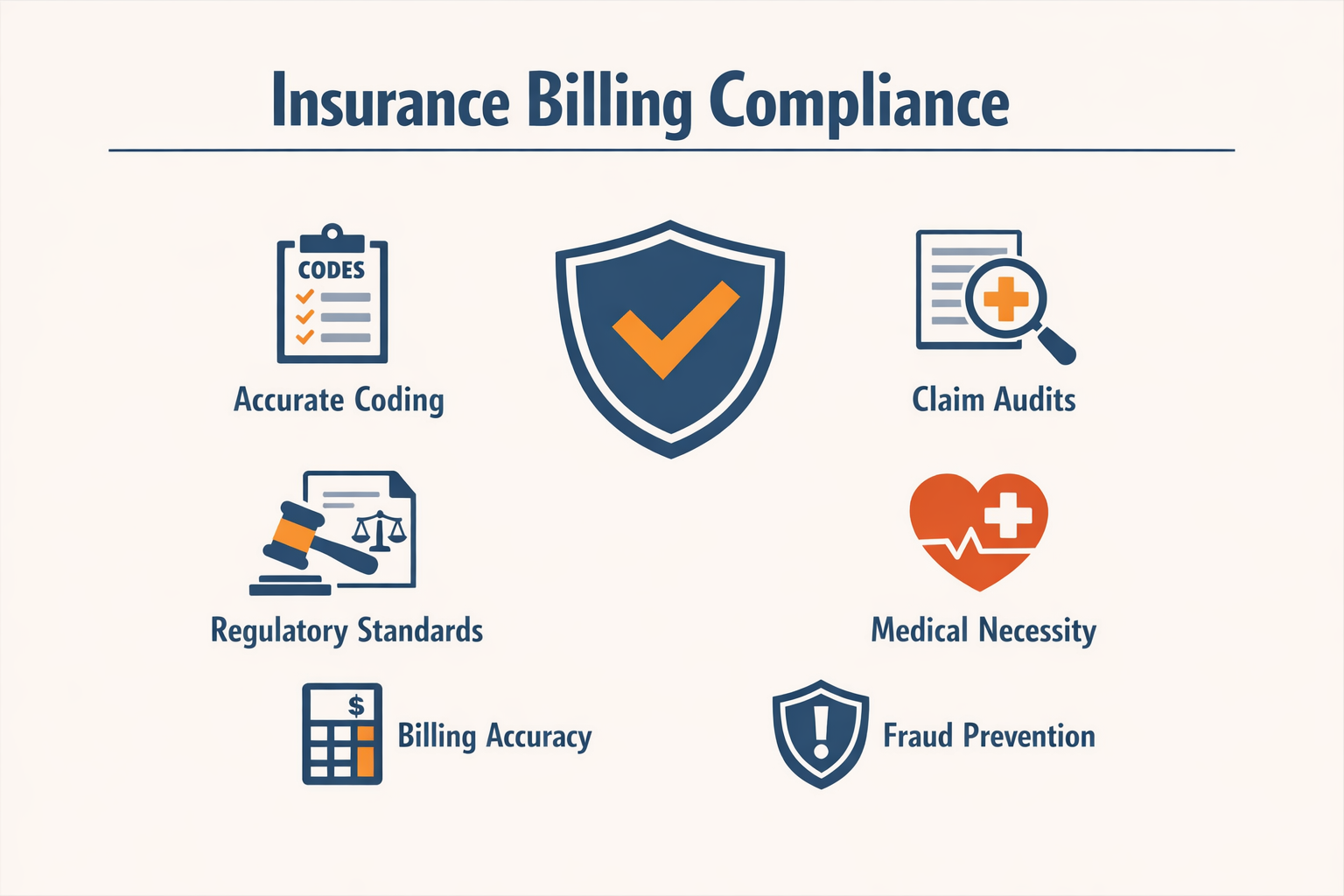
Insurance billing compliance ensures that the coding, billing, and claims for physician and healthcare services abide by regulatory requirements and are accurate. The term refers to the practice of legally and accurately charging for medical services provided to patients, following all relevant federal and state laws. Every claim submitted, every code entered, and every charge recorded must align with the standards set by regulators, payers, and professional oversight bodies.
Compliance is not a suggestion — it is the baseline expectation for every healthcare provider that submits claims to insurance carriers. When a provider bills a service, that line item represents a statement of fact: the service was performed, the code matches the documentation, and the charge reflects the contracted rate or published fee schedule. Any deviation from that standard — whether intentional or accidental — creates exposure.
Core Components of Insurance Billing Compliance
Compliance rests on three pillars: accurate coding, complete documentation, and adherence to payer-specific guidelines. Accurate coding means selecting the correct CPT, ICD-10, or HCPCS code for the service performed, based on the clinical record. Complete documentation means the medical record contains enough detail to support the code and the medical necessity of the service. Adherence to payer guidelines means following the rules published by Medicare, Medicaid, commercial carriers, and managed care organizations — rules that govern everything from prior authorization to timely filing.
Each of these pillars depends on the others. A perfectly coded claim fails if the documentation does not support it. A well-documented service generates a denial if the provider missed a prior authorization requirement. Compliance is the discipline of aligning all three elements before the claim leaves the building.
Key Terms in Insurance Billing Compliance
Several terms appear repeatedly in compliance discussions, and their meanings are specific:
- Claim: A request for payment submitted to an insurance carrier, containing service codes, diagnosis codes, patient demographics, and provider information.
- CPT code: Current Procedural Terminology code, a five-digit numeric code that describes a medical service or procedure.
- ICD-10 code: International Classification of Diseases, 10th Revision code, used to describe a patient's diagnosis or condition.
- HCPCS code: Healthcare Common Procedure Coding System code, used primarily for supplies, durable medical equipment, and services not covered by CPT.
- Medical necessity: The requirement that a service be appropriate, supported by clinical evidence, and consistent with accepted standards of care.
- Upcoding: Billing a higher-level service code than the documentation supports, resulting in a higher payment.
- Unbundling: Billing multiple component codes separately when a single comprehensive code should be used.
- Timely filing: The deadline by which a claim must be submitted to a payer, typically ranging from 90 to 365 days from the date of service.
These terms are not interchangeable, and their precise use matters when reviewing claims, responding to audits, or appealing denials. Compliance requires fluency in this vocabulary.
How Insurance Billing Compliance Differs from General Billing
General billing in a healthcare setting refers to the operational process of generating invoices, posting payments, and managing accounts receivable. Compliance, by contrast, is the framework that governs whether a given charge is permissible. A billing department can run efficiently and still fail compliance if the claims it produces violate coding rules, lack supporting documentation, or ignore payer policies.
The distinction matters because compliance failures carry consequences that operational errors do not. A delayed claim results in a timely filing denial. An undocumented service results in a refund demand. An upcoded claim results in a fraud investigation. Compliance is the guardrail that prevents billing from becoming a liability.
For providers working with insurance defense firms, understanding attorney billing descriptions that pass carrier review offers a parallel view of how payers scrutinize submitted charges — the same principles of specificity, documentation, and guideline adherence apply across professional services billing.
Why Insurance Billing Compliance Matters
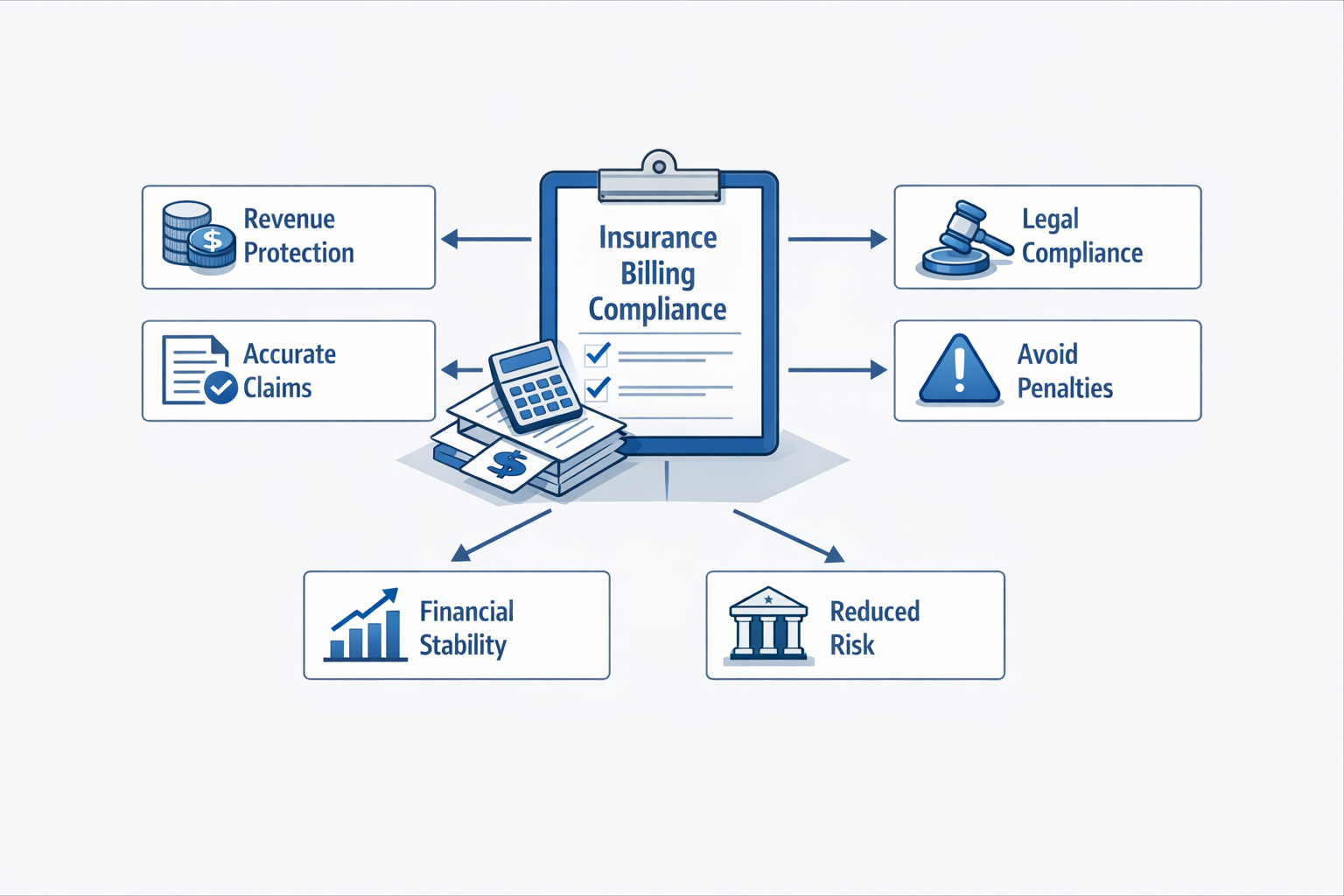
Compliance is not optional in healthcare billing. A single coding error, an undocumented modifier, or a narrative that fails to match the submitted claim can trigger denials, audits, and enforcement actions that reach far beyond the line item in question. Providers who treat billing as a clerical afterthought discover the cost when a payer rejects a claim, a regulator opens an investigation, or a carrier terminates panel participation.
Financial Consequences of Non-Compliance
Non-compliance generates immediate revenue loss through claim denials and delayed reimbursement. When a payer flags a submission for insufficient documentation or improper coding, the claim stops moving. Resubmission requires staff time, corrected records, and often a formal appeal—all while the practice absorbs the cost of care already delivered. Patterns of non-compliance escalate the financial exposure: payers may demand repayment of prior reimbursements, impose contractual penalties, or reduce future payment rates.
Beyond claim-level denials, regulatory penalties carry substantial dollar amounts. Enforcement actions under federal and state healthcare fraud statutes can result in fines that exceed the value of the underlying claim by orders of magnitude. Practices that fail to maintain compliant billing processes face the compounding cost of legal defense, remediation programs, and heightened scrutiny on all future submissions.
Legal and Regulatory Risks
Non-compliance exposes providers to litigation, loss of licensure, and exclusion from participation in government and commercial payer programs. When billing practices cross the line from error into fraud or abuse, the consequences extend to individual practitioners, not just the corporate entity. State medical boards, federal enforcement agencies, and payer fraud units all maintain authority to investigate and sanction providers whose billing records fail to support the care billed.
Reputational damage follows enforcement actions and exclusions. Once a provider appears on a payer's terminated-provider list or a federal exclusion database, referral sources, hospital privileges, and future payer contracts become harder to secure. The cost of rebuilding professional standing often exceeds the direct financial penalties.
Operational Impact on Healthcare Practices
Compliance failures disrupt daily operations. Staff spend hours reworking rejected claims, responding to payer audits, and managing appeals instead of processing new submissions. High denial rates slow cash flow, forcing practices to carry larger accounts receivable and delay payments to their own vendors and employees. When compliance issues trigger external audits, normal billing operations halt while the practice assembles documentation and responds to information requests.
Practices that maintain strong compliance programs avoid these disruptions. Clean claims move through payer systems faster, denials occur less frequently, and staff can focus on current work rather than fixing past errors. The operational stability that follows from attorney billing increments and narrative standards in legal billing applies equally to healthcare: clear, contemporaneous documentation paired with accurate coding produces submissions that payers process without delay.
The cheapest compliance program is the one that prevents the first audit—once a payer or regulator opens an investigation, every hour of response time costs more than the hour spent building correct processes from the start.
Protecting Patient Trust and Care Quality
Patients expect that the bills they receive and the explanations of benefits from their insurers reflect the care they actually received. When billing errors result in surprise bills, incorrect cost-sharing calculations, or denials of coverage, patients lose confidence in the provider. Compliance protects that trust by ensuring that every claim submitted matches the documented encounter and that patients are billed only for services delivered and properly authorized.
Accurate billing also supports care coordination. When claims data reflects true clinical activity, payers and care management programs can identify gaps in care, track chronic disease management, and flag potential safety issues. Non-compliant billing introduces noise into that data, undermining population health efforts and quality reporting that increasingly drive reimbursement.
Key Regulations and Guidelines for Insurance Billing
Healthcare billing operates under a framework of federal and state regulations that define what can be billed, how it must be documented, and what happens when a provider gets it wrong. The Affordable Care Act mandates that healthcare providers adopt an ethics and compliance program to receive reimbursement for patients under federally funded healthcare programs. That requirement is not optional — it is the price of admission to Medicare, Medicaid, and related federal payment streams.
Regulatory scrutiny of billing practices is constant. Medicare compliance audits investigate potential inappropriate claiming through incorrect item numbers, services not rendered, or billing for non-compliant services. The audit trail begins with the line item, and if the documentation does not support the code, the claim fails. State insurance departments and private payers apply similar standards, often layering carrier-specific outside counsel guidelines on top of federal requirements.
Federal Compliance Frameworks
The ACA compliance framework is the foundation. It requires policies, training, monitoring, and a designated compliance officer. Providers who bill federal programs without a documented compliance program risk claim denials, repayment demands, and exclusion from federal health programs. The program must address coding accuracy, claim submission procedures, and the timely correction of identified errors.
Medicare and Medicaid billing rules are codified in the Code of Federal Regulations and interpreted through program manuals and local coverage determinations. These rules specify which services are covered, what documentation is required, and how to submit a clean claim. A clean claim is one that can be processed without additional information — it contains the correct patient identifiers, valid procedure and diagnosis codes, and supporting documentation that matches the billed service.
State and Private Payer Requirements
State insurance laws add another layer. Some states regulate billing increments, prohibit certain fee structures, or require specific disclosures on invoices. Private payers — including commercial insurers and self-insured employers — publish their own billing guidelines, often more restrictive than federal rules. These guidelines specify narrative detail standards, block billing prohibitions, and pre-approval thresholds for certain expense categories.
Carrier outside counsel guidelines are the private-payer equivalent of Medicare's billing manuals. They are contractual requirements, not suggestions. A provider who submits invoices to a carrier panel without reading the applicable guideline will see reductions, rejections, and eventual removal from the panel. The guidelines specify billing increments, usually tenth-of-an-hour, and prohibit block billing — the practice of combining multiple tasks into a single narrative. For more on how carriers enforce these standards, see Outside Counsel Guidelines for Insurance Litigation.
Documentation and Coding Standards
Accurate coding is the operational core of billing compliance. Procedure codes, diagnosis codes, and modifier codes must reflect the service actually performed and documented in the patient record. A code that overstates the complexity or duration of a service is a compliance failure, even if the underlying service was legitimate. Undercoding — selecting a code that understates the service — creates a different problem: it leaves reimbursement on the table and distorts utilization data.
Contemporaneous records are the only acceptable proof of service. A narrative written days or weeks after the encounter, or a time entry backdated to match a billing period, does not meet the standard. Auditors and bill reviewers know what contemporaneous documentation looks like, and they know what retrofitting looks like. The difference is usually obvious.
The audit trail begins with the line item, and if the documentation does not support the code, the claim fails.
Best Practices for Insurance Billing Compliance
A comprehensive compliance program is not optional. It is the framework that determines whether your billing stands up under review. The program must include employee training, documentation accuracy protocols, and evaluation of future non-compliance risks. Without these components, you are submitting invoices on hope rather than process.
Build and Maintain a Compliance Program
Developing a comprehensive compliance program involves creating a framework that includes training employees, ensuring documentation accuracy, and evaluating future non-compliance risks. The program should designate a compliance officer, establish written policies, and create accountability at every level of the billing workflow. Train every person who touches a billing record — not once at onboarding, but on a recurring schedule that reflects changes in payer policies and regulatory updates.
Your compliance program must address the full lifecycle of a claim: intake, coding, submission, follow-up, and appeals. Each stage carries distinct compliance obligations. A strong program documents who is responsible for each step, what the standard is, and how deviations are escalated and corrected.
Run Regular Billing and Coding Audits
Regularly running billing and coding audits is essential to identify compliance errors and prevent future discrepancies. Regular internal audits catch billing errors before external auditors do, identifying compliance gaps and proving good faith compliance efforts. Schedule audits quarterly at minimum, more frequently if your practice has a history of denials or if you have recently changed billing staff or software.
Audits should be random and representative. Pull a sample of closed claims across different payers, service types, and billing personnel. Review the documentation, the codes submitted, and the narratives provided. Compare what was billed to what the clinical record supports. Where you find an error, determine whether it is isolated or systemic — one miscoded procedure is a training issue; ten identical errors across five billers is a program failure.
Review Payer Policies Before Every Submission
Payer policies change. What was reimbursable last quarter may be excluded this quarter, and what required no prior authorization in January may require it in March. Review payer policies carefully before submitting claims, and maintain a current reference library of the policies that govern your most frequent payers. If your billing staff does not know where to find the current policy, they cannot comply with it.
For carriers with published outside counsel guidelines, treat those guidelines as binding. They specify billing increments, narrative detail requirements, and prohibited charges. A single violation — such as block billing when the guideline prohibits it — can trigger a reduction or rejection of the entire invoice.
Use Technology to Support, Not Replace, Judgment
Billing software can enforce increment standards, flag duplicate entries, and validate code combinations. It cannot determine whether the documentation supports the code, whether the narrative is sufficiently detailed, or whether the charge is reasonable. Use technology to your advantage, but do not delegate compliance decisions to automation. A system that auto-populates a code based on a keyword in the clinical note is a convenience, not a substitute for coder judgment.
Technology should also support audit trails. Every edit, every override, and every resubmission should be logged with a timestamp and user ID. When a payer questions a charge six months after submission, you need to reconstruct what happened and why. If your system does not capture that history, you are billing without a safety net.
A compliance program that exists only on paper is not a compliance program — it is a liability waiting to be discovered.
Establish a Clear Overpayment Return Process
When you identify an overpayment, return it. The obligation is not discretionary, and the timeline is not flexible. Under the 60-day rule, practices must report and return overpayments within 60 days of identifying them. Keeping overpayments beyond 60 days converts a billing error into a potential false claim. Document the identification date, the amount, the payer, and the return method. Retain that documentation for the full statute of limitations period.
An overpayment is identified when you know or should have known that you received more than you were entitled to. Constructive knowledge counts. If an internal audit reveals an overpayment, the clock starts when the audit report is issued, not when someone decides to act on it. Delay is not a defense.
Common Mistakes in Insurance Billing Compliance
Noncompliance in medical billing ranges from minor clerical errors to systematic failures that threaten practice viability. Financial implications typically consume three to ten percent of an entire practice budget when errors accumulate unchecked. One cardiology practice discovered this reality when a Medicare audit revealed a ninety-percent error rate, triggering a $680,000 overpayment demand that nearly forced closure.
Retaining Overpayments Beyond the Sixty-Day Window
The sixty-day rule requires practices to report and return overpayments within sixty days of identifying them. Keeping overpayments beyond this threshold converts an administrative error into a potential False Claims Act violation. Many practices fail to establish systematic processes for identifying overpayments, leaving funds in accounts until an external audit forces reconciliation.
Insufficient Documentation of Medical Necessity
Claims submitted without adequate documentation to establish medical necessity face rejection or retroactive recoupment. Providers often assume that a diagnosis code alone satisfies the documentation requirement, but payers expect clinical notes that demonstrate why the service was appropriate for the patient's condition at the time of treatment. When auditors review a claim and find no supporting narrative in the medical record, they deny payment regardless of whether the service was actually necessary.
Inconsistent Application of Coding Standards
Coding errors multiply when practices lack standardized workflows for assigning procedure and diagnosis codes. One provider may interpret a clinical scenario differently than another, producing inconsistent code assignments for identical services. These inconsistencies trigger payer audits when claim patterns deviate from statistical norms. Practices that rely on memory rather than current codebooks compound the problem, especially when annual updates change code definitions or introduce new requirements.
Failure to Verify Coverage Before Service Delivery
Submitting claims for services not covered under the patient's active policy wastes administrative resources and creates patient billing disputes. Coverage verification should occur before every scheduled service, not just at initial registration. Insurance status changes frequently due to employment transitions, policy lapses, and plan modifications. A verification performed ninety days earlier provides no protection when the patient's coverage terminated last week.
Neglecting Payer-Specific Billing Requirements
Each payer maintains distinct requirements for claim submission, prior authorization, and documentation. Practices that apply a single billing template across all payers inevitably violate carrier-specific guidelines. One common error involves submitting claims to commercial payers using Medicare's billing rules, or vice versa. Outside counsel guidelines for insurance litigation establish similar carrier-specific requirements in the legal billing context, where failure to follow the controlling document produces systematic rejections.
The cheapest compliance program is the one that catches errors before they reach the payer, not after the audit letter arrives.
Inadequate Staff Training on Regulatory Changes
Billing regulations change continuously through statute amendments, payer policy updates, and administrative guidance. Staff who learned billing procedures five years ago operate under outdated rules unless the practice maintains an active training program. Compliance failures often trace to knowledge gaps rather than intentional misconduct. A single untrained employee processing hundreds of claims per month can generate systematic errors that persist until an external audit forces correction.
Absence of Internal Audit Procedures
Practices that wait for payer audits to identify compliance problems operate reactively rather than proactively. Internal audits conducted quarterly or semi-annually reveal error patterns while they remain manageable. These reviews should sample claims across all providers, payers, and service types to detect systematic issues before they accumulate into five- or six-figure liabilities. The cardiology practice facing a $680,000 overpayment demand had no internal audit program to catch the errors before Medicare's review.
Frequently Asked Questions about Insurance Billing Compliance
What happens if a provider submits a claim with the wrong billing code?
A claim submitted with an incorrect code typically triggers an automatic rejection at the payer's initial validation layer. The rejection notice will state the reason — often a code-procedure mismatch or a code that does not exist in the current year's set. The provider must correct the code and resubmit. Repeated coding errors, especially patterns that suggest upcoding or unbundling, can prompt an audit. During an audit, the payer reviews a sample of claims to determine whether the errors reflect systemic non-compliance or inadequate staff training.
How often do billing compliance requirements change?
Code sets update annually. The October release of ICD and CPT revisions takes effect the following January, and payers issue updated fee schedules and coverage policies around the same cycle. Regulatory changes — new fraud-prevention rules, updated documentation standards, or revised claim-submission formats — emerge on a less predictable schedule, often following federal rulemaking or state legislative sessions. A compliance program that relies on a single training event will fall behind within months. Continuous monitoring of payer bulletins and regulatory notices is the only reliable method to stay current.
Can a provider appeal a claim denial based on compliance issues?
Yes. Every payer maintains a formal appeals process, and the denial notice includes the deadline and submission address. The appeal must address the stated reason for denial — if the payer cited insufficient documentation, the appeal packet must include the missing records and a cover letter explaining how those records support the billed code. If the payer cited a coding error, the appeal must demonstrate that the original code was correct under the applicable guidelines, or it must propose a corrected code with an explanation of the error. Appeals that resubmit the same claim without new information or clarification are routinely denied at the first level of review.
What is the difference between a compliance audit and a payer audit?
A compliance audit is an internal review conducted by the provider's own compliance officer or an outside consultant. Its purpose is to identify gaps before a payer or regulator finds them. The audit examines coding accuracy, documentation completeness, and adherence to the provider's own policies. A payer audit is initiated by the insurance company, often after claims data suggests a pattern of overpayment, unusual utilization, or coding anomalies. The payer selects a sample of claims, requests the corresponding medical records, and compares what was billed to what the records support. If the payer finds that the provider was overpaid, it will demand repayment and may extrapolate the error rate across all similar claims submitted during the review period.
How long must a provider retain billing records for compliance purposes?
Federal programs require a minimum of six years from the date of service or the date of final payment, whichever is later. Many states impose their own retention periods, and some payers specify retention terms in their provider agreements. The safest practice is to retain all billing records, including the claim form, the remittance advice, and the complete medical record, for at least seven years. Electronic records must remain accessible and readable throughout the retention period, which means maintaining compatible software or exporting records to a stable format before retiring legacy systems.
What should a provider do if they discover a past billing error?
Report it. If the error resulted in an overpayment, federal law requires the provider to refund the overpayment within sixty days of identifying it. The refund must be accompanied by a written explanation of the error and the method used to calculate the amount. If the error resulted in an underpayment, the provider may submit a corrected claim, but only within the payer's filing deadline — typically one year from the date of service. Voluntary disclosure of an error, even one that suggests a compliance weakness, is far less damaging than waiting for the payer or a regulator to discover it during an audit. Outside counsel guidelines for insurance matters often address similar disclosure obligations when billing discrepancies surface during litigation.
Are small providers held to the same compliance standards as large hospital systems?
Yes. Payer contracts, federal regulations, and state insurance codes apply to all participating providers regardless of size. A solo practitioner billing Medicare is subject to the same documentation requirements, the same code-selection rules, and the same fraud-and-abuse statutes as a multi-hospital network. Smaller providers may lack the resources to maintain a dedicated compliance department, but that does not reduce the obligation to bill accurately and to correct errors when they are found. Many small practices address this gap by outsourcing compliance audits to a consultant or by participating in peer-review groups that share compliance tools and training materials.
Conclusion
Insurance billing compliance is not optional. It is the framework that determines whether a healthcare provider gets paid, how quickly reimbursement arrives, and whether the practice survives an audit without penalties. The regulations, coding standards, and documentation requirements discussed in this guide form the minimum threshold for submitting a defensible claim. Falling short of that threshold triggers rejections, write-downs, and in some cases, investigations that can suspend billing privileges or result in civil penalties.
The stakes are clearest when a claim is denied. A provider who cannot demonstrate that the service was medically necessary, properly coded, and accurately documented has no recourse. The carrier's decision stands. The same principle applies to every line item on every invoice: if the record does not support the charge, the charge does not survive review. Compliance is the practice of building that support into the workflow before the claim is submitted, not assembling it after the fact when a denial arrives.
Healthcare providers who treat compliance as a checklist rather than a discipline will find that the checklist grows faster than they can keep up. New codes are published annually. Payer policies change without advance notice. State and federal regulations layer new requirements onto existing frameworks. The only sustainable approach is to embed compliance into the billing process itself: train staff on current standards, audit submissions before they leave the office, and correct errors immediately when they are identified. Waiting for a pattern of denials to emerge before addressing a coding or documentation gap is a choice to lose revenue.
The guidelines in this article are not exhaustive, but they cover the core requirements that apply across most payers and most specialties. Providers who need deeper guidance on a specific regulation, coding system, or payer policy should consult the primary source documents and, where necessary, legal or compliance counsel. What matters is that the practice has a documented process for staying current, a mechanism for identifying when that process fails, and the discipline to fix the failure before it becomes a pattern. That is what compliance looks like in practice.
For more detailed guidance on billing standards and documentation requirements in insurance defense contexts, see Outside Counsel Guidelines for Insurance Litigation. The principles are the same: read the controlling document, follow what it says, and build the record that proves you did.