


California Civil Code Section 2860 for Defense Counsel
Top takeaways
- California Civil Code Section 2860 requires insurers to provide independent counsel when a conflict of interest arises between the insurer and the insured
- A conflict does not exist solely because the insured is sued for an amount exceeding policy limits or for allegations the insurer denies coverage
- Both insurer-provided counsel and independent counsel may participate in all aspects of the litigation when Section 2860 applies
- The insured may waive the right to select independent counsel by signing a specific written statement
- Independent counsel must disclose all non-privileged information to the insurer and cooperate fully in the exchange of information
Introduction
California Civil Code Section 2860 establishes the framework for independent counsel appointments in insurance defense matters. When an insurer owes a duty to defend and a conflict of interest arises, the statute creates a corresponding duty to provide independent counsel to the insured. As part of the Carrier Ready Knowledge Team, our work often involves delving into the intricacies of California Civil Code Section 2860, which is pivotal for defense counsel.
The statute defines when a conflict exists and when it does not. According to Cal. Civ. Code § 2860, subd. (b), no conflict exists as to allegations or facts for which the insurer denies coverage. However, when an insurer reserves its rights on an issue and the outcome of that coverage issue can be controlled by counsel first retained by the insurer, a conflict may exist. The statute clarifies that no conflict arises solely because an insured faces claims for punitive damages or for amounts exceeding policy limits.
Defense counsel operating under Section 2860 navigate a dual-loyalty structure. Cal. Civ. Code § 2860, subd. (f) specifies that where the insured selects independent counsel, both the insurer-provided counsel and independent counsel shall be allowed to participate in all aspects of the litigation. This participation requirement creates practical coordination obligations that affect case management and billing practices tracked through UTBMS activity codes.
The insured retains the right to waive independent counsel selection. Cal. Civ. Code § 2860, subd. (e) sets forth the exact language the insured must sign to authorize the insurer to select defense counsel. This waiver provision appears in the statute itself and has been cited in case law interpreting the section's application.
Understanding Section 2860 is essential for defense counsel who bill insurance carriers in California matters. The statute's requirements interact with carrier outside counsel guidelines, billing increment standards, and narrative detail expectations that govern invoice submission and review.
Understanding the Challenges with Civil Code Section 2860
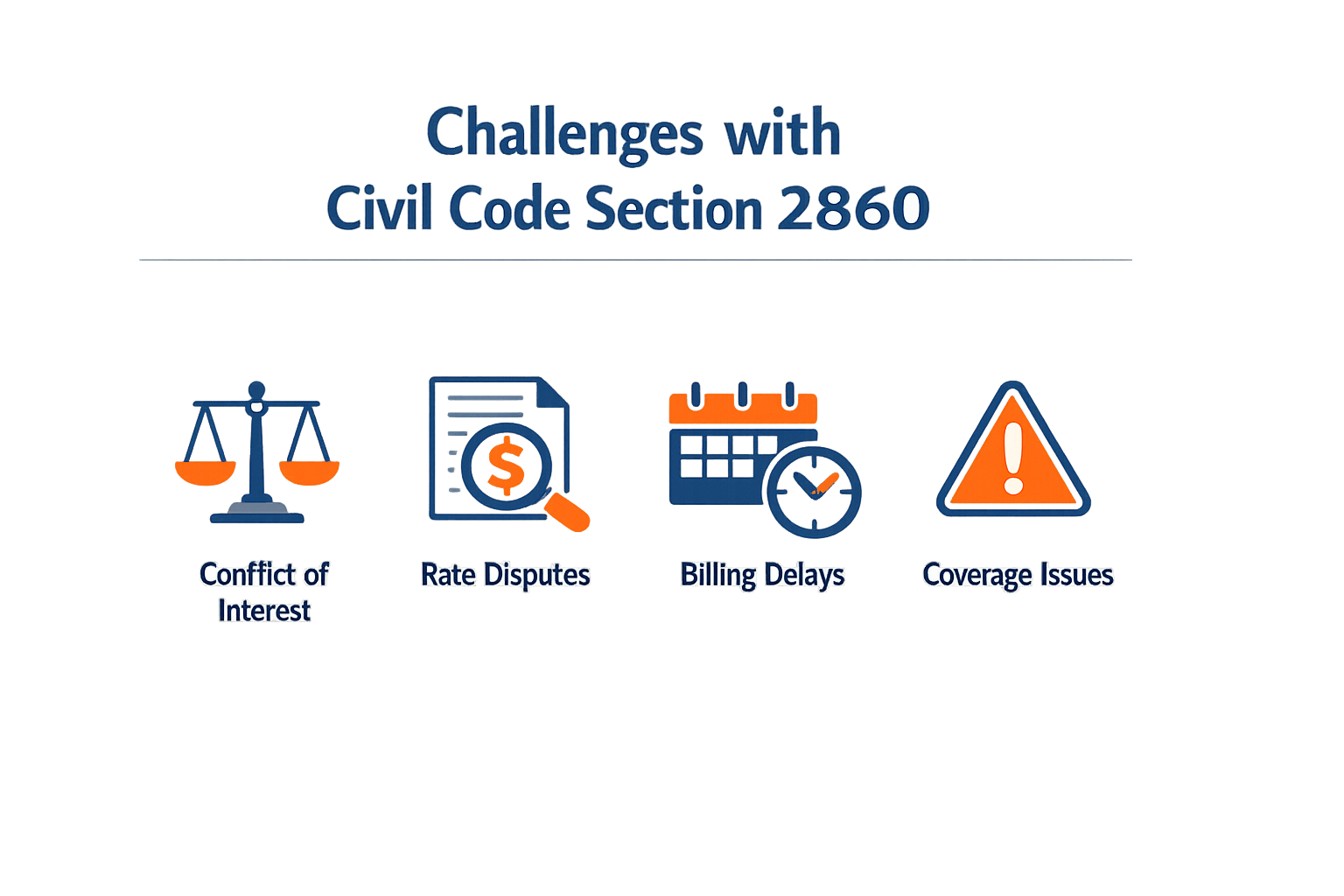
Defense counsel operating under California Civil Code Section 2860 face a recurring set of obstacles that turn statutory entitlement into operational friction. The statute grants the insured a right to independent counsel when a conflict of interest arises, but determining when that conflict is real — and what follows from it — generates ambiguity at nearly every decision point.
When a Conflict Actually Triggers the Right to Independent Counsel
Not every coverage dispute or reservation of rights creates an obligation to provide independent counsel. Cal. Civ. Code § 2860, subd. (b) states that a conflict does not exist solely because the insurer denies coverage for certain allegations, nor does it arise automatically when punitive damages are alleged or when the claim exceeds policy limits. The conflict must be significant and actual, not merely theoretical or potential, and the insured's right to independent counsel depends on whether the coverage issue can be controlled by counsel the insurer selected.
This standard leaves defense counsel in the position of evaluating whether a reservation letter creates a disqualifying conflict or simply preserves the carrier's coverage position. The line is not always clear, and misjudging it can lead to disputes over who pays for defense and whether submitted invoices will be honored.
Disclosure Obligations and the Privilege Boundary
When independent counsel is retained, Cal. Civ. Code § 2860, subd. (d) imposes a duty on both the insured and independent counsel to disclose all information concerning the action to the insurer, except privileged materials relevant to coverage disputes. Defense counsel must decide in real time what falls on which side of that line — a judgment that affects case strategy, billing narratives, and the risk of waiving privilege.
The statute provides that any claim of privilege is subject to in camera review, but the prospect of judicial scrutiny does not resolve the day-to-day question of what to include in a status report or a narrative entry. Overcommunication risks waiving work product; undercommunication risks a claim that counsel failed to cooperate.
Coordination Between Panel Counsel and Independent Counsel
Cal. Civ. Code § 2860, subd. (f) requires that both the insurer's counsel and independent counsel "shall be allowed to participate in all aspects of the litigation" and "cooperate fully in the exchange of information." In practice, this dual-counsel structure creates logistical and billing complications. Each side must determine who attends depositions, who drafts motions, and who communicates with the client — and how those activities are reflected in invoices submitted to the carrier.
Carriers reviewing invoices under these arrangements often scrutinize whether tasks are duplicative or whether independent counsel's billing reflects work the panel attorney already performed. Block billing entries that combine multiple activities become especially problematic when two sets of counsel are working the same file, because the reviewer cannot tell who did what or whether the insurer is paying twice for the same task.
Cooperation between counsels is mandated by statute, but billing clarity is what determines whether the carrier honors the invoice.
The Waiver Question
Cal. Civ. Code § 2860, subd. (e) permits the insured to waive the right to select independent counsel by signing a specific written statement. Defense counsel must recognize when a waiver is valid and when it is not, because an invalid waiver does not eliminate the conflict or the carrier's obligation. If the insured signs the waiver without being fully informed, or if the conflict intensifies after the waiver is executed, the question of who controls the defense and who pays for it resurfaces.
The waiver provision exists to give the insured autonomy, but in practice it shifts the risk of a coverage dispute back onto the insured if the waiver is later challenged. Defense counsel operating under a signed waiver must be prepared to justify that the insured's decision was knowing and voluntary, and that the conflict at the time of signing did not require independent representation.
Steps for Compliance with California Civil Code Section 2860
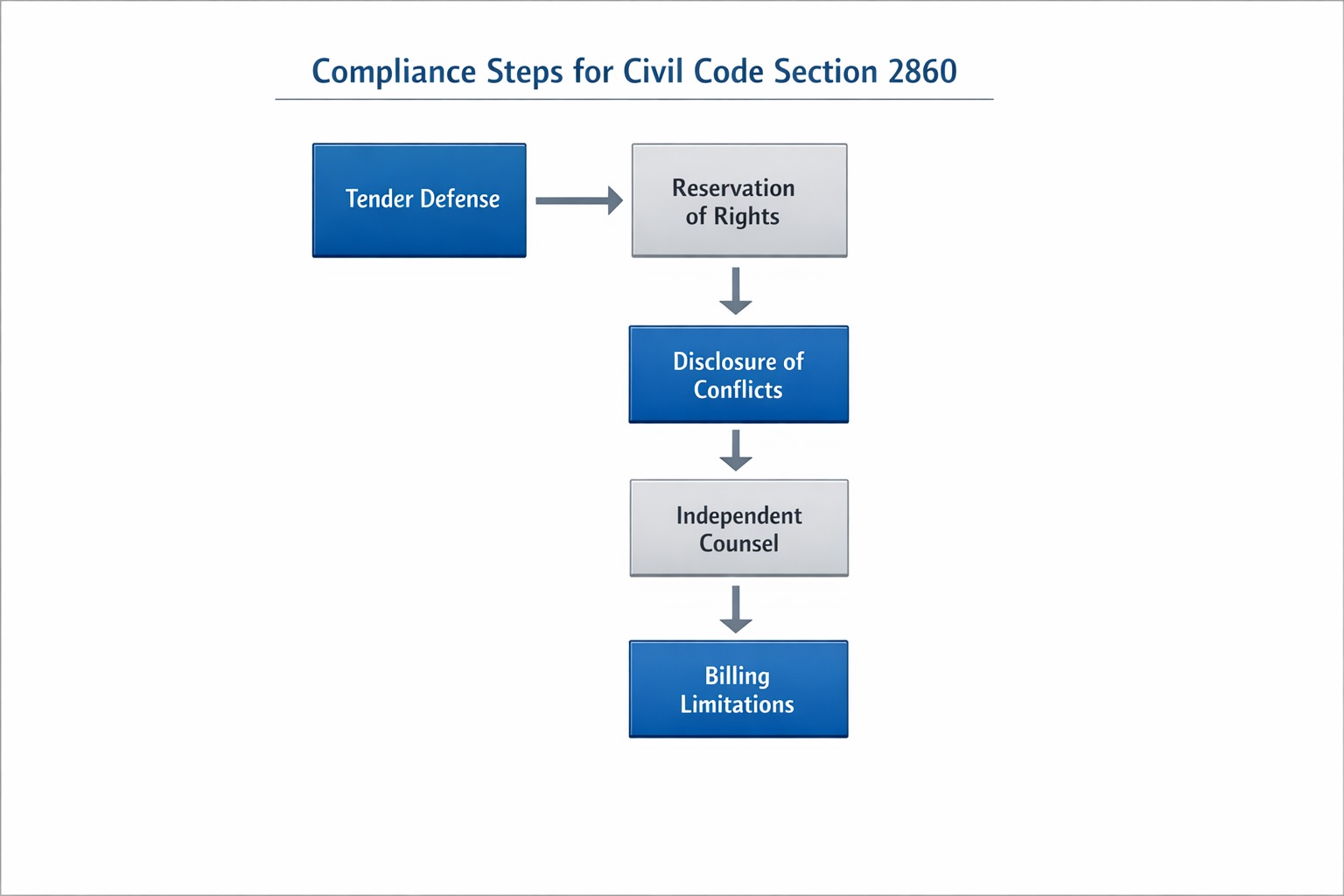
When a conflict of interest triggers the duty to provide independent counsel under California Civil Code Section 2860, defense counsel must follow specific procedural steps to ensure compliance. The statute imposes obligations on the insurer, the insured and independent counsel. Missing a step or misreading the carrier's notice can create billing disputes, coverage gaps or privilege waivers that no party intended.
Recognize When Section 2860 Applies
Step 1
Identify the conflict trigger
California Civil Code Section 2860, subdivision (a), states that the insurer must provide independent counsel when a conflict of interest arises that creates a duty to do so. Subdivision (b) clarifies that a conflict does not exist solely because the insured is sued for an amount exceeding policy limits or because punitive damages are alleged. However, when the insurer reserves rights on a coverage issue and the outcome of that issue can be controlled by counsel the insurer first retained, a conflict may exist. Defense counsel should review the carrier's reservation-of-rights letter and the complaint together to determine whether the reserved issue is genuinely in play.
Step 2
Confirm the insured's right to select counsel
Under subdivision (a), the insured may expressly waive, in writing, the right to independent counsel. Subdivision (e) provides the exact waiver language the insured must sign. If the insured does not sign that waiver, the insured retains the right to select independent counsel. The insurer may propose a method of selecting counsel consistent with the statute, but the insured's consent is required. Defense counsel should confirm that no waiver was signed before proceeding as independent counsel.
Step 3
Establish disclosure and cooperation protocols
Subdivision (d) imposes a duty on independent counsel and the insured to disclose to the insurer all information concerning the action, except privileged materials relevant to coverage disputes. Independent counsel must timely inform and consult with the insurer on all matters relating to the action. Any claim of privilege is subject to in camera review in the superior court. Defense counsel should document what information is shared, what is withheld as privileged, and the dates of all consultations. Carriers often reduce invoices when they believe counsel withheld case-status updates or failed to consult before taking a significant litigation step.
Coordinate with Panel Counsel
Step 4
Manage dual-counsel participation
Subdivision (f) provides that where the insured selects independent counsel, both the counsel provided by the insurer and the independent counsel selected by the insured shall be allowed to participate in all aspects of the litigation. Subdivision (f) further states that counsel shall cooperate fully in the exchange of information consistent with each counsel's ethical and legal obligation to the insured. Defense counsel should establish a written protocol at the outset: who attends depositions, who drafts motions, who communicates with opposing counsel, and how work is divided to avoid duplication. Carriers reviewing invoices will flag overlapping time entries when two counsel bill for the same activity without a clear division of labor.
Submit Invoices in Compliance with Carrier Guidelines
Independent counsel under Section 2860 is not exempt from the carrier's outside counsel guidelines or billing format requirements. Most carriers require LEDES 1998B file format submissions and UTBMS task and activity codes. Entries like "research and draft motion in limine, 4.2" will trigger a reduction for block billing even when submitted by Cumis counsel. Defense counsel should review the carrier's published guidelines before the first invoice and confirm billing increments, narrative detail standards and any pre-approval thresholds that apply to independent counsel.
Tips and Tricks for Navigating Civil Code Section 2860

Defense counsel working under California Civil Code Section 2860 face a dual obligation: representing the insured's interests while maintaining transparency with the carrier. The statute creates a framework that demands cooperation, but the practical execution often trips up even experienced timekeepers. Here are field-tested approaches to staying compliant without unnecessary friction.
Establish Clear Communication Protocols Early
Cal. Civ. Code § 2860, subd. (d) requires independent counsel and the insured to "disclose to the insurer all information concerning the action except privileged materials relevant to coverage disputes." The phrase "except privileged materials relevant to coverage disputes" is the fulcrum. Before billing the first hour, clarify with the carrier which categories of work product fall under that exception. Document the carrier's position in writing. When a dispute arises three months into the case, that initial exchange becomes your reference point.
The statute also mandates that counsel "timely inform and consult with the insurer on all matters relating to the action." Timely does not mean weekly status calls that generate unbillable administrative time. It means notifying the carrier of developments that affect coverage exposure or defense strategy before those developments are locked in. A motion in limine that narrows the punitive-damages claim is worth a phone call the day you decide to file it, not the day after you serve it.
Coordinate With Panel Counsel Without Ceding Control
Cal. Civ. Code § 2860, subd. (f) states that "both the counsel provided by the insurer and independent counsel selected by the insured shall be allowed to participate in all aspects of the litigation," and that "[c]ounsel shall cooperate fully in the exchange of information that is consistent with each counsel's ethical and legal obligation to the insured." This creates a working relationship, not a hierarchy. Panel counsel does not supervise independent counsel, and independent counsel does not report to panel counsel.
In practice, cooperation means sharing work product that advances the defense without compromising the insured's position on coverage. Discovery responses, deposition outlines, and exhibit lists are usually safe to share. Internal memos analyzing whether the carrier's reservation of rights is valid are not. When panel counsel requests a category of material, ask yourself whether disclosure serves the insured's interests in the underlying litigation. If the answer is no, the statute does not compel it.
For billing purposes, time spent coordinating with panel counsel is often recoverable, but narrative detail matters. "Telephone conference with carrier counsel re: deposition strategy, 0.3" is defensible. "Telephone conference with carrier counsel, 0.3" invites a reduction code. Carriers expect independent counsel to justify coordination time by showing what the insured gained from the exchange. For more on how carriers review narrative detail and apply reduction codes, see Block Billing: Reasons for Carrier Rejections and Solutions.
Track Privileged and Non-Privileged Work Separately
One of the most common billing disputes under Section 2860 involves time spent on coverage analysis. The statute does not prohibit independent counsel from advising the insured on coverage issues, but it also does not require the carrier to pay for that advice. If you bill 2.4 hours for "research and draft coverage memorandum," expect a write-down. If you bill the same 2.4 hours as "research and draft motion to compel discovery," and the carrier later learns the motion was cover for a coverage memo, expect a demand for repayment.
The cleaner approach is to track coverage work in a separate matter number from the outset. Many independent counsel maintain two files: one for the defense of the underlying action, billed to the carrier, and one for coverage advice, billed to the insured directly. This eliminates ambiguity and protects both the timekeeper and the client. When a single task touches both files — for example, reviewing the complaint to identify covered and uncovered allegations — allocate the time proportionally and document the allocation in contemporaneous records.
Nothing in this section shall relieve the insured of his or her duty to cooperate with the insurer under the terms of the insurance contract.
Preserve the Insured's Cooperation Duty
Subdivision (f) closes with a reminder: "Nothing in this section shall relieve the insured of his or her duty to cooperate with the insurer under the terms of the insurance contract." Independent counsel does not eliminate the insured's contractual obligations. If the policy requires the insured to appear for an examination under oath, the insured must appear. If the policy requires the insured to produce documents on request, the insured must produce them, subject to privilege.
When the insured resists a carrier request, independent counsel's role is to evaluate whether the request is reasonable under the policy and whether compliance would prejudice the insured's position. If the carrier is demanding material that falls within the coverage-dispute privilege, push back and cite subdivision (d). If the carrier is demanding routine case updates that the policy entitles it to receive, advise the insured to comply. The statute protects the insured from conflicts of interest, not from the policy's cooperation clause.
Conclusion
California Civil Code Section 2860 establishes a clear framework for when insurers must provide independent counsel to insureds, and that framework carries direct billing consequences for defense counsel. When a conflict of interest arises — typically when an insurer reserves rights on a coverage issue that trial counsel can influence — the statute triggers the insured's right to select Cumis counsel paid by the carrier. Defense counsel operating under Section 2860 must understand that the carrier's payment obligation does not eliminate the insured's duty to cooperate or counsel's duty to disclose non-privileged information to the insurer.
As part of the Carrier Ready Knowledge Team, our work often involves delving into the intricacies of California Civil Code Section 2860, which is pivotal for defense counsel. While reviewing various carriers' guidelines, we often find that entries like travel and administrative time billed at attorney rates are commonly flagged for reduction. These billing practices remain subject to carrier guidelines and reasonable-fee standards even when independent counsel is appointed under the statute. The insurer pays for independent counsel, but it does not pay without review.
Defense counsel should treat Section 2860 as a procedural and ethical checkpoint, not a billing safe harbor. The statute specifies who selects counsel and who pays, but it does not override the requirement that fees be reasonable or that time entries comply with the carrier's outside counsel guidelines. Counsel who assume that Cumis status exempts them from narrative-detail rules, billing-increment standards, or block-billing prohibitions will encounter reductions and appeals that could have been avoided by reading the controlling guideline before the first invoice.
For further guidance on preparing compliant invoices and avoiding common carrier rejections, see Block Billing: Reasons for Carrier Rejections and Solutions. The interplay between statutory independent-counsel rights and carrier billing standards is not intuitive, but it is navigable when counsel treat both the statute and the guideline as binding documents that must be reconciled line by line.