


UTBMS Task Codes: Choosing the Right One for Each Entry
Introduction
UTBMS Task Codes are standardized billing codes that insurance carriers use to categorize and manage legal expenses. When a timekeeper writes "research and draft motion in limine, 4.2" without selecting the correct UTBMS Task Codes, most panel guidelines flag the entry for reduction. The UTBMS Litigation code set is used by several insurance carriers to manage legal expenses, and selecting the right task code for each line item determines whether that entry survives bill review.
The codes are designed to categorize legal services into specific activities, making it easier for both law firms and clients to understand and manage billing. The UTBMS code set is a valuable business tool in the insurance community for the planning and management of litigation and litigation costs. Insurance carriers that use UTBMS Task Codes do so because the codes provide a common language between clients and lawyers regarding legal fees, data standards that are generally accepted in the legal community, the ability to compare case budgets to invoice details, and a means of organizing invoice details and budgets to better understand legal expenses. Through our research, we've noted that the published guidelines frequently flag certain entries, such as travel or intra-office conferences, for reductions or rejections.
Consistency in the understanding, use and application of the codes optimizes the value derived from them. A group of insurer representatives and insurance defense lawyers reviewed the UTBMS system to establish whether it is a useful tool for the insurance community. The group determined that the system works well, but there is a need to clarify how the codes are used, as well as a need to educate timekeepers who might be unfamiliar with the UTBMS system. The 2007 updates to the UTBMS were intended to promote consistency in the use and application of the codes by insurers and insurance defense counsel, and to offer guidance to assist lawyers and clients in using the code set effectively.
Understanding the UTBMS Hierarchy
The hierarchy of the Litigation codes matters. Phases are the major categories of legal services typically found in Litigation. Tasks are the actual legal services. Activities are the individual steps taken to perform the legal services. This three-tier structure allows budgets to have different levels of detail than invoices, giving carriers flexibility in how they review and analyze legal spend.
Electronic billing provides the ability to compare a detailed time entry with a more general budget, which is what allows budgeting to be more flexible. Most clients prefer budgeting at either the phase level or task level; rarely will clients request budgets at the activity level. Understanding where UTBMS Task Codes sit in this hierarchy—and how they map to both phases above and activities below—shapes how a timekeeper should select the code for any given entry. For more detail on how the LEDES 1998B file format structures these codes in electronic submissions, carriers rely on field-level accuracy to process invoices without manual intervention.
Why Accurate UTBMS Task Codes Selection Matters
Insurers are increasingly using UTBMS data to analyze much more than the cost of legal services. For example, a carrier might want to know which legal services produce particular outcomes. Inaccurate coding, or use of default or catch-all codes, has a negative impact on the analytical process. This is why the task code L190 has been removed from the Insurance Litigation Code set. Firms that are lax in coding discipline should be concerned—you do not want to be distinguished by the lack of information that you provide to a client.
While the specific utility of the codes will vary from company to company, some common concepts do apply. The insurance carriers and lawyers that participated in the review of the Litigation code set concluded that the codes will also work for Workers' Compensation. Insurers also use other UTBMS code sets, such as the Counseling codes, which are often used for Coverage advisory services, and Expense codes are also widely used.
What Makes Selecting UTBMS Task Codes Difficult?
Selecting the correct UTBMS Task Codes for a given time entry is harder than it looks. The code set is designed to categorize legal services into phases, tasks and activities, but timekeepers often face ambiguity when a single entry could plausibly fit two or three different task codes. The result is inconsistent coding across matters, timekeepers and firms — and that inconsistency undermines the analytical value carriers expect from the data.
Lack of Clarity in Code Application
The UTBMS litigation code set was reviewed by a group of insurer representatives and insurance defense lawyers in 2007 to determine whether it remained a useful tool. The group concluded that the system works well, but identified a need to clarify how the codes are used and to educate timekeepers unfamiliar with the system. Even with that clarification effort, the codes do not eliminate judgment calls. When a timekeeper drafts a motion in limine that also addresses discovery sanctions, the choice between discovery-related task codes and trial-preparation codes is not self-evident. Without clear internal guidance, two timekeepers handling similar work may code the same activity differently.
Carriers use UTBMS data not only to process invoices but also to analyze which legal services produce particular outcomes and to compare case budgets to invoice details. Inaccurate coding, or habitual use of catch-all codes, degrades that analytical process. The 2007 review group removed task code L190 from the insurance litigation code set precisely because it had become a default for entries that should have received more specific codes. Firms that rely on vague or catch-all codes risk being distinguished by the lack of useful information they provide to the client.
Inconsistent Coding Across Carriers and Matters
The utility of UTBMS codes varies from company to company, but the underlying structure — phases, tasks and activities — is constant. Budgets may be prepared at the phase level or task level, rarely at the activity level, and the required level of detail should be clarified as early in the case as possible. When a firm works for multiple carriers, each with different budgeting and coding expectations, timekeepers must track which client requires task-level granularity and which accepts phase-level summaries. That variability increases the likelihood of coding errors, especially when a timekeeper applies one carrier's conventions to another carrier's matter.
Consistency in the understanding, use and application of the codes optimizes the value derived from them and promotes the ease of use by counsel working with various insurance carrier clients.
The absence of a single, universally enforced coding standard means that even experienced timekeepers must consult each carrier's guidelines and internal firm protocols before finalizing a time entry. When those protocols are informal or undocumented, the firm's coding discipline suffers, and the carrier's ability to compare matters or forecast litigation costs is compromised. For more on how carriers treat narrative and coding issues that trigger rejections, see Block Billing: Reasons for Carrier Rejections and Solutions.
Solution Steps
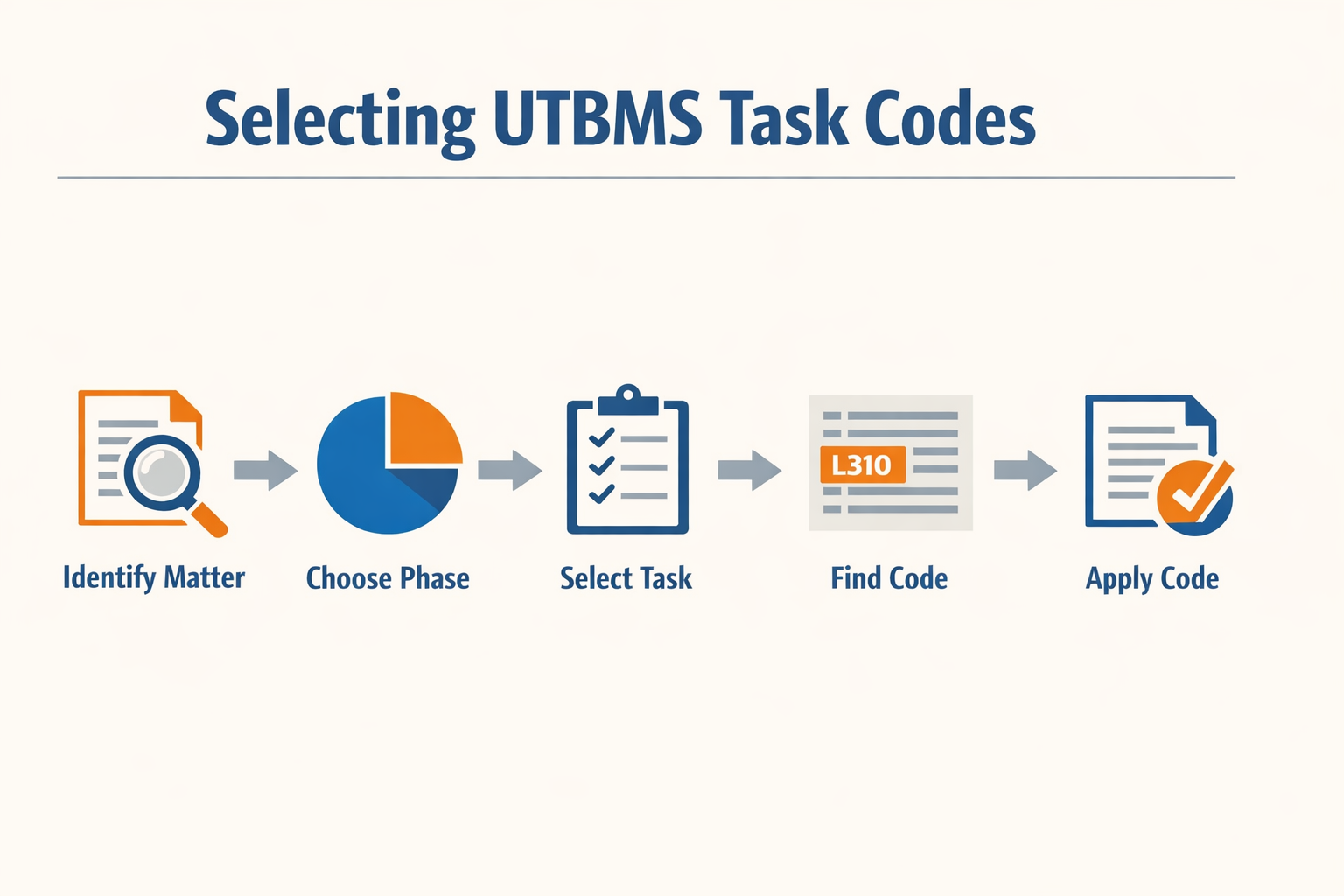
Selecting the correct UTBMS Task Codes for each time entry is a discipline that starts with understanding the three-level hierarchy of the code set. Phases are the major categories of legal services typically found in litigation. Tasks are the actual legal services. Activities are the individual steps taken to perform the legal services. When you code an entry, you are assigning it to a specific task within that hierarchy, and the task you choose determines how the client reads the entry and how it rolls up into budget comparisons and analytical reports.
Understand the Hierarchy Before You Code
The hierarchy matters because electronic billing systems compare detailed time entries to more general budgets. A budget might be set at the phase level, while your invoice codes at the task or activity level. The system rolls your task code up to the corresponding phase, and if the code is wrong, the entry lands in the wrong bucket. That mismatch triggers flags in the client's reporting and can prompt a reduction or a request for clarification.
Step Through the Code Set in Order
Step 1
Identify the phase
Start by determining which phase the work belongs to. Common phases include Case Assessment and Development, Discovery, Trial, and Appeal. If the work does not fit a litigation phase, consider whether it belongs in a different code set, such as Counseling codes for coverage advisory services.
Step 2
Select the task within the phase
Once the phase is clear, review the tasks listed under that phase and choose the one that most closely describes the legal service performed. For example, within the Discovery phase, tasks include depositions, interrogatories, and document production. Choose the task that matches the substance of the entry, not the task that happens to be convenient or familiar.
Step 3
Apply the activity code if required
Some clients require activity-level coding; others do not. If activity codes are required, select the activity that describes the individual step taken to perform the task. For instance, if the task is "Draft pleading," the activity might be "Legal research" or "Document review." The UTBMS Activity Codes A101-A111 for Legal Billing article explains how activity codes layer onto task codes to provide additional granularity.
Step 4
Avoid default and catch-all codes
Carriers increasingly use UTBMS data to analyze which legal services produce particular outcomes. Inaccurate coding, or use of default or catch-all codes, has a negative impact on the analytical process. Task code L190, a catch-all that once appeared in the litigation code set, has been removed from the insurance litigation version of UTBMS. Firms that rely on default codes are distinguished by the lack of information they provide to the client, and that distinction is not favorable.
Clarify Budget Detail Requirements Early
The level of detail required for budgeting will vary by client and by type of case. Most clients prefer budgeting at either the phase level or task level; rarely will a client request a budget at the activity level. Clarify the required level of detail as early in the case as possible. A budget set at the phase level still allows you to invoice at the task or activity level, because the code hierarchy allows budgets to have different levels of detail than invoices. The electronic billing system rolls your detailed entries up to the budget level for comparison.
Consistency in the understanding, use and application of the codes optimizes the value derived from them and promotes ease of use by counsel working with various insurance carrier clients.
Tips and Tricks
Consistency in the understanding, use and application of UTBMS Task Codes optimizes the value derived from them and promotes ease of use across multiple carrier clients. Insurers that require UTBMS Task Codes use them to establish a common language with counsel, compare budgets to actual invoices, and organize billing data for analysis. Timekeepers who treat code selection as an afterthought — defaulting to catch-all codes or choosing the first plausible match — undermine that shared framework and risk standing out for the wrong reasons.
Understand the Hierarchy Before You Code
Phases are the major categories of legal services typically found in litigation. Tasks are the actual legal services. Activities are the individual steps taken to perform the legal services. When you code a line item, you are placing it in this three-tier structure. Most carriers budget at the phase or task level, rarely at the activity level, but invoices should still use the most specific task code that describes the work. A vague task code paired with a generic activity tells the reviewer nothing; a precise task code paired with a matching activity creates a clear, auditable record.
Avoid Removed and Catch-All Codes
Inaccurate coding, or use of default or catch-all codes, has a negative impact on the analytical process carriers run on UTBMS data. Task code L190, a common catch-all in earlier versions, has been removed from the Insurance Litigation Code set. Firms that are lax in coding discipline should be concerned — you do not want to be distinguished by the lack of information that you provide to a client. When no published task code fits, write a detailed narrative and choose the closest adjacent code; do not invent a placeholder or reuse a retired code.
Clarify Budget Detail Early
Although even a summary budget will work, most clients prefer budgeting at either the phase level or task level. The level of detail required for budgeting will vary by client and by type of case. Electronic billing provides the ability to compare a detailed time entry with a more general budget, which is what allows budgeting to be more flexible. Clarify the required level of detail as early in the case as possible. If the carrier budgeted discovery at the task level, your invoice codes should match those task distinctions; if the budget is phase-only, you still code to the task level on the invoice, but the comparison rolls up automatically.
Maintain Coding Discipline Across Timekeepers
Insurers are increasingly using UTBMS data to analyze much more than the cost of legal services. A carrier might want to know which legal services produce particular outcomes. When different timekeepers on the same matter use different UTBMS Task Codes for identical work, the data becomes unusable for outcome analysis. Establish a matter-level coding guide at intake — document which task codes will be used for recurring activities like status conferences, document review, and expert coordination — and share it with every timekeeper who touches the file. For more detail on how narrative and activity codes interact with task codes, see UTBMS Activity Codes A101-A111 for Legal Billing.
You do not want to be distinguished by the lack of information that you provide to a client.
Conclusion
The UTBMS code set is a valuable business tool in the insurance community for the planning and management of litigation and litigation costs. Accurate UTBMS Task Codes selection ensures that invoices communicate the nature and scope of legal work in a language that carriers, bill reviewers and e-billing portals all recognise. When timekeepers apply the correct task and activity codes, the invoice becomes a coherent record of the case's progression rather than a collection of ambiguous entries that invite reductions.
Consistency in the understanding, use and application of the codes optimises the value derived from them and promotes ease of use by counsel working with various insurance carrier clients. Through our research, we have noted that the published guidelines frequently flag certain entries, such as travel or intra-office conferences, for reductions or rejections. This pattern underscores the importance of choosing the right task code to avoid unnecessary billing disputes. Additionally, reading several carriers' guidelines side by side, like Hartford's and Sompo's, reveals that block billing is treated differently across carriers, which can influence how UTBMS Task Codes are applied. For more on invoice rejection patterns across carriers, see E-Billing Portal Invoice Rejections: Common Causes and Fixes.
Firms that maintain disciplined coding practices — selecting the most specific task code, pairing it with the appropriate activity code, and writing a narrative that matches both — distinguish themselves by the quality and clarity of the information they provide. Inaccurate coding, or reliance on default or catch-all codes, has a negative impact on the analytical process that carriers use to evaluate both case outcomes and panel performance. You do not want to be distinguished by the lack of information that you provide to a client.
By understanding these patterns and the specific requirements of each carrier's guidelines, legal professionals can make more informed decisions when selecting UTBMS Task Codes, ultimately leading to more accurate and accepted billing submissions. For further guidance on the detailed activity codes that pair with each task, see our article on UTBMS Activity Codes A101-A111 for Legal Billing.
FAQ
What are UTBMS Task Codes?UTBMS Task Codes are standardized billing codes used by insurance carriers to categorize legal services into specific tasks within litigation phases, enabling consistent tracking and analysis of legal expenses.
How do UTBMS Task Codes differ from activity codes?UTBMS Task Codes represent the actual legal services performed (such as depositions or document production), while activity codes describe the individual steps taken to complete those tasks (such as legal research or drafting).
Why was task code L190 removed from the Insurance Litigation Code set?Task code L190 was removed because it had become a catch-all default that timekeepers used instead of selecting more specific codes, degrading the analytical value of UTBMS data for carriers.
How many UTBMS Task Codes should appear in a typical invoice?The number varies by matter complexity and phase, but each distinct legal service should receive its own specific task code rather than grouping multiple services under one catch-all code.
Do all insurance carriers require the same level of UTBMS Task Codes detail?No, carriers vary in their requirements. Some budget at the phase level while others require task-level detail, so timekeepers should clarify expectations early in each matter.