


UTBMS Litigation Codes for Insurance Defense: L100–L500 Overview
Introduction
One line item coded L190 instead of L120 is enough to flag an invoice for manual review. In our work with the UTBMS Litigation Code Set, specifically the L100 to L500 series, we focus on how these codes are applied within insurance defense and how they interact with carrier guidelines to determine whether a submitted fee entry clears the portal or lands in the rejection queue.
The UTBMS Litigation Code Set organizes legal work into five major phases: L100 Case Assessment, Development and Administration; L200 Pre-Trial Pleadings and Motions; L300 Discovery; L400 Trial Preparation and Trial; and L500 Appeal. Each phase contains task codes that describe categories of work at a level of granularity designed for both billing transparency and fee analysis. Carriers rely on these codes to evaluate staffing, identify block billing, and apply guideline prohibitions to specific line items.
Most carrier outside counsel guidelines require UTBMS codes in every submitted invoice, and many e-billing portals reject files that omit the task code field or populate it with an invalid value. The LEDES 1998B file format reserves field 5 for the task code; when that field is blank or contains a code outside the published UTBMS sets, the portal returns a validation error before any human reviewer sees the invoice. Even when a portal accepts the file, bill reviewers apply reduction codes to entries where the task code does not match the narrative or where the selected code falls under a guideline prohibition.
Understanding the L100–L500 Structure
The L100 phase, Case Assessment, Development and Administration, encompasses work that focuses on the matter as a whole rather than discrete procedural tasks. Task code L110 covers fact investigation and development, including interviews of client personnel and potential witnesses and review of documents to learn the facts of the case. L120 addresses analysis and strategy, including the thinking, strategizing, and planning for a case, as well as initial legal research for case assessment purposes. L130 pertains to experts and consultants, covering the identification, interview, and development of expert reports. L140 is narrowly defined as document and file management, limited to creating and populating document databases or filing systems. L150 applies to budgeting activities, and L160 encompasses settlement and non-binding alternative dispute resolution. L190 serves as the catch-all for time not attributable to any other L100 task.
The L200 phase, Pre-Trial Pleadings and Motions, covers all pleadings and pretrial motions other than discovery. L210 applies to pleadings, including developing and reviewing complaints, answers, counterclaims, and motions directed at pleadings such as motions to dismiss. L220 addresses preliminary injunctions and provisional remedies. L230 covers court-mandated conferences required by court order or procedural rules, excluding settlement conferences. L240 pertains to dispositive motions, including motions for judgment on the pleadings and summary judgment motions. L250 applies to other written motions and submissions, such as motions to consolidate, bifurcate, remand, or stay. L260 addresses class action certification and notice.
The L300 phase, Discovery, includes all work pertaining to discovery according to court or agency rules. L310 covers written discovery, including developing, responding to, objecting to, and negotiating interrogatories and requests to admit, as well as mandatory written disclosures and meet-and-confer sessions.
L100 Case Assessment, Development and Administration focuses on the case as a whole, the "forest" rather than the "trees."
Carriers apply different scrutiny to different task codes. Entries coded L140 for document and file management often trigger reductions when billed at partner or senior associate rates, because the code definition describes a process that many guidelines classify as administrative or clerical. Entries coded L190, the L100 catch-all, receive heightened review because the code's breadth invites misuse; a narrative reading "various case matters" under L190 will be reduced for lack of detail even if the underlying work is compensable. Entries coded L120 for analysis and strategy are accepted when the narrative describes specific strategic planning but rejected when the narrative suggests routine case administration that belongs under a different code.
The interaction between UTBMS codes and block billing is direct: a single line item that combines work from multiple task codes violates both the block-billing prohibition and the UTBMS coding requirement. When a timekeeper writes "review pleadings, research law, and draft motion," the entry spans L210, L120, and L240, and the invoice will be reduced regardless of which single code the timekeeper selects.
Problem Statement
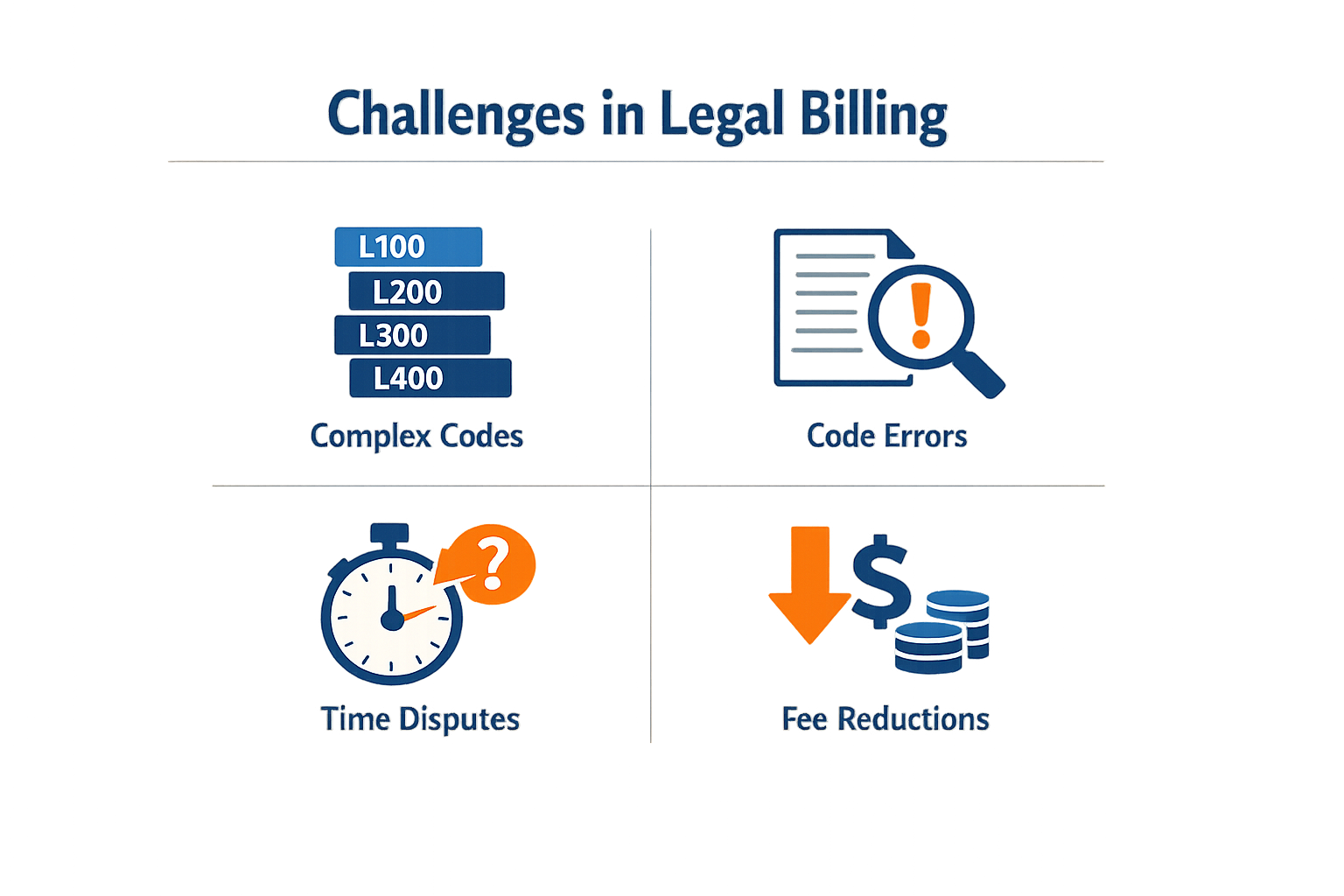
Three carriers reject the same invoice for three different reasons. One cites improper task codes, another flags narrative insufficiency, and the third reduces the time as duplicative. The common thread: each entry used a UTBMS litigation code, but none of the reviewers read it the same way.
Misapplied Task Codes Trigger Reductions
Billing 4.2 hours to L120 Analysis/Strategy when the narrative describes drafting a motion invites a reduction. L120 covers thinking, strategizing, and planning for a case, including discussions and meetings on case strategy. It is not the code for drafting pleadings or motions — that work belongs under L200-series codes. When the task code contradicts the narrative, reviewers default to the narrative and recode the entry, often at a lower allowed rate or with a partial write-down.
Using L190 Other Case Assessment, Development and Administration as a catch-all compounds the problem. L190 is defined narrowly: time not attributable to any other overall task, often pre-determined jointly by the client and law firm. Carriers interpret unilateral use of L190 as a signal that the timekeeper could not identify the correct code or is attempting to bill administrative time at attorney rates. Both readings lead to reductions.
Overlapping Codes Create Ambiguity
L110 Fact Investigation/Development covers interviews of client personnel and potential witnesses, review of documents to learn the facts of the case (but not for document production, L320), and work with an investigator. L130 Experts/Consultants covers identifying and interviewing experts and consultants, working with them, and developing expert reports. When a timekeeper interviews a witness who later becomes a consulting expert, the choice between L110 and L130 is not obvious from the code set alone. Carriers that have published guidance on this scenario typically require L110 for initial witness interviews and L130 only after the expert relationship is formalized. Firms that lack access to that guidance code the entry inconsistently across matters, and the resulting pattern triggers audits.
L140 Document/File Management is defined as a narrowly defined task comprising only the processes of creating and populating document and other databases or filing systems. It includes planning, design, and overall management of this process, and the specification states that work of outside vendors in building litigation support databases should be an Expense. Billing attorney time to L140 for reviewing documents in a database — rather than building the database itself — is a frequent cause of rejection. The code does not cover document review for case assessment (L110) or document review for production (L320); those tasks have their own codes.
Generic Narratives Obscure the Work Performed
An entry reading "research and analysis, 3.5" tells the reviewer nothing about whether the work fits L120 Analysis/Strategy or belongs under a specific motion task like L240 Dispositive Motions. L120 includes initial legal research for case assessment purposes and legal research for developing a basic case strategy, but the specification states that most legal research will be under the primary task for which the research is conducted, such as research for a summary judgment motion (L240). When the narrative omits the purpose of the research, the reviewer cannot verify the code, and the entry is flagged for clarification or reduced.
Block billing under a single UTBMS code aggregates multiple tasks into one line item, preventing the reviewer from allocating time to the correct codes. For more on how carriers handle block billing, see the dedicated discussion of narrative detail standards and reduction patterns.
A UTBMS code is a classification, not a justification — the narrative must still describe what was done, why it was necessary, and how the time was spent.
Discovery Codes Are Frequently Confused
L310 Written Discovery covers developing, responding to, objecting to, and negotiating interrogatories and requests to admit, and includes mandatory meet-and-confer sessions. It also covers mandatory written disclosures as under Rule 26(a). L320 (not provided in the research pack but referenced in L110) governs document production. L340 (referenced in L130) governs preparing for depositions. Billing preparation for a deposition to L310 because the deposition relates to written discovery responses is incorrect — the task code follows the activity, not the subject matter. Carriers that track code usage by matter type flag entries where L310 appears in months when no written discovery was served or received, and those entries are reviewed individually.
L300 Discovery is the phase heading, not a task code. Some e-billing portals accept L300 in the task code field, but reviewers treat it as a coding error and either reject the entry or recode it to L310 by default. Neither outcome benefits the firm.
Solution Steps for Utilizing UTBMS Codes
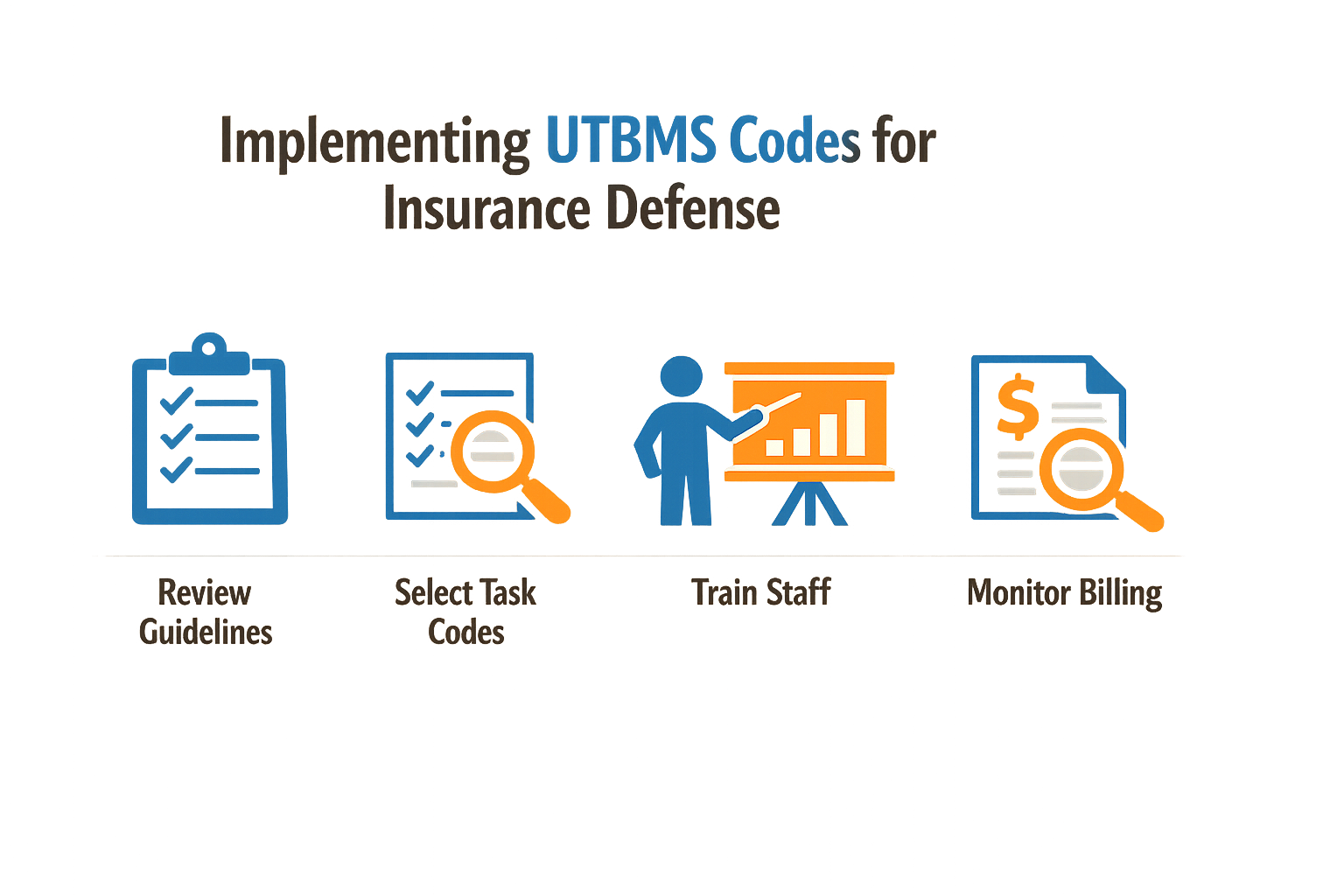
Implementing UTBMS litigation codes in your billing workflow requires a methodical approach grounded in the published task code definitions. The L100 through L500 series provides a structured framework for categorizing litigation work, but effective use depends on understanding each phase's boundaries and applying codes consistently across all timekeepers.
Step 1: Map Your Firm's Workflow to the L100–L500 Structure
Step 1
Identify phase boundaries in your matter lifecycle
Begin by reviewing the five major phases of the UTBMS litigation code set: L100 (Case Assessment, Development and Administration), L200 (Pre-Trial Pleadings and Motions), L300 (Discovery), L400 (Trial Preparation and Trial), and L500 (Appeal). For each active insurance defense matter, determine which phase the current work falls into. L100 encompasses the "forest" view of the case — fact investigation, strategy sessions, expert retention, budgeting, settlement discussions, and document management infrastructure. L200 covers pleadings and all pretrial motions except discovery motions. L300 includes written discovery, depositions, and document production. Understanding these boundaries prevents the common error of coding strategic planning (L120) as trial preparation (L440) or vice versa.
Step 2
Assign task codes at the time-entry level
Require timekeepers to select the appropriate task code when they record time, not during invoice preparation. L110 (Fact Investigation/Development) applies to interviews of client personnel and potential witnesses, review of documents to learn the facts, and work with investigators. L120 (Analysis/Strategy) covers thinking, strategizing, planning discussions, and initial legal research for case assessment. L130 (Experts/Consultants) includes identifying, interviewing, and working with experts and developing expert reports, but excludes preparing for expert depositions (L340) or trial testimony (L420). L140 (Document/File Management) is narrowly defined: it comprises only the processes of creating and populating document databases or filing systems, not reviewing documents for factual content (L110) or production (L320).
Step 3
Code pleadings and pretrial motions with precision
L210 (Pleadings) includes developing and reviewing complaints, answers, counterclaims, third-party complaints, and motions directed at pleadings such as motions to dismiss, motions to strike, and jurisdictional motions. L220 (Preliminary Injunctions/Provisional Remedies) covers strategy, motion papers, affidavits, briefs, and hearings for these remedies. L230 (Court Mandated Conferences) applies to Rule 16 sessions and other court-ordered conferences, excluding settlement conferences (L160). L240 (Dispositive Motions) encompasses motions for judgment on the pleadings and summary judgment motions, including research, drafting, reviewing opponent's papers, and attending hearings. L250 (Other Written Motions and Submissions) captures motions to consolidate, bifurcate, remand, stay, compel arbitration, and for change of venue. L260 (Class Action Certification and Notice) is reserved for proceedings unique to class actions and derivative suits.
Step 4
Apply discovery codes according to activity type
L310 (Written Discovery) covers developing, responding to, objecting to, and negotiating interrogatories and requests to admit, including mandatory meet-and-confer sessions and mandatory written disclosures as under Rule 26(a). When coding discovery work, distinguish between the activity of drafting discovery requests (L310), reviewing documents for production (L320), preparing for and defending depositions (L330 and L340), and motions to compel or for protective orders (L350). The UTBMS structure separates these activities to allow reviewers to assess staffing and time allocation by discovery type. For detailed guidance on pairing task codes with activity codes, see UTBMS Activity Codes A101-A111 for Legal Billing.
Step 5
Distinguish settlement and ADR from case strategy
L160 (Settlement/Non-Binding ADR) includes all activities directed specifically to settlement: planning for and participating in settlement discussions, conferences, and hearings, implementing a settlement, and pursuing mediation or other non-binding ADR. It also covers pre-litigation demand letters and ensuing discussions. Do not use L160 for general case strategy discussions that touch on settlement as one option among many — those belong in L120 (Analysis/Strategy). The distinction matters because many carrier guidelines impose approval thresholds or staffing restrictions on settlement-related time.
Step 6: Validate Codes Before Submission
Before generating a LEDES 1998B file, run a validation check to ensure every line item carries a task code from the L100–L500 series and that no entry uses a code inconsistent with the narrative. Many e-billing portals accept files that omit fields marked as required by the specification, but carriers routinely reject invoices with missing or mismatched task codes during manual review. Confirm that budgeting time is coded L150, that document database setup is L140, and that trial strategy planning before concrete trial preparation begins is L120, not L440.
Tips and Tricks for Accurate Billing with UTBMS Codes
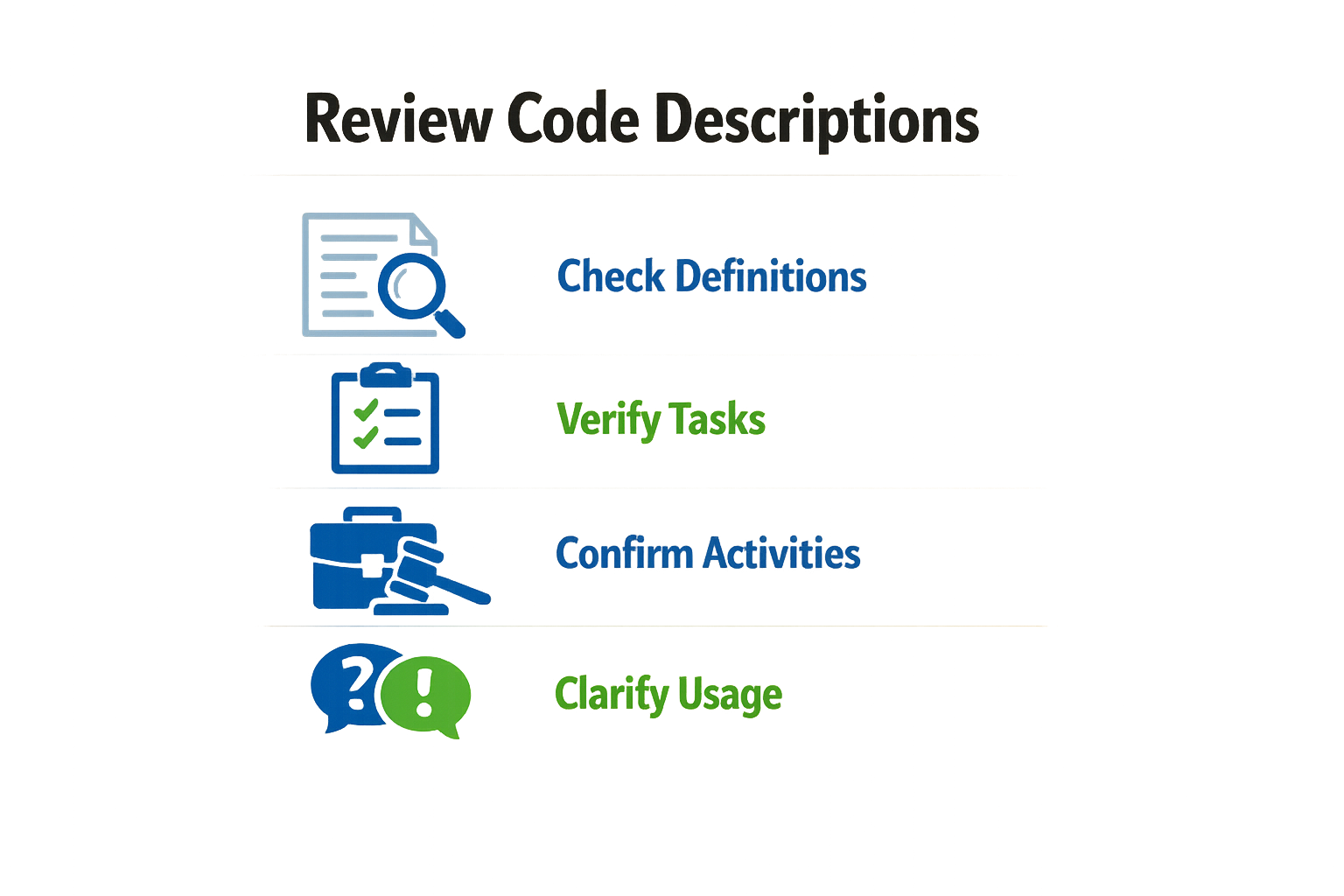
Task code selection errors trigger rejections even when the narrative and hours are defensible. A line item coded L120 Analysis/Strategy that describes drafting a motion belongs under L240 Dispositive Motions or L250 Other Written Motions and Submissions, depending on the motion type. Reviewers read the code first, the narrative second, and a mismatch between the two raises a red flag.
Match the Code to the Work Performed, Not the Outcome
L110 Fact Investigation/Development covers interviews of client personnel and potential witnesses, review of documents to learn the facts of the case, and work with an investigator. It does not cover document review for production purposes — that work falls under L320. When a timekeeper reviews documents to understand what happened, the code is L110; when the same timekeeper reviews the same documents to determine what must be produced in discovery, the code is L320. The distinction turns on the purpose of the review, not the documents themselves.
L140 Document/File Management is narrowly defined: it comprises only the processes of creating and populating document databases or filing systems, including the planning, design, and overall management of this process. It does not cover reviewing documents, analyzing them, or using them in discovery responses. Work of outside vendors in building litigation support databases should be an expense, not a time entry under L140.
L160 Settlement/Non-Binding ADR encompasses all activities directed specifically to settlement, including planning for and participating in settlement discussions, conferences, and hearings. It also covers pursuing and participating in mediation and other non-binding ADR procedures. Pre-litigation demand letters and ensuing discussions fall under L160. A common error is coding settlement strategy discussions as L120 Analysis/Strategy; if the discussion is directed specifically to settlement, L160 is the correct code.
Separate Preliminary Work from Trial Preparation
L130 Experts/Consultants covers identifying and interviewing experts and consultants, working with them, and developing expert reports. It does not include preparing for expert depositions — that work is L340 — or preparing experts for trial, which is L420. A line item that reads "prepare Dr. Smith for deposition" coded L130 will be reduced or rejected; the correct code is L340.
L120 Analysis/Strategy includes initial legal research for case assessment purposes and legal research for developing a basic case strategy. Most legal research, however, is coded under the primary task for which the research is conducted. Research for a summary judgment motion is L240; research for a motion to compel is L350. Once concrete trial preparation begins, trial strategy and planning are coded L440, not L120.
L120 covers the thinking, strategizing, and planning for a case; once concrete trial preparation begins, use L440 for trial strategy and planning.
Code Discovery Tasks with Precision
L310 Written Discovery covers developing, responding to, objecting to, and negotiating interrogatories and requests to admit. It includes mandatory meet-and-confer sessions and mandatory written disclosures as under Rule 26(a). A meet-and-confer session about interrogatories is L310; a meet-and-confer session about a motion to compel is L350. The subject matter of the conference determines the code, not the fact that a conference occurred.
L230 Court Mandated Conferences covers preparing for and attending hearings and conferences required by court order or procedural rules, including Rule 16 sessions. It does not cover settlement conferences, which are L160. A case management conference is L230; a settlement conference is L160, even if both are mandated by the court.
For further guidance on how these task codes interact with activity codes in the LEDES file, see UTBMS Activity Codes A101-A111 for Legal Billing.
Use L190 and L290 Sparingly
L190 Other Case Assessment, Development and Administration is a catch-all for time not attributable to any other L100-series task. L290 (not covered in this section pack) serves the same function for the L200 series. These codes exist for edge cases, not routine work. Specific use in a given matter often may be pre-determined jointly by the client and law firm. A high volume of L190 or L290 entries signals poor coding discipline and invites scrutiny.
L150 Budgeting covers developing, negotiating, and revising the budget for a matter. It does not cover general case management or administrative tasks. A line item coded L150 that describes updating the client on case status is miscoded; that work is better captured under the substantive task being discussed or, if truly administrative, may not be billable at attorney rates under many carrier guidelines.
Conclusion
The UTBMS Litigation Code Set, spanning L100 through L500, serves as the structural backbone of insurance defense billing. Each phase — from Case Assessment and Development (L100) through Pre-Trial Pleadings and Motions (L200) and Discovery (L300) — defines a discrete category of work that carriers expect to see coded accurately in every LEDES 1998B submission. When a line item carries the wrong task code or pairs a task with an incompatible activity code, automated validation flags it, and manual review reduces it.
In our work with the UTBMS Litigation Code Set, specifically the L100 to L500 series, we focus on how these codes are applied within insurance defense. Our review of various carrier guidelines reveals recurring patterns in reduction or rejection, particularly concerning travel, intra-office conferences, and administrative time billed at attorney rates. The difference between an accepted invoice and a rejected one often turns on whether the timekeeper selected L110 Fact Investigation for a witness interview or L120 Analysis for strategic planning, and whether the narrative supports that choice.
Accuracy in UTBMS coding is not a technical nicety — it is a compliance requirement that directly affects cash flow, appeal success rates, and panel standing. Carriers read the task code first, then the narrative, then the activity code; if those three elements do not align, the line item is suspect. Billing professionals who master the L100–L500 structure, pair codes correctly, and write narratives that match the code's published definition will see fewer rejections, faster payments, and cleaner audits. For deeper insight into how activity codes interact with task codes, see our guide to UTBMS Activity Codes A101-A111 for Legal Billing.
The investment in learning these codes pays immediate returns. Every hour spent understanding the distinction between L210 Pleadings and L240 Dispositive Motions, or between L130 Experts and L340 Expert Depositions, is an hour that prevents a write-down later. The UTBMS Litigation Code Set is not optional, and it is not ambiguous — it is the common language of insurance defense billing, and fluency in that language is the price of admission.
FAQ
What is the UTBMS Litigation Code Set?The UTBMS Litigation Code Set is a standardized framework published by the American Bar Association in 1997 that organizes legal work into five major phases (L100–L500) for consistent billing and fee analysis in insurance defense matters.
Why do carriers require UTBMS codes on invoices?Carriers use UTBMS codes to evaluate staffing, identify block billing, apply guideline prohibitions to specific line items, and validate invoices through automated e-billing portals before manual review.
What happens if I use the wrong UTBMS code?When a task code contradicts the narrative, bill reviewers re-classify the entry based on the narrative alone, often resulting in reductions, lower allowed rates, or partial write-downs even if the underlying work is compensable.
How do I choose between overlapping UTBMS codes?Select the code that describes the immediate task performed, not the larger strategic goal or subject matter. For example, research for a summary judgment motion is L240 (Dispositive Motions), not L120 (Analysis/Strategy).
Can I use L190 as a general catch-all code?No. L190 (Other Case Assessment, Development and Administration) is narrowly defined for time not attributable to any other L100 task, often pre-determined jointly by client and firm. Unilateral use signals poor coding discipline and triggers scrutiny.
What is the difference between L110 and L320?L110 (Fact Investigation/Development) covers reviewing documents to learn the facts of the case, while L320 governs document review for production purposes. The distinction turns on the purpose of the review, not the documents themselves.