

UTBMS Litigation Codes: L100–L500 for Insurance Defense
Introduction to the UTBMS Litigation Code Set
What the UTBMS Litigation Code Set Is
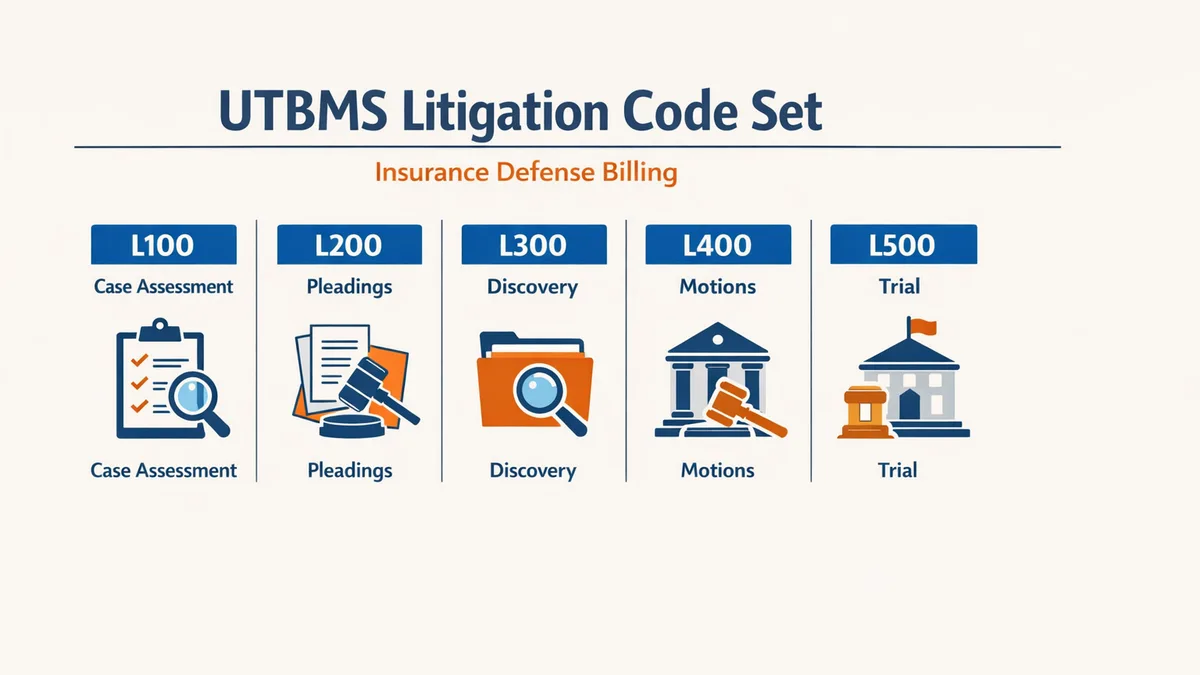
The UTBMS Litigation Code Set is intended for use in all adversarial matters including litigation, binding arbitrations, and regulatory/administrative proceedings. The code set organizes legal work into phases, each identified by a three-digit task code beginning with the letter L. The L100 series covers case assessment, development and administration; L200 addresses pre-trial pleadings and motions; and L300 governs discovery.
Each task code carries a definition that guides attorneys in coding time. For example, L100 Case Assessment, Development and Administration focuses on the case as a whole, the "forest" rather than the "trees." Within that phase, L110 Fact Investigation/Development covers all actions to investigate and understand the facts of a matter, including interviews of client personnel and potential witnesses, review of documents to learn the facts of the case (but not for document production, L320), work with an investigator, and all related communications and correspondence.
Why the UTBMS Litigation Code Set Matters in Insurance Defense
Carrier outside counsel guidelines rely on the UTBMS Litigation Code Set to enforce billing restrictions. A guideline may prohibit or cap time billed under L140 Document/File Management, which comprises only the processes of creating and populating document and other databases or filing systems. When a timekeeper bills 2.5 hours under L140, the bill reviewer knows that the work involved planning, design, and overall management of the database process—not substantive legal analysis.
Our review of various carrier guidelines reveals recurring patterns in reduction or rejection, particularly concerning travel, intra-office conferences, and administrative time billed at attorney rates. The task code is the first signal a reviewer reads. If the code and the narrative do not align, or if the code maps to a restricted activity, the line item is vulnerable regardless of how well the narrative is written.
For more on how activity codes refine task-level detail, see UTBMS Activity Codes A101-A111 for Legal Billing.
The Structure of the L100 Through L500 Series
The UTBMS Litigation Code Set divides work into five major phases. L100 Case Assessment, Development and Administration includes fact investigation (L110), analysis and strategy (L120), expert work (L130), document management (L140), budgeting (L150), settlement and non-binding ADR (L160), and a catch-all for other case administration (L190).
L200 Pre-Trial Pleadings and Motions covers pleadings (L210), preliminary injunctions and provisional remedies (L220), court-mandated conferences (L230), dispositive motions (L240), other written motions (L250), and class action certification and notice (L260). L300 Discovery encompasses written discovery (L310) and additional discovery tasks defined in the full code set.
How Reviewers Read UTBMS Codes
When an invoice arrives at an e-billing portal, the UTBMS task code populates a required field in the LEDES 1998B file. Several e-billing portals accept files that omit fields marked as required by the specification, but the task code field is rarely one of them. The portal validates the code against an internal table, and the bill reviewer uses the code to sort, filter, and flag line items for closer scrutiny.
A line item coded L120 Analysis/Strategy tells the reviewer that the entry involves thinking, strategizing, and planning for the case, including discussions, writing, and meetings on case strategy. It also includes initial legal research for case assessment purposes and legal research for developing a basic case strategy. If the narrative describes drafting a motion, the reviewer will expect L240 Dispositive Motions or L250 Other Written Motions instead—not L120. The mismatch triggers a reduction or a request for clarification.
Understanding the Challenges in Legal Billing
When an invoice is reduced or rejected at the e-billing portal, the reason often traces back to a mismatch between the narrative, the UTBMS Litigation Code Set task code, and what the carrier guideline permits. A line entry reading "research and draft motion in limine, 4.2" triggers scrutiny not because the work is illegitimate, but because the timekeeper combined multiple tasks into one entry without identifying which UTBMS code applies. That practice—block billing—appears in reduction codes across nearly every major carrier's published guidelines.
The UTBMS Litigation Code Set divides work into discrete phases and tasks precisely to prevent this ambiguity. Phase L100, Case Assessment, Development and Administration, covers strategy, fact investigation, and expert work. Phase L200, Pre-Trial Pleadings and Motions, addresses pleadings, dispositive motions, and preliminary injunctions. Phase L300, Discovery, encompasses written discovery, depositions, and document production. When a single narrative spans two or more of these tasks, the reviewer cannot verify that the billed time aligns with the approved budget category or that the rate is appropriate for the work described.
Why Accurate Coding Matters
Bill reviewers read UTBMS codes before they read narratives. The code sets the expectation; the narrative either confirms or contradicts it. A line coded L120, Analysis/Strategy, should describe thinking, strategizing, or legal research for case assessment. If the narrative instead describes drafting interrogatories, the correct code is L310, Written Discovery. The mismatch signals either carelessness or an attempt to bill discovery work at a higher rate by misclassifying it as strategy.
Carrier guidelines specify which tasks require pre-approval, which are capped at a dollar threshold, and which are excluded entirely. Administrative tasks billed at attorney rates, intra-office conferences without a stated purpose, and travel time in excess of guideline limits all appear in published reduction reports. The UTBMS code is the first filter: if the code itself is on the exclusion list, the narrative is irrelevant. For more on how narratives and codes interact during the review process, see our guide to block billing and carrier rejections.
Common Coding Errors in Insurance Defense
Three patterns recur in rejected invoices. First, timekeepers assign L190, Other Case Assessment, Development and Administration, to work that fits an existing task code. The 1997 UTBMS specification states that L190 is for "time not attributable to any other overall task" and that its "specific use in a given matter often may be pre-determined jointly by the client and law firm." Using L190 as a catch-all for miscellaneous work invites a reduction unless the carrier has agreed in advance to its scope.
Second, timekeepers code document review as L140, Document/File Management, when the review is for a substantive purpose. The specification defines L140 narrowly: it covers "only the processes of creating and populating document and other databases or filing systems." Reviewing documents to understand the facts of the case is L110, Fact Investigation/Development. Reviewing documents for production is L320, Document Production. Coding substantive review as L140 misrepresents the nature of the work and the rate at which it should be billed.
Third, timekeepers conflate settlement work (L160, Settlement/Non-Binding ADR) with trial preparation (L400 series). Preparing for a settlement conference is L160. Preparing for trial is L440, Trial Preparation, or a more specific trial task. The distinction matters because many guidelines impose stricter limits on trial preparation than on settlement efforts.
The Litigation Code Set is intended for use in all adversarial matters including litigation, binding arbitrations, and regulatory/administrative proceedings.
The Consequence of Inaccurate Coding
An inaccurate code does not merely delay payment. It creates a record. E-billing portals track reduction codes, and carriers use that data to evaluate panel counsel performance. A pattern of coding errors signals insufficient training, inadequate internal review, or deliberate misclassification. Any of those conclusions jeopardizes the firm's position on the panel.
Moreover, once a line is reduced, the appeal process requires the firm to demonstrate that the original code was correct and that the narrative supports it. If the code was wrong, the appeal fails. If the narrative was vague, the appeal fails. The burden is on the submitting firm to prove compliance with the guideline, and the evidence is the LEDES file the firm submitted.
Steps to Effectively Utilize UTBMS Codes
The UTBMS Litigation Code Set is intended for use in all adversarial matters including litigation, binding arbitrations, and regulatory proceedings. Each phase and task code serves a specific purpose, and applying them correctly requires understanding both the definitions and the practical workflow of a matter. The following steps provide a structured approach to coding time entries with the L100 through L500 series.
Step 1
Review the phase and task definitions before coding
Before assigning any UTBMS code, consult the definitions published in the ABA UTBMS Litigation Code Set. Phase L100 Case Assessment, Development and Administration focuses on the case as a whole, the "forest" rather than the "trees". Task L110 Fact Investigation/Development covers interviews of client personnel and potential witnesses, review of documents to learn the facts of the case, and work with an investigator. Task L120 Analysis/Strategy includes the thinking, strategizing, and planning for a case, as well as initial legal research for case assessment purposes. Understanding these distinctions prevents misclassification and the rejections that follow.
Step 2
Match the activity to the correct phase and task
Once you know what the timekeeper did, identify the phase that governs that work. Phase L200 Pre-Trial Pleadings and Motions covers all pleadings and all pretrial motions and procedures other than discovery. Task L210 Pleadings includes developing complaints, answers, counter-claims and third party complaints, as well as motions directed at pleadings such as motions to dismiss. Task L240 Dispositive Motions encompasses developing and discussing strategy for or opposing motions for judgment on the pleadings and motions for complete or partial summary judgment. If the work involves discovery according to court or agency rules, it belongs in Phase L300 Discovery, not L200.
Step 3
Apply the task code to the narrative
Write a narrative that describes the specific activity, then assign the task code that matches the work performed. Task L130 Experts/Consultants covers identifying and interviewing experts and consultants, working with them, and developing expert reports, but does not include preparing for expert depositions or trial. Task L140 Document/File Management is narrowly defined: it comprises only the processes of creating and populating document and other databases or filing systems. If the narrative describes reviewing documents to learn the facts of the case, use L110, not L140. If it describes building a litigation support database, use L140.
Step 4
Code settlement and ADR activities separately
Task L160 Settlement/Non-Binding ADR covers all activities directed specifically to settlement, including planning for and participating in settlement discussions, conferences, and hearings and implementing a settlement. It also covers pursuing and participating in mediation and other non-binding Alternative Dispute Resolution procedures. Pre-litigation demand letters and ensuing discussions fall under L160. Do not mix settlement work with case strategy under L120 or with dispositive motions under L240. Reviewers expect settlement time to carry its own code.
Step 5
Use the catch-all code only when no other task fits
Task L190 Other Case Assessment, Development and Administration is for time not attributable to any other overall task. Specific use in a given matter often may be pre-determined jointly by the client and law firm. Task L250 Other Written Motions and Submissions covers developing, responding to, and arguing all motions other than dispositive, pleadings, and discovery, such as motions to consolidate, to bifurcate, to remand, to stay, to compel arbitration, for MDL treatment and for change of venue. If a motion fits L210, L220, L230, or L240, use that code, not L250 or L190.
Integrating UTBMS Codes with E-Billing Portals
When submitting invoices through an e-billing portal, the UTBMS Litigation Code Set task code populates a specific field in the LEDES 1998B file format. Portals validate the code against the published code set. If the code does not exist in the specification, the portal rejects the line item. Phase L200 Pre-Trial Pleadings and Motions includes task codes L210, L220, L230, L240, L250, and L260. Task L260 Class Action Certification and Notice covers proceedings unique to class action litigation and derivative suits such as class certification and notice. If you submit a line item coded L270, the portal flags it as invalid because L270 does not appear in the published set.
Phase L300 Discovery includes all work pertaining to discovery according to court or agency rules. Task L310 Written Discovery covers developing, responding to, objecting to, and negotiating interrogatories and requests to admit, and includes mandatory meet-and-confer sessions. It also covers mandatory written disclosures as under Rule 26(a). When the narrative describes a meet-and-confer session, code it to L310, not to L160 or L190. Reviewers read the task code first, then the narrative; if the two do not align, the line item is flagged for reduction.
Tips and Tricks for Accurate Billing with UTBMS Codes
Accurate UTBMS Litigation Code Set coding is not a matter of memorizing five hundred task definitions. It is a matter of reading the specification, understanding what each phase and task is intended to capture, and applying that understanding consistently across every line item. The 1997 ABA UTBMS Litigation Code Set states that the definitions "should guide attorneys in coding time," and that guidance is binding — not advisory — when a carrier guideline incorporates UTBMS by reference.
Match the Work to the Phase Definition, Not the Label
The phase description in the UTBMS specification defines the boundary of each code. L100 Case Assessment, Development and Administration "focuses on the case as a whole, the 'forest' rather than the 'trees'". That means time spent on overall strategy, fact investigation before formal discovery, and expert engagement belongs in L100. Time spent responding to a specific interrogatory or preparing a witness for deposition does not, even if it feels like case development.
L200 Pre-Trial Pleadings and Motions "covers all pleadings and all pretrial motions and procedures other than discovery." If the work is directed at a motion — drafting it, opposing it, researching the law for it, preparing for the hearing — it belongs in L200. If the work is directed at obtaining or producing documents, taking or defending depositions, or negotiating discovery protocols, it belongs in L300, regardless of how much legal analysis it requires.
Use the Task Code That Describes the Primary Activity
L120 Analysis/Strategy is defined to include "thinking, strategizing, and planning for a case, including discussions, writing, and meetings on case strategy." It also covers "initial legal research for case assessment purposes and legal research for developing a basic case strategy." But the specification immediately adds: "Most legal research will be under the primary task for which the research is conducted, such as research for a summary judgment motion (L240)."
That instruction resolves the most common coding ambiguity in litigation billing. If you research the law to draft a motion for summary judgment, the task code is L240 Dispositive Motions, not L120. If you research the law to prepare an expert report, the task code is L130 Experts/Consultants, not L120. L120 is reserved for research that informs the overall case strategy before a specific motion, pleading, or discovery task has been identified.
The same principle applies to L110 Fact Investigation/Development. The specification states that L110 "covers interviews of client personnel and potential witnesses, review of documents to learn the facts of the case (but not for document production, L320)." If you review documents to identify what must be produced in response to a request, the task code is L320, not L110. If you review documents to understand what happened before the lawsuit was filed, the task code is L110.
Code Mandatory Disclosures and Meet-and-Confer Sessions Under the Discovery Phase
L310 Written Discovery includes "mandatory written disclosures as under Rule 26(a)" and "mandatory meet-and-confer sessions." These are not L100 tasks, even though they occur early in the case and feel administrative. The specification places them in L300 Discovery because they are procedural steps governed by discovery rules. Carriers that track discovery spend separately from case assessment will expect these entries under L310, and a line item coded L190 Other Case Assessment for a Rule 26(a) disclosure is likely to be flagged as miscoded.
Distinguish L160 Settlement from L100 Strategy and L200 Motions
L160 Settlement/Non-Binding ADR "encompasses planning for and participating in settlement discussions, conferences, and hearings and implementing a settlement." It also "covers pursuing and participating in mediation and other non-binding Alternative Dispute Resolution (ADR) procedures" and "includes pre-litigation demand letters and ensuing discussions."
Time spent drafting a demand letter, preparing a mediation statement, attending a settlement conference, or negotiating a release belongs in L160. Time spent analyzing whether to settle — without a specific settlement discussion or mediation session in prospect — belongs in L120 Analysis/Strategy. Time spent drafting a motion to enforce a settlement agreement belongs in L250 Other Written Motions, not L160, because enforcement is a motion practice, not a settlement activity.
Apply L140 Document/File Management Narrowly
L140 Document/File Management is "a narrowly defined task that comprises only the processes of creating and populating document and other databases or filing systems." It includes "the planning, design, and overall management of this process." It does not include reviewing documents for relevance, privilege, or responsiveness — that work belongs in L320 Document Production. It does not include organizing exhibits for trial — that work belongs in L420 Trial Preparation/Strategy.
The specification adds: "Work of outside vendors in building litigation support databases should be an Expense." That means attorney or paralegal time spent managing the vendor or designing the database structure is coded L140, but the vendor's invoice is not a fee entry at all. Carriers that see L140 entries with high hours or senior-attorney rates will often ask whether the work should have been delegated or expensed.
Code Budgeting and Administrative Conferences Correctly
L150 Budgeting "covers developing, negotiating, and revising the budget for a matter." That is the only activity the code is intended to capture. Time spent discussing the budget with the client belongs in L150. Time spent discussing the case with the client — status updates, strategy, next steps — belongs in L120 Analysis/Strategy or the task code for the specific work being discussed.
L230 Court Mandated Conferences covers "preparing for and attending hearings and conferences required by court order or procedural rules (including Rule 16 sessions) other than settlement conferences (L160)." A case management conference under Rule 16 is coded L230. A settlement conference is coded L160. A discovery dispute hearing is coded L350 Discovery Motions, not L230, because it is a motion practice under the L300 phase.
Use L190 and L290 Only When No Other Code Fits
L190 Other Case Assessment, Development and Administration is defined as "time not attributable to any other overall task." The specification adds: "Specific use in a given matter often may be pre-determined jointly by the client and law firm." That means L190 is a residual code, not a default. If the work fits L110, L120, L130, L140, L150, or L160, use that code. If it does not, and the client has not pre-approved a specific use of L190, consider whether the time belongs in a different phase entirely.
The same principle applies to L290 and the other "Other" codes in the litigation set. They are not catch-alls for work that is hard to describe. They are narrow residual categories for work that genuinely does not fit the defined tasks in the phase.
For a deeper look at how UTBMS codes interact with billing compliance requirements, see Block Billing: Reasons for Carrier Rejections and Solutions.
Conclusion and Best Practices for UTBMS Billing
The UTBMS Litigation Code Set, spanning L100 through L500, provides a standardized framework for categorizing legal work in adversarial matters. When applied consistently, these codes enable carriers to review invoices efficiently and law firms to demonstrate the value and necessity of billed time. In our work with the UTBMS Litigation Code Set, specifically the L100 to L500 series, we focus on how these codes are applied within insurance defense and how they interact with carrier guidelines to shape billing outcomes.
Accurate code selection begins with understanding the definitions published in the 1997 ABA UTBMS Litigation Code Set. L100 Case Assessment, Development and Administration focuses on the case as a whole, the "forest" rather than the "trees." L200 Pre-Trial Pleadings and Motions covers all pleadings and pretrial motions other than discovery. L300 Discovery includes all work pertaining to discovery according to court or agency rules. Each phase carries distinct definitions that guide attorneys in coding time entries.
Best Practices for Code Application
Select the most specific task code that describes the work performed. For example, time spent drafting a motion for summary judgment belongs under L240 Dispositive Motions, not the broader L200 phase code. Time developing expert reports falls under L130 Experts/Consultants, while preparing for an expert deposition is coded to L340. Mixing these codes or defaulting to a phase-level code dilutes the narrative and invites reduction.
Pair each task code with a detailed, contemporaneous narrative. A line reading "L120, 2.5" tells the reviewer nothing. A line reading "L120 Analysis/Strategy: review complaint and applicable statutes; outline affirmative defenses and counterclaim theories, 2.5" demonstrates the work and supports the time. Narratives should specify the document reviewed, the issue analyzed, or the strategy developed.
Avoid block billing when using the UTBMS Litigation Code Set. Combining multiple tasks under one code — for instance, "L210, L240, L310: draft answer, research summary judgment issues, review interrogatories, 6.8" — obscures the work and triggers rejection under most carrier guidelines. Each task deserves its own line item with its own code and narrative. For a detailed discussion of how carriers evaluate narrative detail, see Block Billing: Reasons for Carrier Rejections and Solutions.
Compliance with Carrier Guidelines
Many carrier outside counsel guidelines specify which UTBMS Litigation Code Set codes are reimbursable and which require pre-approval or are excluded entirely. Review the applicable guideline before submitting an invoice. Some carriers prohibit billing for L140 Document/File Management at attorney rates, directing that database-building work be billed as a paralegal task or an expense. Others cap reimbursement for L150 Budgeting or require that settlement work under L160 be billed separately from litigation tasks.
When a guideline is silent on a particular code, that silence is not permission. If the code describes administrative work, intra-office coordination, or a task that does not advance the defense, the line may be reduced even in the absence of an explicit prohibition. Our review of various carrier guidelines reveals recurring patterns in reduction or rejection, particularly concerning travel, intra-office conferences, and administrative time billed at attorney rates.
The following definitions elaborate on the intended scope of each phase and task and should guide attorneys in coding time.
Final Recommendations
Maintain a reference copy of the UTBMS Litigation Code Set definitions and consult it when coding time entries. Train timekeepers to code contemporaneously, not at month-end when memory has faded. Use the L190 and similar "Other" codes sparingly; they are catch-alls, not defaults. When an entry does not fit cleanly into a defined task, examine whether the work is reimbursable at all before assigning a code.
Submit invoices in the LEDES 1998B format with UTBMS Litigation Code Set codes populated in the designated fields. E-billing portals validate these fields, and missing or invalid codes trigger automatic rejection. For further guidance on file structure and field requirements, consult resources on the LEDES 1998B specification.
By applying the UTBMS Litigation Code Set with precision, pairing codes with detailed narratives, and aligning submissions with carrier guidelines, law firms reduce rejection rates and demonstrate compliance. The code set is a tool, not a formality — when used correctly, it clarifies the work performed and supports the fees requested.
FAQ
How does the UTBMS Litigation Code Set improve billing accuracy?
The UTBMS Litigation Code Set provides standardized task codes that categorize legal work into discrete phases. Reviewers use these codes to validate that billed time aligns with carrier guideline restrictions, budget categories, and approved rates. Accurate code selection reduces rejections and demonstrates compliance.
What is the difference between L110 and L140 in the UTBMS Litigation Code Set?
L110 Fact Investigation/Development covers reviewing documents to learn the facts of the case and interviewing witnesses. L140 Document/File Management is narrowly defined: it covers only the processes of creating and populating document databases or filing systems. Substantive document review belongs in L110, not L140.
When should I use L190 in the UTBMS Litigation Code Set?
L190 Other Case Assessment, Development and Administration is for time not attributable to any other overall task. Use it only when the work does not fit L110, L120, L130, L140, L150, or L160, and preferably after pre-determining its specific use with the client.
How do e-billing portals validate UTBMS Litigation Code Set codes?
E-billing portals validate the UTBMS task code against the published code set. If the code does not exist in the specification, the portal rejects the line item. The code must also align with the narrative and the carrier guideline restrictions to pass manual review.
Master the UTBMS Litigation Code Set (L100–L500) with insurance defense examples to improve billing accuracy and compliance.