


Legal Bill Review Services: Software vs. Managed Legal Bill Review
Introduction
Software vs. Managed Legal Bill Review describes two validation methods that insurance carriers use before paying legal invoices. Legal invoices submitted to insurance carriers pass through a review process before payment. That process takes one of two forms: software-based review or managed review. Software-based review validates the invoice file against the LEDES 1998B specification, checks UTBMS task and activity codes, and flags entries that violate pre-programmed rules. Managed review adds a layer of human judgment — reviewers read the narrative detail, compare line items to the carrier's outside counsel guidelines, and apply reduction codes when an entry fails to meet the stated standard.
In the realm of legal bill review services, understanding the nuances between software-based and managed review approaches is crucial. Our team at Carrier Ready delves into this by examining the specifications and guidelines that govern these processes. For instance, the LEDES Oversight Committee's 98B format page provides a precise definition of the field set required for electronic billing submissions. However, we have observed that several e-billing portals accept files that omit fields marked as required by the specification.
This discrepancy highlights a key difference between software-based reviews, which rely heavily on strict adherence to format specifications, and managed reviews, which often involve a more nuanced interpretation of billing entries. By comparing various carriers' guidelines, such as those from Hartford and Sompo, we notice that while some carriers treat block billing as an outright prohibition, others see it as a trigger for reduction. This variability underscores the importance of understanding each carrier's specific requirements, which managed review services are particularly adept at navigating.
Both approaches have their merits, with software offering efficiency and consistency, while managed services provide flexibility and a deeper understanding of the context behind billing entries. The choice between them depends on the carrier's tolerance for automated rejection, the complexity of the matter, and the level of scrutiny required by the panel counsel agreement.
Why Software vs. Managed Legal Bill Review Matters
Legal bill review exists because invoices submitted through e-billing portals routinely contain entries that violate carrier outside counsel guidelines, fail LEDES format validation, or lack the narrative detail required to justify the time billed. A single invoice may trigger multiple reduction codes — block billing, vague task descriptions, prohibited activities, incorrect UTBMS codes, or billing increments that do not match the carrier's published standard. The question is not whether the invoice will be reviewed, but how: by software rules alone, or by a managed service that applies both automation and human judgment.
The Core Challenge: Consistency vs. Context
Software-based review engines enforce rules uniformly. They flag tenth-of-an-hour violations, reject LEDES files with missing required fields, and apply reduction codes when a narrative matches a prohibited phrase. Managed review services, by contrast, read the same invoice with an eye to the carrier's intent behind the guideline. Where a software rule sees "research and draft motion in limine, 4.2" and applies a block-billing reduction, a managed reviewer asks whether the entry describes a single continuous task or multiple discrete activities that should have been itemized separately. One approach prioritizes speed and reproducibility; the other prioritizes accuracy in context.
Submission and Appeal Mechanics
When an invoice is reduced, the appeal path differs by platform and by the review method in use. Software reductions are typically tied to a numbered code and a brief explanation; the firm submits a written appeal through the portal, and the same software (or a queue manager) routes it for secondary review. Managed services often provide a named reviewer and a direct communication channel, which can shorten the appeal cycle when the reduction turns on a judgment call rather than a hard rule. Block Billing: Reasons for Carrier Rejections and Solutions explains how carriers distinguish between outright prohibitions and triggers for reduction, a distinction that matters in both review models.
Budget Approval and Pre-Invoice Requirements
Some carriers require budget approval before the first invoice can be submitted. Legal Exchange, for example, requires budgets for all types of matters except Workers Compensation claims. The budget must be approved by the carrier's claims professional before the firm may submit an invoice. Software enforces this gate mechanically: no approved budget in the system, no invoice accepted. A managed service enforces the same rule but may also flag budgets that are technically compliant yet misaligned with the carrier's staffing expectations or historical spend on similar matters.
The cheapest review method is the one that catches the error before the invoice is submitted, not after it is reduced.
How Software vs. Managed Legal Bill Review Operates
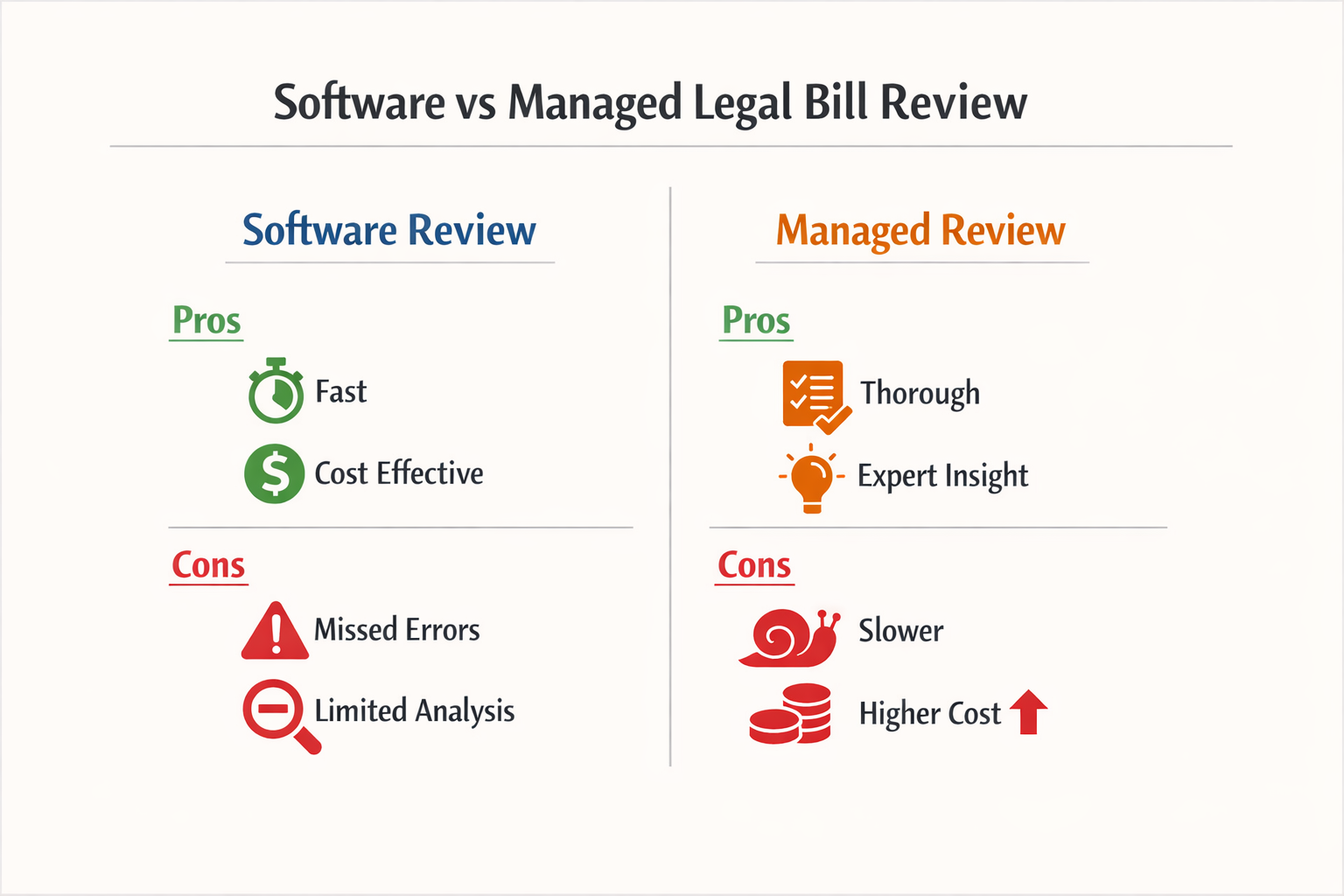
Software-based and managed legal bill review operate through distinct workflows, each suited to different organizational needs and risk tolerances. Understanding how each approach functions — from invoice submission to final payment — clarifies where one method may outperform the other.
How Does Software-Based Bill Review Work?
Software-based bill review relies on automated validation rules applied at the point of invoice submission. When a law firm submits an invoice through an e-billing portal, the platform checks the LEDES file against a rule set derived from the carrier's outside counsel guidelines. Common validation steps include:
Step 1
File format and field validation
The platform confirms that the submitted file conforms to the LEDES 1998B specification, verifying that required fields are populated and that UTBMS task and activity codes fall within permitted ranges. Files that fail this check are rejected before human review.
Step 2
Guideline rule application
The software applies programmed rules — billing increment enforcement, block billing detection, rate ceiling checks, and narrative length thresholds. Line items that violate a rule are flagged with a reduction code, and the system calculates a proposed adjustment.
Step 3
Exception routing
Invoices with flagged entries are routed to a queue for adjuster or in-house counsel approval. The reviewer sees the flagged line items, the reduction code, and the software's proposed adjustment. The reviewer may accept, modify, or override the recommendation.
Step 4
Payment and appeal path
Once the reviewer approves the adjusted invoice, payment is processed. The law firm receives a remittance detail showing which line items were reduced and under which codes. The firm may submit an appeal through the platform's appeal module, typically within a defined window — for example, Markel accepts appeals up to 45 calendar days after payment is processed.
Software-based review excels at consistency and speed. Every invoice is measured against the same rule set, and validation occurs in seconds rather than hours. The trade-off is rigidity: the software cannot interpret context, recognize a justified exception, or negotiate a narrative that technically violates a guideline but accurately describes the work performed. For more on how block billing triggers rejections and what constitutes a compliant narrative, see our detailed breakdown of carrier reduction patterns.
How Does Managed Legal Bill Review Work?
Managed bill review introduces human judgment at multiple stages of the workflow. A third-party review firm or an in-house team of auditors examines each invoice line by line, applying both the carrier's published guidelines and contextual knowledge of the matter, jurisdiction, and litigation phase.
Step 1
Initial intake and file validation
The reviewer confirms that the invoice file is structurally sound and that basic field requirements are met. Unlike pure software review, the managed reviewer may accept a file with minor formatting deviations if the substantive content is clear.
Step 2
Line-by-line substantive review
The reviewer reads each narrative, evaluates the UTBMS codes, and considers whether the time charged is reasonable for the task described. The reviewer applies the guideline's prohibitions but also interprets them: a narrative that bundles two closely related tasks may be accepted if the total time is reasonable and the tasks are contemporaneous.
Step 3
Contextual adjustment and negotiation
When a line item appears excessive or unclear, the managed reviewer may contact the billing attorney for clarification before imposing a reduction. This negotiation step — absent in pure software review — allows the firm to provide additional context that may justify the entry.
Step 4
Final recommendation and payment
The managed reviewer submits a report to the carrier or client with recommended adjustments, supporting rationale, and any notes from the negotiation process. The client approves payment, and the firm receives a detailed explanation of each reduction, often with more narrative context than a software-generated reduction code provides.
Managed review offers flexibility and nuance. The reviewer can recognize when a guideline prohibition should yield to the realities of a complex matter, and the firm has an opportunity to defend its billing before a reduction is finalized. The cost is time and expense: managed review is slower and more labor-intensive than automated validation, and the quality of review depends on the expertise of the individual reviewer.
Managed review allows a carrier to enforce guidelines without treating every deviation as a per se violation — a distinction that matters when the guideline itself is silent or ambiguous.
What Are the Key Differences Between Software and Managed Review?
| Criterion | Software-Based Review | Managed Review |
|---|---|---|
| Speed | Seconds to minutes per invoice | Hours to days per invoice |
| Consistency | Identical rule application across all invoices | Varies by reviewer judgment |
| Contextual flexibility | None — rules applied as written | High — reviewer interprets guidelines |
| Cost per invoice | Low — automated processing | Higher — requires trained staff |
| Appeal process | Formal, platform-based, often time-limited | May include pre-reduction negotiation |
| Best for | High-volume, low-complexity matters with clear guidelines | Complex, high-stakes matters requiring judgment |
Some carriers combine both methods: software performs the initial validation and flags obvious violations, then a managed reviewer examines flagged entries and high-dollar invoices. This hybrid approach captures the efficiency of automation while preserving human judgment for the entries that warrant it.
Tips and Tricks
Choosing between Software vs. Managed Legal Bill Review services is not a one-size-fits-all decision. The right approach depends on invoice volume, carrier diversity, and the internal resources available to handle appeals and guideline interpretation. Three considerations help clarify the choice: the frequency of guideline updates, the complexity of the matters being billed, and the appetite for direct engagement with reduction codes.
Match the Tool to the Volume and Variability
Software-based review scales efficiently when invoice volume is high and the carriers involved publish stable, well-documented outside counsel guidelines. If your firm submits hundreds of invoices per quarter to a small set of carriers, automated validation against LEDES 1998B field requirements and UTBMS code sets delivers consistent results with minimal human intervention. Managed review becomes more attractive when the carrier mix changes frequently, when guidelines are ambiguous or silent on key billing practices, or when the matters involve staffing arrangements that trigger pre-approval thresholds. A managed reviewer reads the guideline as written and applies the reduction codes the carrier actually uses, not the ones the software assumes are universal.
Understand What Each Approach Does Not Do
Software validates format and flags entries that match known rejection patterns. It does not interpret narrative detail, assess whether a 4.2-hour block entry is reasonable in context, or determine whether a motion in limine was within the scope of the retention. Managed review performs those contextual judgments, but it does not eliminate the need for clean LEDES files or accurate UTBMS coding on the front end. If your e-billing portal rejects an invoice because a required field is blank, no amount of human review will bypass that validation error. The two approaches address different failure modes: software catches structural defects, managed review catches guideline violations that require judgment. Understanding common e-billing portal invoice rejections helps firms prevent both types of failure.
The cheapest option is the one that prevents the rejection or reduction from happening in the first place.
Plan for the Appeal Path Before the Invoice Is Submitted
Whether you use software or managed review, the appeal process begins with the invoice narrative and the contemporaneous records that support it. If a reduction code is applied, the carrier expects a response that cites the guideline provision, explains why the entry complies, and provides documentation. Markel, for example, accepts appeals up to 45 calendar days after payment is processed, and all appeals must be submitted through the e-billing system's appeal module. A software-based workflow can flag high-value reductions for appeal, but the appeal itself — the argument and the supporting records — is a human task. A managed review service that includes appeal support will draft the response and coordinate with the billing attorney; a software-only approach leaves that work to the firm. Budget for the appeal path when comparing the total cost of each option.
Verify Budget and Approval Requirements Early
Some carriers require matter budgets before the first invoice is submitted. Legal Exchange, used by Markel and other carriers, requires budgets for all matter types except Workers Compensation claims. The budget must be approved by the assigned claims professional before an invoice can be processed. Software-based review will not bypass this requirement, and a managed reviewer cannot approve a budget on the carrier's behalf. Confirm budget and pre-approval thresholds at the outset of the engagement, and ensure the e-billing portal reflects the approved figures. Missing this step delays payment regardless of which review method you use.
For firms handling block billing issues that trigger carrier rejections, understanding the specific prohibition language in each guideline is essential — software flags the pattern, but only a human or a managed reviewer can determine whether the narrative detail is sufficient to survive the reduction.
Conclusion
The choice between Software vs. Managed Legal Bill Review is not binary. Each approach addresses a different layer of the billing control problem. Software enforces format compliance, flags guideline violations, and produces reduction codes at scale. Managed review interprets narrative detail, evaluates staffing decisions, and applies carrier-specific policy to line items that pass automated checks. Firms that treat these as mutually exclusive options miss the operational reality: most carriers use both, in sequence.
In our work examining carrier vendor-services workflows, we observe that e-billing portals perform the first-pass validation—LEDES field structure, UTBMS code assignment, billing increment adherence—before any human reviewer opens the file. This is software at work. The second pass, where a reviewer decides whether "research and draft motion in limine, 4.2" is block billing under a specific guideline version, is managed review. Both passes generate reduction codes; both require an appeal path; both shape the final payment. Understanding this two-stage structure helps firms decide where to invest: better LEDES hygiene reduces software rejections, while tighter narrative discipline and staffing documentation survive managed review.
For organizations evaluating their bill review infrastructure, the controlling question is not which method to choose, but which risks each method mitigates and where the current process fails. A carrier receiving ten thousand invoices per quarter cannot manually review every line item; software handles volume. A carrier facing fee disputes in California independent-counsel matters cannot rely on automated reduction codes alone; managed review interprets Civil Code section 2860 and applies it to the facts of the engagement. The best practice is to define the failure mode—format errors, guideline violations, narrative insufficiency, staffing disputes—and match it to the tool that prevents it. For more on how guideline violations trigger rejections, see our guide to block billing and carrier rejections.
As we noted in examining LEDES Oversight Committee specifications and carrier portal behavior, strict adherence to the 98B format does not guarantee acceptance, and acceptance does not guarantee payment. Software enforces one set of rules; managed review enforces another; and the carrier guideline—named, versioned, and cited—sits above both. Firms that quote the controlling document, track reduction codes, and appeal with pinpoint citations to the guideline provision fare better under either review method. The mechanics differ; the principle does not: read the guideline, document the work contemporaneously, and submit the invoice in the format the carrier specifies. That discipline survives both software validation and human judgment.
FAQ
What is Software vs. Managed Legal Bill Review?Software vs. Managed Legal Bill Review describes two distinct methods carriers use to validate legal invoices. Software-based review uses automated rules to check LEDES file format, UTBMS codes, and guideline compliance. Managed review adds human reviewers who interpret narrative detail, apply carrier-specific guidelines, and assess line-item context before applying reduction codes.
When should a law firm choose software-based review over managed review?Software-based review works best for high-volume, low-complexity matters with stable carrier guidelines. If your firm submits hundreds of invoices per quarter to carriers with clear, well-documented outside counsel guidelines, automated validation delivers consistent results with minimal cost. Managed review becomes necessary when guidelines are ambiguous, when matters involve complex staffing arrangements, or when the carrier mix changes frequently.
Can software-based review interpret narrative detail or assess reasonableness?No. Software validates format and flags entries that match prohibited patterns, but it cannot interpret whether a 4.2-hour block entry is reasonable in context or whether a motion in limine was within the scope of the retention. Those judgments require human review. Software catches structural defects; managed review catches guideline violations that require interpretation.
How do carriers combine software and managed review?Most carriers use a two-stage process: software performs initial validation of LEDES field structure, UTBMS codes, and billing increments, then routes flagged entries or high-dollar invoices to a managed reviewer. This hybrid approach captures the efficiency of automation while preserving human judgment for entries that warrant contextual analysis.
What happens if an invoice is reduced under software-based review?The law firm receives a remittance detail showing which line items were reduced and the reduction codes applied. The firm may submit an appeal through the e-billing platform's appeal module, typically within a defined window. For example, Markel accepts appeals up to 45 calendar days after payment is processed. The appeal must cite the guideline provision and provide documentation supporting the original entry.