


Pre-Bill Review Checklist for Insurance Defense Firms
Top takeaways
- A systematic pre-bill review checklist prevents invoice rejections and reduces write-downs before submission to carriers
- Insurance defense billing requires alignment with carrier-specific guidelines, LEDES file validation, and UTBMS code accuracy
- Common rejection triggers include block billing, incorrect billing increments, and missing narrative detail
- Pre-submission review catches errors that bill reviewers flag consistently across panels
Introduction
One entry reading "research and draft motion in limine, 4.2" is enough to trigger a reduction under most panel guidelines. When preparing bills for submission in the insurance defense sector, a meticulous pre-bill review process is essential. Our team has found that understanding the nuances of carrier outside counsel guidelines is crucial — for instance, when comparing guidelines from different carriers, such as Arch 2025.5, Hartford's billing FAQ, and Sompo's guidelines, we noticed that only one treats block billing as an outright prohibition rather than a reduction trigger.
Insurance defense firms submit invoices through e-billing portals that validate file structure, reject non-compliant entries, and route approved invoices to bill review. A rejection at the portal level costs time; a reduction after bill review costs revenue. Both are avoidable when the invoice passes through a structured pre-bill review checklist before the timekeeper signs off and the billing coordinator clicks submit.
The LEDES Oversight Committee's 98B format page defines the field set precisely, yet several portals accept files that omit fields the specification marks as required. This discrepancy can lead to rejections if not addressed during the pre-bill review. Recurring reduction patterns — travel, intra-office conferences, and administrative time billed at attorney rates — are commonly flagged across various guidelines. Recognizing these patterns helps in adjusting the billing entries accordingly before submission, ensuring a smoother billing process and reducing the likelihood of disputes.
Why Pre-Bill Review Matters
Carrier outside counsel guidelines specify what may be billed, at what rate, in what increment, and with what level of narrative detail. A pre-bill review checklist operationalizes those requirements at the line-item level. It catches the tenth-of-an-hour rounding error, the missing UTBMS activity code, the narrative that describes three tasks in one entry, and the expense that exceeds the pre-approval threshold. Each of these triggers a reduction code when the bill reviewer sees it; none of them should survive internal review.
Bill review is not negotiation. The reviewer applies the guideline to the invoice and issues reduction codes for non-compliant entries. The firm may appeal, but the appeal requires documentation that should have been in the narrative or the case file from the start. A block billing entry that lumps conference, research, and drafting into one line will be reduced even if the work was necessary and the time accurate, because the guideline prohibits block billing and the narrative does not permit the reviewer to allocate time across tasks.
What a Pre-Bill Review Checklist Prevents
A systematic checklist catches errors in three categories: file structure and format, guideline compliance, and narrative sufficiency. File structure errors — incorrect LEDES field delimiters, missing required fields, invalid UTBMS codes — trigger portal rejections before a human reviewer sees the invoice. Guideline compliance errors — block billing, incorrect increments, charges above the pre-approval threshold — trigger reductions during bill review. Narrative sufficiency errors — vague task descriptions, missing detail on conference participants, no explanation for travel — trigger reductions and make appeals harder to win.
Client-specific billing instructions add another layer. Some carriers limit firms to one invoice per billing interval; others require separate invoices for fees and expenses. Some accept LEDES 1998B only; others accept LEDES XML. The pre-bill review checklist must incorporate these instructions, because a structurally correct invoice submitted to the wrong portal or in the wrong format will be rejected outright.
Problem Statement
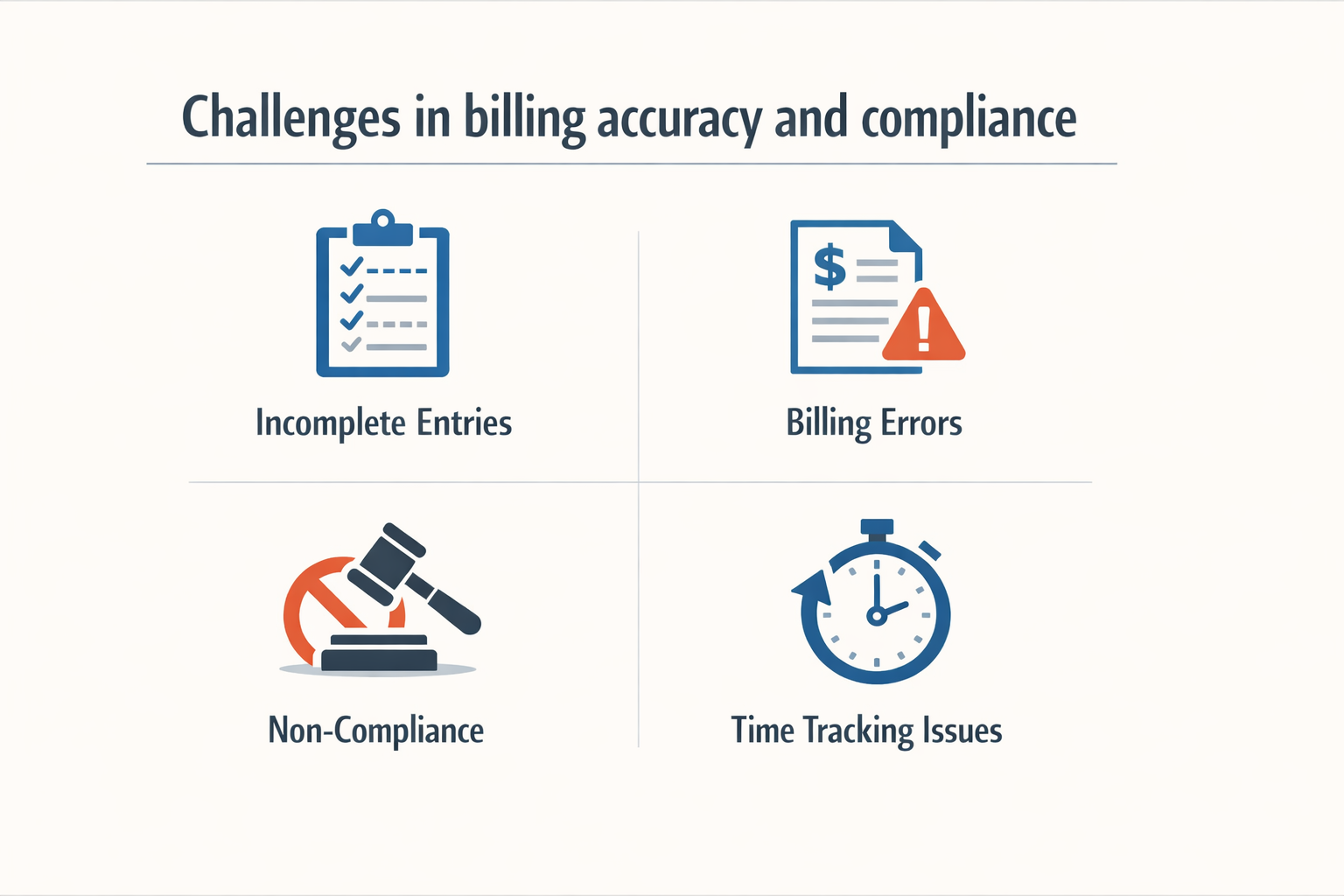
Insurance defense firms face persistent friction at the intersection of billing submission and carrier review. The friction is not abstract — it arrives as line-item reductions, portal rejections, and strained relationships with adjusters who control panel assignments. A single invoice reading "research and draft motion in limine, 4.2" can trigger a write-down under most guidelines, yet firms continue to submit entries written exactly that way.
Arbitrary Reductions and Strained Relationships
Outside billing review companies apply reduction codes that firms describe as archaic and arbitrary. The 2024 CLM Defense Counsel Study reports that billing review rarely comes back without reductions, and those reductions are based on word choice rather than the substance of the work performed. Carriers that do not use third-party review are described as "much more pleasurable to deal with" because they create a better relationship with the firms they rely upon to defend their insureds.
The continued push for lower rates and minor deductions — what the study characterizes as "nickel and diming" — does not create the type of engagement carriers should want their firms to feel. When a firm sees reduction after reduction tied to narrative phrasing or UTBMS code selection, the relationship deteriorates. The firm begins to view billing as adversarial rather than collaborative.
Compliance Gaps and Portal Rejections
Carrier billing rules are not uniform. One guideline treats block billing as an outright prohibition; another treats it as a reduction trigger but not a rejection event. A firm that submits the same invoice to three carriers may see three different outcomes — one acceptance, one reduction, one hard rejection at the portal.
Client billing rules often mandate that a law firm submit only one invoice per billing interval, whether monthly or quarterly. When a firm submits multiple invoices for the same matter in the same period, the portal may reject the second submission, forcing the firm to consolidate and resubmit. The LEDES XML E-Billing 2.1 White Paper notes that vendors in particular need to take note of this instruction, because a rule limiting submissions can cascade into delayed payment if the firm does not catch the violation during pre-bill review.
Recurring Reduction Patterns
Certain line items attract reductions across carriers. Travel time billed at the full attorney rate, intra-office conferences without a stated purpose, and administrative tasks billed at attorney rates are flagged repeatedly. A firm that does not audit for these patterns before submission will see the same reductions month after month, training the adjuster to expect write-downs and training the firm to accept lower effective rates.
The problem is not that the work was unnecessary. The problem is that the narrative, the UTBMS code, or the billing increment does not align with the guideline's stated requirements. A pre-bill review catches these misalignments before the invoice leaves the firm.
Solution Steps
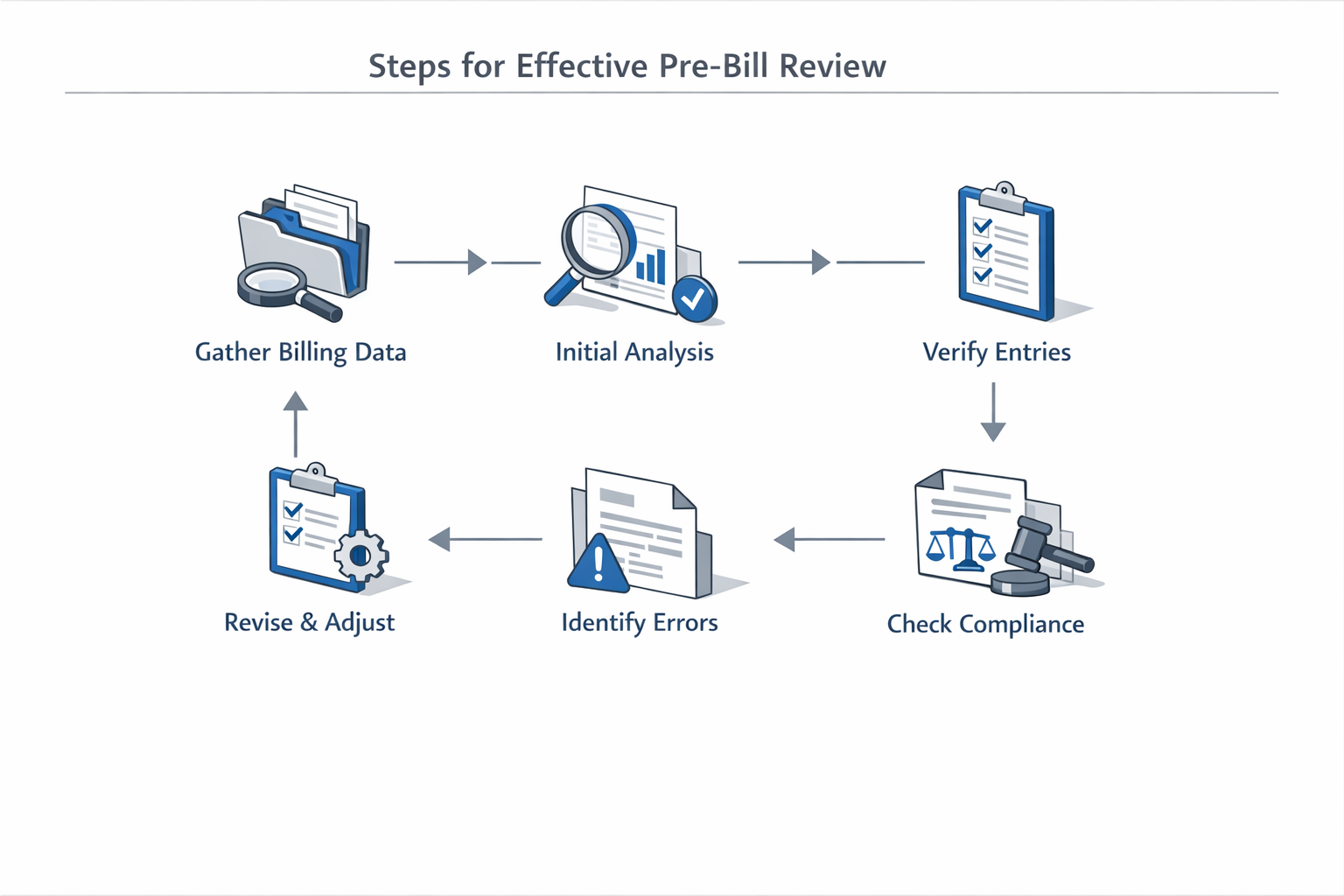
A systematic pre-bill review process catches errors before they reach the carrier and trigger reductions. Each step below addresses a discrete category of compliance and accuracy that bill reviewers examine.
Step 1
Verify timekeeper information on every line item
Confirm that each billing entry includes the name or initials of the timekeeper who performed the work, the date the work was performed, the hours billed, a detailed description of the services performed, and the total amount billed for that entry. PRISM's Liability Defense Counsel Standards, adopted July 1, 2025, require all five elements on every line; omitting any one triggers a rejection or a request for resubmission.
Step 2
Assign and validate UTBMS task and activity codes
Enter task and activity codes for each line item before the invoice leaves your system. The task code describes the category of work performed; the activity code narrows it further. Electronic invoice systems expect task-based aggregation, which means services performed in a single day may generate multiple time entries, each tagged with its own task and activity pair. Validate that the code combination matches the narrative—reviewers flag mismatches as data-quality failures.
Step 3
Check billing increments and eliminate block billing
Review each narrative for block billing—multiple distinct tasks combined into one entry. Break compound entries into separate lines, each with its own task code, activity code, and time allocation. Confirm that time is recorded in the increment the carrier specifies; most panel guidelines require tenth-of-an-hour precision, and rounding to quarter-hours inflates the total.
Step 4
Audit narrative detail for sufficiency
Read every narrative as if you had no other context. Does it state what the timekeeper did, or does it merely name a document or a category? Entries like "research and draft motion in limine, 4.2" fail the detail test under most guidelines. Rewrite vague narratives to include the specific issue researched, the authority consulted, or the argument developed.
Step 5
Cross-check totals and expense classifications
Recalculate line-item extensions and verify that the invoice total matches the sum of all entries. Classify expenses according to the carrier's chart of accounts; many portals reject invoices that assign a disbursement to the wrong expense code. If the guideline requires pre-approval for an expense category, confirm that approval is documented and attached before submission.
Pre-Bill Review Reduces Rejections
A checklist-driven review catches the errors that e-billing portals flag most often: missing timekeeper identifiers, invalid code pairs, and narratives too thin to survive scrutiny. Fixing them before submission avoids the appeal cycle and the write-down that follows a second rejection.
Tips and Tricks

A few practical adjustments to the pre-bill review routine can eliminate most rejections before they happen. The following tips address recurring patterns that bill reviewers flag across multiple carriers and portals.
Organize time entries by task, not by calendar day
Most panel guidelines expect task-based aggregation rather than chronological narratives. The UTBMS framework identifies a three-phase approach to categorize services performed, which means that multiple time entries may result from work done on a single day. When a timekeeper drafts a motion, reviews discovery, and attends a client call on the same date, those activities belong in separate line items with distinct task codes. Grouping them under one narrative creates block billing, even when each activity is itemized within the description.
Verify totals before adjusting them
Portals that permit manual adjustment of invoice totals introduce a reconciliation risk. When the sum of line items does not match the stated total, the file fails validation or triggers a hold for manual review. Before adjusting any total, confirm that the underlying entries support the new figure. If a reduction is necessary, remove or revise the line item rather than changing the header amount.
Use the checklist in reverse for appeals
When a carrier reduces an invoice, the reduction code often points to a guideline provision that the original submission violated. Running the same block billing checklist against the reduced entries reveals whether the reviewer applied the rule correctly. If the narrative met the guideline's detail standard and the task code matched the work performed, the reduction may be reversible on appeal. The checklist becomes the appeal brief's exhibit list.
The same tool that prevents rejections also documents compliance when a reduction is unwarranted.
Itemize every billing entry with complete metadata
PRISM's Liability Defense Counsel Standards, adopted July 1, 2025, state that each billing entry must include the timekeeper's name or initials, the date the work was performed, the hours billed, a detailed description of the services, and the total amount billed for that entry. Omitting any of these elements invites a rejection or a line-by-line hold. When the portal auto-populates a field, verify that the value is correct rather than assuming the system inferred it accurately.
Run a final format check before export
Portals accept files that omit fields the LEDES specification marks as required, but downstream processing may fail when those fields are missing. A final review of the exported file—opened in a text editor or spreadsheet, not just previewed in the billing system—catches empty columns, misaligned delimiters, and placeholder text that should have been replaced. This step takes two minutes and prevents a rejection that costs two weeks.
Conclusion
A disciplined pre-bill review process is not a courtesy to the carrier — it is the difference between predictable reimbursement and recurring write-downs. Every line item that leaves your office carries a narrative, a code, and a timestamp that will be measured against the carrier's published standard. When those elements align, the invoice clears. When they do not, the reduction notice arrives, and the appeal window is narrow.
The checklist outlined in this article addresses the three categories of error that trigger the majority of reductions: block billing, increment violations, and unsupported task codes. Our team has observed that recurring reduction patterns — travel, intra-office conferences, and administrative time billed at attorney rates — appear in nearly every guideline we have reviewed. Recognizing these patterns and adjusting entries before submission reduces dispute volume and preserves the firm's standing with panel administrators.
Carriers that do not rely on third-party billing review companies tend to foster stronger relationships with defense counsel, as noted in the 2024 CLM Defense Counsel Study. The absence of an intermediary does not eliminate the need for rigor; it shifts the responsibility for compliance entirely to the submitting firm. Whether the invoice goes to a review vendor or directly to the carrier, the same structural requirements apply: tenth-of-an-hour increments, task-specific narratives, and codes that match the work performed.
Firms should also be aware that some clients impose submission rules limiting the number of invoices per billing interval — typically one per month or quarter, as described in the LEDES XML E-Billing 2.1 White Paper. Where such a rule exists, the pre-bill review must account for all time and expenses in the period before the file is generated. A second submission is not an option.
Implement the checklist as a standing procedure. Assign responsibility for each step to a specific role — timekeeper, billing coordinator, or supervising attorney — and document completion before the file is exported. The goal is not perfection; it is consistency. A process that catches 90 percent of errors before submission will outperform a process that catches none, and the carrier will notice the difference over time.
For additional guidance on structuring compliant narratives and avoiding common rejection triggers, see our article on Block Billing: Reasons for Carrier Rejections and Solutions. The investment in pre-bill discipline pays forward in reduced rejections, faster payment cycles, and fewer appeals.