


Paralegal Billing Entry Examples PDF for Accurate Invoicing
Introduction
Paralegal billing entry examples demonstrate how a single line item reading "legal research, 3.5" triggers a reduction under most carrier outside counsel guidelines. The narrative offers no UTBMS task code anchor, no subject matter, and no way for the bill reviewer to verify that the work was necessary or properly staffed. When that entry comes from a paralegal timekeeper, the rejection often cites both block billing and inadequate narrative detail — two separate guideline violations that could have been avoided with a single additional sentence.
Paralegals bill substantial hours on insurance defense matters, discovery-intensive litigation, and transactional work subject to panel counsel guidelines. Each billed entry passes through an e-billing portal that validates timekeeper classification, checks narrative length and structure, and flags entries that appear to combine multiple tasks. The Carrier Ready Knowledge Team has reviewed thousands of reduction codes and appeal responses; the pattern is consistent: entries that specify the document, the action, and the outcome survive review, while entries that summarise a block of work do not.
Accurate billing entries serve three functions. They satisfy the carrier guideline's narrative requirements, they provide the adjuster or corporate counsel with enough detail to approve payment, and they create a contemporaneous record that withstands scrutiny if the invoice is later audited. A well-constructed entry names the timekeeper classification, states the task in terms that map to a UTBMS activity code, and describes what was done in enough detail that a reviewer who was not present can verify the work. The difference between a compliant entry and a rejected one is often a matter of adding ten words.
This article walks through the structure of paralegal billing entries that meet carrier and corporate client standards, identifies the narrative elements that prevent rejections, and provides line-item examples organised by task type and billing increment. The examples reflect the timekeeper classification conventions published by the LEDES Oversight Committee and the narrative detail standards found in the outside counsel guidelines of major insurance carriers. Each section addresses a specific challenge — ambiguity, guideline compliance, time management — and offers a solution that can be applied immediately to pending invoices.
Problem Statement
Paralegals face three recurring obstacles when creating billing entries: narrative ambiguity that triggers bill review reductions, classification errors that violate carrier guidelines, and time-pressure habits that erode detail. Each obstacle is measurable — reviewers cite the defect, carriers reject the line item, and the firm writes down the charge — yet many billing systems treat these failures as random events rather than predictable patterns.
Ambiguous Narratives and Guideline Violations
A line item reading "research and draft motion, 3.5" tells the reviewer nothing about the motion's subject, the legal issue researched, or the document produced. Most carrier outside counsel guidelines prohibit block billing — the practice of lumping multiple tasks into a single entry — and require contemporaneous detail sufficient to evaluate reasonableness. When a paralegal combines research, drafting, and revision into one narrative with a single aggregated time figure, the entry is non-compliant on its face. Bill reviewers apply reduction codes to ambiguous entries as a matter of routine, not discretion.
Classification errors compound the problem. The LEDES Oversight Committee publishes a revised timekeeper classification reference that distinguishes paralegals, legal assistants, discovery technicians, and administrative staff by role and credential. A paralegal performing substantive legal research under attorney supervision is not a clerk or secretary, and billing that work under the wrong classification code — such as CLKSEC instead of a paralegal-specific code — invites immediate rejection or rate adjustment. Carriers expect the timekeeper classification in the LEDES file to match the narrative and the rate, and mismatches signal either carelessness or intentional up-coding.
Time-Pressure Habits and Loss of Detail
Paralegals working under deadline often enter time in batches at the end of the day or week, relying on memory rather than contemporaneous notes. This practice produces vague narratives ("case management activities, 2.1") that obscure what was actually done and make it impossible for a reviewer to assess whether the time was reasonable. Guidelines require detail sufficient to permit evaluation; generic descriptions fail that test. The longer the gap between the work and the entry, the weaker the narrative and the higher the risk of reduction.
Another common challenge is the failure to segregate clerical tasks from substantive paralegal work. A paralegal who spends thirty minutes reviewing medical records and ten minutes filing copies is performing two distinct activities — one billable at the paralegal rate, the other either non-billable or billable at a lower administrative rate. Combining them into a single 0.7-hour entry billed at the paralegal rate violates the principle that clerical work should not be billed at professional rates. Carriers enforce this principle through reduction codes and narrative audits, and they expect the billing entry to reflect the actual distribution of effort.
A billing entry that cannot be evaluated cannot be defended, and what cannot be defended will be reduced.
Inconsistent Application of Billing Increments
Most panel guidelines specify tenth-of-an-hour increments, meaning every task must be recorded in 0.1-hour (six-minute) blocks. A paralegal who rounds a four-minute task to 0.1 and a nine-minute task to 0.2 is complying with the increment rule, but one who records 0.15 or 0.25 is not — those figures imply quarter-hour billing, which many carriers expressly prohibit. The increment rule is not a suggestion; it is a structural requirement of the LEDES format and the guideline. Entries that violate it are flagged by e-billing portal validation routines before a human reviewer ever sees them.
The combination of ambiguous narratives, classification errors, time-pressure habits, and increment violations creates a predictable pattern of rejections and reductions. The solution is not to write longer narratives or to guess at the correct code — it is to adopt a structured entry protocol that addresses each failure mode with a specific, repeatable practice. That protocol is the subject of the next section.
How Do You Write Paralegal Billing Entry Examples That Pass Review?
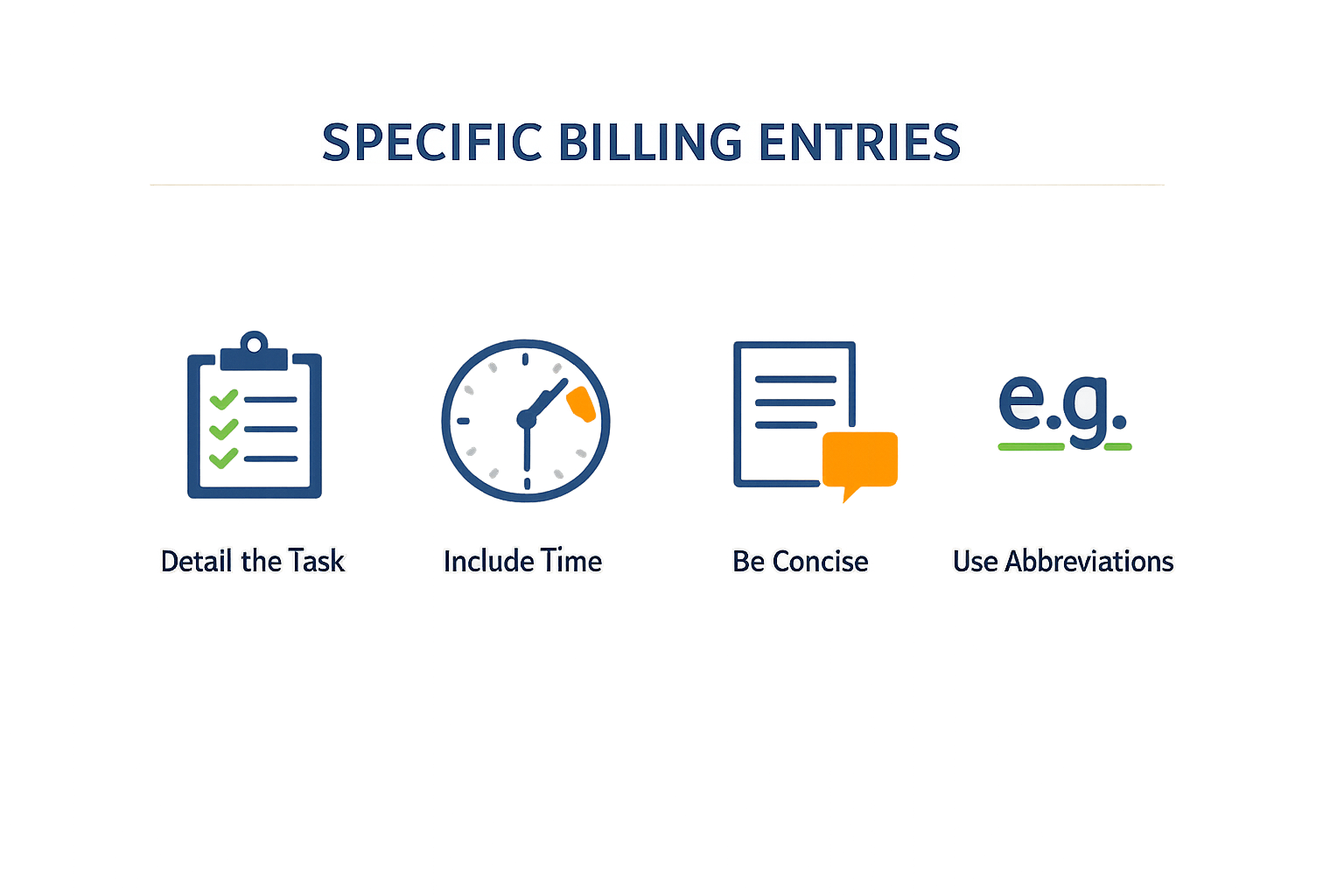
A billing entry that survives review starts with accurate classification. The LEDES Oversight Committee publishes a reference document that defines timekeeper roles, and that document makes clear that each classification carries specific expectations. A paralegal is not an associate, a contract attorney is not a staff attorney, and a discovery technician is not a general analyst. When a timekeeper performs work in multiple capacities on the same matter, the entry must reflect the capacity in which the work was performed — not the timekeeper's primary title.
Step 1: Classify the Timekeeper Correctly
Step 1
Identify the role for the specific task
Before drafting the narrative, confirm which timekeeper classification applies to the work performed. If a paralegal conducted legal research under attorney supervision, the classification remains paralegal. If an attorney performed discovery-specific strategy work, the classification may be Discovery Attorney rather than Associate. The LEDES Revised Timekeeper Classifications reference document states that it is possible for a law firm attorney to function in multiple capacities on a matter, and the same principle applies to non-attorney timekeepers.
Misclassification inflates the billed rate and triggers automatic rejections in e-billing portals that validate timekeeper codes against rate schedules. A single entry coded as Associate when the work was paralegal-level will fail validation, and the entire invoice may be held pending correction.
Step 2: Record Time Contemporaneously in the Required Increment
Step 2
Log time as the work occurs
Write the entry immediately after completing the task, not at the end of the day or week. Contemporaneous records capture detail that memory does not preserve. Most carrier guidelines specify tenth-of-an-hour increments; rounding to the nearest quarter-hour without express permission violates the guideline and invites reduction.
An entry reading "review correspondence, 0.3" is contemporaneous and compliant. An entry reading "review correspondence and draft response, 1.5" is block billing — multiple tasks aggregated into one line — and most panel guidelines prohibit it outright.
Step 3: Write a Specific, Task-Focused Narrative
Step 3
Describe one discrete task per entry
The narrative must identify what was done, not why it mattered or what the outcome was. "Review plaintiff's interrogatory responses" is sufficient. "Review plaintiff's interrogatory responses to assess credibility and identify inconsistencies for cross-examination" is advocacy, not a fee entry, and reviewers reduce entries that read like case summaries.
For more on how narrative specificity interacts with rejection workflows, see E-Billing Portal Invoice Rejections: Common Causes and Fixes.
Step 4: Assign the Correct UTBMS Task and Activity Codes
Step 4
Match codes to the work performed
UTBMS task codes categorize the phase of the matter (for example, L300 for discovery). Activity codes specify the action taken within that phase (for example, A103 for document review). When billing for specialist services associated with discovery, accurate classification ensures proper invoicing and reduces the risk of code-mismatch rejections.
An entry with task code L100 (case assessment) and activity code A105 (draft pleading) will fail validation because pleadings belong to task code L200 (pleadings). The e-billing portal reads the codes as structured data, and inconsistent coding triggers an automatic hold.
Step 5: Verify Compliance Before Submission
Step 5
Check the entry against the guideline
Before the invoice leaves the firm, compare each entry to the carrier's outside counsel guidelines. Confirm that the timekeeper classification matches the rate schedule, the increment complies with the stated requirement, the narrative avoids block billing, and the UTBMS codes align with the task performed. If the guideline prohibits a category of work — for example, "travel time not compensable" — remove those entries or seek pre-approval in writing.
What Are Common Paralegal Billing Entry Examples?
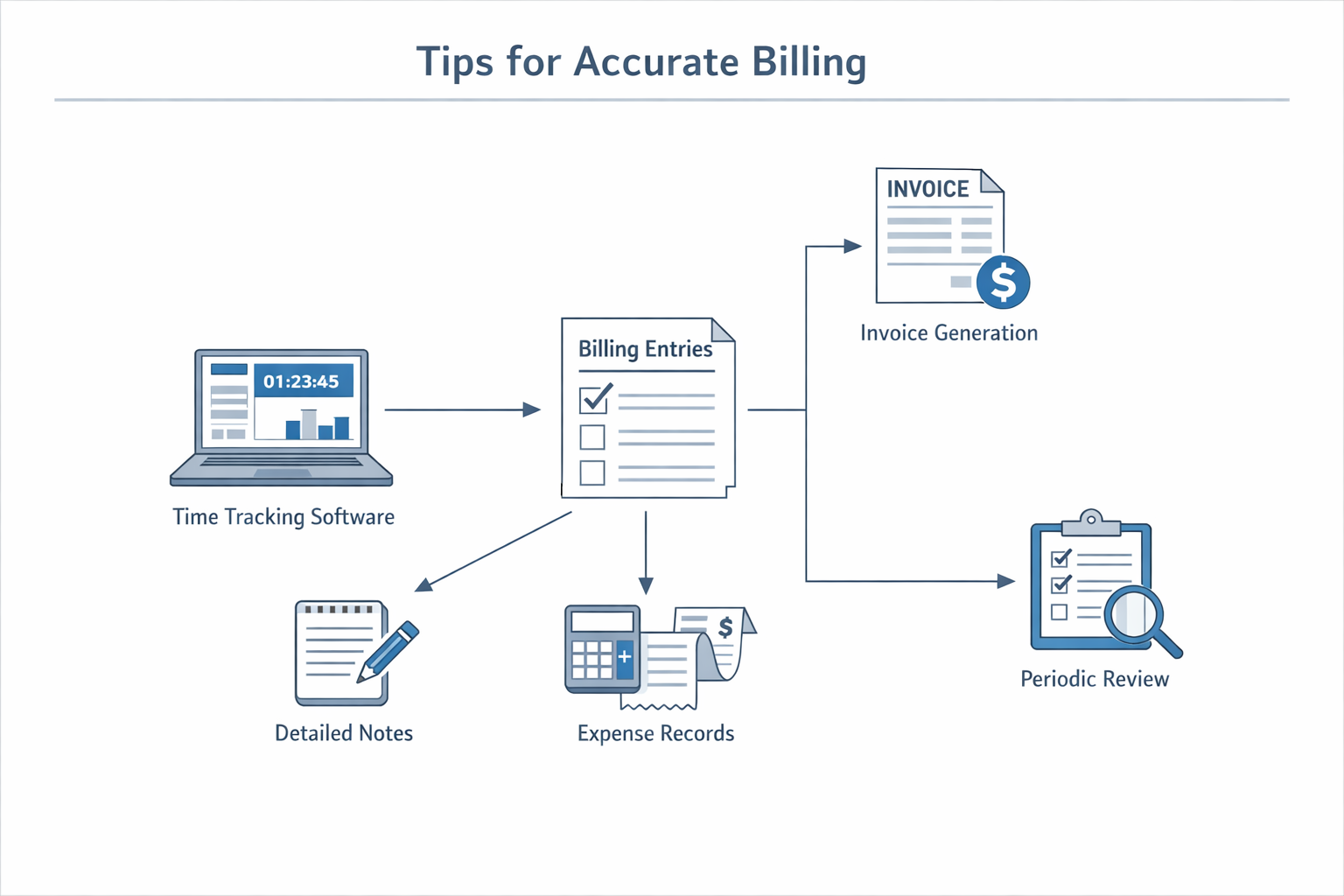
A clean billing entry begins with accurate timekeeper classification. The LEDES Oversight Committee publishes a revised timekeeper classification reference that defines each code's scope — and misclassifying a paralegal as an associate or a contract attorney as a staff attorney will trigger a reduction before the narrative is even read. When a paralegal performs discovery work, the entry should reflect paralegal-level work under the correct UTBMS task code, not specialist attorney work that invites a guideline challenge.
Record Time Contemporaneously
Contemporaneous records are the foundation of defensible billing. An entry logged at the end of the week is not contemporaneous, and a bill reviewer can see the pattern. Record the task, the time increment, and a sufficient narrative the same day the work is performed. When an adjuster or auditor questions a line item three months later, the timekeeper who wrote it on the day will remember what happened; the timekeeper who batched entries at month-end will not.
Use Tenth-of-an-Hour Increments Where Required
Most panel guidelines specify tenth-of-an-hour billing increments. A six-minute task is 0.1 hours, not 0.15 or 0.2. Rounding every task up to the next quarter-hour produces an invoice that fails validation before it reaches human review. Check the guideline version that governs the matter, confirm the increment rule, and configure the time-entry software to enforce it. If the guideline is silent, tenth-of-an-hour is the safer default.
Avoid Block Billing in the Narrative
Block billing — listing multiple discrete tasks in a single line item — is prohibited under most carrier outside counsel guidelines. "Review correspondence, draft discovery responses, telephone conference with client, 3.5" will be reduced or rejected outright. Each task gets its own line, its own UTBMS activity code, and its own increment. The extra rows cost nothing to generate and eliminate the single most common reduction code. For detailed guidance on what constitutes block billing and how reviewers identify it, see Block Billing: Reasons for Carrier Rejections and Solutions.
One entry reading "research motion, draft motion, review cases, 4.2" is enough to trigger a reduction under most panel guidelines.
Classify Timekeepers Correctly
When a law firm attorney functions in multiple capacities on a matter — for example, handling both general case management and specialist discovery services — the billing entries must reflect which capacity the attorney occupied for each task. An attorney performing only specialist services associated with discovery is classified as a Discovery Attorney (DSCATT) for those entries, not as an associate or partner. A contract attorney working on a temporary basis is classified as TEMPAT, not ASSOC. The LEDES revised timekeeper classification reference defines the scope of each code; using the wrong code invites a rate challenge even when the narrative is clean.
Validate Before Submission
E-billing portals reject files that fail format validation, and a rejected file costs time and delays payment. Before submitting a LEDES 1998B file, confirm that every timekeeper classification code is recognized, every UTBMS task and activity code is valid, and every billing increment matches the guideline requirement. Most portals provide a pre-submission validator; use it. A file that passes validation still faces human review, but a file that fails validation never reaches a reviewer at all.
Maintain a Billing Entry Reference Library
Keep a file of approved entries for common tasks, organized by UTBMS task code and matter type. When a new paralegal needs to draft a discovery-response entry, the reference library shows exactly what narrative detail, activity code, and increment passed review on the last three matters. The library is not a template to copy verbatim — each entry must reflect the actual work performed — but it eliminates guesswork about what level of detail satisfies the guideline.
Sample paralegal billing entry examples by task type:
| Task Type | Example Entry | Time | UTBMS Code |
|---|---|---|---|
| Document review | Review plaintiff's medical records from County Hospital (45 pages) | 0.8 | L310/A103 |
| Discovery response | Draft responses to defendant's interrogatories nos. 1-15 | 1.2 | L320/A105 |
| Legal research | Research service-of-process requirements for out-of-state defendant | 0.3 | L110/A101 |
| Court filing | E-file motion for extension of time via state portal | 0.1 | L200/A104 |
| Correspondence | Review and respond to opposing counsel email re: deposition schedule | 0.2 | L500/A102 |
Conclusion
Accurate paralegal billing entries are not optional when carriers and e-billing portals enforce validation at submission. A single line item that merges two tasks, omits a UTBMS code, or rounds to a quarter-hour can trigger an automated rejection before any human reviewer opens the invoice. The examples in this article — drawn from LEDES timekeeper classifications and common guideline provisions — show how specificity, contemporaneous detail, and correct classification prevent those rejections and the appeal cycles that follow.
Using concrete paralegal billing entry examples as templates reduces the guesswork. When a paralegal knows that "Research service-of-process requirements for out-of-state defendant, 0.3" passes validation and "Research and draft motion, 4.2" does not, the next invoice reflects that knowledge. The free PDF resource linked in this article provides additional line-item examples, classification guidance, and a quick-reference table for tenth-of-an-hour conversions — tools that turn guideline compliance from a review bottleneck into a repeatable workflow.
Billing accuracy is not about perfection on the first pass; it is about building a library of entries that survive the validation rules you submit to most often. Track which narratives clear the portal, which trigger reduction codes, and which classifications the reviewer questions. Over time, that internal knowledge base becomes the fastest path to clean invoices and faster payment. For additional guidance on UTBMS activity codes and how reviewers interpret them, see UTBMS Activity Codes A101-A111 for Legal Billing. Understanding reasonable attorney fees standards also helps paralegals structure entries that withstand scrutiny.
When the billing entry is clear, the timekeeper classification is correct, and the increment matches the guideline, the invoice moves forward. That is the standard carriers enforce, and it is the standard paralegal billing entries must meet.
FAQ
What is a paralegal billing entry example?A paralegal billing entry example is a line item that specifies the task performed, the time spent in tenth-of-an-hour increments, and enough narrative detail to permit a bill reviewer to verify the work. A compliant entry includes the document or subject matter, the action taken, and the appropriate UTBMS task and activity codes.
How do I write paralegal billing entry examples that pass carrier review?Write each entry contemporaneously, use tenth-of-an-hour increments, avoid block billing by separating tasks into individual lines, classify the timekeeper correctly, and include enough detail to identify the document and the action taken. Review the carrier's outside counsel guidelines before submission.
What are common mistakes in paralegal billing entry examples?Common mistakes include block billing multiple tasks into one entry, using vague narratives such as "case management," misclassifying the timekeeper, rounding to quarter-hour increments when guidelines require tenths, and failing to assign UTBMS codes that match the work performed.
Where can I find paralegal billing entry examples?Many carriers publish sample entries in their outside counsel guidelines, and the LEDES Oversight Committee provides timekeeper classification and UTBMS code references. Firms often maintain internal reference libraries of approved entries organized by task type and matter.
Why do paralegal billing entry examples get rejected?Entries are rejected for narrative ambiguity, block billing, incorrect timekeeper classification, mismatched UTBMS codes, non-compliant billing increments, and failure to meet the carrier's guideline requirements for contemporaneous detail.