

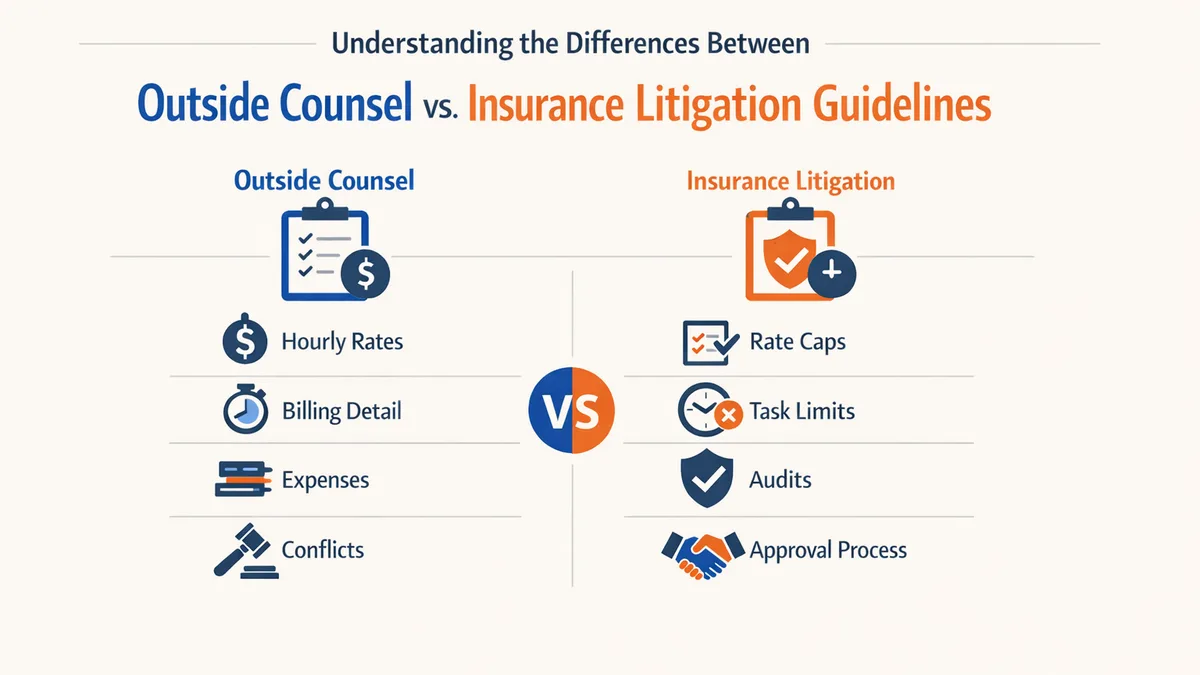
Outside Counsel Guidelines vs Insurance Litigation Guidelines
Introduction
Outside counsel guidelines vs insurance litigation guidelines both govern the relationship between legal service providers and their clients, but they serve different purposes and impose distinct requirements. Outside counsel guidelines are a standard document that establishes policies and procedures governing the relationship between a company and its external legal representatives. These guidelines typically address staffing, budgets, billing increments, expense reimbursement, communication protocols, and reporting obligations. They represent a significant development in how large corporate law firms conduct their practice, as they shift control over engagement terms from counsel to the client.
Insurance litigation guidelines, by contrast, are issued by insurance carriers to defense counsel handling claims on behalf of insureds. These guidelines detail requirements such as staffing limits, litigation plans, matter budgets, and specific billing practices that reflect the unique economics and oversight needs of insurance defense work. Carriers use these guidelines to manage panel counsel relationships, control costs, and ensure consistency across the portfolios they underwrite. In my work with the Carrier Ready Knowledge Team, I've often explored the nuances between outside counsel guidelines and insurance litigation guidelines, and one key difference lies in how these documents handle billing practices.
The distinction matters because the two guideline types impose different obligations on timekeepers and billing staff. A line item that complies with a general corporate outside counsel guideline may still violate an insurance carrier's published requirements. For example, a carrier guideline may prohibit block billing outright, while a corporate guideline may treat it as a reduction trigger rather than an absolute bar. Similarly, insurance litigation guidelines often specify pre-approval thresholds for expert fees, depositions, or travel expenses that are lower than those found in corporate guidelines, and they may require submission through designated e-billing portals with carrier-specific LEDES and UTBMS validation rules.
Understanding which guideline governs a matter is the first step toward compliance. For insurance defense counsel, the controlling document is the carrier's published guideline, not the law firm's standard engagement letter or the corporate client's general outside counsel guidelines. For panel counsel, the carrier guideline version in effect at the time of the invoice submission controls, and updates to those guidelines may apply retroactively to open matters unless the guideline itself states otherwise. Misidentifying the controlling guideline is a common cause of invoice rejection, reduction, and appeal.
Problem Statement
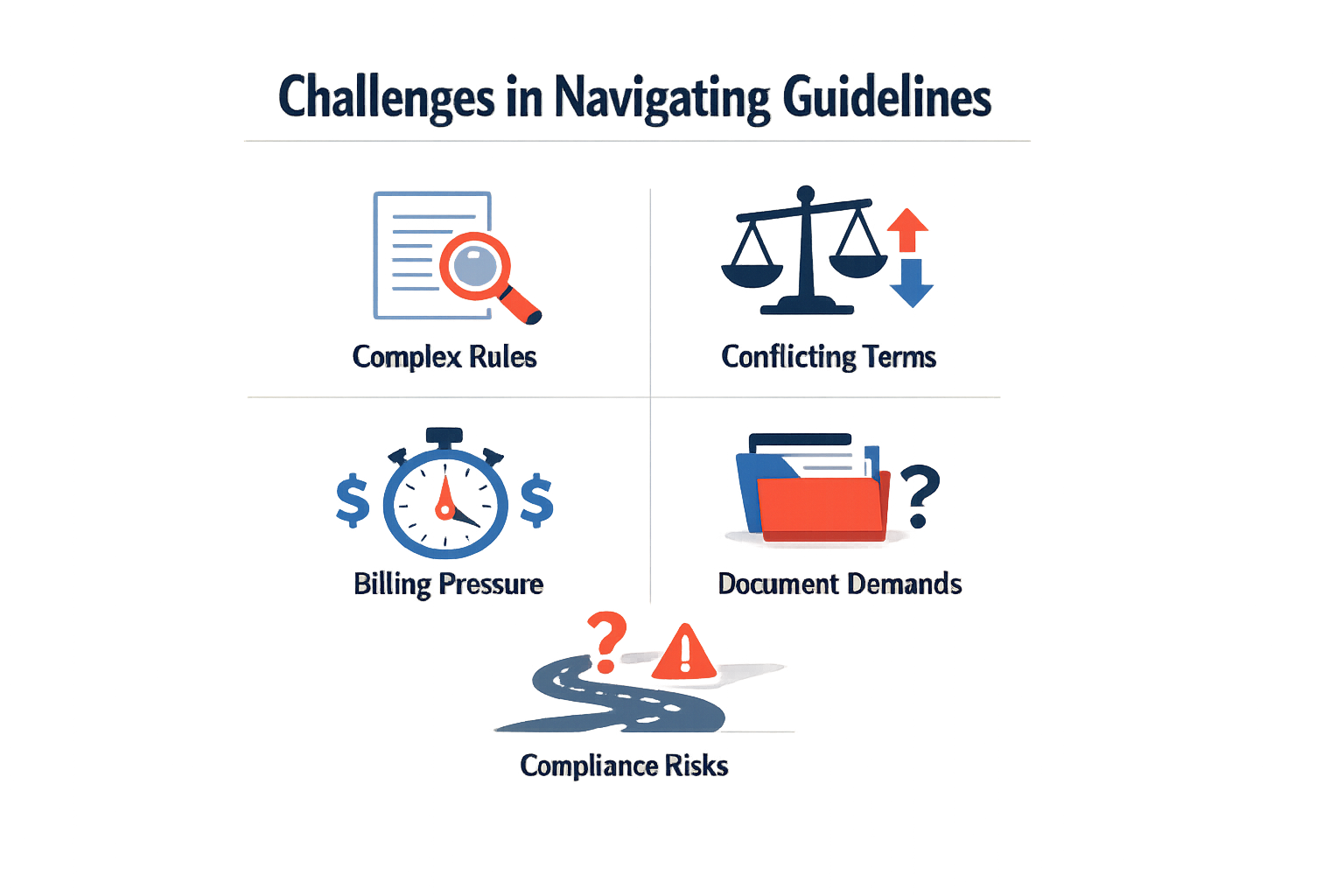
Outside counsel routinely encounter friction when working under both outside counsel guidelines and insurance litigation guidelines. The core difficulty is not that these documents exist — it is that firms discover their requirements too late, after time has been recorded in ways the carrier will not accept. One invoice submitted under terms the firm believed were clear triggers a reduction, and the appeal reveals that a different paragraph in a different section controlled the outcome. The guidelines were available from the start, but the firm read them as advisory rather than dispositive.
A second problem is structural: many carriers publish guidelines that are vague enough to pass legal review but too imprecise to guide daily billing decisions. A prohibition on block billing sounds straightforward until the firm submits an invoice with entries reading "research and draft motion in limine, 4.2" and learns that the carrier interprets that as block billing while another carrier with identical language does not. The guidelines exist, but their enforcement is inconsistent, and the firm has no reliable way to predict which line items will survive review. For more on how block billing triggers reductions, see Block Billing: Reasons for Carrier Rejections and Solutions.
Common Failure Modes
Guidelines fail when they are written once and then ignored by both the client and the firm. A carrier publishes a 40-page document, emails it to every panel firm, and assumes compliance. The firm's billing coordinator skims the summary page, misses the section on narrative detail requirements, and continues entering time the way the firm has always done it. Six months later, the first invoice is rejected, and the firm discovers that the guideline required contemporaneous task-level entries, not end-of-day summaries. The guideline was clear, but no one enforced it until the bill reviewer applied it.
Another failure mode is the absence of an enforcement mechanism. A guideline states that pre-approval is required for expert fees above a threshold, but the e-billing portal accepts the invoice without flagging the missing approval. The bill reviewer reduces the expert charge three weeks later, and the firm appeals on the ground that the portal should have rejected the submission if approval was mandatory. The carrier's position is that the guideline controlled, and the portal's behaviour is irrelevant. The firm's position is that the portal's acceptance implied waiver. Neither side has a process that prevents the dispute from arising in the first place. For more on portal validation, see E-Billing Portal Invoice Rejections: Common Causes and Fixes.
A third issue is scattered communication. The firm receives the guidelines by email, but subsequent amendments arrive as PDF attachments in matter-specific correspondence, and no one maintains a central repository. When an invoice is reduced, the firm appeals by citing the version it received at engagement, and the carrier responds by citing an amendment issued four months earlier that the firm never saw. The guidelines were updated, but the update never reached the timekeepers who needed it.
Solution Steps
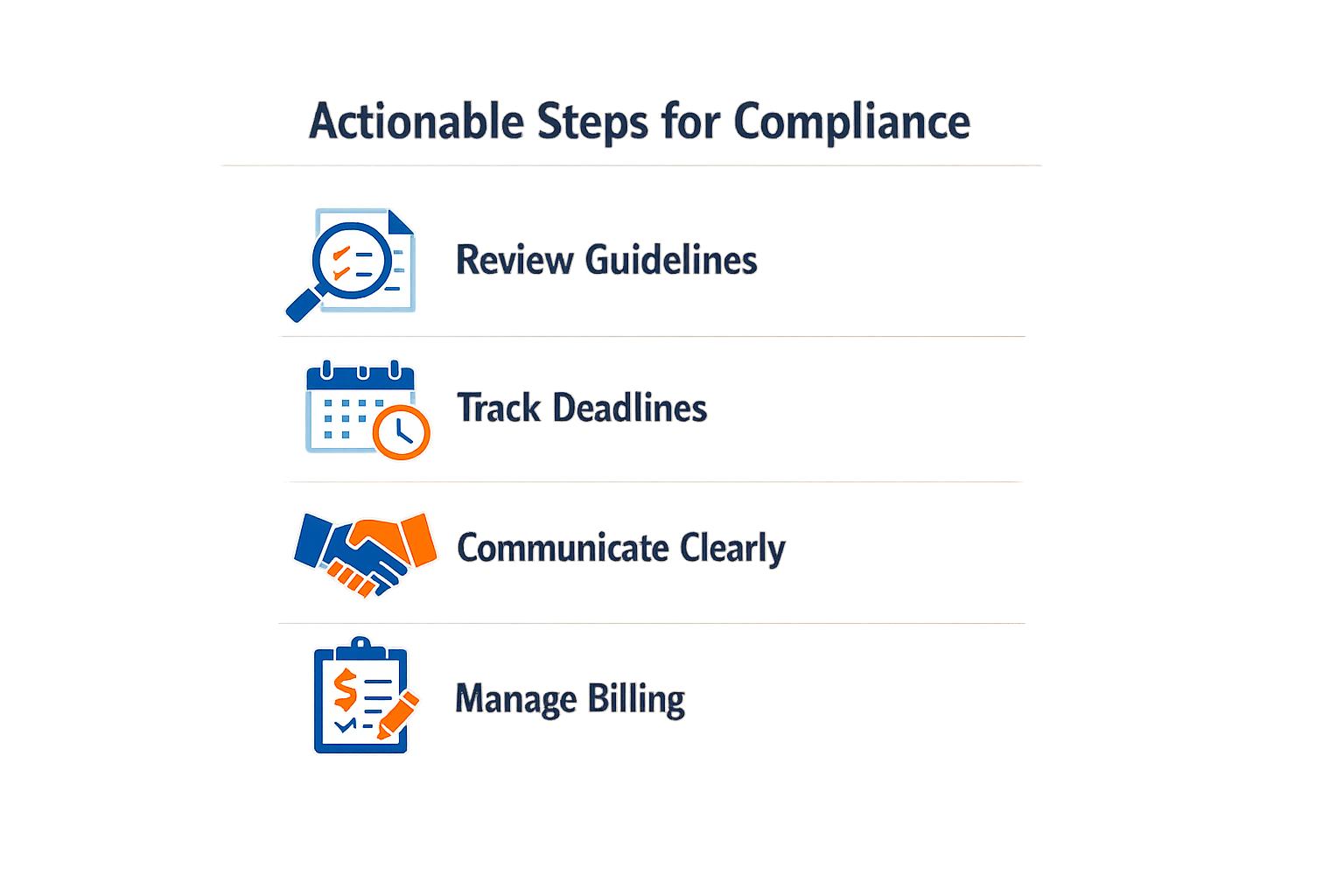
Aligning with both outside counsel guidelines and insurance litigation guidelines requires a deliberate operational process, not a one-time PDF review. The steps below provide a framework for ensuring compliance before the first invoice leaves your firm.
How Do You Read Outside Counsel Guidelines vs Insurance Litigation Guidelines?
Step 1
Obtain the current version
Request the carrier's outside counsel guidelines at the time of engagement, and confirm the version number or effective date. A guideline dated 2023 may differ materially from one issued in 2025, and the carrier expects you to follow the version in force when you submit the invoice.
Step 2
Identify non-negotiable prohibitions
Scan for language that uses "must," "shall," "prohibited," or "not permitted." These are hard stops. If the guideline states that block billing is prohibited, a single combined entry will trigger a reduction or rejection, regardless of how efficient the narrative reads.
Step 3
Extract rate caps, billing increments, and staffing ratios
Document the maximum hourly rate for each timekeeper level, the required billing increment (most commonly tenth of an hour), and any staffing ratio or approval threshold for senior attorney time. These are the numeric boundaries that bill reviewers enforce first.
Build an Internal Approval Workflow
Outside counsel guidelines do not enforce themselves. Your firm needs a process that interprets the guideline, applies it to the matter, and reviews every invoice before submission.
Step 4
Assign guideline ownership
Designate one person—typically a billing coordinator or senior paralegal—to maintain the current version of each carrier's guidelines and to flag updates when they arrive. This person becomes the first checkpoint before any invoice goes to the e-billing portal.
Step 5
Map guideline rules to your timekeeping system
If the guideline prohibits travel time billed at full hourly rates, configure your system to flag or reduce those entries automatically. If the guideline requires contemporaneous narrative detail, train timekeepers to record the detail on the day the work occurs, not when the invoice is prepared.
Review Before Submission
Step 6
Run a pre-submission audit
Before generating the LEDES file, review the draft invoice against the guideline's checklist: rate caps, billing increments, task code accuracy, narrative sufficiency, and expense documentation. Identify and correct violations before the carrier's bill reviewer sees them. For details on LEDES field requirements, see LEDES 1998B File Format - All 24 Fields Explained.
Step 7
Document approval and adjustments
If you adjust an entry to comply with the guideline, note the reason in your internal records. If the carrier later disputes the adjustment or requests clarification, you can point to the guideline provision that required the change.
Establish Matter-Level Expectations
Guidelines set the floor. Effective compliance also requires alignment at the matter level, where staffing decisions and budget expectations are negotiated before work begins.
Step 8
Confirm staffing and budget in writing
Before the engagement starts, document the anticipated staffing mix, the estimated budget, and any pre-approval thresholds for specific tasks or expenses. Share this plan with the carrier and obtain written confirmation. This step prevents disputes over whether a senior partner's time was necessary or whether a particular expert was pre-approved.
Step 9
Update the plan when scope changes
If the matter's complexity increases or the carrier requests additional work, revise the staffing plan and budget in writing and obtain approval before incurring the cost. Guidelines often require pre-approval for expenses above a stated threshold; treat staffing changes the same way.
| Step | Focus | Timing |
|---|---|---|
| Obtain and interpret guideline | Hard prohibitions, rate caps, increments | At engagement |
| Build internal workflow | Assign ownership, map rules to system | Before first invoice |
| Pre-submission audit | Check compliance, correct violations | Before every submission |
| Confirm matter-level expectations | Staffing, budget, pre-approval | At engagement and when scope changes |
Tips and Tricks
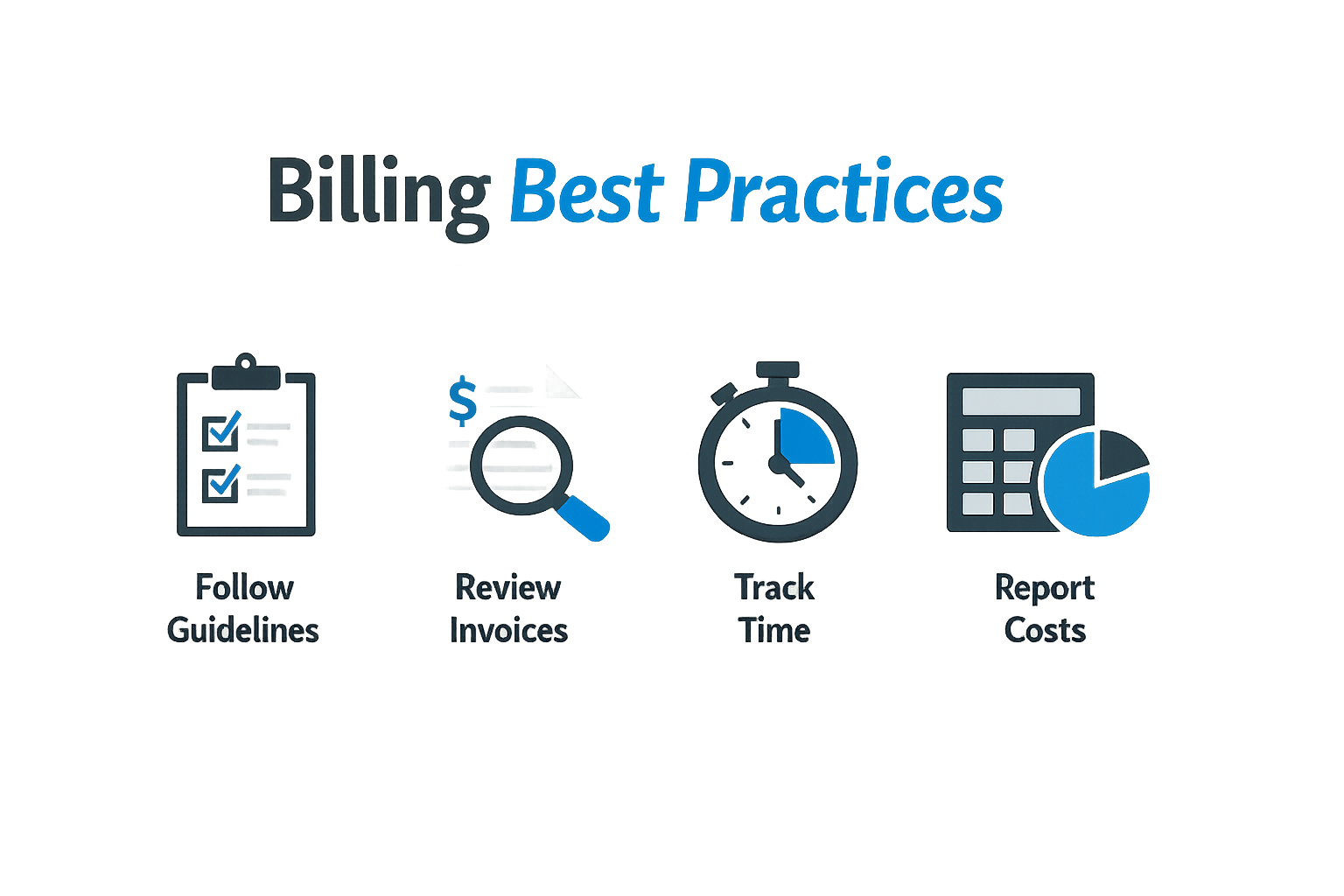
Firms that excel at navigating outside counsel guidelines treat them as a roadmap to understanding the client, not a compliance burden. This approach reduces risk and demonstrates sophistication, responsiveness, and business judgment. When a carrier publishes a guideline, it is signaling what matters to its bill reviewers and what will trigger reductions. Reading the guideline carefully before the first invoice goes out is the single most effective way to avoid write-downs.
Keep guidelines concise and focused
Good outside counsel guidelines cover only the rules that matter, which ensures better compliance from law firms. A guideline that runs to fifty pages of boilerplate is less likely to be read than one that runs to ten pages of specific prohibitions and requirements. Carriers that publish concise guidelines see higher compliance rates because timekeepers can actually remember what the rules are. If your firm is negotiating guideline terms at engagement, focus on the provisions that will affect your billing practice — staffing ratios, pre-approval thresholds, and billing increments — rather than general ethical obligations that already bind you.
Align your time entries with guideline expectations
Most carrier guidelines prohibit block billing, but the definition of block billing varies. One carrier may define it as any entry that describes more than one task; another may allow multiple tasks in a single entry if they are related and the time is broken out. The safest practice is to create one line item per distinct task, with a narrative that describes what was done, not what will be done or what the task is about. When a guideline specifies tenth-of-an-hour increments, round every entry to the nearest tenth — rounding to the nearest quarter-hour will trigger a reduction even if the total time is reasonable.
The cheapest invoice is the one that passes review on the first submission without a single line flagged for clarification.
If your firm uses UTBMS task and activity codes, match them to the work described in the narrative. Reviewers read the code first, then the narrative, and a mismatch between the two is a red flag. For detailed guidance on how reviewers interpret activity codes, see UTBMS Activity Codes A101-A111 for Legal Billing. A narrative that says "research" paired with activity code A103 (fact investigation) will draw scrutiny, even if the time itself is reasonable.
Treat guideline enforcement as a partnership
When a carrier's bill reviewer reduces a line item, the reduction code and the explanation are data. They tell you what the reviewer saw, what rule the reviewer applied, and what the reviewer expects to see next time. If the reduction is based on a misreading of the narrative, appeal it with a clarification, not an argument. If the reduction is based on a guideline provision you missed, adjust your billing practice for the next invoice. Firms that treat reductions as feedback rather than adversarial actions build stronger relationships with their clients and see fewer reductions over time.
Conclusion
Understanding the differences between outside counsel guidelines and insurance litigation guidelines is not optional for panel counsel or independent counsel working insurance defense matters. Each carrier publishes its own set of requirements, and those requirements control the invoice submission, the bill review process, and the reduction or rejection outcomes that follow. When an invoice fails to meet the stated standard — whether that standard addresses billing increments, block billing, staffing ratios, or pre-approval thresholds — the reduction code arrives with the next remittance, and the appeal path is narrow.
In my work with the Carrier Ready Knowledge Team, I've often explored the nuances between outside counsel guidelines and insurance litigation guidelines. One key difference lies in how these documents handle billing practices. For instance, when we look at block billing, a common point of contention, reading Arch 2025.5, Hartford's billing FAQ, and Sompo's guidelines together reveals that only one treats block billing as an outright prohibition rather than a reduction trigger. This indicates a significant divergence in how carriers approach billing transparency and accountability.
Strong Guidelines Are Specific and Enforceable
The 2026 ACC Law Department Management Benchmarking Report indicated that outside counsel accounted for 47% of total legal spend, an increase from 45% the previous year. That figure underscores the volume of invoices moving through e-billing portals and the scale of the bill review operation. Strong outside counsel guidelines are specific, measurable, and enforceable, containing clear rate provisions, billing format requirements, staffing rules, task-based rules, and expense rules. When a guideline states that narrative detail must identify the document reviewed, the party contacted, or the issue researched, that requirement is testable on every line item. When it states that travel time bills at a reduced rate or that administrative tasks are non-billable, those rules are equally enforceable.
Carriers with published guidelines expect outside counsel to read them, to configure timekeeping systems to comply with them, and to train timekeepers on the prohibited practices before the first invoice is submitted. The guideline is the contract. Where the guideline is silent, the LEDES specification and the UTBMS code definitions fill the gap, and where those are silent, the carrier's past reduction patterns and appeal responses provide the interpretive guidance. The firm that waits for the first reduction to learn the rule has already paid the tuition.
Compliance Begins Before the First Time Entry
Adherence to both outside counsel guidelines and insurance litigation guidelines starts at the matter-opening stage, not at the invoice-generation stage. The guideline governs staffing decisions, task assignment, expense approvals, and narrative-entry discipline from day one. When a matter is assigned to a senior associate rather than a partner, or when a conference call is scheduled with three attendees rather than five, or when a timekeeper writes a contemporaneous narrative that names the motion rather than describing generic research, those decisions reflect guideline compliance in action. The invoice is the record of those decisions, and the bill reviewer reads that record against the stated standard.
For firms handling insurance defense work, the path forward is straightforward: obtain the current version of every carrier guideline that governs your panel work, compare those guidelines to your firm's timekeeping and billing configuration, identify the gaps, and close them before the next invoice cycle. Where a guideline requirement is ambiguous, contact the carrier's billing contact or the e-billing portal's support team and request clarification in writing. Where two guidelines conflict, apply the more restrictive standard unless the carrier states otherwise. The cost of compliance is lower than the cost of repeated reductions, and the operational benefit — predictable remittance, fewer appeals, and a stronger panel relationship — compounds over time.
Understanding these differences is crucial for legal professionals navigating the complexities of billing in insurance litigation. By examining the guidelines and specifications, we can better prepare for the challenges and expectations set by each carrier. For additional context on a common rejection trigger, see Block Billing: Reasons for Carrier Rejections and Solutions.
FAQ
What is the main difference between outside counsel guidelines vs insurance litigation guidelines?
Outside counsel guidelines are issued by corporate clients to govern the relationship with external law firms, covering general billing, staffing, and reporting. Insurance litigation guidelines are issued by carriers specifically for defense counsel handling insurance claims, with more detailed billing restrictions, pre-approval thresholds, and carrier-specific portal requirements.
Why do carriers enforce insurance litigation guidelines more strictly than corporate outside counsel guidelines?
Carriers manage large volumes of claims across multiple panel firms and need consistent cost control. Insurance litigation guidelines include carrier-specific prohibitions and lower approval thresholds because carriers pay the bills directly and bear the financial risk of claim outcomes.
Can a law firm follow corporate outside counsel guidelines when handling insurance defense work?
No. When representing an insured under a carrier's panel arrangement, the carrier's insurance litigation guidelines control the billing relationship. Corporate outside counsel guidelines do not override carrier-specific requirements, and firms must comply with the carrier's published guideline version in effect at invoice submission.