


How to Bill in 6-Minute Increments Without Losing Time
Top takeaways
- The six-minute increment — 0.1 hour — is the industry standard, used by 82.8% of companies in 2026
- Billing in tenths of an hour requires contemporaneous time records captured as close as possible to when the work occurs
- Accurate 6-minute billing protects your revenue while satisfying carrier outside counsel guidelines and e-billing portal validations
- Mastering the 0.1-hour standard reduces invoice rejections and write-downs during bill review
Introduction
Billing in 6-minute increments is the standard for insurance defense and corporate panel work. The six-minute increment — also called tenth-of-an-hour billing — remains the overwhelming standard. The 2026 CLM Litigation Management Study found that 82.8% of companies continue to require 6-minute increments, virtually unchanged from 77% in 2023. Almost eight out of ten companies use this standard, and it shows no sign of erosion.
One line reading "review correspondence, draft letter, revise letter, 0.5" will trigger a reduction under most panel guidelines. The narrative is block billing, and the half-hour entry obscures whether each task took six minutes or twenty. Carriers and bill reviewers expect line items billed to the nearest tenth of an hour, with each discrete task recorded separately and contemporaneously.
Billing in 6-minute increments is not a suggestion. It is a contractual requirement in most carrier outside counsel guidelines, a validation rule in e-billing portals, and a bright-line test during bill review. When you bill in larger increments — quarter hours, half hours, or rough estimates — you create reduction exposure. Bill reviewers flag those entries, apply reduction codes, and write down your invoice. The lost revenue is rarely recovered on appeal.
This guide walks through how to bill in 6-minute increments without losing time to rounding errors, administrative friction, or guideline violations. You will learn the mechanics of tenth-of-an-hour billing, the contemporaneous record-keeping standard that supports it, and the practical steps that keep your invoices clean when they reach the e-billing portal. The goal is straightforward: capture every six minutes of work, record it immediately, and submit line items that survive bill review on the first pass.
What Makes 6-Minute Increments Difficult to Track?
The six-minute billing increment — one-tenth of an hour — is the standard for insurance defense and panel counsel work. The 2026 CLM Litigation Management Study reports that 82.8 percent of companies use 6-minute increments, virtually unchanged from 77 percent in 2023. That consistency does not mean the practice is easy. Converting minutes to tenths, capturing work that falls between increments, and avoiding the appearance of rounding up all create friction in daily timekeeping.
The Conversion Problem
Every minute of work must map to a tenth-of-an-hour entry. The Northern District of California Criminal Justice Act billing chart sets the conversion: 1–6 minutes equals 0.1 hour, 7–12 minutes equals 0.2, and so on through 55–60 minutes equaling 1.0. A task that takes four minutes and a task that takes six minutes both bill at 0.1 — the timekeeper records the same entry, but one captures all the time and the other leaves two minutes on the table. Over a day, those orphaned minutes add up. A lawyer who completes eight tasks of five minutes each has worked 40 minutes but can bill only 0.8 hours (eight tenths), losing eight minutes to the rounding convention.
The Perception of Rounding Up
Bill reviewers scrutinize entries that appear to round up consistently. A timekeeper who records 0.1 for every email, regardless of actual duration, will draw attention during the next audit cycle. Outside counsel guidelines typically require contemporaneous time records, and many carriers expect the narrative to reflect the work performed, not just the increment billed. A line reading "email to client, 0.1" is acceptable when the email took four minutes to draft and send. The same entry is a problem when the email took 30 seconds and the timekeeper rounded up to meet the billing floor.
The 2024 CLM Defense Counsel Study found that 15 percent of associates reported at least one client requiring three-minute increments, but only 1 percent of non-associates reported the same, yielding an aggregate of 5 percent. The three-minute increment has not displaced the 6-minute increments standard, and timekeepers cannot assume that shorter increments are available unless the block billing guidelines or engagement letter explicitly permit them.
The Narrative Mismatch
A tenth of an hour is six minutes. The narrative must describe work that reasonably fits that duration. "Research motion in limine standard, 0.1" is plausible if the lawyer opened a reference and confirmed a citation. "Research motion in limine standard, review three cases and draft memo, 0.1" is not. The mismatch between the description and the increment is a common rejection trigger in e-billing portals. When the narrative suggests more work than six minutes allows, the reviewer will reduce the entry or request a breakdown.
How Do You Bill in 6-Minute Increments Accurately?
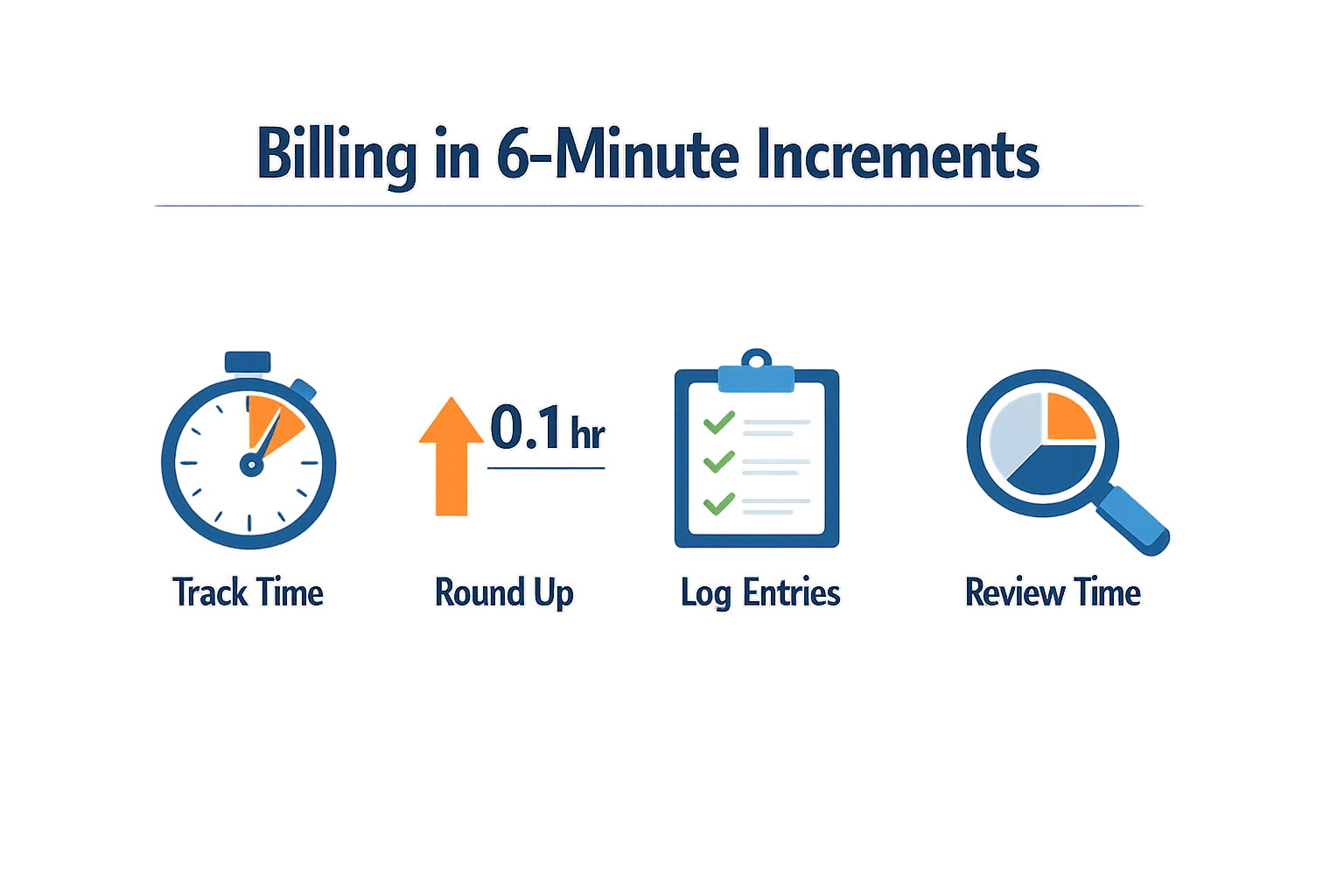
Billing in 6-minute increments — tenths of an hour — is not optional under many panel guidelines and court billing rules. The Central District of California CJA Panel Manual states at page 13 that time spent must be billed to the nearest tenth of an hour. That means every task you record rounds to 0.1, 0.2, 0.3 and so on, with no fractional tenths allowed. The steps below show you how to capture time accurately, convert it to tenths, and document it so that bill reviewers accept the entry without reduction.
Step 1: Record Time as Close as Possible to When the Work Occurs
Step 1
Capture time immediately
The Central District of California CJA Committee determined that contemporaneous time and attendance records must be kept in a format where the time is recorded as close as possible to when the services were performed. Do not reconstruct your day at 5 p.m. or the next morning. When you finish a task — reviewing an email, drafting a paragraph, placing a call — note the start and stop time in your log or timer. Immediate capture eliminates guesswork and supports the narrative detail that bill reviewers expect.
Use a timer, a time-stamped note, or a running log with clock entries. The format does not matter; the proximity does. If you wait until the end of the day, you will round incorrectly or lose small increments that add up over a month.
Step 2: Convert Elapsed Minutes to Tenths Using a Reference Chart
Step 2
Apply the tenth-of-an-hour chart
The Florida Justice Administrative Commission publishes a chart that maps minute ranges to tenths: 1–6 minutes equals 0.1 hour, 7–12 minutes equals 0.2 hours, 13–18 minutes equals 0.3 hours, and so on through 55–60 minutes equaling 1.0 hour. This chart is the standard conversion table for tenth-of-an-hour billing. Print it, tape it to your monitor, or save it as a desktop reference. Every time you finish a task, look at the elapsed minutes and write down the corresponding tenth.
For example, if you spent 14 minutes reviewing a motion, that rounds to 0.3 hours. If you spent 5 minutes on a phone call, that rounds to 0.1 hours. Do not invent your own rounding rules or use quarter-hour increments — carriers and courts expect tenths, and any other unit will trigger a rejection or a reduction code.
| Minutes Elapsed | Tenth of an Hour | Minutes Elapsed | Tenth of an Hour |
|---|---|---|---|
| 1–6 | 0.1 | 31–36 | 0.6 |
| 7–12 | 0.2 | 37–42 | 0.7 |
| 13–18 | 0.3 | 43–48 | 0.8 |
| 19–24 | 0.4 | 49–54 | 0.9 |
| 25–30 | 0.5 | 55–60 | 1.0 |
Step 3: Write a Separate Line Item for Each Discrete Task
Do not combine multiple activities into one narrative. If you reviewed a motion, then called opposing counsel, then drafted a reply paragraph, those are three line items with three separate tenths entries. Block billing — aggregating tasks into a single narrative — is prohibited under most carrier outside counsel guidelines and will result in a reduction. Each line item should state one task, one timekeeper, one tenth increment, and one UTBMS activity code if the submission format requires it.
Step 4: Verify the Entry Before Submission
Step 4
Check narrative, increment and code alignment
Before you submit the invoice or upload the LEDES file, scan each line item to confirm that the narrative describes one task, the time entry is a clean tenth (0.1, 0.2, not 0.15 or 0.25), and the activity code matches the task type. If the e-billing portal or the carrier guideline requires a UTBMS code, make sure the code you selected aligns with the work described — a mismatch will trigger a validation error or a manual reduction.
If your time-entry software auto-rounds or allows fractional tenths, override it. The submission must show tenths only, and the narrative must support the time claimed. A five-word narrative paired with a 0.8-hour entry will not survive review, even if the increment is technically correct.
What Are the Best Practices for Tracking 6-Minute Increments?
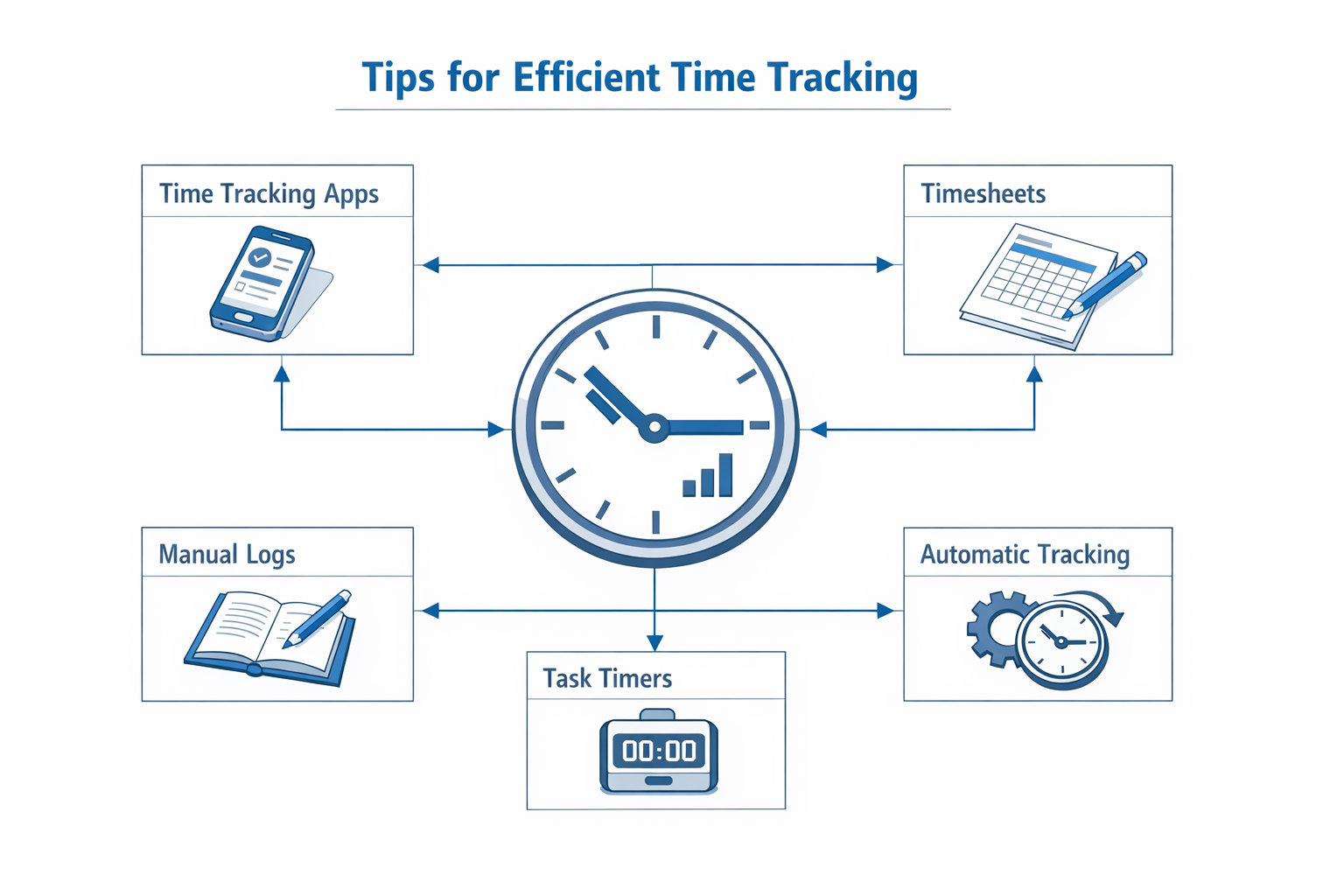
Accurate time logs are the foundation of defensible 6-minute billing. PRISM's Liability Defense Counsel Standards state that invoices should accurately itemize, in detail, all work performed on a matter, and that attorneys and paralegals should bill actual time spent in increments no greater than one-tenth of an hour for each entry. Meeting that standard requires more than a timer — it requires a system that captures the work as it happens, not hours later when the details have blurred.
Capture time contemporaneously
The most effective timekeepers log entries as tasks occur, not at the end of the day. When you draft a discovery response, enter the line immediately after you finish. When you take a client call, record the entry before you move to the next task. Contemporaneous recording eliminates the guesswork that leads to rounding errors and block billing. If your practice involves frequent interruptions, keep a running scratch pad — paper or digital — and transfer entries to the billing system at natural breaks. The goal is to preserve the actual time spent, not to reconstruct it from memory.
Use task-specific narratives
Each entry should describe one discrete task. "Review and draft" is a flag for block billing; "review complaint" and "draft answer to complaint" are two separate entries. When you switch tasks mid-increment, stop the first entry and start a new one. If you spend four minutes reviewing a motion and two minutes responding to an email, that is two entries — 0.1 hour and 0.1 hour — not one entry for 0.1 hour covering both. The narrative for each line should match the UTBMS activity code you assign. If the code is A101 (plan and prepare for issue or plan and prepare for trial or hearing), the narrative should describe planning or preparation, not multiple unrelated activities.
Align your system with guideline requirements
Most carrier outside counsel guidelines specify tenth-of-an-hour increments and prohibit block billing. PRISM's standards are explicit on this point: increments no greater than 1/10th of an hour, and detailed itemization of all work performed. Configure your time-entry system to default to 0.1-hour increments and to require a separate line for each task. If your software allows batch entry or copy-forward of narratives, disable those features — they invite aggregation. When you submit invoices through an e-billing portal, the validation engine will flag entries that violate increment or block billing rules. Fixing those entries after submission wastes time and delays payment. Build compliance into the entry process, and the portal submission becomes routine.
The cheapest minute to bill correctly is the one you enter as it happens — not the one you reconstruct under deadline pressure after a rejection notice.
Review entries before submission
Before you finalize an invoice, scan every line for aggregation, vague narratives, and increment consistency. If you see an entry reading "research, draft and revise motion, 1.8," break it into separate tasks: research the issue, draft the motion, revise the motion. Each task gets its own line, its own increment, and its own narrative. If you see entries rounded to 0.2 or 0.3 hours without clear justification, verify that the time spent actually matches the increment. Reviewers know that most tasks do not fall neatly into multiples of 0.2 hours. When every entry on an invoice is a round number, the invoice signals estimation rather than contemporaneous recording.
Conclusion
Billing in 6-minute increments — tenths of an hour — is not a suggestion. Most carrier outside counsel guidelines and court-appointed counsel programs specify this standard, and e-billing portals validate line items against it. The conversion is mechanical: 1–6 minutes rounds to 0.1, 7–12 minutes to 0.2, and so on through the hour. What makes the standard hard is not the arithmetic but the discipline it demands.
The steps outlined above — contemporaneous capture, single-task entries, and a conversion chart at hand — turn the tenth-of-an-hour requirement from a source of write-downs into a routine part of timekeeping. When you record 0.1 for a six-minute task, you are not losing five minutes of billable time; you are meeting the standard the reviewer expects. When you record 0.2 for an eleven-minute task, you are not padding; you are rounding correctly within the bracket. The system rewards accuracy, not speed, and accuracy begins the moment you start the clock.
Reviewers read LEDES files and narratives with the conversion chart in front of them. They know that 0.1 covers up to six minutes and that a string of identical 0.1 entries signals either block billing or implausibly brief tasks. They also know that rounding every task up to the next tenth, regardless of actual time, is a pattern that triggers reduction codes. The way to avoid both flags is to track time as it happens, record it in minutes, convert it once, and move on. No double entry, no reconciliation at month-end, no guessing.
If your current process leaves you with a stack of paper slips at the end of the week and a calculator, the fix is not a better calculator. The fix is capturing time when the work is fresh and converting it immediately. If your billing software does not display tenths and minutes side by side, print the chart and tape it to your monitor. If your firm's template asks for narrative detail but does not enforce a single-task rule, enforce it yourself. The guideline does not care whether your internal process is elegant; it cares whether the submitted line item is compliant.
The tenth-of-an-hour standard is older than LEDES, older than e-billing, and it is not going away. Courts publish the conversion chart for appointed counsel; carriers publish it in their outside counsel guidelines; billing platforms validate against it. Learning to bill in 6-minute increments without losing time is not about mastering a trick — it is about building a habit that aligns your timekeeping with the format every reviewer expects. For more on how narrative detail and task codes interact with billing increments, see Block Billing: Reasons for Carrier Rejections and Solutions.
FAQ
What is a 6-minute increment in billing?A 6-minute increment equals one-tenth (0.1) of an hour. It is the standard rounding unit for legal billing under most carrier outside counsel guidelines and court-appointed counsel programs.
How do I convert minutes to 6-minute increments?Use the standard conversion chart: 1–6 minutes = 0.1 hour, 7–12 minutes = 0.2 hours, 13–18 minutes = 0.3 hours, and so on through 55–60 minutes = 1.0 hour.
Why do carriers require 6-minute increments?Carriers require 6-minute increments to ensure consistent, auditable billing. The 2026 CLM study found 82.8% of companies use this standard to prevent over-billing and support detailed invoice review.
Can I round up to the next 6-minute increment?You must round to the nearest tenth based on actual time worked. Consistently rounding up every task will trigger audit flags and reductions during bill review.
What happens if I bill in 15-minute increments instead?Billing in 15-minute (0.25-hour) increments violates most carrier guidelines and will trigger invoice rejections or reductions in e-billing portals that validate against the 0.1-hour standard.