


Invoice Reduction Appeal: How to Appeal an Invoice Reduction
Top takeaways
- Insurance carriers reduce invoices based on guideline violations, narrative detail insufficiency, or billing increment non-compliance
- Most carriers provide a 45-day window from final approval to submit an appeal through the e-billing portal
- One in five law firms appeals every adjustment, while others selectively challenge reductions based on documented justification
- Successful appeals require specific evidence: contemporaneous records, guideline citations, and line-item explanations
- The appeal module in the e-billing system is the only accepted submission path — email and phone requests are not processed
Introduction
To appeal invoice reduction successfully, you must act within the carrier's deadline and submit through the designated e-billing portal module with complete documentation. A single line item reading "legal research, 3.5" triggers a reduction. The bill reviewer flags it as block billing, applies reduction code 42, and writes down $875 without contacting the firm. Forty-five days later, the appeal window closes. The firm never submitted a dispute because no one monitored the portal's final approval date.
This scenario repeats across thousands of invoices each month. Carriers reduce line items for guideline violations, and law firms either accept the write-down or file an appeal before the deadline expires. The difference between recovering the full amount and absorbing the loss is understanding the appeal path and executing it within the carrier's procedural requirements.
The appeal process is a formal dispute resolution mechanism built into e-billing platforms. It requires the firm to submit additional documentation, cite the controlling guideline provision, and explain why the original time entry or expense met the carrier's published requirements. Appeals that succeed share three characteristics: they reference the specific guideline section, they attach contemporaneous supporting records, and they address the stated reason for the reduction rather than arguing about the carrier's general billing philosophy.
Most carriers specify the appeal deadline in calendar days from the invoice's final approval date, not from the date the firm receives payment or views the adjusted invoice. Missing the deadline forfeits the right to dispute the reduction. Monitoring the e-billing portal for final approval notifications and tracking the appeal-allowed-until date for every submitted invoice is not optional — it is the only way to preserve the firm's ability to challenge block billing rejections and other guideline-based reductions.
The appeal itself is submitted through the portal's appeal module. The firm logs into the platform, navigates to the adjusted invoice, and clicks the appeal button to launch the dispute workflow. The system prompts the firm to select the line items being contested, enter the explanation for each item, and attach supporting documents. Once submitted, the appeal enters the carrier's review queue, and the firm receives a decision within the timeframe specified in the guideline — typically 30 to 60 days.
Problem Statement
Invoice reductions from insurance carriers land in the e-billing portal with little warning and less explanation. A reduction code appears next to a line item, a dollar amount disappears from the approved total, and the firm must decide whether to accept the write-down or challenge it. The decision is not straightforward. Billing review rarely comes back without reductions, and the reductions often rest on word choice, task code interpretation, or guideline provisions the firm did not violate.
The appeal window is short. One carrier allows 45 days from the final approval date; appeals received after that period will not be considered. During that window, the firm must gather contemporaneous records, locate the controlling guideline language, draft a response that addresses the stated reduction code, and submit the appeal through the portal's designated module. Miss the deadline, and the reduction becomes permanent.
The Friction Points
Firms face three recurring obstacles when invoice reductions arrive. First, the reduction code itself may be opaque. A code that reads "narrative insufficient" or "task not pre-approved" does not specify which sentence failed or which approval the reviewer expected to see. Second, the firm may not know which version of the outside counsel guidelines the reviewer applied. Guideline versions change; a prohibition that appears in the 2025 edition may not have existed when the work was performed. Third, the appeal path is procedural. The portal requires the appeal to be submitted in a particular module, with particular fields populated, or the system will not route it for human review.
Post-appeal invoice adjustment rates vary by relationship. Executives report median reductions of 5% for panel counsel and 10% for non-panel counsel after the appeal is resolved. The gap suggests that familiarity with a carrier's billing standards and review practices reduces write-downs, but it does not eliminate them. Even panel firms appeal adjustments, and one in five firms appeals every reduction that appears on an invoice.
The practical problem is not that reductions occur — guideline enforcement is a stated feature of the bill review process. The problem is that the firm must respond quickly, with precision, using only the tools and timelines the carrier's system permits. For detail on how task and activity codes influence reduction decisions, see UTBMS Activity Codes A101-A111 for Legal Billing.
How Do You Appeal Invoice Reduction Decisions?
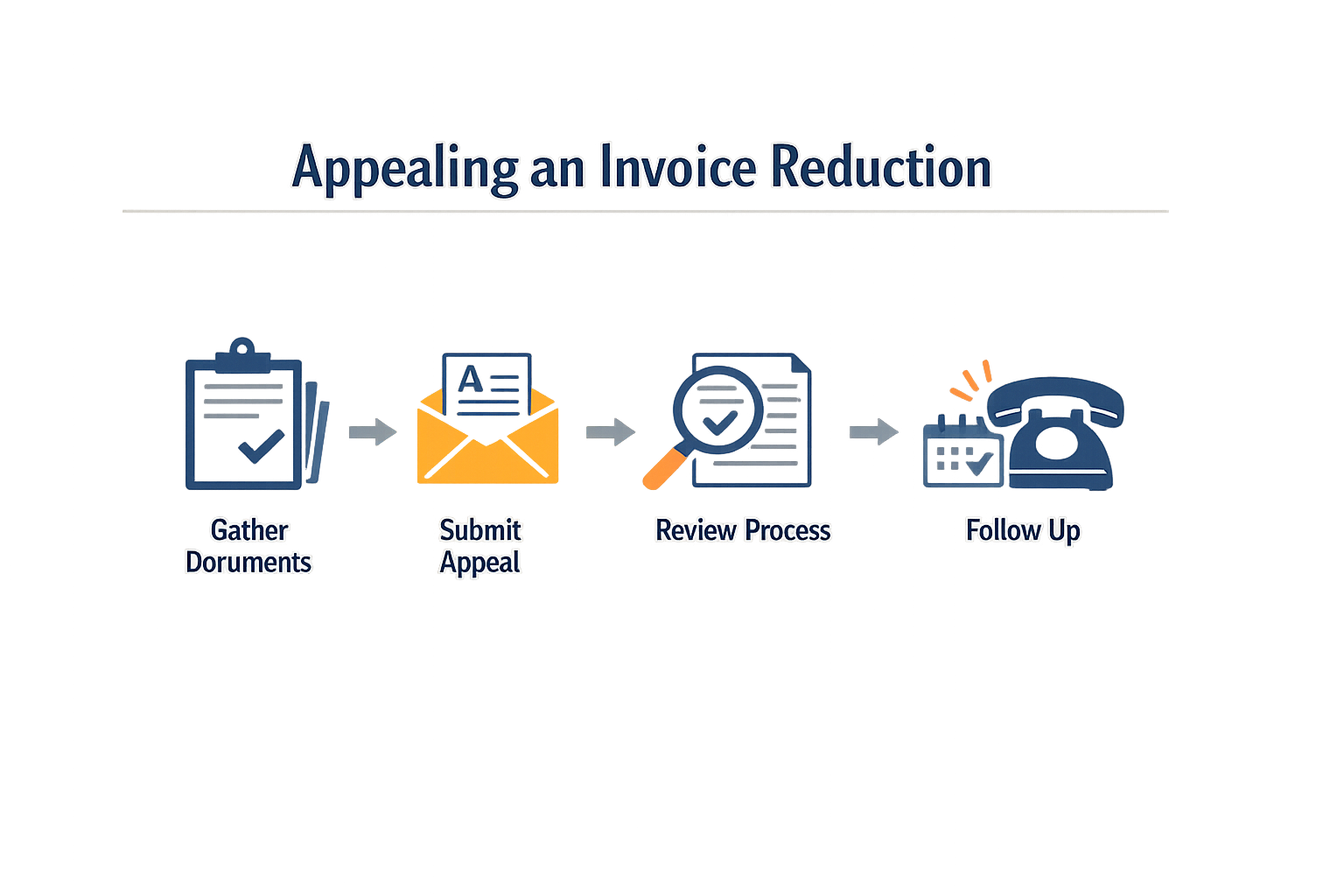
Most carriers provide a defined window and a structured process to appeal invoice reduction decisions. The key is acting within the deadline and submitting the appeal through the correct channel with the documentation the reviewer needs to reconsider the line item.
Step 1: Confirm the Appeal Deadline
Step 1
Identify the final approval date and appeal window
Every processed invoice displays a final approval date and an appeal deadline. Markel's outside counsel guidelines, for example, allow appeals up to 45 calendar days after payment of the original invoice is processed. Appeals received after that window will not be considered. Log into the e-billing portal, locate the invoice in question, and note both dates before taking any other action.
The appeal deadline is carrier-specific and non-negotiable. Some portals display the appeal-allowed-until date on the invoice summary page; others require you to open the invoice detail view. If the deadline has passed, the reduction is final.
Step 2: Review the Reduction Code and Explanation
Before drafting an appeal, read the reduction code and any accompanying note from the bill reviewer. Reduction codes tell you why the line item was adjusted—block billing, insufficient narrative detail, duplicate entry, task code mismatch, or a guideline prohibition. The explanation may be one sentence or a reference to a specific guideline section. Either way, it identifies the gap you need to close.
If the reduction code references a guideline provision, pull the current version of the carrier's outside counsel guidelines and confirm what that section actually says. Do not rely on memory or an older version. Guideline language changes, and the version in effect when the invoice was submitted controls the appeal.
Step 3: Gather Supporting Documentation
Step 3
Assemble contemporaneous records and approval evidence
The appeal succeeds or fails on documentation. Collect the timekeeper's contemporaneous time entry, any email or file note that corroborates the work performed, and any pre-approval correspondence if the line item required advance consent under the guidelines. If the reduction involved a staffing objection—say, partner time on a task the guidelines assign to an associate—gather the matter-specific approval or the email thread showing the carrier consented to the assignment.
Contemporaneous records are entries made at or near the time the work was performed. A narrative drafted weeks later to support an appeal is not contemporaneous and carries less weight. If your time-entry system captures the original narrative before any edits, preserve that version.
Step 4: Draft a Clear, Specific Appeal Statement
The appeal statement is not an argument brief. It is a short explanation of why the line item complies with the guidelines and why the reduction should be reversed. State the reduction code, quote the guideline provision if applicable, and explain how the line item satisfies that requirement. Attach the supporting documentation and reference it by name in the statement.
For example: "The reduction cites block billing. The narrative reads 'review correspondence from opposing counsel re discovery schedule, 0.3; draft response email, 0.2.' These are two distinct activities with separate time increments, consistent with the prohibition on aggregating unrelated tasks. Attached: original time entry showing separate line-item entry at time of performance."
Avoid general objections like "the time was reasonable" or "the work was necessary." The reviewer already decided the work was outside the guidelines. Your appeal must show that the work was inside them.
Step 5: Submit Through the E-Billing Portal Appeal Module
Step 5
Use the portal's designated appeal workflow
Carriers require appeals to be submitted through the e-billing system's appeal module, not by email or phone. For Markel matters, log into Legal Exchange, navigate to the invoice, and click the Appeal button to launch the Adjusted Line Items Dialog. Follow the on-screen instructions to attach your statement and supporting documents, then submit. The portal will generate a confirmation and assign a tracking number.
Do not submit the same appeal twice. If you need to supplement your appeal with additional documentation, contact the portal's support line—for Legal Exchange, that is Bottomline Technologies at lebsupport@bottomline.com or +1.888.923.9553—and ask whether the system allows supplemental submissions or whether you must withdraw and refile.
For a detailed breakdown of how e-billing portals handle submission errors and validation failures, see E-Billing Portal Invoice Rejections: Common Causes and Fixes.
Step 6: Track the Appeal and Respond to Follow-Up Requests
Once submitted, the appeal enters the carrier's review queue. Some portals display appeal status in real time; others send email notifications when the review is complete. If the reviewer requests additional information or clarification, respond within the timeframe specified in the request. Silence is treated as abandonment.
If the appeal is denied, the portal will display the denial reason. Some carriers allow a second-level appeal to a senior reviewer or claims counsel; others treat the first denial as final. Read the denial notice carefully to determine whether further recourse is available and what the deadline is.
What Makes an Appeal Invoice Reduction Successful?
Successful appeals rest on preparation before the invoice leaves your desk. Carriers process hundreds of appeals each month; the ones that move quickly through the queue are the ones that arrive complete, cite the controlling guideline provision, and point the reviewer to the supporting record without forcing them to reconstruct your argument.
Document Every Line Item at Entry
Most reductions trace back to narrative insufficiency or ambiguous task codes. The best time to cure those defects is when the timekeeper records the entry, not when the bill reviewer flags it three weeks later. Maintain contemporaneous records that specify the document reviewed, the issue researched, or the witness interviewed. When a reduction lands, you can pull the underlying file note and demonstrate that the work was guideline-compliant and the narrative was accurate as entered.
Know the Guideline Version You Are Appealing Under
Carriers publish outside counsel guidelines with version numbers and effective dates. The version in force on the date of service controls the appeal. If the reduction cites guideline section 4.2 and you respond with an argument based on section 4.1 from an earlier version, the reviewer will deny the appeal without reaching the merits. Locate the controlling version, quote the exact provision, and show that your entry complies with what that provision requires.
Communicate Proactively with the Billing Contact
When the carrier's bill review unit flags an issue, respond promptly and provide the requested detail in the format the reviewer specifies. Delays signal that you cannot support the entry, and reviewers interpret silence as concession. If the reduction is based on a guideline prohibition you believe does not apply, state your position clearly, cite the controlling language, and attach the supporting record. If the reduction is correct, acknowledge it and move on — disputing a valid reduction wastes the reviewer's time and damages your credibility on future appeals.
The appeal that wins is the one that makes the reviewer's job easier, not harder.
Maintain a Reduction Log
Track every reduction by matter, line item, reduction code, amount, and outcome. Over time, the log reveals patterns: one reviewer consistently reduces a particular UTBMS task code, or one carrier interprets "legal research" more narrowly than others. Use that intelligence to adjust entries before submission and to frame appeals in terms the reviewer has accepted in prior matters. The log also documents your appeal success rate, which is useful when negotiating fee arrangements or panel status.
Conclusion
An appeal invoice reduction is not the end of the conversation. One out of five defense firms appeals every adjustment, and the data shows that appeals work: carriers report median post-appeal reductions of 5% for panel counsel and 10% for non-panel counsel, well below the initial write-down percentages. The difference between those numbers and the original reduction is money your firm recovered by following a disciplined appeal process.
The steps are straightforward. Compare the reduction code to the controlling guideline, assemble contemporaneous records that show compliance, draft a factual response that cites the guideline's own language, and submit through the portal's designated appeal path. Most carriers resolve appeals within thirty days if the documentation is clean and the argument is tied to the guideline text.
Billing review companies apply reduction codes mechanically, and their decisions are not final. When a reduction is unsupported by the guideline or contradicted by the invoice detail, appeal the reduction with the same precision you would bring to any evidentiary dispute. The carrier's own published standards are your strongest authority, and a well-documented appeal shifts the burden back to the reviewer to justify the write-down.
Tracking appeal outcomes by reduction code, reviewer and guideline provision builds institutional knowledge that prevents future disputes. The firms that recover the most are the ones that treat the appeal process as a feedback loop, not a one-time protest. Every successful appeal is a data point that informs how you draft the next invoice, assign the next task code, and document the next entry at the time the work is done.
Frequently asked questions
How long do I have to appeal invoice reduction from my carrier?
Most insurance carriers allow 45 calendar days from the invoice's final approval date to submit an appeal through the e-billing portal. The deadline is carrier-specific and non-negotiable; appeals received after the window closes will not be considered.
Where do I submit my appeal invoice reduction?
Submit all appeals through the e-billing portal's designated appeal module. Email and phone requests are not processed. Log into the platform, navigate to the adjusted invoice, and click the Appeal button to launch the dispute workflow.
What documentation do I need to appeal invoice reduction successfully?
You need contemporaneous time entries, any corroborating email or file notes, the controlling guideline provision, and pre-approval correspondence if the line item required advance consent. The appeal succeeds or fails on documentation quality.