


Hartford v. J.R. Marketing: Understanding Cumis Fees Recovery
Introduction
The Cumis Counsel Question
When a conflict of interest arises between insurer and insured, California Civil Code section 2860 requires the insurer to provide independent counsel — commonly called Cumis counsel after the 1984 decision in San Diego Federal Credit Union v. Cumis Insurance Society, Inc. Cal. Civ. Code § 2860, subd. (a) states that the insurer must provide independent counsel unless the insured waives that right in writing. The statute sets out qualification requirements, fee limitations, and cooperation duties, but it does not explicitly address what happens when Cumis counsel submits invoices that the insurer later alleges are excessive or fraudulent.
Hartford v. J.R. Marketing arose from that gap. Hartford initially refused to defend its insureds in a third-party lawsuit, then was compelled by court order to provide Cumis counsel and pay all reasonable and necessary defense costs. The order expressly preserved Hartford's right to later challenge and recover payments for unreasonable and unnecessary charges. After the underlying litigation settled, Hartford sought to recoup a portion of the $13.5 million it had paid to the law firm Squire Sanders, alleging the bills included charges that were excessive, unreasonable, and unnecessary. The central question: could Hartford recover directly from Cumis counsel, or was its remedy limited to seeking reimbursement from its insureds?
For carriers managing block billing and narrative detail standards, the case illustrates the stakes when fee disputes escalate beyond routine reductions. Hartford did not allege ordinary billing judgment calls; it alleged that certain charges were "fraudulent, or were otherwise manifestly and objectively useless and wasteful when incurred." The California Supreme Court held that under those circumstances, Hartford could proceed directly against Cumis counsel. The court reasoned that Cumis counsel had been unjustly enriched at the insurer's expense, and that placing the burden on the insureds — who had paid for a defense, not additional rounds of litigation — would be inequitable.
What Hartford Does Not Decide
Hartford v. J.R. Marketing is a narrow holding. It does not establish a general right for insurers to bypass their insureds and sue defense counsel over routine fee disputes. The court emphasized that its conclusion rested on the enforcement order, which required Hartford to pay all submitted invoices within thirty days but preserved Hartford's right to challenge unreasonable charges after the underlying case resolved. Without that order, the insurer's remedy would run against the insured, with the insured then having a potential indemnity claim against counsel.
The decision also does not alter the reimbursement framework set out in Buss v. Superior Court (16 Cal.4th 35), which permits an insurer to recover defense costs solely attributable to claims that were clearly outside policy coverage. Hartford addresses a different scenario: not which claims were covered, but whether the fees charged to defend covered claims were reasonable. The two cases operate in separate lanes. Buss permits recovery of costs allocated to uncovered claims; Hartford permits recovery of excessive fees within the defense of covered or potentially covered claims, but only when a court order or similar mechanism expressly allows post-payment challenge and the fees are alleged to be fraudulent or manifestly wasteful.
What Problem Does Hartford v. J.R. Marketing Solve?
When an insurer provides independent counsel under a reservation of rights, the fee arrangement shifts from the usual panel-counsel framework to a relationship governed by Civil Code section 2860. The insured selects counsel, the insurer pays the bills, and everyone proceeds under a court order or settlement agreement that typically caps rates or subjects invoices to later review. The problem emerges when the underlying action settles and the insurer alleges that independent counsel submitted invoices containing excessive, duplicative, or otherwise unreasonable charges. The question becomes: from whom may the insurer recover those amounts?
Two Competing Theories
One view holds that the insurer's right to reimbursement runs only against the insured. The policy is a contract between carrier and policyholder; independent counsel is the insured's agent, not the insurer's, and any claim for overbilling should follow the contractual relationship. Under this theory, the insurer seeks reimbursement from the insured, and the insured may then pursue indemnity from counsel in a separate malpractice or fee-dispute action.
The opposing view holds that when independent counsel bills an insurer directly, pursuant to a court order that expressly preserves the insurer's right to challenge unreasonable charges, the insurer may recover excessive fees directly from counsel. Allowing counsel to retain payments that were fraudulent or manifestly wasteful would unjustly enrich the law firm at the insurer's expense, and requiring the insured to serve as an intermediary would impose additional litigation and financial exposure on a policyholder who paid for a defense, not for a fee dispute.
The Hartford Dilemma
Hartford Casualty Insurance v. J.R. Marketing, LLC presented these competing theories in stark relief. Hartford initially declined to defend, then provided independent counsel under a court order that required prompt payment of all submitted invoices but expressly preserved Hartford's right to seek reimbursement of unreasonable and unnecessary charges after the underlying action concluded. Hartford paid independent counsel approximately $13.5 million during the pendency of the third-party suit. When that action settled, Hartford filed a cross-complaint seeking to recover a significant portion of the fees, alleging that the invoices included excessive and duplicative time entries.
The California Supreme Court reversed. The court held that under the circumstances of the case—where independent counsel billed the insurer directly pursuant to a court order that expressly permitted later recovery of excessive fees—the insurer could seek reimbursement directly from counsel if the invoices included charges that were fraudulent or manifestly and objectively useless when incurred. The decision turned on unjust enrichment: independent counsel had no convincing reason to be immune from liability for enriching themselves through excessive billing, and the insureds should not face additional rounds of litigation for the acts of their lawyers.
Implications for Insurers and Independent Counsel
The Hartford decision does not grant insurers an automatic right to recover every disputed fee from independent counsel. The opinion is careful to limit its holding to fees that are fraudulent or manifestly and objectively useless and wasteful when incurred. Reasonable disagreements over billing judgment, staffing decisions, or the value of particular work product do not meet that threshold. The insurer must prove that the charges were so far outside the bounds of professional conduct that retaining the payment would constitute unjust enrichment.
For insurers, the decision opens a direct path to recovery in egregious cases, but it does not eliminate the need to document the basis for each challenged entry and to show that the work was objectively wasteful at the time it was performed. For independent counsel, the decision underscores the importance of contemporaneous time records, narrative detail sufficient to demonstrate the necessity of each task, and adherence to the billing increments and guidelines that govern panel counsel. Understanding LEDES 1998B file format requirements and UTBMS activity codes helps counsel submit invoices that withstand later scrutiny.
Solution Steps
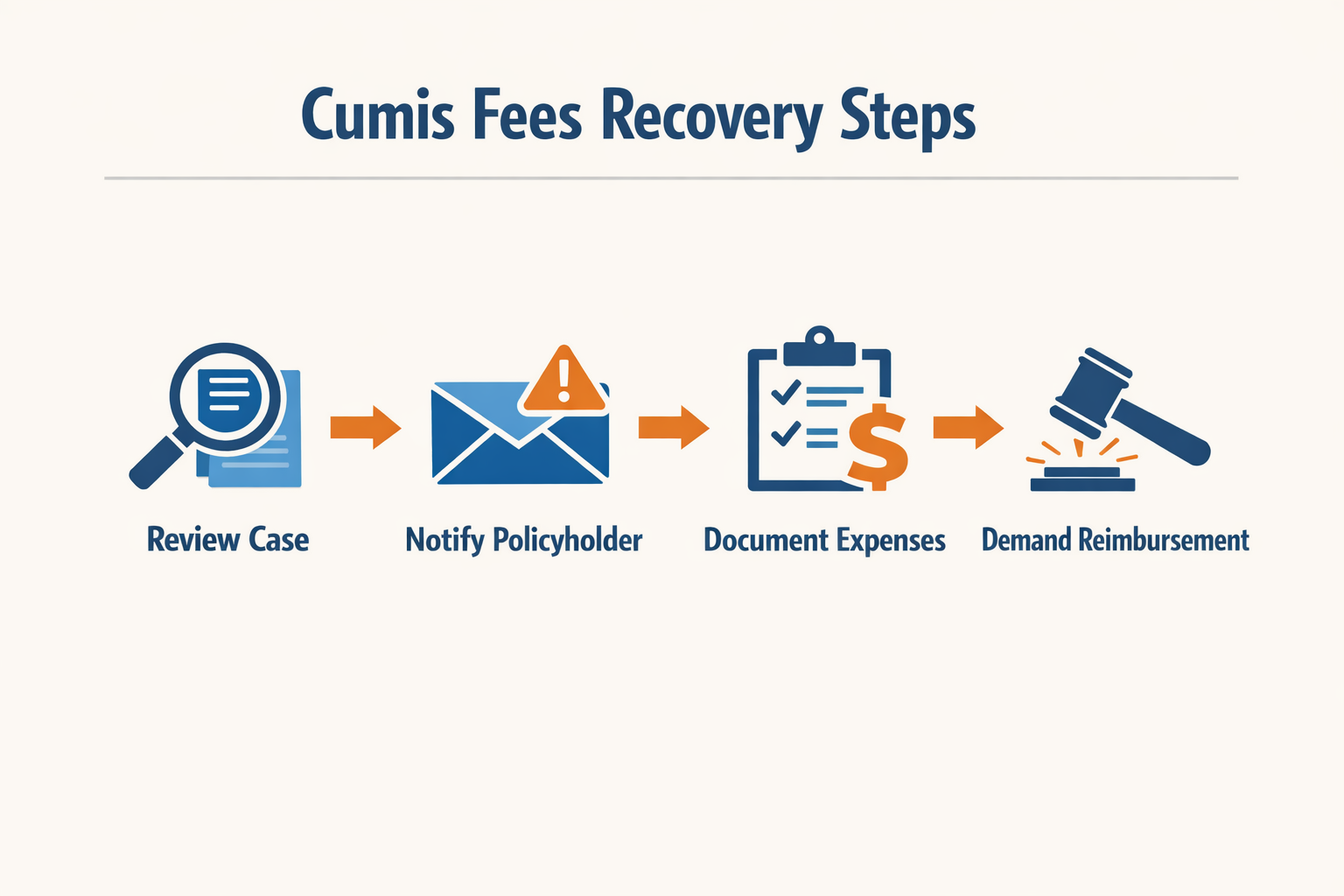
The California Supreme Court's decision in Hartford v. J.R. Marketing established a framework for insurers seeking to recover excessive Cumis fees. The court held that when independent counsel bills for time and costs that were fraudulent, or were otherwise manifestly and objectively useless and wasteful when incurred, the insurer may seek reimbursement directly from Cumis counsel rather than from the insured. This framework applies where a court order expressly preserved the insurer's right to later challenge and recover payments for unreasonable and unnecessary charges.
Step 1: Preserve Your Right to Challenge Fees in the Underlying Order
Step 1
Secure express reservation language
When a court compels you to provide independent counsel under a reservation of rights, the order should state that you retain the right to challenge fees as unreasonable or unnecessary and to seek reimbursement after resolution of the underlying action. In Hartford v. J.R. Marketing, the enforcement order provided that "to the extent Hartford seeks to challenge fees and costs as unreasonable or unnecessary, it may do so by way of reimbursement after resolution of the [underlying action]." Without this language, your recovery path is less certain.
If the proposed order is silent on fee challenges, submit a revised order that includes express reservation of your right to seek reimbursement. The order should also state that submitted bills must be reasonable and necessary, even if other provisions—such as Civil Code section 2860 rate caps—are waived due to your earlier breach of the duty to defend.
Step 2: Document the Billing as You Pay It
Cumis counsel submit invoices in the same formats as panel counsel: LEDES 1998B files with UTBMS task and activity codes, narrative detail, and timekeeper identifiers. Review each invoice when you receive it, and flag line items that appear excessive, duplicative, or unrelated to the defense of potentially covered claims. Keep a contemporaneous log of questioned charges, organized by invoice date, timekeeper, task code, and the specific objection.
Do not withhold payment based on these objections if the court order requires prompt payment of all submitted invoices. The Hartford court recognized that the enforcement order directed the insurer to pay all defense costs within thirty days of receipt, and that the insurer's remedy was reimbursement after resolution of the underlying action, not contemporaneous withholding.
Step 3: Wait Until the Underlying Action Resolves
The enforcement order in Hartford v. J.R. Marketing expressly provided that fee challenges would be addressed "after resolution of the [underlying action]." File your reimbursement claim only after the third-party lawsuit settles or concludes at trial. Filing earlier invites a motion to dismiss for prematurity and wastes the documentation effort.
Once the underlying action resolves, calculate the total amount paid to independent counsel and the total amount you contend was excessive. Organize your contemporaneous log into categories: fraudulent billing, manifestly useless work, work on uncovered claims, and work that violated the narrative and increment standards in your outside counsel guidelines. The Hartford decision permits recovery of amounts that were fraudulent or manifestly and objectively useless and wasteful when incurred, so your documentation must show that the charges meet this threshold at the time they were billed.
Step 4: Assert Your Claim Directly Against Cumis Counsel
The California Supreme Court held that under the circumstances of Hartford v. J.R. Marketing, the insurer may seek reimbursement directly from Cumis counsel, not solely from the insured. The court reasoned that if Cumis counsel, operating under a court order that expressly provided the insurer would be able to recover excessive fees, sought and received payment for fraudulent or manifestly useless time, Cumis counsel have been unjustly enriched at the insurer's expense.
File a cross-complaint or a separate reimbursement action against the law firm. Plead unjust enrichment and, if supported by the facts, fraud. Attach your contemporaneous ledger as an exhibit and identify each questioned line item by invoice number, line number, date, timekeeper, narrative, and the reason the charge was excessive. The court will review these line items under the standard the Supreme Court articulated: whether the charges were fraudulent, or were otherwise manifestly and objectively useless and wasteful when incurred.
For guidance on how carriers evaluate billing detail and apply reduction codes, see our article on e-billing portal invoice rejections.
Step 5: Prepare for Cumis Counsel's Defense
Cumis counsel will argue that their billing was reasonable and necessary, that they operated under time pressure and a conflict-of-interest environment, and that the insurer waived any objection by paying the invoices without contemporaneous protest. Counter these arguments with your contemporaneous ledger, the language of the enforcement order preserving your right to challenge fees, and the Supreme Court's holding that express reservation of the right to recover excessive payments prevents unjust enrichment.
Cumis counsel may also argue that any recovery claim should run against the insured, not the firm. The Hartford court rejected this argument, noting that insureds paid to receive a defense of potentially covered claims, not to face additional litigation and monetary exposure for the acts of their lawyers. The court concluded that Cumis counsel provide no convincing reason why they should be absolutely immune from liability for enriching themselves through excessive billing.
Tips and Tricks
The Hartford v. J.R. Marketing decision does not eliminate the insurer's obligation to pay reasonable and necessary Cumis fees — it establishes that the insurer may later recover fees that were manifestly unreasonable or fraudulent. Insurers and counsel who understand the court's actual holding can avoid disputes, document their positions clearly, and resolve disagreements without protracted litigation.
Document the Enforcement Order or Agreement
When an insurer agrees to provide Cumis counsel under a reservation of rights, the parties should memorialize in writing (1) the rate the insurer will pay, (2) whether that rate is subject to Cal. Civ. Code § 2860, subd. (c) or has been negotiated differently, and (3) whether the insurer retains the right to challenge fees as unreasonable or unnecessary after the underlying matter concludes. In Hartford, the enforcement order expressly preserved the insurer's right to seek reimbursement for unreasonable charges; without that language, the insurer's path to recovery would have been far less clear. A court order or a signed letter agreement that spells out these terms protects both the insurer and the insured from later confusion.
Use Contemporaneous Records and Narrative Detail
Cumis counsel bill at rates the insurer does not control, and the insurer may not review the work in real time the way it would with panel counsel. That makes clear, contemporaneous time records essential. Each line item should identify the task, the activity, and enough narrative detail to show the work was reasonably necessary to defend the covered claims. Block billing — lumping multiple tasks into one entry — invites post-settlement scrutiny and gives the insurer a basis to argue that some portion of the entry was duplicative or unrelated to the defense. Counsel who follow the standards described in block billing guidance will find their invoices far easier to defend if the insurer later challenges a fee.
Cooperate and Communicate with the Insurer
Cal. Civ. Code § 2860, subd. (d) requires independent counsel and the insured to disclose all non-privileged information to the insurer and to consult with the insurer on all matters relating to the action. That duty does not disappear because counsel is independent. Counsel who provide the insurer with regular status reports, copies of significant filings, and advance notice of major expenditures — expert retention, depositions in distant cities, trial preparation — build a record that the fees were reasonable and that the insurer had the opportunity to object in real time. An insurer that learns of a large invoice months after the work was done will scrutinize it far more closely than one that approved the work in advance.
How Does Hartford v. J.R. Marketing Apply to Fee Arbitration?
Cal. Civ. Code § 2860, subd. (c) states that disputes concerning attorney's fees not resolved by contract or policy provisions shall be resolved by binding arbitration. The statute does not require the parties to litigate every disagreement. Where the insurer believes a rate or a charge is unreasonable, and counsel disagrees, a short arbitration before a single neutral arbitrator will resolve the issue faster and at lower cost than a coverage action. Counsel and insurers who invoke that mechanism early — rather than waiting until after settlement and then filing cross-complaints — will spend less on the dispute than they would recovering or defending the fees.
Conclusion
The California Supreme Court's decision in Hartford v. J.R. Marketing clarified a critical question that had lingered since Buss: when an insurer pays Cumis fees under a court order that expressly preserves the right to challenge unreasonable charges, the insurer may seek reimbursement directly from independent counsel—not solely from the insured. The court held that Cumis counsel who bill for time that is fraudulent, manifestly useless, or objectively wasteful when incurred have been unjustly enriched at the insurer's expense, and no convincing reason exists to grant them absolute immunity from liability for that enrichment.
This ruling does not open the door to routine second-guessing of every invoice. The court was careful to limit its holding to charges that are fraudulent or "manifestly and objectively useless and wasteful when incurred." Insurers cannot recover simply because a line item reflects a higher rate than the carrier would have preferred, or because a task took longer than the carrier's internal benchmarks suggest. The Hartford framework applies when the enforcement order itself contemplated post-resolution recovery of unreasonable fees, and when the overbilling crosses the threshold from mere disagreement into waste or fraud.
Practical Implications
For insurers managing Cumis arrangements, Hartford underscores the importance of preserving reimbursement rights in any court order that compels payment of independent counsel fees. If the order is silent on the insurer's ability to challenge fees later, the insurer may find itself without a remedy even when billing is excessive. For independent counsel, the decision confirms that billing under a reservation of rights is not a blank check. Counsel must maintain contemporaneous records, avoid block billing, and ensure that each line item reflects work that was reasonable and necessary when performed—standards that align with the narrative detail and increment requirements found in most carrier outside counsel guidelines.
The Hartford decision also clarifies that the insured should not bear the financial burden of their own lawyers' overbilling. The court rejected the argument that any recovery must flow first through the insured, noting that insureds paid for a defense of potentially covered claims, not for additional rounds of litigation over their counsel's excessive fees. This principle protects the insured from being caught between the insurer's reimbursement claim and the independent counsel's billing practices.
Hartford v. J.R. Marketing remains the controlling authority on Cumis fee recovery in California. Insurers, insureds, and independent counsel each have distinct responsibilities under the framework it establishes: insurers must document and preserve their reimbursement rights in court orders; independent counsel must bill transparently and avoid charges that are objectively wasteful; and insureds are entitled to expect that their defense will not expose them to liability for their lawyers' billing conduct. Read the enforcement order, understand what it permits, and ensure that every invoice can withstand scrutiny under the standard the Supreme Court announced.
FAQ
Can an insurer always recover excessive Cumis fees directly from independent counsel?
No. Hartford v. J.R. Marketing permits direct recovery only when (1) a court order expressly preserves the insurer's right to challenge fees after payment, and (2) the fees are fraudulent or manifestly and objectively useless when incurred. Routine billing disputes remain between insurer and insured.
What standard must the insurer meet to recover fees under Hartford v. J.R. Marketing?
The insurer must prove that the challenged charges were fraudulent or manifestly and objectively useless and wasteful at the time they were incurred. Reasonable disagreements over billing judgment or staffing decisions do not meet this threshold.
Does Hartford v. J.R. Marketing change the Buss v. Superior Court reimbursement framework?
No. Buss permits an insurer to recover defense costs solely attributable to claims clearly outside policy coverage. Hartford addresses a different scenario: recovery of excessive fees within the defense of covered or potentially covered claims, when a court order expressly allows post-payment challenge.
What should an insurer include in a court order to preserve the right to challenge Cumis fees?
The order should state that the insurer retains the right to challenge fees as unreasonable or unnecessary and to seek reimbursement after resolution of the underlying action. It should also require that submitted bills be reasonable and necessary, even if rate caps are waived.
How does Hartford v. J.R. Marketing protect insureds from fee disputes?
The decision allows insurers to recover excessive fees directly from Cumis counsel rather than from the insured, preventing insureds from facing additional litigation and financial exposure for their lawyers' billing conduct. The court reasoned that insureds paid for a defense, not for fee disputes.