


Hartford v. J.R. Marketing: When Insurers Can Recover Cumis Fees
Introduction
Understanding Hartford v. J.R. Marketing and Its Impact on Cumis Fees
Hartford v. J.R. Marketing is a California case that addresses when an insurer can recover independent counsel fees from a policyholder after paying Cumis counsel under Civil Code section 2860. The case establishes that when a conflict of interest requires independent counsel, the insurer must pay for that defense at the time — but if the underlying claim ultimately falls outside coverage, the carrier may seek reimbursement for those fees from the policyholder who caused or contributed to the conflict.
When a conflict of interest requires an insurer to pay for independent counsel under California Civil Code section 2860, the question of who ultimately bears that cost can determine whether a carrier writes off hundreds of thousands in legal fees or recovers them from the policyholder it was contractually obligated to defend. Hartford v. J.R. Marketing addresses exactly that question: under what circumstances can an insurer, after paying Cumis counsel to defend its insured, turn around and seek reimbursement for those fees from the same policyholder it was contractually obligated to defend?
The case matters because it draws a line between the insurer's duty to provide a defense and the policyholder's responsibility for conduct that creates or exacerbates the conflict. For carriers managing outside counsel guidelines, bill review teams, and e-billing portal submissions, the decision provides a framework for evaluating whether a fee dispute over independent counsel should be treated as a contractual claim, a restitution matter, or an unrecoverable cost of doing business. It also underscores the importance of contemporaneous records, narrative detail, and billing increments that demonstrate the reasonableness of the fees paid — because if recovery is available, the carrier must prove not only that the policyholder caused the conflict but that the fees themselves were reasonable and necessary.
For firms submitting invoices through e-billing portals on behalf of Cumis counsel, the Hartford v. J.R. Marketing decision reinforces that every line item, every UTBMS task code, and every tenth-of-an-hour entry may later be scrutinized not just by the carrier's bill reviewer but by a court evaluating whether those fees are recoverable. The ruling does not eliminate the insurer's obligation to pay independent counsel; it clarifies when that payment shifts from a pure defense cost to a recoverable expense.
The Role of Civil Code Section 2860 and Independent Counsel
California Civil Code section 2860 governs when an insured is entitled to independent counsel at the insurer's expense. A conflict of interest arises when the insurer reserves rights on coverage, when the insurer's interests diverge from the insured's on a dispositive issue, or when facts alleged in the complaint trigger both covered and uncovered claims. Once the conflict is established, the insurer must pay for counsel selected by the insured, subject to the insurer's right to set reasonable billing guidelines and to approve counsel from a panel if such a panel exists.
Hartford v. J.R. Marketing does not alter the section 2860 framework. The insurer's duty to pay remains. What the decision addresses is a separate question: after the insurer has fulfilled that duty and paid the independent counsel's invoices, can it recover those fees from the policyholder as damages or restitution if the policyholder's own conduct — fraud, concealment, or breach of cooperation duties — created the conflict or made the defense more expensive than it otherwise would have been?
The answer depends on the nature of the policyholder's conduct, the terms of the insurance contract, and whether the insurer can demonstrate that the fees paid were reasonable and directly attributable to the conduct for which recovery is sought. This makes the case a billing case as much as a coverage case: the quality of the fee entries, the sufficiency of the narrative detail, and the absence of block billing or guideline violations all become evidence in the recovery action.
What Problems Does Hartford v. J.R. Marketing Solve for Carriers?
The Hartford v. J.R. Marketing decision created immediate billing complications for carriers and panel counsel. When a conflict of interest triggers the appointment of independent counsel under California Civil Code section 2860, the insurer must pay reasonable fees for that Cumis attorney — but the case left open whether the carrier could later recover those fees from the policyholder if the underlying claim turned out to be outside coverage. That gap forced carriers to choose between absorbing potentially unrecoverable defense costs or litigating fee disputes after the defense had concluded, when documentation and contemporaneous records were already stale.
The Conflict-of-Interest Trigger
Civil Code section 2860 mandates independent counsel when the insurer reserves rights on a coverage issue that creates an actual conflict with the insured's interests. The insurer pays the Cumis attorney's fees as incurred, and those fees are not subject to the carrier's standard outside counsel guidelines or staffing ratios. The problem emerges at the end of the case: if the claim resolves in a way that confirms no coverage ever existed — for example, the complaint alleged only excluded conduct, or the insured's own testimony established an intentional act outside the policy — the carrier has already paid tens or hundreds of thousands in independent counsel fees for a claim it never owed a duty to defend.
Recovery and Reimbursement Uncertainty
Hartford v. J.R. Marketing addressed whether an insurer that paid Cumis fees under a reservation of rights could seek reimbursement from the insured after a court determined no coverage existed. The decision turned on whether the fees were "costs of defense" the insurer owed under the policy, or payments made on the insured's behalf that could be recovered in equity once coverage was denied. Carriers that had treated Cumis fees as non-recoverable found themselves unable to recoup those payments; carriers that had included reimbursement language in their reservation letters faced disputes over whether the insured had notice and an opportunity to control the defense.
The cheapest independent counsel engagement is the one with a clear, written agreement on fee recovery before the first invoice arrives.
The ruling's implications extend beyond the policyholder relationship. Panel counsel submitting invoices to e-billing portals must know whether they are billing as carrier-appointed defense counsel or as independent Cumis counsel, because the distinction affects narrative detail requirements, task code selection, and whether the invoice is subject to the carrier's outside counsel guidelines. A line item coded as "research coverage defenses" under a Cumis engagement may be appropriate, but the same entry on a panel-counsel invoice would trigger a reduction under most guidelines. Block billing practices compound the problem, because a single narrative covering both liability investigation and coverage research makes it impossible to separate recoverable defense work from non-recoverable coverage analysis after the fact.
Documentation and Contemporaneous Records
When a carrier seeks to recover Cumis fees post-judgment, the court examines whether the fees were reasonable and whether they were incurred for the insured's benefit or the carrier's. Invoices that lack narrative detail, that combine multiple tasks in a single entry, or that fail to distinguish between defense work and coverage work undermine the recovery claim. The insured's counsel will argue that block-billed entries are ambiguous and that the carrier cannot meet its burden to prove the fees were solely for defense rather than for the insurer's coverage investigation. The result is a second round of fee litigation, often years after the underlying case closed, with incomplete records and fading recollections.
Carriers face a parallel problem with LEDES file submissions. Independent counsel may not be familiar with UTBMS task and activity codes, and may submit invoices in narrative format or with generic codes that do not map to the carrier's billing guidelines. When the carrier later seeks reimbursement, the lack of standardized coding makes it difficult to demonstrate that every billed hour was reasonable and necessary for the defense, rather than for coverage analysis or claim investigation that benefited only the insurer.
Solution Steps to Address Cumis Fees
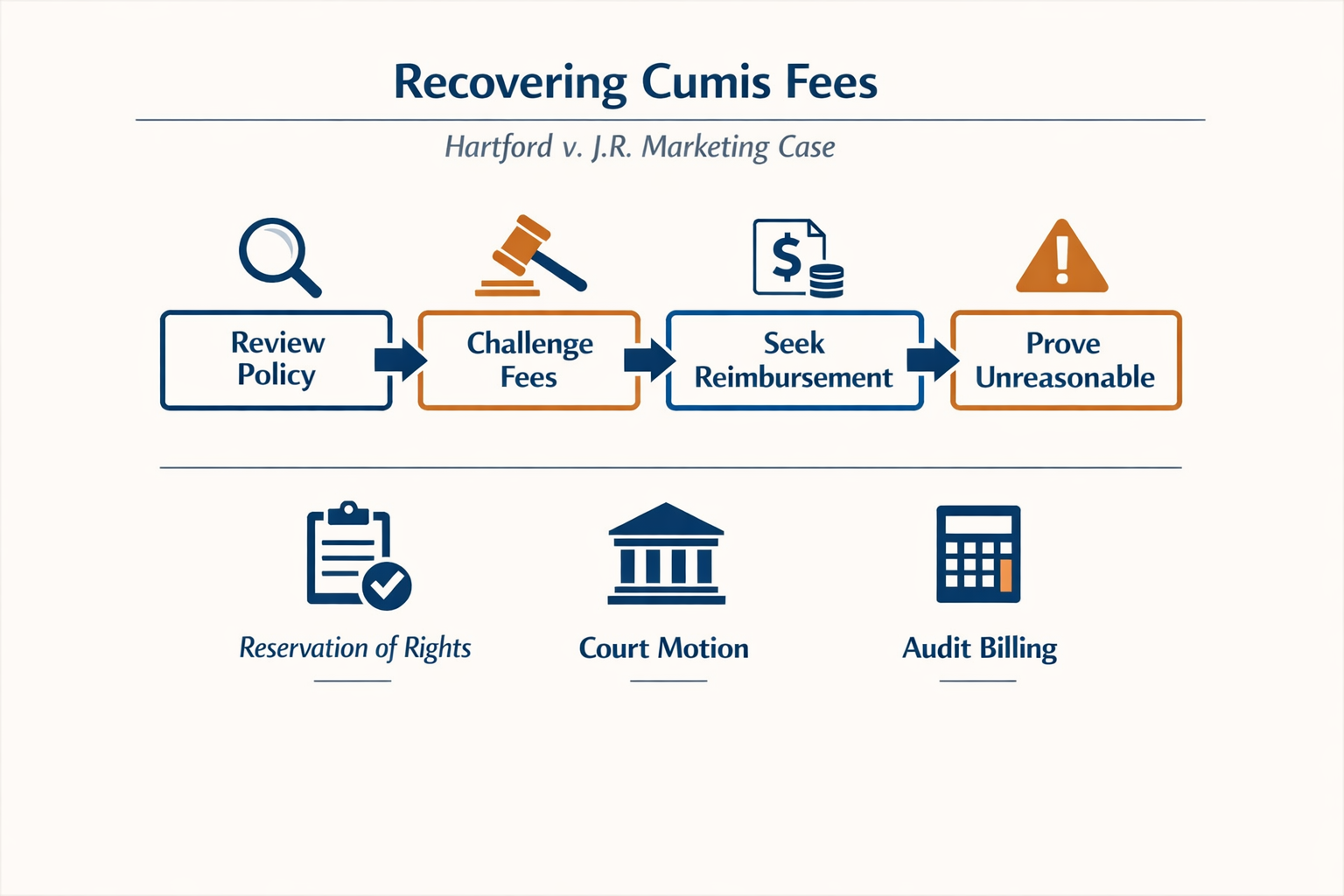
When a conflict of interest requires independent counsel under California Civil Code section 2860, the insurer pays for that counsel's fees. The Hartford v. J.R. Marketing decision establishes that insurers may recover those fees from the policyholder when the underlying claim falls outside the policy's coverage. The path to recovery is not automatic — it requires documentation, timing and a clear showing that no duty to defend existed.
Step One: Document the Conflict and the Appointment
Before independent counsel submits a single invoice, the insurer must establish the factual basis for the conflict in writing. The conflict letter should identify the specific coverage defenses that create a material divergence between the insurer's interest and the insured's interest. If the insurer appoints independent counsel without stating why panel counsel cannot serve, the appointment itself may undermine a later claim that no duty to defend existed.
Once independent counsel is appointed, the insurer should confirm in writing that the appointment is made under Civil Code section 2860 and that fees will be paid subject to the insurer's reservation of rights. This confirmation is not a waiver of coverage defenses — it is a record that the fees were incurred because of a conflict, not because the insurer accepted a duty to defend the entire action.
Step 1
Establish the conflict in writing
Issue a conflict letter that names the coverage defenses creating the divergence and states that independent counsel is being appointed under Civil Code section 2860. Confirm that the appointment is subject to a reservation of rights and does not constitute acceptance of a duty to defend claims outside the policy.
Step Two: Monitor Billing for Covered and Uncovered Claims
Independent counsel's invoices should distinguish time spent on covered claims from time spent on uncovered claims. When a complaint alleges both covered and uncovered causes of action, the insurer's duty to defend extends only to the covered claims. Time entries that lump defense work into a single narrative — block billing — make it impossible to determine which portion of the fees the insurer is obligated to pay and which portion is recoverable from the insured.
Carriers routinely reject block-billed invoices under outside counsel guidelines, and the same principle applies to Cumis fee recovery. If independent counsel's time records do not separate covered from uncovered work, the insurer cannot meet its burden to show that the fees it seeks to recover were incurred solely in defense of claims for which no duty existed. For detailed guidance on how carriers evaluate narrative detail and why block billing triggers rejections across panel guidelines, refer to published carrier standards.
Step 2
Require task-level detail in invoices
Direct independent counsel to use separate line items for each claim or cause of action. If the complaint alleges both negligence (covered) and intentional interference (uncovered), the invoice should show distinct time entries for each. Block entries such as "research and draft motion, 4.2" do not satisfy this requirement.
Step Three: Segregate Fees at the Conclusion of the Matter
Once the underlying action is resolved, the insurer must calculate the portion of independent counsel's fees attributable to uncovered claims. This calculation is the foundation of the recovery demand. If the insurer paid fees for work on both covered and uncovered claims, it may recover only the portion that corresponds to claims outside the duty to defend.
The segregation must be supported by the time records. If independent counsel billed 100 hours on a motion to dismiss an uncovered claim and 50 hours on discovery related to a covered claim, the insurer may seek to recover the 100 hours but not the 50. If the time records do not permit this level of granularity, the insurer's recovery claim is weakened.
Step Four: Assert the Claim for Reimbursement
After segregating the fees, the insurer must formally demand reimbursement from the insured. The demand should specify the amount sought, identify the uncovered claims to which the fees relate, and cite Hartford v. J.R. Marketing as authority for the recovery. The demand is not a coverage denial — it is a claim for reimbursement of fees the insurer was not obligated to pay in the first place.
If the insured disputes the demand, the insurer may need to file a separate action for reimbursement or assert a setoff in a declaratory relief action. The insurer's ability to recover depends on its ability to prove that the fees were incurred in defense of claims outside the policy and that the time records support the allocation.
Step 3
Issue a reimbursement demand with supporting detail
Send a demand letter that lists the uncovered claims, the total fees attributable to those claims, and the time entries that support the allocation. Attach a summary of independent counsel's invoices showing the segregation. Cite Hartford v. J.R. Marketing and state that the insurer is entitled to reimbursement because no duty to defend existed for those claims.
Step Five: Prepare for Dispute and Potential Litigation
Policyholders often resist reimbursement demands, particularly when the fees are substantial. The insured may argue that the insurer's payment of the fees constituted an admission of a duty to defend, or that the allocation between covered and uncovered work is arbitrary. The insurer's best defense is a complete set of time records, a clear conflict letter, and a reservation of rights that was communicated at the outset.
If the matter proceeds to litigation, the insurer must be prepared to present the time records, the invoices, and the coverage analysis that supports the allocation. The court will not accept a lump-sum recovery claim without a factual basis for the amount sought. The insurer's burden is to show, line item by line item, that the fees were incurred in defense of claims outside the duty to defend.
Tips and Tricks for Insurers
Carriers that pay independent counsel fees under Civil Code section 2860 can recover those costs when the insured's conduct defeats coverage. The Hartford v. J.R. Marketing decision clarified the mechanics, but the practical challenge is building a record that survives scrutiny when the insured contests the allocation. Three operational habits reduce disputes and preserve recovery rights.
Document the Conflict at the Outset
Every independent counsel engagement begins with a conflict that triggers section 2860. Document that conflict in writing when you first tender defense. State the specific coverage defense or reservation that creates the divergence of interest, and retain the letter or email that notifies the insured of the appointment. If the insured later claims the conflict was minor or manufactured, the contemporaneous record controls. A clear statement at the start anchors the allocation analysis later.
Track Fees by Issue Throughout the Defense
Independent counsel bills for the entire defense, but only the portion that benefits the insured is non-recoverable. If the case involves both covered and uncovered claims, separate the time contemporaneously. Ask counsel to use UTBMS task codes that distinguish coverage investigation (L320) from liability defense (L330), and review the LEDES file monthly rather than at the end of the case. When the final allocation arrives, you will have a line-item trail that supports each dollar assigned to the insured's benefit versus the carrier's investigation.
Preserve the Allocation Methodology for Review
Courts defer to reasonable allocations, but "reasonable" requires a disclosed method. Whether you allocate by claim, by issue, or by a time-based formula, write it down and apply it consistently. If you adjust the split mid-case because new facts emerge, document the reason for the change. The insured's right to contest the allocation depends on transparency; if your method is defensible and you can show your work, the allocation stands. If you cannot explain how you arrived at the split, expect the court to reduce your recovery or reject it entirely.
An allocation that survives judicial review is one the carrier can explain in three sentences and support with a spreadsheet the court can read.
Carriers that follow these practices reduce the risk that a successful coverage defense is undermined by a fee dispute at the back end. The right to recover independent counsel fees is not automatic, but it is predictable when the record is clean and the allocation is transparent. For billing-increment and narrative-detail standards that apply to independent counsel invoices, see Block Billing: Reasons for Carrier Rejections and Solutions.
Conclusion
The Hartford v. J.R. Marketing case establishes a clear framework for when insurers can recover Cumis counsel fees from policyholders after a conflict of interest triggers Civil Code section 2860. The decision confirms that insurers who pay independent counsel fees at statutory rates retain the right to seek reimbursement when the underlying claim falls outside policy coverage, even though the conflict required independent counsel at the time of appointment.
Three principles emerge from the decision. First, paying Cumis fees does not waive the insurer's right to contest coverage or recover defense costs later. Second, the conflict that triggers section 2860 and the coverage determination that permits fee recovery are separate inquiries, resolved at different points in the litigation timeline. Third, insurers must document the coverage position and the basis for any subsequent recovery claim with the same rigor applied to panel counsel fee disputes.
For carriers managing defense costs under section 2860, Hartford v. J.R. Marketing reinforces that independent counsel fees are a component of defense costs subject to the same coverage analysis as any other claim expense. The conflict changes who selects counsel and what the insurer pays per hour, but it does not immunize those fees from recovery when coverage does not apply. Understanding this distinction allows insurers to meet their statutory obligations during the conflict period while protecting their contractual rights when the coverage question is finally resolved.
Carriers submitting or reviewing invoices for independent counsel should apply the same block billing and narrative detail standards that govern panel counsel submissions. The fact that section 2860 controls the rate and the selection does not excuse deficient time entries or unsupported line items, and fee disputes over Cumis invoices follow the same reduction and appeal mechanics as any other defense bill.
Frequently asked questions
Can an insurer recover Cumis counsel fees after paying them?
Yes. Hartford v. J.R. Marketing holds that insurers may recover independent counsel fees from the policyholder when the underlying claim ultimately falls outside coverage, even though the conflict required the insurer to pay those fees initially under Civil Code section 2860.
Does paying Cumis fees waive the insurer's coverage defenses?
No. The Hartford v. J.R. Marketing decision clarifies that an insurer's payment of independent counsel fees under a reservation of rights does not waive the insurer's right to contest coverage or seek reimbursement later if coverage is denied.
What documentation is required to recover Cumis fees?
The insurer must provide contemporaneous records showing the conflict that triggered section 2860, time records that segregate covered from uncovered work, and evidence that the fees paid were reasonable under ABA Model Rule 1.5 and California standards.
How should independent counsel bill to preserve the carrier's recovery rights?
Independent counsel should use separate line items for each claim or cause of action, avoid block billing, and apply UTBMS task codes that distinguish liability defense from coverage investigation. Invoices should be submitted in LEDES 1998B format with sufficient narrative detail to support later allocation.