


Civil Code 2860: Cumis Counsel Billing Rates & Guidelines
Top takeaways
- Civil Code Section 2860 requires insurers to provide independent counsel when a conflict of interest arises during defense.
- Cumis counsel fees and billing practices are governed by statutory duties to disclose, inform, consult, and cooperate with the insurer.
- Common billing disputes arise from travel time, intra-office conferences, and administrative tasks billed at attorney rates.
- Understanding the legal framework and carrier guidelines prevents fee reductions and strengthens the attorney-insurer relationship.
- The statute does not explicitly address billing rates, leaving "reasonable" fees subject to interpretation and case law.
Introduction
California civil code 2860 establishes the framework for independent counsel—commonly called Cumis counsel—when an insurer's duty to defend conflicts with the insured's interests. The statute states that when a conflict of interest arises, "the insurer shall provide independent counsel to represent the insured unless, at the time the insured is informed that a possible conflict may arise or does exist, the insured expressly waives, in writing, the right to independent counsel." This provision creates a statutory right to independent representation funded by the carrier, but it leaves the question of billing rates and fee reasonableness largely to case law and carrier-published guidelines.
As part of the Carrier Ready Knowledge Team, we delve into the complexities of Cumis counsel billing practices in California, particularly under civil code 2860. A common misconception is that the duty to pay independent counsel is loosely defined. However, case law provides clarity on what a carrier may and may not recover. In our research, we also find that the published guidelines frequently flag travel, intra-office conferences, and administrative time billed at attorney rates as entries prone to reductions. For a detailed breakdown of how billing entries are structured and reviewed, see LEDES 1998B File Format - All 24 Fields Explained.
The statute addresses counsel selection, cooperation duties, and privilege, but it does not specify hourly rates, billing increments, or narrative detail standards. Carriers fill this gap with outside counsel guidelines that define block billing prohibitions, pre-approval thresholds for expenses, and reduction codes for noncompliant entries. Civil Code Section 2860, subdivision (f), requires that "both the counsel provided by the insurer and independent counsel selected by the insured shall be allowed to participate in all aspects of the litigation," and that "counsel shall cooperate fully in the exchange of information that is consistent with each counsel's ethical and legal obligation to the insured." This dual-participation model creates billing complexity when both panel counsel and Cumis counsel submit invoices for overlapping work.
Fee disputes typically center on three questions: whether the rate is reasonable for the market and the matter, whether the time entries comply with carrier billing guidelines, and whether the work performed falls within the scope of the insurer's defense obligation. The statute itself provides no rate ceiling, but carriers often apply their standard panel rates or negotiate separate Cumis counsel rate schedules. When a carrier reduces or rejects a Cumis counsel invoice, the appeal path mirrors the process for panel counsel: the timekeeper reviews the reduction code, consults the guideline provision cited, and submits a written response through the e-billing portal or directly to the bill reviewer.
Explore Cumis counsel billing in California, including civil code 2860 rates, guidelines, and common fee disputes.
What is Cumis Counsel?
Cumis counsel is an attorney who represents the insured independently when a conflict of interest exists between the insurer and the insured under civil code 2860. The term derives from California Civil Code Section 2860, which codifies the duty of an insurer to provide independent counsel under specific circumstances. Unlike panel counsel or defense counsel retained directly by the carrier, Cumis counsel owes allegiance solely to the insured, not to the insurer paying the fees.
When the Duty to Provide Independent Counsel Arises
Cal. Civ. Code § 2860, subd. (a) states that if a policy imposes a duty to defend and a conflict of interest arises, the insurer must provide independent counsel to represent the insured unless the insured expressly waives that right in writing. A conflict does not exist merely because the insurer denies coverage for certain allegations or facts in the litigation. However, when an insurer reserves its rights on a coverage issue and the outcome of that issue can be controlled by counsel first retained by the insurer, a conflict of interest may exist.
The statute clarifies that no conflict is deemed to exist solely because punitive damages are alleged or because the insured is sued for an amount exceeding policy limits. The conflict that triggers the Cumis duty is structural: the insurer-selected attorney's loyalty is divided between the carrier's coverage interests and the insured's defense interests.
Role and Duties of Cumis Counsel
Once independent counsel is selected by the insured, both the insurer-provided counsel and the independent counsel are allowed to participate in all aspects of the litigation. Cal. Civ. Code § 2860, subd. (f) requires full cooperation in the exchange of information consistent with each counsel's ethical and legal obligations to the insured. The insured and independent counsel must disclose to the insurer all information concerning the action except privileged materials relevant to coverage disputes, and must timely inform and consult with the insurer on all matters relating to the action.
For a deeper look at how attorney fees are structured and what constitutes reasonable billing, see our guide on ABA Model Rule 1.5: Reasonable Attorney Fees & California Rule 1.5.
Why Cumis Counsel Matters in Legal Billing
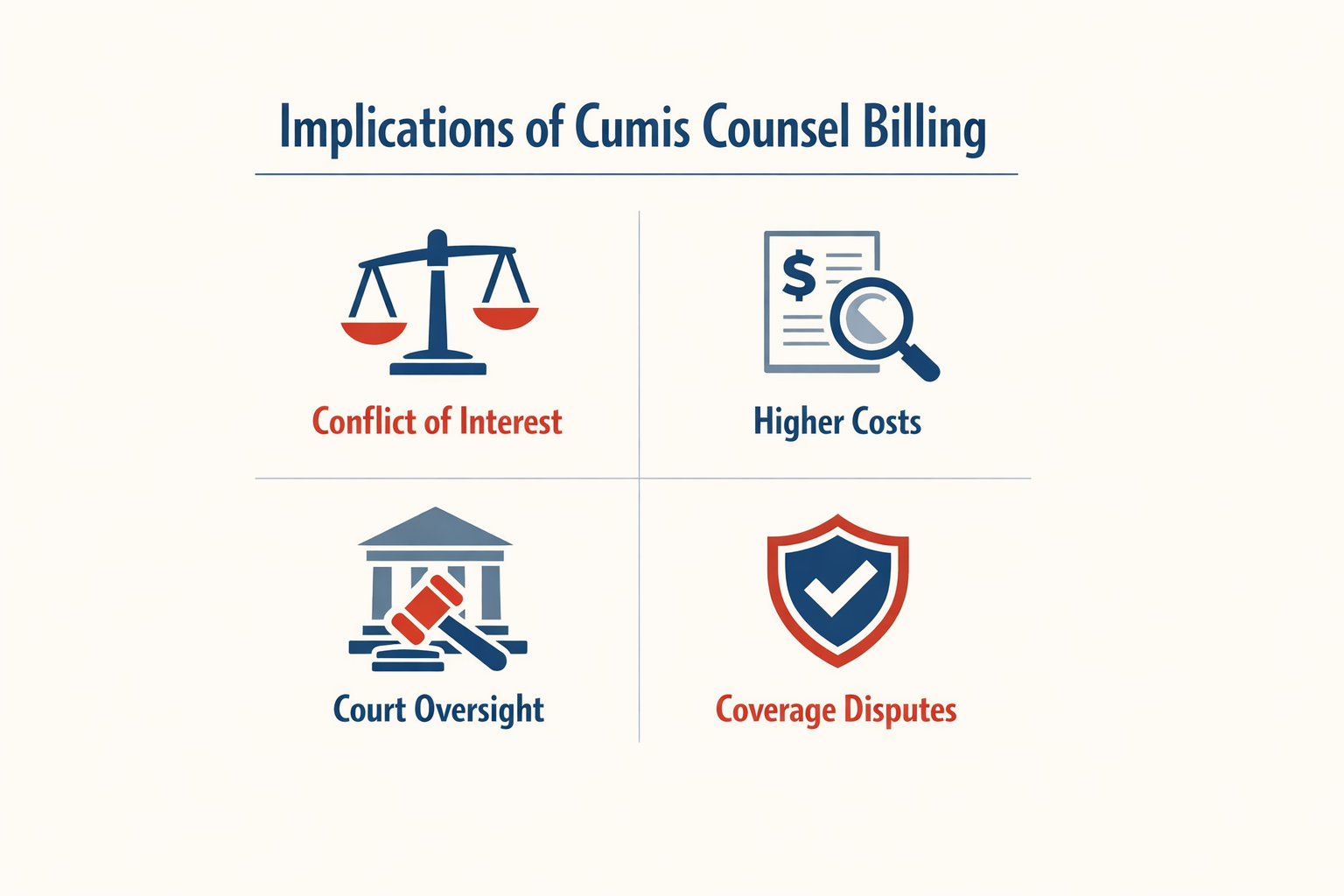
The requirement to provide independent counsel under civil code 2860 reshapes the financial relationship between carrier and insured. When a conflict of interest exists, the insured gains the right to select counsel whose allegiance is owed solely to the insured, not the carrier. The carrier pays for that representation, but the usual mechanisms of panel selection, staffing ratios, and pre-approval thresholds no longer apply in the same way. This shift affects invoice submission, bill review, and the grounds on which a carrier may reduce or reject a line item.
Financial Control Transfers to the Insured
Under panel counsel arrangements, the carrier selects the firm, negotiates the rate, and enforces its outside counsel guidelines through the engagement letter. When civil code 2860 applies, the insured selects independent counsel. The carrier retains the obligation to pay, but its control over counsel selection is displaced. This creates tension in billing: the carrier still conducts bill review and applies its guidelines, but the insured's counsel owes no contractual duty to comply with those guidelines. The result is a higher volume of invoice disputes, reduction appeals, and fee litigation than occurs with panel counsel.
Conflict of Interest as the Threshold
The duty to provide independent counsel does not arise automatically. It is triggered when a conflict of interest or potential conflict of interest exists. Courts have held that these conflicts usually involve the insured seeking coverage and the insurer attempting to avoid it. The conflict exists because the interests of the insurer and the insured diverge, precluding the use of counsel who purports to jointly represent both parties. It is the existence of the conflict, not the carrier's reservation of rights alone, that creates the need for Cumis counsel — an attorney whose allegiance is owed solely to the insured.
The existence of the conflict or potential conflict creates the need for independent or Cumis counsel — an attorney who owes his or her allegiance solely to the insured.
When an insurer provides its own counsel but reserves its right to assert noncoverage at a later date, a conflict of interest exists between the insurer and the insured. Under these circumstances, the insured has a right to independent counsel paid for by the insurer. This right persists even if the insurer forgoes its own representation; the insured retains its right to independent counsel that it selects and controls.
Billing Implications for Carriers and Counsel
The financial implications extend beyond the hourly rate. Independent counsel billing often includes higher staffing levels, more detailed motion practice, and extended discovery work that panel counsel guidelines would restrict. Carriers apply the same LEDES file formats, UTBMS task and activity codes, and narrative detail standards to independent counsel invoices, but the legal basis for enforcing reductions is weaker. A carrier may argue that a line item is unreasonable under the circumstances, but it cannot enforce a guideline prohibition that the insured's counsel never agreed to follow.
Bill review practice for independent counsel invoices tends to focus on reasonableness rather than guideline compliance. Reduction codes such as "excessive time" or "unnecessary task" replace "guideline violation" as the stated reason for a write-down. This shifts the burden: the carrier must justify the reduction on substantive grounds, not procedural ones. Appeals of these reductions are more likely to proceed to fee arbitration or litigation, and the carrier's recovery of disputed amounts is less certain.
How to Navigate Cumis Counsel Billing
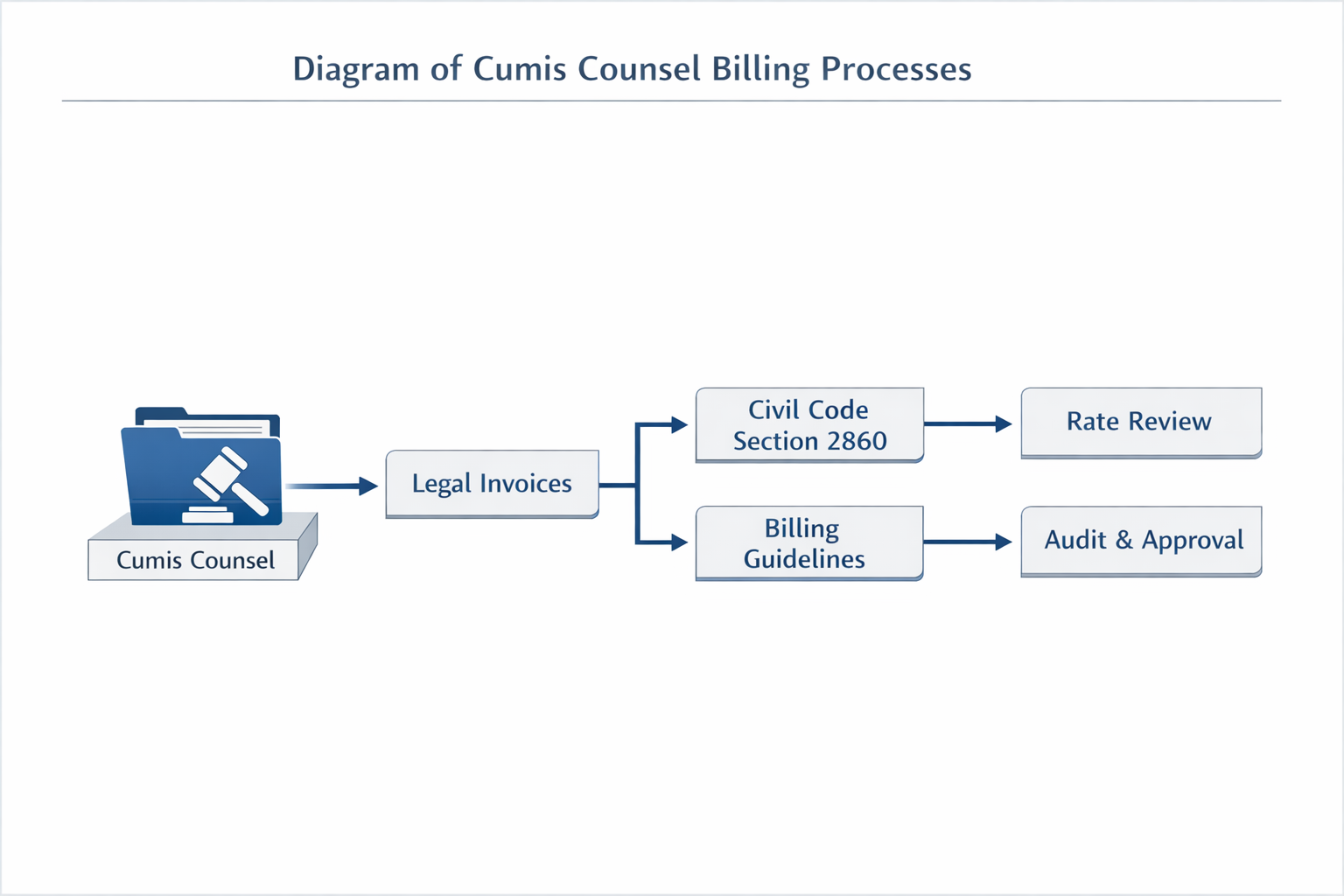
Navigating Cumis counsel billing requires understanding the statutory framework, the insured's selection and control rights, and the limited duties counsel owes to the carrier. Civil code 2860 defines when independent counsel must be provided and what that counsel's obligations are — but it does not dictate billing rates, narrative detail, or invoice format. Those requirements come from carrier outside counsel guidelines, which apply to Cumis counsel submissions the same way they apply to panel counsel invoices.
Step 1: Confirm the Conflict and the Duty to Provide Independent Counsel
Step 1
Confirm the conflict and the duty to provide independent counsel
Before billing as Cumis counsel, verify that a conflict of interest exists and that the insurer has acknowledged the duty to provide independent counsel under civil code 2860, subdivision (a). The insured must be informed of the conflict and must not have waived, in writing, the right to independent counsel. Without a documented conflict and acknowledgment, the billing relationship defaults to standard panel counsel terms, and the insurer may reject invoices submitted under a Cumis arrangement.
Step 2: Understand Counsel Selection and Control
Civil code 2860 grants the insured the right to select and control independent counsel. Even if the insurer waives its own representation, the insured retains this right. The insurer may not unilaterally designate counsel or impose a pre-approved roster when a section 2860 conflict exists. If the insurer provides a list of acceptable counsel, the insured is not bound by it unless the policy contains a method-of-selection provision consistent with section 2860.
Step 3: Identify Cumis Counsel's Duties to the Insurer
Cumis counsel owes limited duties to the insurer. Under 32 Cal.App.4th 78, page 90, paragraph 45, those duties are to disclose, inform, consult, and cooperate regarding nonprivileged information. There is no explicit duty in section 2860 for Cumis counsel to defend on behalf of the insurer. This distinction matters for billing: time entries for tasks that benefit the insurer — such as coverage analysis or insurer-directed research — may be challenged if they fall outside the statutory scope.
Step 4: Apply Carrier Outside Counsel Guidelines to Cumis Invoices
Most carriers apply their published outside counsel guidelines to Cumis counsel invoices without exception. This means tenth-of-an-hour increments, no block billing, contemporaneous narrative detail, and UTBMS task and activity codes are required. If the guideline specifies a pre-approval threshold for experts or travel, that threshold applies to Cumis counsel the same way it applies to panel counsel. The fact that counsel is independent under section 2860 does not exempt the invoice from guideline compliance.
Step 5: Submit Invoices Through the Designated E-Billing Portal
Carriers typically require Cumis counsel to submit invoices through the same e-billing portal used by panel counsel. The portal validates LEDES file structure, UTBMS codes, and narrative length before the invoice reaches a human reviewer. A Cumis invoice that fails validation is rejected for the same reasons a panel invoice is rejected: missing line-item detail, prohibited block billing, or incorrect task codes. Resubmit with corrections rather than appealing the validation failure — the portal applies the guideline mechanically.
Step 6: Document Selection, Approval, and Rate Agreement
Before submitting the first invoice, document the insured's selection of counsel, the insurer's acknowledgment of the section 2860 duty, and any agreed billing rate. If the insurer proposes a rate, confirm it in writing. If no rate is agreed, bill at the rate customary for the insured's counsel in the relevant market and matter type. Disputed rates are resolved after the fact, but an invoice with no rate documentation invites a reduction to the carrier's standard panel rate.
Best Practices for Cumis Counsel Billing
Cumis counsel billing under civil code 2860 demands precision in both documentation and invoicing. The statute imposes specific duties on independent counsel to disclose, inform, consult, and cooperate with the insurer regarding nonprivileged information. These obligations shape how time entries, narratives, and supporting records must be prepared. A billing practice that ignores these statutory duties invites reductions, appeals, and protracted fee disputes.
Carriers expect contemporaneous time records that reflect the limited scope of Cumis counsel's role. Civil code 2860, subdivision (c), does not impose a duty on independent counsel to defend on behalf of the insurer — only to communicate nonprivileged case developments and strategic decisions. Billing entries that suggest Cumis counsel is acting as the insurer's litigation manager, rather than the insured's advocate, will be flagged during bill review. The line item must describe work performed for the insured, not work performed to satisfy the carrier's coverage investigation or claims-handling objectives.
Document the Disclosure and Cooperation Duties Separately
When Cumis counsel performs work to satisfy the statutory duties under civil code 2860, that work should be documented in discrete line items with clear narratives. An entry reading "telephone conference with carrier adjuster regarding case status, 0.3" is compliant. An entry reading "research and draft coverage analysis memorandum for carrier, 2.1" is not — that task falls outside the duties specified in the statute and may be challenged as work for the insurer's benefit rather than the insured's defense.
Carrier outside counsel guidelines frequently prohibit billing attorney time for administrative tasks, intra-office conferences that do not advance the litigation, and travel time at attorney rates. These prohibitions apply with equal force to Cumis counsel. The fact that counsel is independent does not exempt the invoice from the carrier's billing standards. If the guideline specifies tenth-of-an-hour increments, Cumis counsel must comply. If the guideline prohibits block billing, each task must be itemized separately, even when multiple tasks occur on the same day.
Use UTBMS Codes That Reflect Independent Counsel's Role
When submitting invoices through an e-billing portal, Cumis counsel must assign UTBMS task and activity codes that accurately describe the work performed. A task code such as L310 (depositions) paired with an activity code such as A102 (analyze) is appropriate for reviewing deposition transcripts in preparation for cross-examination. A task code such as L610 (investigation) paired with an activity code such as A199 (other) is not — it suggests work that may benefit the carrier's coverage position rather than the insured's defense.
The LEDES 1998B file submitted to the carrier must include the correct timekeeper classification in the TIMEKEEPER_CLASS field. Independent counsel should be classified as "associate," "partner," or "of counsel" based on actual status within the firm, not as "contract attorney" or "special counsel." Misclassification can trigger automated rejections in the e-billing portal, delaying payment and requiring resubmission.
Maintain Contemporaneous Records for Every Entry
Civil code 2860 does not alter the requirement that all billed time be supported by contemporaneous records. A time entry created days or weeks after the work was performed is not contemporaneous, even if the work itself was necessary and reasonable. Carriers conducting bill review expect to see time entries recorded on the same day the work occurred, with narratives that describe the specific task completed and the file or document reviewed.
When a carrier requests supporting documentation for a fee entry, Cumis counsel must be prepared to produce the underlying records without delay. A request for correspondence, research memoranda, or draft pleadings is not an intrusion on the attorney-client privilege when the request is limited to nonprivileged materials. Civil code 2860, subdivision (c), expressly requires independent counsel to disclose nonprivileged information to the insurer. A refusal to produce requested records may result in a reduction or disallowance of the disputed entry.
The duties specified in civil code 2860 that Cumis counsel owes the insurer are limited to the duties to disclose, inform, consult and cooperate regarding nonprivileged information.
Common Mistakes in Cumis Counsel Billing
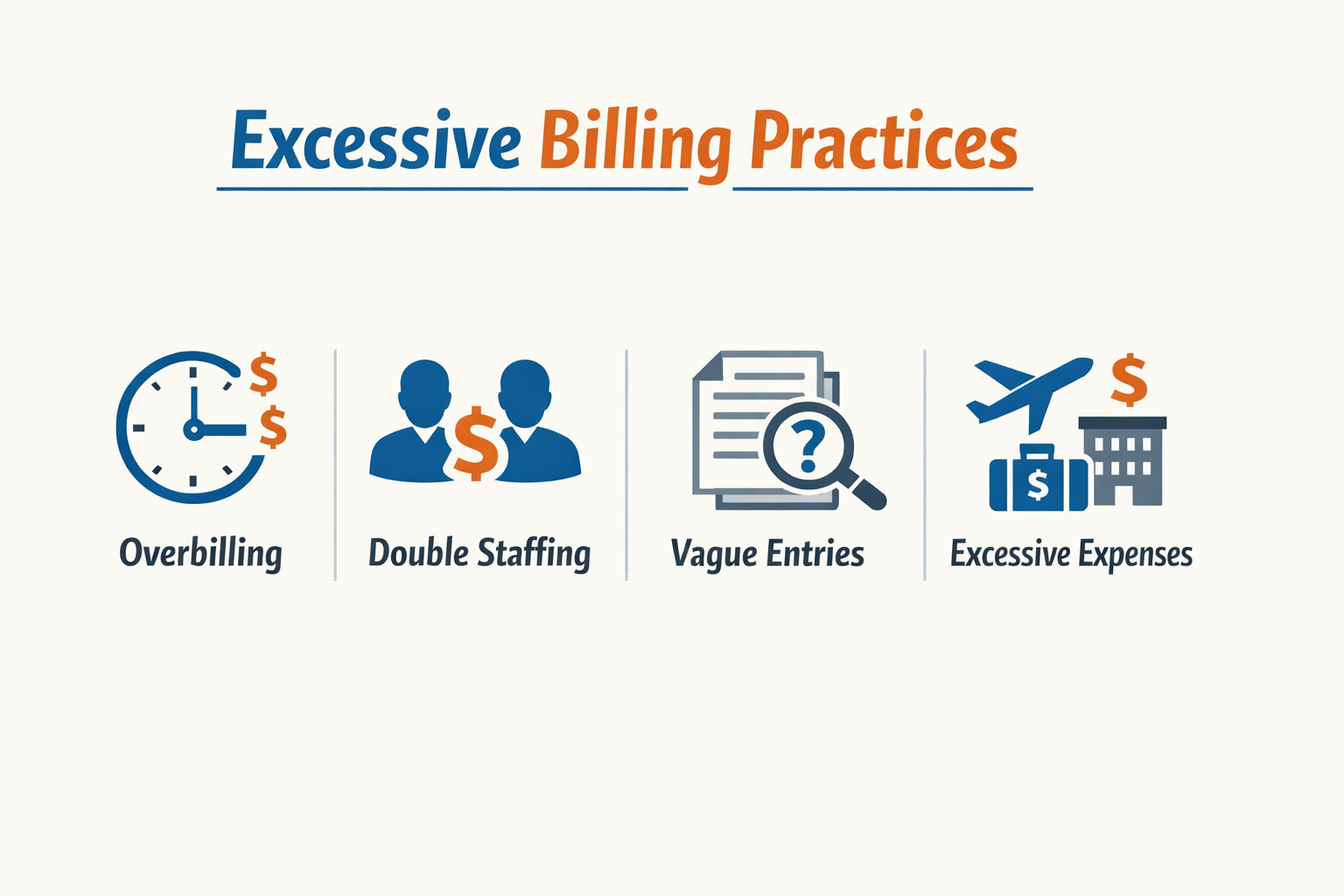
Misunderstanding when independent counsel is required under civil code 2860 leads to unnecessary fee disputes and invoice reductions. Carriers reject invoices when counsel bills for representation that does not meet the statutory conflict threshold, and defense firms lose recoverable fees when they fail to distinguish between a theoretical and an actual conflict.
Assuming Every Reservation of Rights Triggers Independent Counsel
A reservation of rights by an insurer does not necessarily constitute a conflict of interest requiring the insurer to provide independent counsel. The conflict must be "significant, not merely theoretical, actual, not merely potential," as established in Dynamic Concepts, Inc. v. Truck Ins. Exchange, 61 Cal.App.4th 1007. Billing for Cumis counsel when the carrier has issued only a general reservation—without identifying a specific coverage issue that defense counsel can control—invites immediate reduction.
Carriers routinely reduce invoices when the retention letter or the underlying complaint does not show a coverage issue that counsel retained by the insurer can influence. If the reservation states only that punitive damages or excess exposure may not be covered, civil code 2860, subdivision (b) does not apply—those circumstances alone do not create the required conflict. Counsel who bill as independent counsel in those situations see their invoices flagged for write-down or rejected outright in the e-billing portal.
Failing to Document the Qualifying Conflict in the Invoice Narrative
When a qualifying conflict does exist, many defense firms submit invoices without explaining what the conflict is or why independent counsel was necessary. A line item reading "research coverage issues, 2.4" tells the bill reviewer nothing about whether the work relates to a conflict that satisfies the statute. Carriers expect contemporaneous records that tie each entry to the specific coverage dispute that triggered the independent-counsel obligation.
Best practice: include a brief reference to the coverage issue in narrative detail for any entry that would not otherwise be compensable under a standard panel-counsel engagement. For example, "review reservation letter re: intentional-act exclusion and analyze facts bearing on insured's intent" connects the work to a coverage question that defense counsel can influence. Without that connection, the entry looks like ordinary defense work billed at independent-counsel rates, and the carrier will reduce it to the panel rate or disallow it entirely.
Billing Administrative and Clerical Tasks at Attorney Rates
Published guidelines frequently flag travel, intra-office conferences, and administrative time billed at attorney rates as entries prone to reductions. This pattern is especially pronounced in independent-counsel invoices, where carriers scrutinize every line for compliance with the reasonable-rate standard. Billing 0.8 hours for "prepare and send correspondence to carrier re: case status" at $450 per hour invites a reduction code citing clerical work billed at attorney rates.
Reviewers apply the same standards to Cumis counsel that they apply to panel counsel: work that a paralegal or legal assistant can perform must be billed at the appropriate non-attorney rate, or it will be written down. The fact that the engagement is independent counsel does not exempt the invoice from the ordinary billing-increment, narrative-detail, and staffing-ratio requirements in the carrier's outside counsel guidelines. For additional guidance on common billing errors that trigger reductions, see Block Billing: Reasons for Carrier Rejections and Solutions.
Submitting Invoices Without Pre-Approval for Threshold Expenses
Many carriers impose pre-approval thresholds for experts, investigators, and other litigation expenses. Independent counsel are not exempt from those thresholds. Submitting an invoice with a $12,000 expert fee when the guideline requires advance approval for any expense over $2,500 results in a reduction or a request for retroactive approval, which the carrier may deny. The invoice then sits in a pending state while the parties negotiate, delaying payment and increasing administrative burden.
Review the controlling outside counsel guidelines before incurring any significant expense. If the guidelines specify a dollar threshold, obtain written approval before the expense is incurred. If the guidelines are silent, request approval as a precaution—carriers appreciate the courtesy, and the contemporaneous approval record eliminates disputes at invoice time.
Frequently asked questions
Does every conflict of interest entitle the insured to independent counsel at the carrier's expense?
No. Not every conflict triggers the obligation to provide independent counsel. The mere fact that a carrier disputes coverage does not entitle the insured to Cumis counsel, nor does the fact that the complaint seeks punitive damages or damages in excess of policy limits. The insurer owes no duty to provide independent counsel in these situations because the Cumis rule is not based on insurance law but on the ethical duty of an attorney to avoid representing conflicting interests.
For independent counsel to be required, the conflict of interest must be significant, not merely theoretical, actual, not merely potential. The insured's right to independent counsel depends upon the nature of the coverage issue, as it relates to the issues in the underlying case.
What billing increments do carriers typically require for Cumis counsel invoices?
Most carriers with published outside counsel guidelines specify tenth-of-an-hour increments for time entries. Rounding to quarter-hour or half-hour increments often triggers automated rejections in e-billing portals. Where a guideline is silent on increments, the carrier may still apply tenth-of-an-hour standards during bill review.
Can Cumis counsel block bill multiple tasks in one line item?
No. Block billing is prohibited under most panel guidelines. One entry reading "research and draft motion in limine, 4.2" is enough to trigger a reduction. Each discrete task requires its own line item with a specific narrative. Carriers expect contemporaneous records that isolate research time, drafting time, and revision time as separate entries.
Are travel expenses and travel time reimbursable at attorney rates?
Travel time billed at attorney rates is frequently flagged for reduction. Many carrier guidelines specify a reduced rate or flat reimbursement for travel time, and some exclude it entirely. Travel expenses such as mileage, airfare, and lodging are typically reimbursable at cost, subject to pre-approval thresholds stated in the guideline. Counsel should verify the specific carrier's policy before incurring travel costs.
What happens if a Cumis counsel invoice is rejected by the e-billing portal?
The portal generates a rejection notice with one or more reduction codes. Common codes include block billing, insufficient narrative detail, unapproved expense, or incorrect UTBMS task code. Counsel may appeal the reduction by submitting a revised invoice or a written explanation, depending on the carrier's appeal procedure. The guideline or portal documentation will specify the timeline and format for appeals.
Does civil code 2860 set a maximum hourly rate for Cumis counsel?
Civil code 2860 does not set a specific dollar cap. It requires the carrier to pay the reasonable cost of independent counsel, which is determined by the nature of the case, the counsel's experience, and the prevailing rates in the relevant market. Carriers may impose rate caps in their published guidelines, but those caps are subject to the statutory reasonableness standard.
Can a carrier reduce fees for intra-office conferences billed at attorney rates?
Yes. Intra-office conferences are a common target for reductions. Carriers expect these entries to be billed at the lowest reasonable rate, and many guidelines prohibit billing partner time for routine internal coordination. Where multiple timekeepers bill for the same conference, the narrative must justify each participant's role and the time spent.
What documentation should accompany a fee dispute or appeal under civil code 2860?
The appeal should include the original invoice, the rejection notice with reduction codes, and a written explanation addressing each reduction. Where the dispute concerns reasonableness of rates or hours, counsel should provide supporting documentation such as declarations, market rate surveys, or case-specific complexity factors. The carrier's guideline will specify the required format and submission method.
Conclusion
Civil code 2860 establishes a clear framework for independent counsel billing when a conflict of interest exists between insurer and insured. The statute grants the insured the right to select counsel and requires the insurer to pay reasonable fees, but it does not eliminate the carrier's right to review and challenge billing entries that fall outside recognized standards. Understanding this balance is essential for defense counsel operating under Cumis appointments in California.
The published guidelines from carriers frequently flag travel, intra-office conferences, and administrative time billed at attorney rates as entries prone to reductions. These patterns underscore the importance of precise billing practices: tenth-of-an-hour increments, narrative detail that ties each entry to the defense, and avoidance of block billing. When a carrier reduces an invoice, the path forward begins with the reduction code and the specific guideline provision cited — not with assumptions about what the statute permits.
As part of the Carrier Ready Knowledge Team, we observe that many fee disputes arise not from the hourly rate itself, but from how time is described and categorized. A line item reading "research and draft motion in limine, 4.2" will trigger a reduction under most panel guidelines, even when the underlying work is defensible. The solution is contemporaneous, granular entries that allow a bill reviewer to see exactly what was done and why it advanced the defense. For additional context on how carriers evaluate narrative detail, see Block Billing: Reasons for Carrier Rejections and Solutions.
Civil code 2860 does not eliminate billing oversight — it shifts the duty to pay from the insured to the insurer while preserving the carrier's right to enforce reasonable billing standards. Counsel who honor that structure, submit invoices that comply with published guidelines, and respond to reductions with specificity rather than appeals to statutory entitlement will find the path to payment far less contested.