


Comparing Legal Billing Codes: UTBMS, ABA, and Carrier-Specific Codes
Top takeaways
- Legal billing codes standardize how timekeepers describe work on invoices, making line items readable to bill reviewers and e-billing portals
- UTBMS task codes organize work by phase (for example L200 for pre-trial pleadings, L300 for discovery), while activity codes describe what the timekeeper did (A102 for research, A103 for drafting)
- Carrier-specific codes and ABA-origin codes serve different purposes, and understanding which system applies to a given matter determines whether an invoice validates or rejects
- As part of the Carrier Ready Knowledge Team, we often delve into the intricacies of legal billing codes, particularly the differences between UTBMS, ABA, and carrier-specific codes
- Each coding system reflects a distinct billing philosophy: UTBMS emphasizes task-based granularity, while carrier guidelines may impose additional restrictions or substitutions
Introduction to Legal Billing Codes
Comparing legal billing codes begins with understanding that legal billing codes are the taxonomy that e-billing portals, bill reviewers and outside counsel guidelines rely on to process invoices. A line item reading "research and draft motion in limine, 4.2" tells a human reader what happened, but a submission system needs a task code, an activity code and a narrative that aligns with both. When the codes mismatch or the narrative contradicts the code, the portal flags the entry and the invoice sits in a rejection queue until someone fixes it.
The UTBMS litigation code set, published by the ABA in 1997, divides work into phases and tasks. Phase L100 covers case assessment, development and administration—the forest rather than the trees. Phase L200 addresses pre-trial pleadings and motions, encompassing complaints, answers, motions to dismiss and dispositive motions. Each task code pairs with an activity code: A102 for research, A103 for draft or revise, A104 for review or analyze. The combination tells the reviewer not only what phase of the case generated the time, but what the timekeeper actually did.
Carrier guidelines determine which codes a panel firm must use and whether deviations trigger a rejection or a reduction. Reading Arch 2025.5, Hartford's billing FAQ, and Sompo's guidelines together, we discovered that only one treats block billing as an outright prohibition rather than a reduction trigger. The same variability appears in code requirements: some carriers accept UTBMS codes without modification, others publish their own task lists, and a few permit narrative-only billing for certain matter types. The key is knowing which rulebook governs the invoice you are preparing.
Understanding the structure of these codes and how they interact with e-billing validation rules is the first step toward clean submissions. A timekeeper who selects L240 (dispositive motions) and pairs it with A103 (draft/revise) produces a line item that passes automated checks. The same entry coded L190 (other case assessment) with no further explanation will draw a reviewer query, even if the narrative is identical. For more detail on how activity codes function within the UTBMS framework, see UTBMS Activity Codes A101-A111 for Legal Billing.
Billing codes are not decoration. They are the control vocabulary that determines whether an invoice moves forward or stops. When a firm submits time without codes, or with codes that do not match the carrier's published list, the result is a rejection notice and a cycle of resubmission that delays payment and increases administrative cost. The sections that follow examine the specific challenges these code systems create and the steps required to navigate them.
What Makes Comparing Legal Billing Codes Difficult?
Three different billing code systems — UTBMS, ABA, and carrier-specific codes — create overlapping obligations that legal professionals must navigate simultaneously. A single line item may need to satisfy UTBMS task and activity code semantics, comply with a carrier's guideline on what those codes permit, and meet the carrier's own code requirements if the carrier has published a proprietary set. When these systems conflict, the invoice is rejected, the timekeeper rewrites the entry, and the cycle repeats.
Code Ambiguity and Overlapping Definitions
UTBMS task codes define broad categories of work. The ABA UTBMS Litigation Code Set (1997) defines L100 as "Case Assessment, Development and Administration," which "focuses on the case as a whole, the 'forest' rather than the 'trees.'" Within L100, task code L120 covers "Analysis/Strategy," including "thinking, strategizing, and planning for a case," while L110 addresses "Fact Investigation/Development," encompassing "interviews of client personnel and potential witnesses" and "review of documents to learn the facts of the case." The line between strategic thinking and fact investigation is not sharp. A timekeeper reviewing witness statements to assess case strategy could defensibly code the entry L110 or L120, yet a bill reviewer may reject one and accept the other based on the narrative alone.
Task code L200, "Pre-Trial Pleadings and Motions," subdivides into codes like L210 ("Pleadings"), L240 ("Dispositive Motions"), and L250 ("Other Written Motions and Submissions"). L250 explicitly includes "motions to consolidate, to bifurcate, to remand, to stay, to compel arbitration, for MDL treatment and for change of venue." A motion in limine, however, does not appear in the L250 list, nor does it fit cleanly under L210 or L240. The timekeeper must choose a code, but the carrier's bill reviewer may apply a different interpretation and reduce the entry for miscoding.
Carrier-Specific Code Requirements
Carriers that publish outside counsel guidelines often specify which UTBMS codes are reimbursable and at what rates. Some carriers go further and publish their own code sets, which may or may not align with UTBMS. When a carrier requires its proprietary codes in addition to UTBMS codes, the timekeeper must map each entry to both systems. If the carrier's code set uses different labels or granularity than UTBMS, the timekeeper is left to interpret the mapping without formal guidance.
A carrier may prohibit certain UTBMS codes outright. For example, a guideline may state that L140 ("Document/File Management") is not reimbursable because it is "narrowly defined" as "creating and populating document and other databases or filing systems," and the carrier expects that work to be billed as an expense rather than attorney time. The timekeeper who codes database oversight as L140 will see the entry rejected, even though the UTBMS definition explicitly includes "planning, design, and overall management of this process."
The Consequences of Miscoding
An incorrectly coded line item triggers a rejection in the e-billing portal. The rejection may be accompanied by a reduction code, a brief explanation, or no explanation at all. The timekeeper or billing coordinator must then determine whether the code was wrong, the narrative was insufficient, or the carrier's guideline prohibits the activity entirely. Each scenario requires a different response: recode and resubmit, add narrative detail and resubmit, or appeal the reduction with a citation to the guideline.
When the cause of rejection is unclear, the default response is often to recode the entry under a more generic task code and resubmit. This practice — sometimes called "code shopping" — obscures the actual work performed and makes it harder for the client to understand what services were billed. Over time, it erodes the semantic value of the code set itself. For more on how e-billing portal invoice rejections arise and how to address them, see the linked guide.
The cheapest fix for a rejected line item is often the one that makes the next reviewer's job harder.
Steps to Navigate Legal Billing Codes
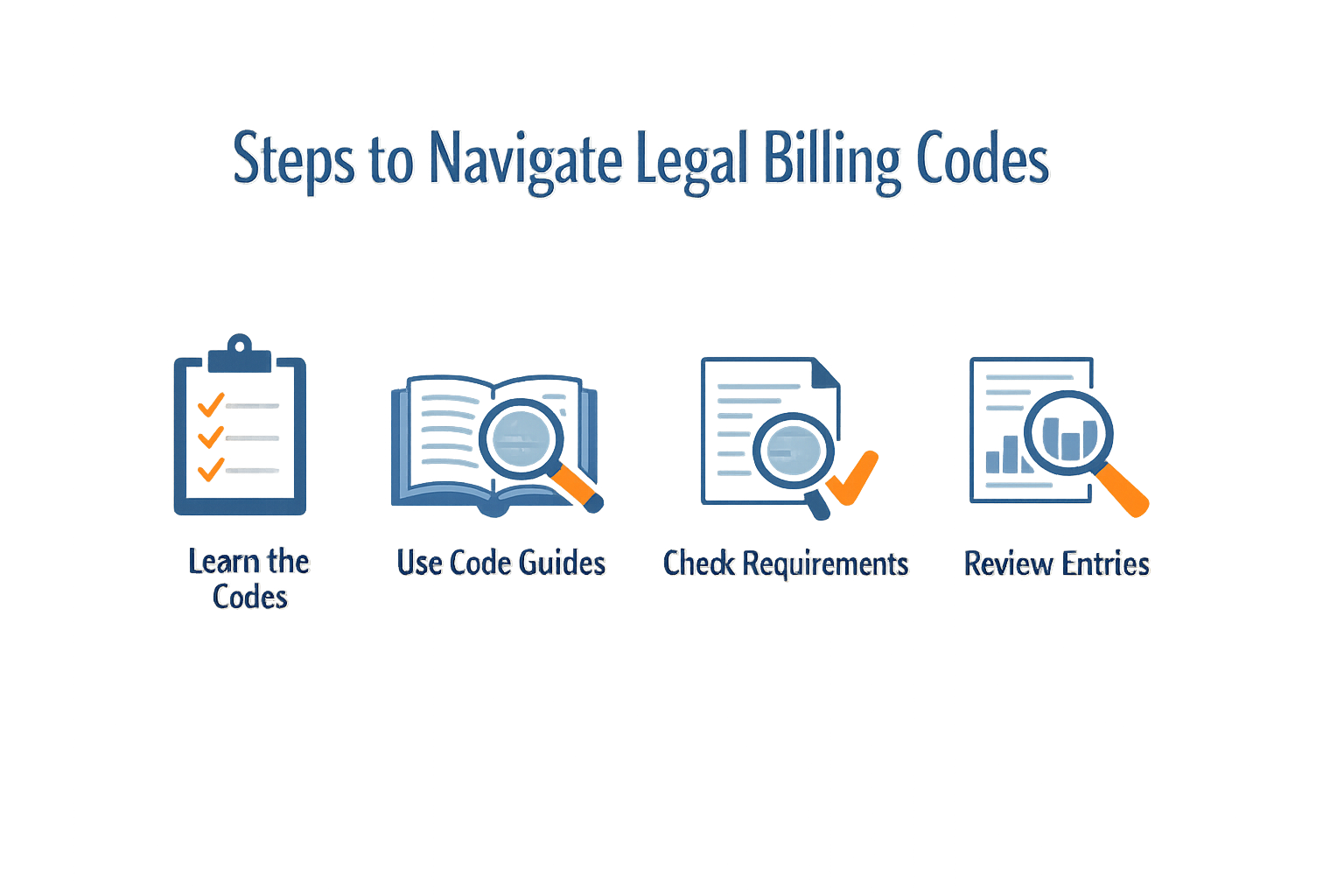
Legal professionals working with carrier panels and e-billing portals need a systematic approach to selecting and applying the correct billing codes. The UTBMS code sets—published by the ABA in 1997 and maintained by the LEDES Oversight Committee—provide the structure most portals expect. The process below walks through code selection, validation against carrier requirements, and common decision points where timekeepers choose between similar codes.
Step 1: Identify the Task Code That Describes the Work
Step 1
Identify the task code
Start with the litigation phase. UTBMS litigation codes group work into phases: L100 Case Assessment, Development and Administration covers strategy, fact investigation, and expert work; L200 Pre-Trial Pleadings and Motions covers all pleadings and pretrial motions other than discovery; L300 Discovery addresses written discovery, depositions, and document production; L400 Trial addresses all trial preparation and trial activity; and L500 Post-Trial and Appeal covers post-trial motions and appellate work. Choose the phase that matches the stage of the case, then drill into the three-digit task code. For example, L240 Dispositive Motions covers summary judgment work, while L250 Other Written Motions covers procedural motions like motions to consolidate or bifurcate.
When a single time entry spans two tasks—research for a motion in limine and drafting the motion—split the entry. One line captures the research under the appropriate task code, and a second line captures the drafting. Block billing that combines multiple tasks into one narrative violates most panel guidelines and triggers reductions during bill review.
Step 2: Select the Activity Code That Describes How the Work Was Done
Step 2
Select the activity code
Once the task code is set, pair it with an activity code from the ABA UTBMS Activity Code set. The eleven activity codes run from A101 Plan and prepare for through A111 Other. A102 Research covers legal research; A103 Draft/revise covers drafting and editing documents; A104 Review/analyze covers reviewing incoming documents or evidence; A105 Communicate (in firm) covers internal discussions; A106 Communicate (with client) covers client calls and emails; A107 Communicate (other outside counsel) and A108 Communicate (other external) distinguish co-counsel from opposing counsel and third parties; A109 Appear for/attend covers court appearances, depositions, and hearings; A110 Manage data/files covers document database work; and A111 Other is the catch-all.
The activity code clarifies the nature of the work within the task. A line coded L240 (summary judgment motion) paired with A102 (research) tells the reviewer the timekeeper researched the legal standard. The same task paired with A103 (draft/revise) indicates the timekeeper drafted or edited the motion itself. Reviewers flag entries where the activity code does not align with the narrative—draft motion coded as A104 (review) will draw a query or a reduction.
Step 3: Verify the Code Against the Carrier Guideline
Step 3
Verify against carrier guidelines
Carrier outside counsel guidelines sometimes restrict or redefine UTBMS codes. Before submitting an invoice, check the guideline version that governs the matter. Some carriers prohibit certain task codes outright—administrative tasks like file organization may be non-billable. Others impose dollar thresholds or require pre-approval for high-cost tasks like expert witness work (L130 Experts/Consultants) or trial preparation (L400). If the guideline is silent on a code, the standard UTBMS definition controls, but silence is not permission to bill without restriction.
When a guideline conflicts with standard UTBMS usage, the guideline wins. If a carrier defines L150 Budgeting as non-billable, time spent on budget discussions cannot be invoiced under that code or recoded to a different task to bypass the restriction. Attempting to recode prohibited work is a red flag during bill review and can lead to broader scrutiny of the entire invoice.
Step 4: Pair the Code with a Compliant Narrative
The task and activity codes alone do not satisfy most carrier requirements. The narrative must provide enough detail for a reviewer to understand what was done, why it was necessary, and how much time it took. A line reading "L240/A103, research and draft summary judgment motion, 4.2" is block billing—it combines research (A102) and drafting (A103) into one entry and does not break out the time spent on each. Split the entry into two lines: one for research, one for drafting, each with its own time and its own narrative.
Narratives must also avoid vague language. "Review correspondence" does not tell the reviewer which correspondence, from whom, or for what purpose. "Review opposing counsel's response to discovery request, set two, regarding plaintiff's employment history" gives the reviewer enough context to evaluate the necessity and the time. For more on avoiding common narrative pitfalls, see Block Billing: Reasons for Carrier Rejections and Solutions.
Step 5: Validate the LEDES File Before Submission
Most e-billing portals require invoices in LEDES 1998B format. The LEDES file is a pipe-delimited text file with twenty-four fields, including the task code, activity code, and narrative. Field 8 (TASK_CODE) and field 9 (ACTIVITY_CODE) must contain valid UTBMS codes; if either field is blank or contains a code the portal does not recognize, the file will be rejected at validation. Field 6 (LINE_ITEM_DESCRIPTION) holds the narrative and must comply with the carrier's narrative standards—maximum character count, no block billing, and sufficient detail.
Before uploading the file, run it through a LEDES validator or the portal's pre-submission check. Validation errors at submission are easier to fix than rejections after the invoice enters the review queue. Common validation failures include mismatched task and activity codes (a task code from the corporate code set paired with a litigation activity code), missing required fields, and narratives that exceed the character limit. For a detailed breakdown of the LEDES format, see LEDES 1998B File Format - All 24 Fields Explained.
Tips and Tricks for Using Legal Billing Codes
One code is rarely wrong in isolation. The problem emerges when the task code, the activity code, the narrative and the hours tell four different stories. A line reading "L240 / A102 / research and draft motion in limine / 4.2" triggers a reduction not because any single field is incorrect, but because L240 is dispositive motions, A102 is planning and strategizing, and motions in limine are evidentiary — none of those align. The reviewer sees a mismatch and writes it down.
Match the Code to the Work, Not the Other Way Around
Task codes describe the phase of litigation; activity codes describe what you did during that phase. L250 covers other written motions and submissions, such as motions to consolidate, bifurcate, remand, stay, compel arbitration, for MDL treatment, and for change of venue. If you drafted a motion to bifurcate, L250 is correct. If you then pair it with activity code A111 (data analysis), the combination is incoherent. A111 belongs with document review or expert work, not motion practice. Use A101 for the planning phase, A103 for the drafting, and A105 for the revision — those codes describe the mechanical steps of producing a written filing.
L120 is analysis and strategy. It includes initial legal research for case assessment purposes and legal research for developing a basic case strategy, but once you are researching for a specific motion, the code shifts to the motion's task code — L240 for summary judgment, L250 for a motion to compel arbitration. The 1997 litigation code set states this explicitly: "Most legal research will be under the primary task for which the research is conducted." If your time entry reads "L120 / research for summary judgment motion," a bill reviewer will move it to L240 and note the correction. The safer practice is to code it correctly the first time.
Avoid Catch-All Codes Unless You Document the Exception
L190 is labeled "Other Case Assessment, Development and Administration" and covers time not attributable to any other overall task. The code set notes that specific use in a given matter often may be predetermined jointly by the client and law firm. That sentence is a warning, not permission. L190 is a residual category; if you use it without prior agreement, the reviewer will ask what the time was for and why no other code fit. The same principle applies to activity code A111 (other) in the A100 series. These codes exist for edge cases, not for convenience when the correct code requires an extra fifteen seconds to locate.
For more on how activity codes structure the narrative, see UTBMS Activity Codes A101-A111 for Legal Billing.
Separate Phases Even When the Work Feels Continuous
L130 covers experts and consultants — identifying and interviewing them, working with them, and developing expert reports. It explicitly excludes preparing for expert depositions (L340) and trial (L420). If you spent two hours reviewing an expert's draft report and then one hour preparing the expert for deposition, those are two line items under two task codes. The work may have occurred in a single afternoon, but the phases are distinct. Combining them into one entry reading "L130 / work with expert / 3.0" is block billing, and the L340 component will be moved or reduced.
The code describes the litigation phase, not the calendar day. Work that spans two phases requires two line items, even when performed consecutively.
Test Your Entries Against the Task Code Definitions
L140 is document and file management. It comprises only the processes of creating and populating document and other databases or filing systems, including the planning, design, and overall management of this process. It does not cover reviewing documents to learn the facts of the case — that is L110. It does not cover document production — that is L320. L140 is the infrastructure work of building the system. If your entry reads "L140 / review documents for privilege," the code is wrong; privilege review during production is L320. If the entry reads "L140 / design document database," the code is correct.
L150 covers budgeting — developing, negotiating, and revising the budget for a matter. If you spent time preparing a fee estimate for a motion, that time belongs to the motion's task code, not L150. L150 is for the matter-level budget, not individual task estimates. The distinction is narrow, but bill reviewers enforce it.
Pre-Clear Ambiguous Work Before You Bill It
L160 covers settlement and non-binding ADR. It encompasses planning for and participating in settlement discussions, conferences, and hearings and implementing a settlement, and it includes pre-litigation demand letters and ensuing discussions. If you are in litigation and you draft a settlement demand, L160 is the correct code. If you draft a pre-litigation demand letter that also preserves a limitations defense, you may reasonably argue that part of the time belongs in L210 (pleadings) because the letter serves a dual function. The safer course is to ask the client or the carrier which code they prefer, document the answer, and bill accordingly. Ambiguity resolved in advance does not become a reduction.
Conclusion: Mastering Legal Billing Codes
Understanding and correctly using legal billing codes is not optional when submitting invoices to insurance carriers or corporate clients that mandate LEDES files and UTBMS codes. A single miscoded line item can trigger a portal rejection, a reduction code, or a write-down that requires an appeal and delays payment. The difference between task code L110 (Fact Investigation/Development) and L120 (Analysis/Strategy) may seem academic until a bill reviewer flags the entry and asks why strategy time was billed at a junior associate rate under a fact-development code.
As part of the Carrier Ready Knowledge Team, we often delve into the intricacies of legal billing codes, particularly the differences between UTBMS, ABA, and carrier-specific codes. Each of these coding systems serves a unique purpose in the legal billing landscape. The UTBMS codes are standardized and widely used across various legal services to categorize tasks, activities, and expenses. However, when we examine carrier-specific codes, we find that they can vary significantly from one insurance provider to another, reflecting each carrier's unique requirements and preferences.
Apply the Codes Consistently
Consistency across timekeepers and across invoice cycles is what bill reviewers look for. When one attorney uses L240 for summary judgment work and another uses L250 for the same motion in the same matter, the reviewer sees either confusion or an attempt to obscure the nature of the work. Neither interpretation helps the invoice clear review. Establish internal coding conventions, document them, and train every timekeeper who touches the matter.
Carrier guidelines often specify which codes are pre-approved and which require advance authorization. Reading Arch 2025.5, Hartford's billing FAQ, and Sompo's guidelines together, we discovered that only one treats block billing as an outright prohibition rather than a reduction trigger. This kind of cross-source discovery helps us understand how different carriers interpret and apply billing codes, which can impact how legal services are billed and reviewed.
The Real Cost of Coding Errors
A rejected invoice is not just an administrative inconvenience. It delays payment, consumes additional non-billable time to correct and resubmit, and signals to the client that the firm's billing process lacks rigor. In insurance defense work, where margins are tight and guideline compliance is a condition of panel membership, repeated coding errors can jeopardize the relationship. The cheapest billing system is the one that produces clean LEDES files the first time.
Mastering legal billing codes means treating the UTBMS task and activity codes as a controlled vocabulary, not a suggestion. It means reading the carrier guideline and the LEDES specification as binding instructions, not background material. And it means recognizing that every line item is a factual representation subject to review, reduction, and potential dispute. The firms that get this right are the ones whose invoices clear review without write-downs, whose timekeepers code accurately without constant supervision, and whose clients renew panel appointments year after year. For more guidance on avoiding common invoice rejections, see our article on E-Billing Portal Invoice Rejections: Common Causes and Fixes.
Frequently asked questions
How do I choose between UTBMS codes when the work fits multiple categories?
Start with the most specific task code that matches the litigation phase. If research supports a specific motion, code it under that motion's task code (L240 for summary judgment) rather than the general research code (L120). The 1997 UTBMS Litigation Code Set states that most legal research will be under the primary task for which the research is conducted. When genuinely ambiguous, consult the carrier guideline or contact the client for clarification before billing.
What happens if a carrier's proprietary codes conflict with UTBMS codes?
The carrier guideline controls. If a carrier publishes its own code set or restricts certain UTBMS codes, you must follow those requirements even if they differ from standard UTBMS definitions. Map your time entries to both systems if required, and document any ambiguities in writing with the carrier before submitting the invoice. Attempting to bypass carrier restrictions by recoding work under a different task triggers red flags during bill review.
Can I combine multiple activities into one line item to save time?
No. Block billing—combining research, drafting, and review into a single narrative—violates most carrier guidelines and triggers reductions. Each activity requires its own line item with its own task code, activity code, time entry, and narrative. Split entries by activity even when the work occurred consecutively on the same day. The added administrative effort is smaller than the cost of a rejected invoice and the non-billable time required to fix it.
How often should I review carrier guidelines for code changes?
Review the guideline at the start of each new matter and whenever you receive a guideline update notice from the carrier. Carriers revise their outside counsel guidelines periodically, and code requirements can change between versions. Subscribe to carrier newsletters or portal notifications to receive updates, and maintain a library of current guidelines organized by carrier and effective date. Billing under an outdated guideline is treated the same as billing under no guideline at all.
What should I do when a LEDES file passes validation but the invoice is still rejected?
Validation checks file format and code syntax, not substantive compliance with carrier guidelines. A rejection after validation typically means the codes or narratives violate a specific guideline provision—prohibited task codes, insufficient narrative detail, or block billing. Review the rejection notice for the stated reason, compare your entries against the carrier guideline, and correct the specific violation before resubmitting. If the rejection reason is unclear, contact the carrier's billing department for clarification rather than guessing and resubmitting multiple times.