


How to Choose the Right UTBMS Task Codes for Each Entry
Introduction
When selecting UTBMS task codes for legal billing, it's crucial to understand the nuances that each code represents. The UTBMS task codes are designed to categorize legal services into specific activities, making it easier for both law firms and clients to understand and manage billing. A single line item reading "legal research, 3.5" submitted under the wrong task code can mean the difference between acceptance and a reduction code that strips half the entry's value.
Task codes are a granular description of the service provided by area of law. Task codes roll up to less-granular phases within the area of law, creating a two-tier taxonomy that bill reviewers read for staffing ratios, phase budgets, and narrative sufficiency. When a timekeeper assigns task code L320 (fact investigation) to work that is actually L310 (depositions), the reviewer sees a mismatch between the narrative and the code — and that mismatch is enough to trigger a manual hold or an automated rejection at the e-billing portal.
Carrier outside counsel guidelines treat task codes as enforceable classifications. Hartford's guidelines, Sompo's guidelines, and others specify which codes require prior approval, which are prohibited outright, and which trigger automatic scrutiny when billed above a threshold amount. Through our research, we've noted that the published guidelines frequently flag certain entries, such as travel or intra-office conferences, for reductions or rejections. This pattern underscores the importance of choosing the right task code to avoid unnecessary billing disputes.
The published UTBMS code sets, maintained by the LEDES Oversight Committee, define the universe of permissible task codes for LEDES 1998B file format submissions. Law firms that treat task code selection as a clerical afterthought discover the consequences when the e-billing portal returns a validation error or when the carrier's bill review team applies a reduction code citing "inappropriate task code for narrative." The cost of a mis-coded entry is not just the write-down on that line — it is the cumulative effect on the firm's approval rate, the time spent appealing reductions, and the carrier's confidence in future invoices.
This article explains how to select the right UTBMS task code for each entry, what the codes mean in the context of carrier guidelines, and how to avoid the common coding errors that lead to rejections and reductions.
Understanding the Problem with UTBMS Task Codes
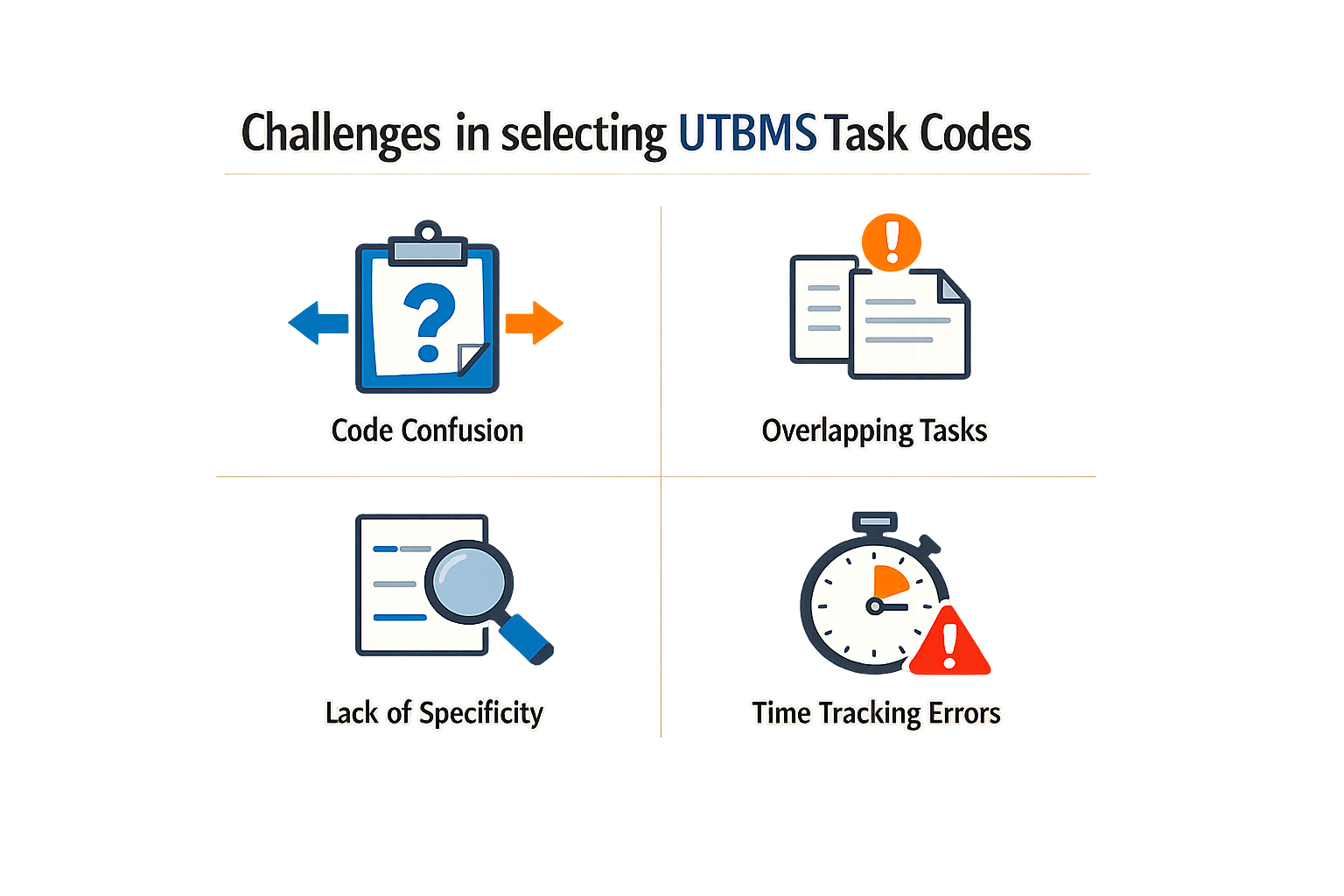
The UTBMS task code field sits in every LEDES invoice line, but choosing the right code is harder than it looks. Task codes describe the service by area of law at a granular level, rolling up to broader phases within that practice area. When a timekeeper enters "research case law on summary judgment standard," the billing professional must decide whether that maps to legal research, motion practice, or case assessment — and different carriers read the same entry differently.
Most rejection notices do not cite the task code by name. Instead, they flag the narrative or the activity code, and the task code mismatch surfaces only when counsel appeals the reduction. A line coded to L320 (depositions) that describes drafting an expert report will draw a reduction even if the activity code is correct, because the task and the narrative do not align. The reviewer assumes the task code is wrong, or the narrative is wrong, or both — and reduces the entry rather than asking for clarification.
The Granularity Mismatch
Clients split on how granular they want the coding. Some carriers require task codes for every line; others accept phase codes and ignore the task field entirely. The UTBMS specification includes both, but outside counsel guidelines rarely state which level the carrier expects. When the guideline is silent, billing staff default to task codes because the e-billing portal requires a value in that field — but the bill reviewer may be reading only the phase, leaving the task code effort wasted and the narrative under-supported.
Activity codes add a second layer. They identify the specific action — writing, speaking, researching — but not every client requires them. When a carrier's portal accepts activity codes but the guideline does not mention them, billers face a choice: populate the field and risk a reduction for over-coding, or leave it blank and risk a validation error. The safer path is to check the carrier's sample LEDES file or prior accepted invoices, but many firms do not retain those records in a searchable form.
Common Coding Errors and Their Triggers
Certain task codes attract reductions more often than others. Travel time, intra-office conferences, and administrative tasks appear in the UTBMS code set, but many guidelines prohibit billing them at all. A line coded to A101 (administrative) will survive the portal validation and fail the human review, because the code exists in UTBMS but the guideline disallows the activity. The task code is technically correct and substantively unacceptable at the same time.
For more on how block billing intersects with task code selection and narrative sufficiency, see the discussion of guideline prohibitions and reduction codes. Block billing compounds the task code problem: when one line describes three distinct activities, the single task code cannot represent all three, and the reviewer reduces the entry or asks for a breakdown the timekeeper can no longer reconstruct.
The task code is technically correct and substantively unacceptable at the same time.
Another frequent error is coding a conference or communication to the subject matter rather than the activity. A call with opposing counsel about a motion in limine might be coded to L330 (motions) when it should be E120 (conferences with opposing counsel). The narrative supports the motion work, but the task code describes the vehicle, not the substance. Different reviewers resolve this differently, and the lack of a uniform standard means the same entry can pass at one carrier and fail at another.
Mismatches between the task code and the timekeeper's role also trigger scrutiny. A partner coded to C100 (case assessment) who bills 8.5 hours in a single day will draw a reduction on the assumption that assessment is a junior-lawyer task or that the time is inflated. The task code is correct for the work described, but the staffing pattern makes the line incredible. The reviewer reduces it, and the appeal requires both a task-code justification and a staffing explanation — two separate arguments the firm must document and defend.
Steps to Select the Right UTBMS Task Code
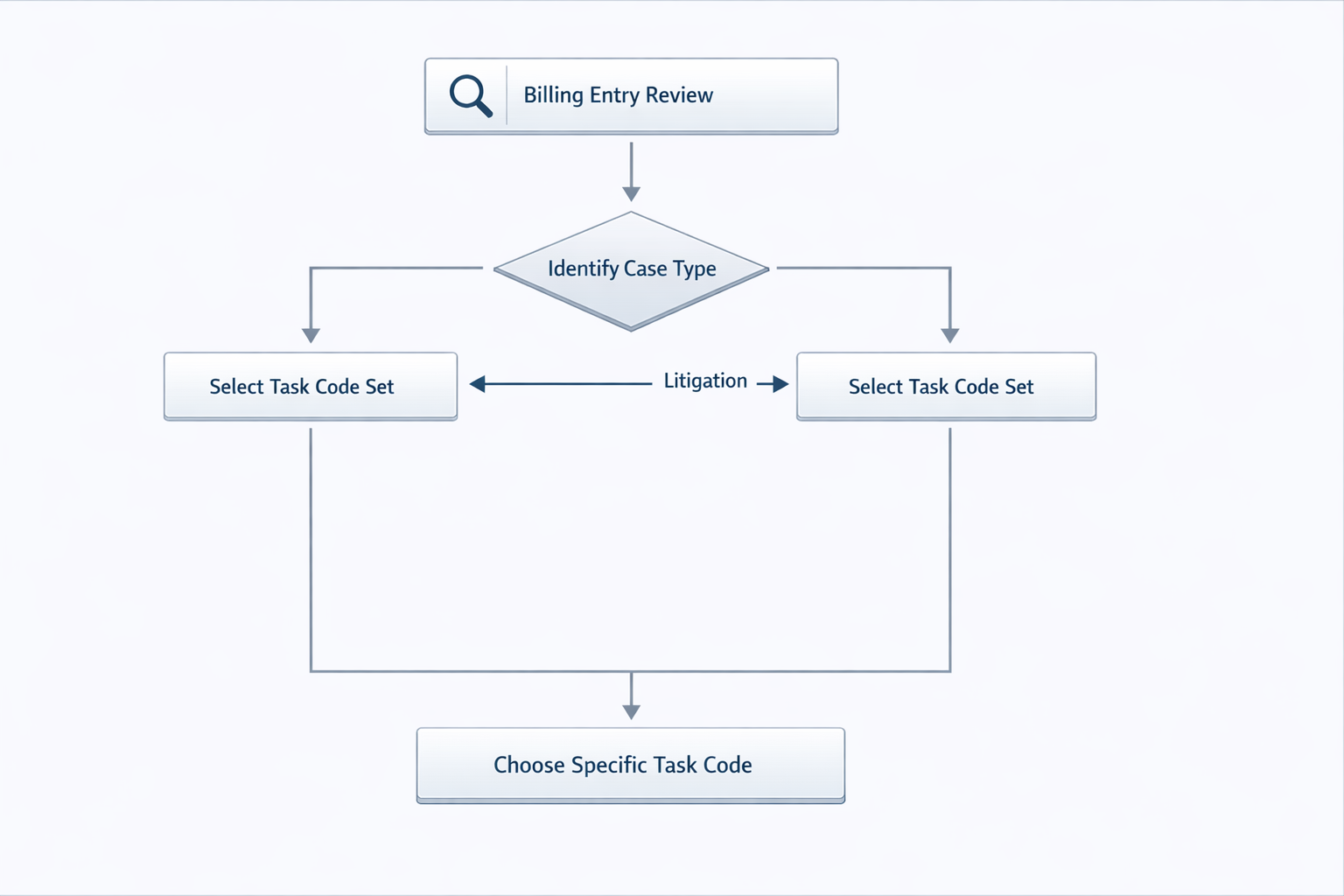
Selecting the correct UTBMS task code for each billing entry is not a guessing exercise. It requires reading what the timekeeper actually did, matching that work to the code definitions, and confirming the carrier's guideline permits the code in the first place. The steps below walk through that process in the order a biller should follow when coding a line item.
Step 1
Read the narrative and identify the primary activity
Start with the timekeeper's narrative. The primary activity is the verb that consumed the bulk of the time: drafted, reviewed, researched, attended, conferred. If the narrative reads "reviewed complaint and drafted answer," the primary activity is drafting — the review was preparatory. Code L110 (Pleadings) applies, not L120 (Discovery). If the narrative lists three equal activities with no dominant verb, the entry is block-billed and must be split before you can assign a code.
Step 2
Match the activity to the UTBMS task code hierarchy
UTBMS task codes are organized by phase of litigation and type of work. Case assessment and pre-litigation investigation fall under A (Case Assessment, Development and Administration). Pleadings are L110. Discovery is L200-series. Motions are L300-series. Trial is L500. Post-trial and appeal are L600. Administrative tasks — docketing, file organization, billing — are A100-series. Match the primary activity identified in Step 1 to the code whose published definition covers that work. Do not assign a litigation code to administrative work or vice versa.
Step 3
Consult the carrier guideline for prohibited or restricted codes
Some carriers restrict or prohibit specific UTBMS task codes. Before finalizing the code, check the outside counsel guideline that governs the matter. If the guideline states that intra-office conferences (A103) require pre-approval above a threshold, and the entry exceeds that threshold without approval, the code triggers a rejection. If the guideline prohibits travel time as a separate line item, do not use A101 for travel — absorb the time into the substantive code or write it off. The code must be both technically correct and guideline-compliant.
Step 4
Pair the task code with the appropriate activity code
UTBMS task codes describe what phase of the case the work belongs to. Activity codes (the A101–A199 series within the UTBMS activity code set) describe the nature of the work: plan, strategize, draft, review, organize. A single task code pairs with multiple possible activity codes. For example, L110 (Pleadings) can pair with A102 (plan and prepare), A104 (draft pleading), or A105 (review pleading). Choose the activity code that matches the verb in the narrative. This pairing appears in the LEDES file's TASK_CODE and ACTIVITY_CODE fields and gives the bill reviewer a two-dimensional view of the entry. For more detail on activity code definitions, see UTBMS Activity Codes A101-A111 for Legal Billing.
Step 5
Verify the code against the LEDES file format requirements
The LEDES 1998B file format expects UTBMS task codes in a specific field and enforces a character limit. Task codes are alphanumeric strings, typically four to six characters (for example, L110, A101). The TASK_CODE field in LEDES 1998B is a text field; the code must match the published UTBMS set exactly, with no trailing spaces, no punctuation, and no invented codes. If your billing system auto-populates a code that does not appear in the UTBMS task code list, the e-billing portal will reject the file at validation. Confirm the code exists in the current UTBMS specification before submitting.
Choosing the Right Code Reduces Rejections
Following these steps in order — narrative first, code second, guideline third — aligns the invoice with both the UTBMS standard and the carrier's expectations. Skipping Step 3 is the most common source of avoidable rejections: a code that is technically correct under UTBMS but prohibited by the guideline still triggers a reduction. Skipping Step 1 and coding from memory leads to mismatches between the narrative and the code, which bill reviewers flag immediately.
Tips and Tricks for Effective UTBMS Task Code Selection

Accurate UTBMS task code assignment is not a matter of guesswork. It requires attention to the client's stated preferences, the actual work performed, and the granularity the billing system expects. The difference between a clean submission and a rejected invoice often comes down to whether the timekeeper chose the code that matches what the guideline anticipates.
Read the Client's Outside Counsel Guidelines First
Before assigning a single task code, obtain and read the carrier's outside counsel guidelines in full. Some clients require granular task codes that describe the specific activity — drafting a motion, reviewing discovery, attending a deposition. Others prefer less-granular phase codes that group related work into broader categories such as pleadings, discovery, or trial preparation. The published UTBMS specification supports both approaches, but the client determines which level of detail the invoice must reflect.
Look to your client for information on how they want services classified. A guideline that specifies task-code-level detail expects every line item to carry a task code, not a phase code. A guideline that accepts phase codes may reject an invoice submitted with task codes the system does not recognize. The controlling document is the guideline, not the timekeeper's preference or the firm's default configuration.
Match the Code to the Work Actually Performed
Task codes are a granular description of the service provided by area of law. The code must reflect what the timekeeper did, not what the matter involves or what the client cares about most. A line item reading "legal research" with task code L310 (depositions) is a mismatch that invites a reduction or a request for clarification. The correct code for legal research is L320 (legal research), regardless of whether the research supports a deposition, a motion, or a brief.
When the work spans multiple activities — for example, research followed by drafting — split the entry into two line items with distinct task codes, or choose the code that describes the predominant activity and ensure the narrative makes the scope clear. Do not use a single task code to cover unrelated activities in one block; that practice is block billing, and most carrier guidelines prohibit it. For more on how carriers treat combined activities, see Block Billing: Reasons for Carrier Rejections and Solutions.
Use Activity Codes to Add Precision
UTBMS task codes describe the type of work; activity codes describe how the work was done. Task code L310 indicates deposition work; activity code A101 (plan and prepare) or A102 (draft) narrows that to deposition preparation or deposition outline drafting. Not every e-billing system requires activity codes, but when the client's guideline or portal does require them, the combination of task and activity code eliminates ambiguity and reduces the likelihood of a reviewer questioning the entry.
Activity codes are not optional decoration. They are part of the UTBMS standard, and they carry semantic weight. An entry coded L310 with activity code A103 (revise) tells the reviewer that the timekeeper revised deposition materials, not that the timekeeper attended the deposition (which would be A105, attend). The distinction matters when the guideline sets different approval thresholds or staffing rules for preparation versus attendance.
The code must reflect what the timekeeper did, not what the matter involves or what the client cares about most.
Keep a Reference Chart at Hand
Maintain a reference chart that lists the task codes the firm uses most often, the corresponding activity codes, and examples of line-item narratives that pair correctly with each code. Update the chart when a client guideline specifies a non-standard code or when a portal rejection identifies a mismatch the firm had not previously encountered. The chart is not a substitute for reading the guideline, but it reduces the cognitive load on timekeepers entering fees in real time and it ensures consistency across multiple matters for the same client.
The chart should include at least the task code number, the task code description from the UTBMS specification, the phase the code rolls up to, and one or two sample narratives. For example: L320 (legal research), rolls up to Discovery phase, sample narrative "research motion to compel standard, 1.5" or "research statute of limitations issue, 0.8." The timekeeper can then match the actual work to the sample and confirm the code fits before submitting the entry.
Conclusion
Choosing the right UTBMS task codes is not a clerical afterthought — it is a structural decision that determines whether an invoice clears the e-billing portal, survives bill review, and gets paid without reduction. A single misapplied code can flag an entire entry for write-down, trigger a demand for re-submission, or place the timekeeper's narrative under heightened scrutiny. Clear and consistent billing, built on accurate task code selection, protects both the firm's revenue and the client relationship.
Through our research into published carrier guidelines, we've observed that certain entries — travel, intra-office conferences, and administrative tasks — are frequently flagged for reductions or rejections when paired with the wrong task code. Reading several carriers' guidelines side by side, like Hartford's and Sompo's, reveals that block billing is treated differently across carriers, which directly influences how task codes should be applied. These patterns underscore the importance of choosing the right task code to avoid unnecessary billing disputes.
The mechanics are straightforward: read the controlling guideline, match the work performed to the task code definition, confirm that the activity code and narrative align, and verify the pairing before submission. When a line item is reduced or rejected, the appeal path begins with the task code — reviewers look first at whether the code accurately describes the work, then at whether the work itself was necessary. A well-chosen code supports both questions.
For firms that bill multiple carriers or handle high-volume defense work, task code accuracy is an operational requirement, not a best practice. It reduces rejection rates, shortens the billing cycle, and minimizes the administrative cost of appeals and re-submissions. Invest the time to train timekeepers on the UTBMS structure, maintain a reference guide that maps common activities to their correct codes, and review invoices for code consistency before they leave the firm. The return on that investment is measurable: fewer reductions, faster payment, and a reputation for billing clarity that meets carrier expectations.