


Billable Hours Calculator: 6-Minute & 15-Minute Increments
Top takeaways
- A billable hours calculator converts minutes worked into decimal hours using standardized increments, most commonly tenths of an hour
- Federal courts and many carriers require time to be reported in tenths, where 1–6 minutes equals 0.1 hours and 55–60 minutes equals 1.0 hours
- Accurate conversion from minutes to decimal hours is essential for e-billing portal submission and compliance with outside counsel guidelines
- Billing increment conventions vary by jurisdiction and client; some use six-minute increments, others use fifteen-minute increments
- Understanding the conversion chart prevents invoice rejections and write-downs during bill review
Introduction
What a Billable Hours Calculator Does
A billable hours calculator converts the minutes a timekeeper spends on a task into the decimal-hour format required by most e-billing portals and outside counsel guidelines. Time for work spent performing a service should be reported in tenths of an hour, and compensation is calculated by multiplying the applicable rate per hour by the total number of hours. The Northern District of California's Criminal Justice Act billing instructions state this requirement explicitly, and the same tenth-of-an-hour standard appears in carrier panel guidelines across insurance defense billing.
The conversion is mechanical. One to six minutes rounds to 0.1 hours. Seven to twelve minutes rounds to 0.2 hours. The pattern continues in six-minute bands until fifty-five to sixty minutes, which rounds to 1.0 hours. A timekeeper who drafts a letter for eighteen minutes records 0.3 hours; a thirty-minute telephone conference records 0.5 hours. The Central District of California's CJA Panel Manual requires that time spent must be billed to the nearest tenth of an hour, and most LEDES 1998B file format submissions enforce the same rule in the HOURS field.
Why Billing Increments Matter
Before standardized time codes and electronic invoicing, paper bills often presented services in narrative paragraphs that ran for multiple pages, making it virtually impossible to digest the work performed on a single day. The shift to structured billing and decimal hours gave carriers and corporate clients a consistent way to compare timekeepers, evaluate staffing ratios and identify block billing. A billable hours calculator enforces that consistency at the point of entry, before the invoice reaches the e-billing portal.
Increment conventions are not universal. Six-minute increments—tenths of an hour—are the federal-court and carrier-guideline standard. Fifteen-minute increments, where any work under fifteen minutes rounds to 0.25 hours, appear in some firm policies and state-court fee applications, but they are uncommon in insurance defense billing. When a guideline specifies tenths and a timekeeper submits quarters, the portal flags the line item and the bill reviewer applies a reduction code. The calculator eliminates that mismatch by applying the client's required increment from the start.
Problem Statement
In the mid-1990s, major US law departments and insurers sought to better understand the services provided by outside counsel. Paper bills presented information in a manner that was virtually impossible to digest — it was not uncommon for a bill to include a description of services performed by a timekeeper on a single day that ran for multiple paragraphs or pages. That opacity created two enduring problems: carriers could not verify what they were paying for, and firms could not demonstrate the value they delivered.
The shift to electronic billing and structured time entries did not eliminate the underlying challenge. Law firms still face difficulty calculating billable hours accurately when timekeepers record work in uneven increments, round inconsistently, or fail to match the increment standard specified in the outside counsel guideline. A firm that bills in quarter-hour blocks when the carrier requires tenth-of-an-hour precision will trigger automatic rejections in the e-billing portal, even if the substantive work is defensible.
Misalignment Between Billing Increment and Carrier Requirement
Carriers segment legal spend by phase — pre-suit, discovery, ADR, trial — and by attorney role to understand cost drivers and compare matter economics across their panel. When a firm submits time entries that do not conform to the carrier's billing increment standard, the line items cannot be aggregated cleanly, and the bill review team cannot distinguish whether a 0.3-hour entry represents eighteen minutes of work or a rounded quarter-hour. That ambiguity invites reduction codes and write-downs, which the firm must then appeal with contemporaneous records that may no longer exist.
The breakdown of billing by attorney role also matters. If a partner records 0.5 hours for a task that a senior associate could perform, and the guideline prohibits partner time on that UTBMS task code, the reviewer will reduce the entry regardless of whether the time calculation itself is arithmetically correct. The block billing problem — multiple tasks lumped into one narrative — compounds the increment problem, because the reviewer cannot tell which portion of a 2.7-hour block corresponds to which task, and therefore cannot verify that each task was billed at the approved rate and increment.
The Cost of Incorrect Billing Practices
Incorrect billing practices impose costs on both sides. Firms experience delayed payment, increased administrative burden responding to reduction notices, and erosion of panel standing when rejection rates climb. Carriers pay for bill review labor that could be avoided if invoices arrived clean the first time, and they lose confidence in firms that cannot demonstrate billing discipline. The percentage of legal billing attributable to expenses versus billable hours becomes harder to track when time entries are inconsistent, and portfolio-level litigation arrangements — which depend on predictable cost data — become unworkable.
Alternative fee arrangements and non-hourly billing proposals have gained traction in part because the billable hour, when calculated inconsistently, is misaligned with the transparency that clients now expect. A firm that cannot produce a defensible billable hours calculation in tenth-of-an-hour increments will struggle to negotiate any fee structure that relies on accurate time records as a backstop or reconciliation mechanism.
Solution Steps
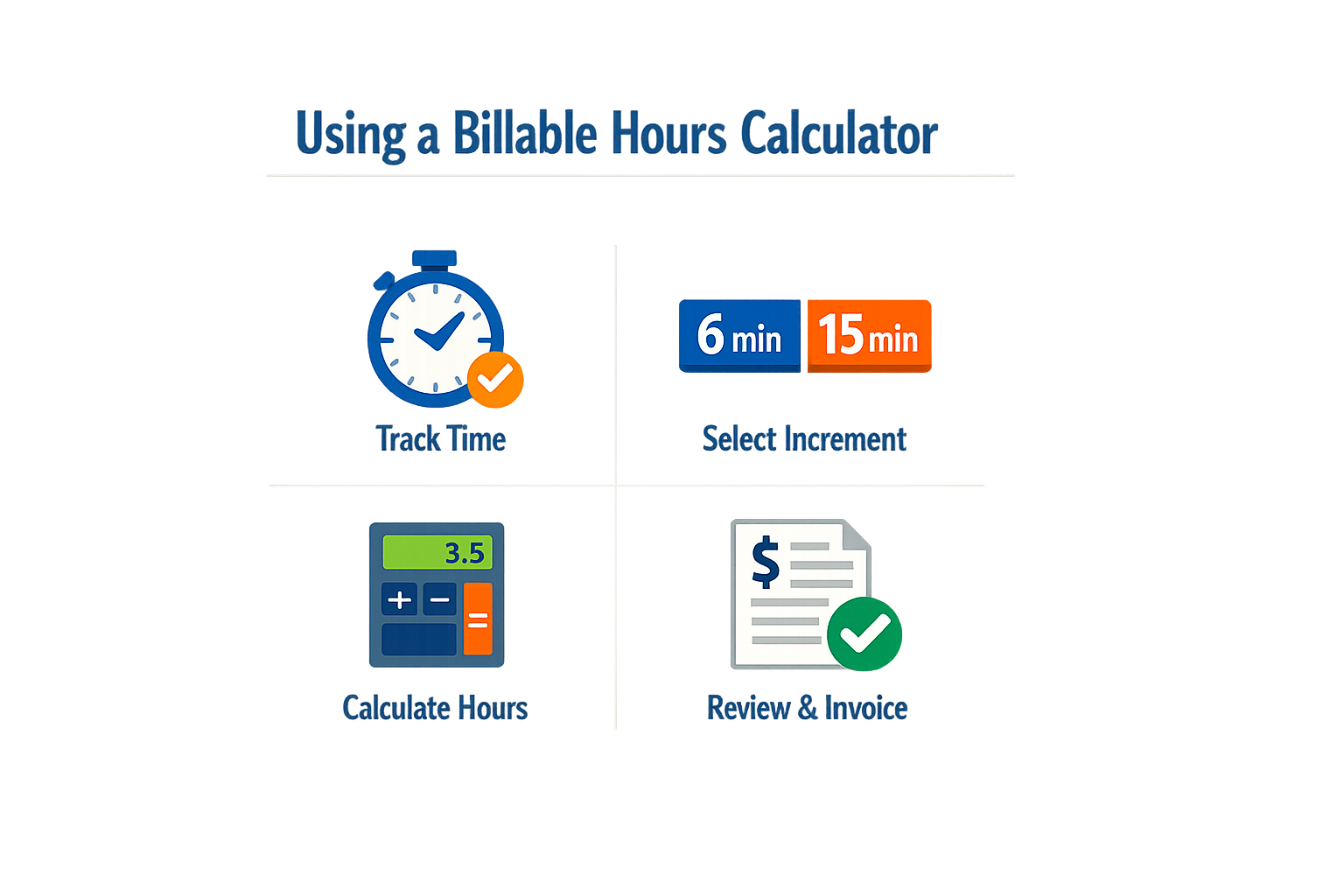
A billable hours calculator translates clock time into the billing increment your matter requires. Most outside counsel guidelines and court-appointed fee vouchers specify tenth-of-an-hour increments, which means every task rounds to a six-minute block. Some firms still bill in quarter-hour increments, though that practice is increasingly disfavored by carriers and courts. The steps below show how to convert actual minutes into compliant billing entries using either standard.
Step 1: Record the Actual Minutes Worked
Capture the start and stop time for each discrete task. If you spent nineteen minutes reviewing a motion, write down nineteen minutes — not "about twenty" and not "a quarter hour." Contemporaneous records matter when a bill reviewer or auditor questions the entry later. The LEDES 1998B file format requires hours in decimal form, so converting minutes accurately at the point of entry reduces downstream rejection risk.
Step 1
Capture start and stop times
Log the clock time for each task as you finish it. Waiting until the end of the day or the end of the week invites rounding errors and makes it harder to justify the increment you ultimately bill.
Step 2: Apply the Conversion Chart for Tenth-of-an-Hour Increments
Tenth-of-an-hour billing divides each hour into ten six-minute blocks. The Northern District of California Criminal Justice Act billing chart and the Florida Justice Administrative Commission chart both publish the same conversion table: 1–6 minutes rounds to 0.1 hour, 7–12 minutes to 0.2, 13–18 to 0.3, and so on through 55–60 minutes equaling 1.0 hour. If your task took nineteen minutes, the chart assigns 0.4 hours (the 19–24 minute band). If it took six minutes, you bill 0.1.
| Minutes Worked | Tenth-of-Hour Increment |
|---|---|
| 1–6 | 0.1 |
| 7–12 | 0.2 |
| 13–18 | 0.3 |
| 19–24 | 0.4 |
| 25–30 | 0.5 |
| 31–36 | 0.6 |
| 37–42 | 0.7 |
| 43–48 | 0.8 |
| 49–54 | 0.9 |
| 55–60 | 1.0 |
Step 2
Find your minute band
Locate the range that contains your actual minutes, then read across to the decimal value. That decimal is what you enter in your time-keeping system and what appears in the LEDES hours field.
Step 3: Apply the Conversion for Quarter-Hour Increments
Quarter-hour billing rounds every task to the nearest fifteen-minute block: 0.25, 0.50, 0.75 or 1.0 hour. A task that takes eight minutes rounds up to 0.25 (fifteen minutes), and a task that takes sixteen minutes also rounds to 0.25. This method inflates short tasks and can trigger block-billing scrutiny when multiple small entries appear on one line. Most carrier guidelines now prohibit quarter-hour rounding or explicitly require tenth-of-an-hour precision, so confirm your matter's billing standard before you apply this step.
Step 4: Multiply the Increment by the Timekeeper Rate
Once you have the decimal hours, multiply by the timekeeper's hourly rate to produce the line-item fee. A partner billing at $450 per hour who worked 0.4 hours generates a $180.00 line item. A paralegal at $150 per hour working 0.2 hours generates $30.00. The calculation is straightforward, but the increment you choose in step two or three controls the result — a quarter-hour system would have billed 0.25 hours ($112.50) for an eight-minute task, where a tenth-of-an-hour system bills 0.2 hours ($90.00) for the same work.
Step 3
Calculate the line-item fee
Decimal hours × hourly rate = line-item amount. Record this amount in your time entry, and ensure the narrative, UTBMS task and activity codes, and date fields are complete before you submit the entry to the billing system.
Step 5: Aggregate and Validate Before Submission
Sum the line items for each timekeeper, confirm that the total matches the matter budget or pre-approval threshold, and validate that every entry carries a compliant narrative and the correct increment. E-billing portals parse the hours field in the LEDES file and flag any value that does not align with the carrier's increment rule. A single line billed at 0.27 hours will fail validation if the portal expects tenth-of-an-hour precision, because 0.27 does not appear in the standard conversion chart.
Tips and Tricks
A billable hours calculator eliminates arithmetic mistakes, but the tool is only as reliable as the data entered. One misplaced decimal or a forgotten increment convention sends the wrong figure into the LEDES file, and the e-billing portal flags the line item before the reviewer even sees it. The Northern District of California's Criminal Justice Act instructions state that time must be reported in tenths of an hour, and compensation is calculated by multiplying the applicable rate by the total number of hours — which means the rounding step happens before the multiplication, not after.
Verify the Increment Convention Before You Start
Some carriers and court systems specify six-minute increments; others permit quarter-hour rounding. The conversion chart published by the Northern District of California shows that 1–6 minutes round to 0.1 hours, 7–12 minutes to 0.2, and so on through 55–60 minutes at 1.0 hours. A quarter-hour system would round 1–15 minutes to 0.25 hours, which produces a materially different total when applied to dozens of entries. Check the outside counsel guidelines or the court's billing manual before you configure the calculator, and confirm that every timekeeper on the matter uses the same increment. When the guideline is silent, tenth-of-an-hour is the safer default — most e-billing portals validate against that convention, and a submission that mixes conventions will generate rejection codes faster than any other formatting error.
Record the Actual Minutes, Then Round
Enter the raw minutes worked into the calculator and let the tool perform the conversion. Rounding in your head before you log the time introduces two opportunities for error: you may round incorrectly, and you lose the audit trail that shows the actual duration. The Central District of California's CJA Panel Manual states that time spent must be billed to the nearest tenth of an hour, which means the rounding rule is a requirement, not a suggestion. When a line item shows 0.3 hours and the reviewer questions it, contemporaneous records that show 16 minutes worked support the entry; a timesheet that shows only 0.3 with no underlying minute figure leaves you with nothing to produce on appeal.
Avoid Rounding Every Task Separately in a Block
If you worked three tasks in sequence — 4 minutes, 5 minutes, and 3 minutes — rounding each one separately produces 0.1 + 0.1 + 0.1 = 0.3 hours. Adding the minutes first gives 12 minutes, which rounds to 0.2 hours. The first approach inflates the total by 50 percent. The safer practice is to log each task with its actual duration, sum the minutes for related work, then apply the increment conversion to the total. This approach also reduces block billing exposure: three separate entries with separate task codes and narratives survive guideline scrutiny better than one combined entry, and the math stays honest.
A calculator that rounds before it sums will produce a different total than one that sums before it rounds — and only one of those totals matches the court's conversion chart.
Conclusion
Accurate time tracking in tenths or quarters of an hour is not optional for panel counsel — it is a threshold requirement that determines whether an invoice clears the submission gate or lands in the rejection queue. The difference between "research motion, 4.2" and a compliant line-item narrative is the difference between payment and a reduction code that takes thirty days to appeal.
Legal spend segmented by phase — pre-suit, discovery, ADR, trial — reveals where billable hours concentrate and where staffing ratios drift out of alignment with carrier expectations. When a bill reviewer sees discovery hours balloon without corresponding activity codes, the invoice triggers scrutiny that a calculator alone cannot prevent. The increment is a formatting convention; the narrative and the code are the substance.
Traditional hourly billing continues to face scrutiny over whether it aligns law firm and client interests, but as long as carriers require LEDES 1998B files with UTBMS task and activity codes, the mechanics of the billable hours calculator remain the operational reality. Firms that treat the increment as a rounding exercise rather than a contemporaneous-records discipline will see the pattern in their reduction codes and appeal logs. The calculator is a tool; the guideline is the rulebook.
No software, spreadsheet or time-entry system eliminates the requirement to record what you did, when you did it, and which UTBMS code describes it. The tenth-of-an-hour convention exists to enforce that discipline at the line-item level, and the carriers that publish outside counsel guidelines enforce it at the invoice level. The firms that survive bill review are the ones whose timekeepers understand that the calculator is the last step, not the first.