


Attorney Billing Increments: 0.1 vs. 0.25 and What Carriers Require
Top takeaways
- Billing increments determine the minimum unit of time an attorney can charge, with 0.1 (six minutes) and 0.25 (fifteen minutes) being the most common standards
- Carrier outside counsel guidelines often specify required billing increments, and submitting invoices with non-compliant increments triggers rejections at the e-billing portal
- The Central District of California CJA Panel Manual requires time to be billed to the nearest tenth of an hour, illustrating how court and carrier rules converge on this standard
- Understanding which increment a guideline requires—and applying it consistently across all line items—is essential to avoid write-downs and appeal cycles
- Contemporaneous time records must support whatever increment you bill, regardless of whether the standard is 0.1 or 0.25
Introduction
Attorney billing increments are the smallest unit of time you can charge for legal services. The choice between 0.1 and 0.25 hour increments is not a matter of firm preference—it is a compliance requirement. A single line item rounded to 0.25 when the guideline mandates 0.1 can result in a reduction code, a portal rejection, or both.
Billing increments are governed by the controlling guideline for each matter. The Central District of California CJA Panel Manual states plainly that "time spent must be billed to the nearest tenth of an hour." While that rule governs Criminal Justice Act appointments, the same tenth-of-an-hour standard appears in carrier outside counsel guidelines across the insurance defense and corporate panel landscapes. When a guideline specifies an increment, that specification is binding on every timekeeper, every task, and every invoice submitted under that engagement.
The 0.1 increment—six minutes—allows finer granularity and reduces the risk of overbilling for short tasks. A two-minute email becomes 0.1 hours, not 0.25. The 0.25 increment—fifteen minutes—simplifies mental arithmetic but inflates small entries and invites scrutiny when the narrative does not justify a quarter-hour. Carriers that publish guidelines generally prefer or require the smaller increment, and block billing compounds the problem when combined with coarse rounding.
Compliance begins with reading the controlling document. Different carriers have specific requirements regarding billing increments—some prefer 0.1 hour increments for their precision, while others might accept 0.25 hour increments for simplicity. By comparing guidelines from different carriers side by side, we can identify which carriers have specific preferences or requirements and understand the broader landscape of billing practices. It is important to note that these guidelines are not legal advice but serve as a framework for understanding what carriers require in terms of billing increments.
What Problems Do Attorney Billing Increments Cause?
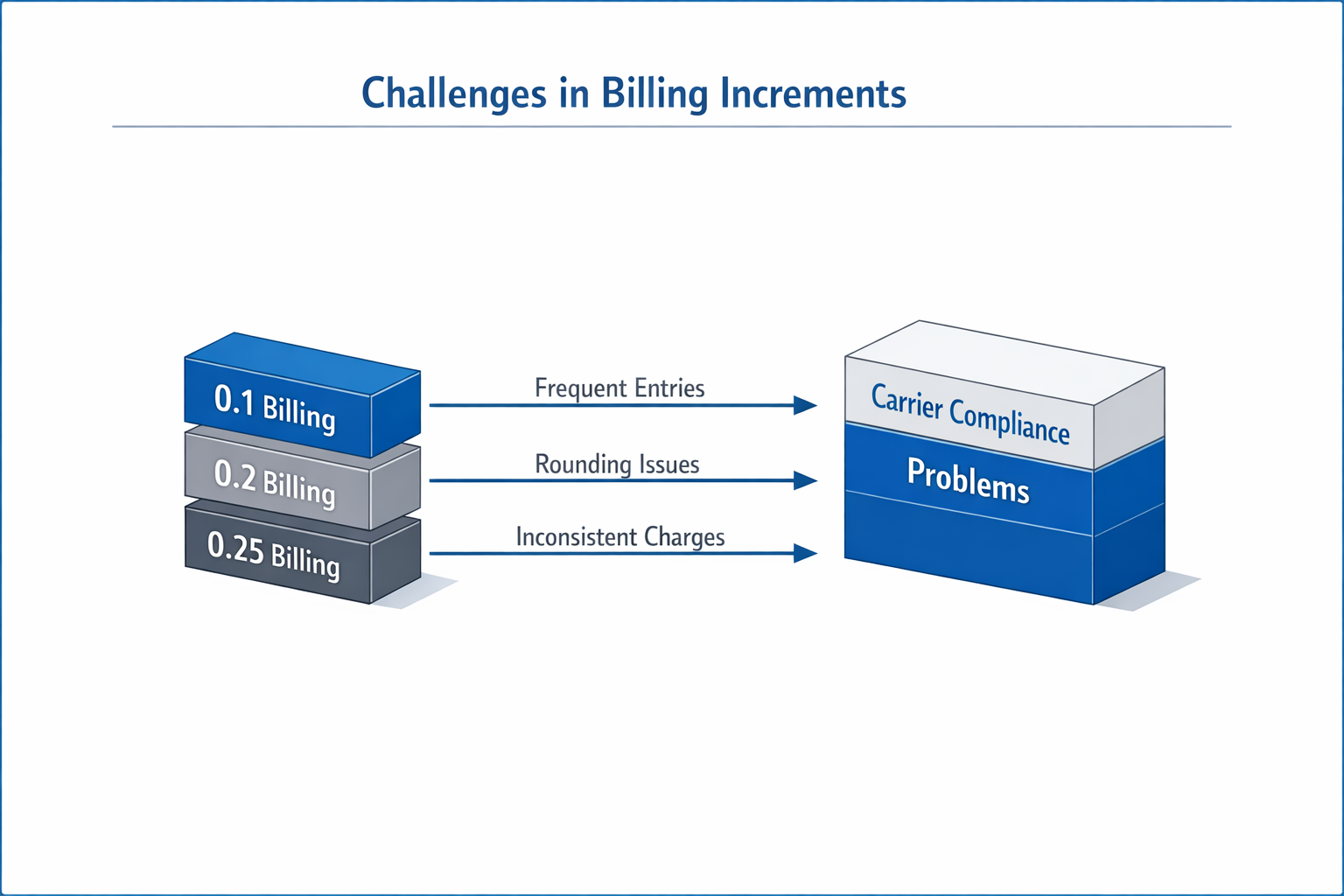
Attorneys billing for legal services encounter immediate friction when their time-entry conventions clash with the requirements published by carriers, courts, and e-billing platforms. The choice between tenth-of-an-hour and quarter-hour increments is not a matter of preference—it is a compliance question with direct consequences for invoice acceptance and payment.
Increment Mismatch and Rejection Risk
When a guideline mandates tenth-of-an-hour billing and an attorney rounds a seven-minute task to 0.25 hours, the line item overstates the time by eight minutes. Multiply that rounding error across dozens of entries, and the invoice total diverges measurably from the work performed. Bill reviewers flag these discrepancies, and e-billing portals programmed to enforce increment rules reject the submission outright.
The Central District of California's CJA Panel Manual states at page 13 that "time spent must be billed to the nearest tenth of an hour." That language leaves no room for quarter-hour rounding in CJA matters within that district. An attorney who submits 0.25-hour entries for a CJA appointment in the Central District triggers a reduction or a request for re-submission, delaying payment and requiring administrative correction.
Contemporaneous Records and Audit Exposure
Carrier guidelines and court rules frequently require contemporaneous time records. When an attorney's internal timekeeping system captures time in six-minute units but the final invoice rounds those entries to fifteen-minute blocks, the supporting documentation no longer matches the billed amount. During an audit or fee dispute, the attorney must reconcile the discrepancy or accept a write-down to the contemporaneous figure.
The C.D. Cal. CJA Panel Manual, at page 13, item 11, provides that attorneys "must maintain contemporaneous time and attendance records and expense records for all work performed," and that "these records are subject to audit and must be maintained for three years after approval of the final voucher." If the contemporaneous record shows 0.3 hours and the invoice shows 0.5 hours due to quarter-hour rounding, the auditor applies the lower figure and the attorney absorbs the difference.
Proration and Multi-Matter Allocation
Attorneys who handle multiple matters simultaneously face additional complexity when prorating time spent in common. A guideline that mandates tenth-of-an-hour billing requires the attorney to divide shared time with corresponding precision. Rounding each matter's share to the nearest quarter-hour before summing the totals can produce an aggregate that exceeds the actual time spent, violating the rule that total billed time for a day cannot exceed the hours worked.
The C.D. Cal. CJA Panel Manual, at page 13, item 6, states that an attorney "must not prorate time in such a way that you have billed a larger amount than you would have billed if all the time was assigned to one representation," and "must not bill for more time in any day than you actually spent performing CJA services for that day." Quarter-hour rounding applied to prorated entries routinely breaches that ceiling, triggering reductions and compliance inquiries.
You must not bill for more time in any day than you actually spent performing CJA services for that day—even if the addition of the time billed to each individual category exceeds the time actually billed on that day.
Carrier-Specific Increment Requirements
Different carriers publish different increment standards, and an attorney who bills multiple carriers must track which guideline governs each matter. A firm that defaults to quarter-hour billing for all clients will generate non-compliant invoices for every carrier that requires tenth-of-an-hour precision. The resulting rejections, appeals, and re-submissions consume administrative resources and delay revenue recognition.
For more detail on how block billing intersects with increment compliance, see Block Billing: Reasons for Carrier Rejections and Solutions.
When an attorney lacks visibility into the increment requirement before submitting the invoice, the first notice of non-compliance arrives as a rejection code or a unilateral reduction. Recovering the written-down amount requires an appeal supported by contemporaneous records that demonstrate the actual time spent, a process that many carriers limit to a narrow window and a single round of review.
How Do You Bill in Compliant Attorney Billing Increments?
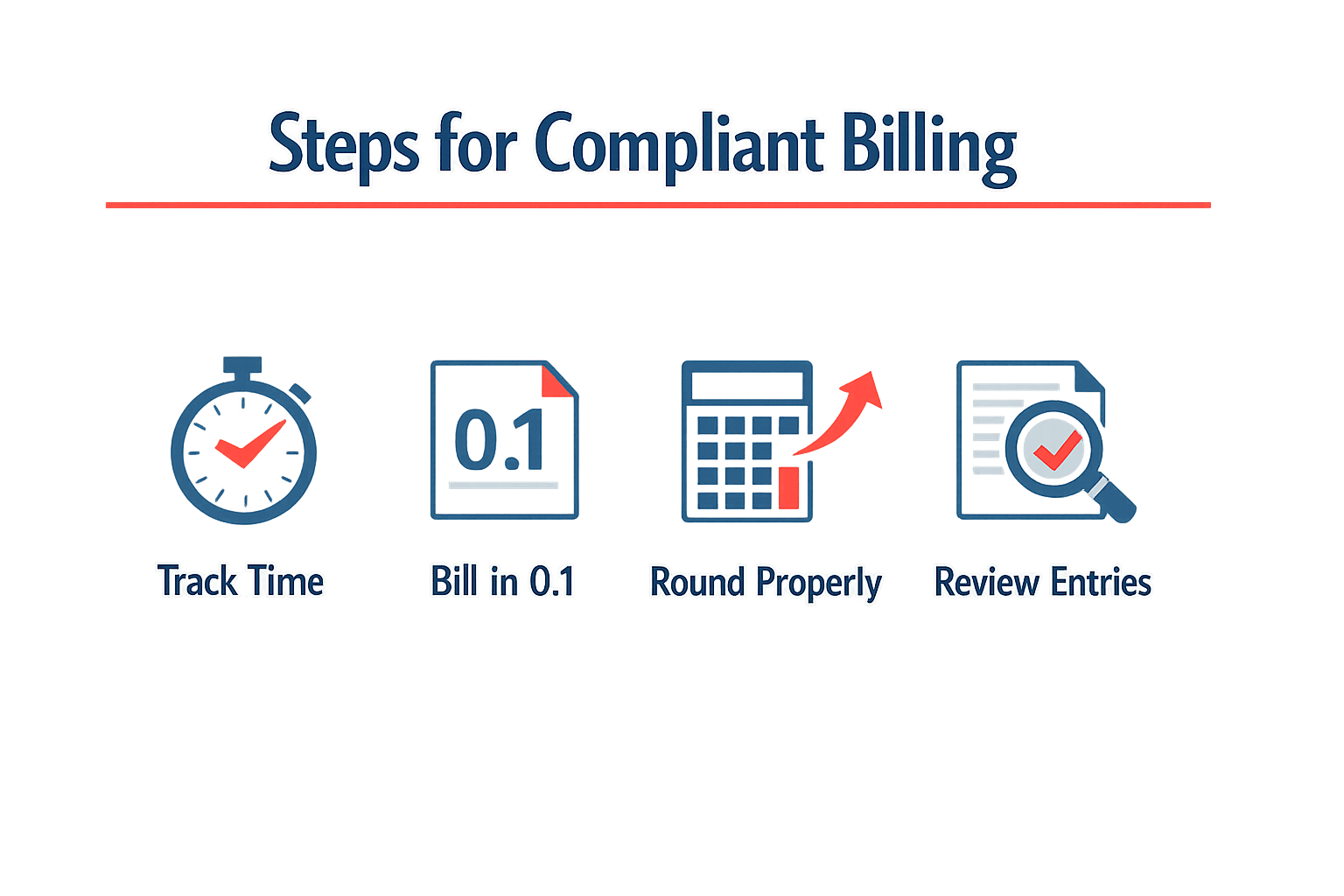
Compliance with billing increment requirements begins with knowing which standard applies to the matter at hand. Attorneys working under court appointment programs, such as the Criminal Justice Act panel in the Central District of California, face explicit rules. The C.D. Cal. CJA Panel Manual states at page 13, list item 7, that "[t]ime spent must be billed to the nearest tenth of an hour." That is a 0.1 increment mandate, not a suggestion. Carriers with published outside counsel guidelines often impose the same standard, though some remain silent and a few permit 0.25 increments. Where the controlling document does not specify an increment, the safest practice is to bill in tenths.
Step 1
Locate and read the controlling guideline
Before submitting any invoice, identify the document that governs billing for that representation. For court appointments, consult the relevant district's CJA manual or local rule. For insurance defense and panel work, obtain the carrier's current outside counsel guidelines and note the version number and effective date. If the guideline is silent on increments, assume tenth-of-an-hour billing unless you have written confirmation that a larger increment is acceptable.
Step 2
Configure timekeeping systems to enforce the increment
Set your time and billing software to round or capture time in the increment the guideline requires. Most systems allow you to choose 0.1, 0.25, or other intervals. Selecting the correct increment at the point of entry prevents rounding errors and ensures that every line item on the invoice matches the standard. If you track time manually or in a spreadsheet, apply the same rounding discipline before transferring entries to a LEDES 1998B file or other submission format.
Step 3
Maintain contemporaneous records
The C.D. Cal. CJA Panel Manual requires at page 13, list item 11, that attorneys "maintain contemporaneous time and attendance records and expense records for all work performed." Those records are subject to audit and must be kept for three years after approval of the final voucher. The same principle applies to carrier work: if a bill reviewer or auditor asks how a 0.3 entry was derived, contemporaneous notes—not reconstructed estimates—provide the answer. Record the actual start and end time for each task, then round to the required increment when preparing the invoice.
Step 4
Prorate time spent on multiple matters
When a single block of time benefits more than one client or case, the CJA manual at page 12, list item 3, requires that you "prorate any time spent in common on two or more cases, and must cross-reference all cases on the supporting materials to the vouchers." The same logic applies to carrier billing: if you spend 0.6 hours researching an issue common to three files, bill 0.2 to each and note the cross-reference in your records. Never bill the full 0.6 to each matter. Time spent exclusively on one case is charged only to that case, and boilerplate language developed for one client cannot be re-billed in full when reused for another.
Step 5
Verify increment compliance before submission
Before uploading an invoice to an e-billing portal or mailing a voucher to the court, review every line item to confirm that the hours billed appear in the required increment. A single entry reading 0.25 when the guideline requires 0.1 can trigger a rejection or a reduction. Automated validation in some portals will flag increment errors; others pass the invoice to a human reviewer who may reduce or reject the entire submission. Catching the error before submission avoids the delay and administrative burden of an appeal.
Compliance is not a one-time setup. Guidelines change, carriers issue new versions, and courts update local rules. Attorneys who bill multiple carriers or courts must track which increment applies to each matter and configure their systems accordingly. When in doubt, the tenth-of-an-hour standard is the safer choice and aligns with the expectations of most bill reviewers and auditors.
Tips and Tricks for Efficient Billing Practices
Attorneys who maintain contemporaneous time records and bill to the nearest tenth of an hour position themselves for cleaner invoice submissions and fewer reductions. The Central District of California CJA Panel Manual states that time spent must be billed to the nearest tenth of an hour, and that contemporaneous time and attendance records must be maintained for all work performed. These records are subject to audit and must be kept for three years after approval of the final voucher. The same discipline applies to insurance defense billing: carriers expect tenth-of-an-hour precision and contemporaneous entry, not reconstructed narratives weeks later.
Keep Time Records as You Work
Billing from memory at the end of the day or the end of the week produces vague narratives and inflated entries. Record each task as you complete it, note the start and stop times, and round to the nearest tenth. A 7-minute phone call is 0.1 hours, not 0.2 or 0.25. A 23-minute document review is 0.4 hours, not 0.5. Rounding up consistently triggers scrutiny; rounding to the actual increment keeps the invoice defensible.
Avoid Block Billing and Generic Descriptions
A single line reading "research and draft motion, review correspondence, conference with client, 4.8" violates most carrier guidelines and invites reduction. Break each task into its own line with its own increment. "Research motion in limine re prior convictions, 1.2" is a billable entry. "Draft motion in limine re prior convictions, 2.1" is a second entry. "Conference with client re motion strategy, 0.3" is a third. The total may be the same 3.6 hours, but the transparency is night and day. For a detailed explanation of why carriers reject block billing and how to structure compliant entries, see Block Billing: Reasons for Carrier Rejections and Solutions.
Prorate Time Spent on Multiple Matters
When a single activity benefits more than one case, prorate the time and cross-reference the matters in your supporting materials. The C.D. Cal. CJA Panel Manual requires that time spent in common on two or more cases be prorated, and that all cases be cross-referenced on the supporting materials to the vouchers. If you spend 1.5 hours in a hearing that covers three clients, bill 0.5 hours to each client and note the other case numbers in your records. Do not bill 1.5 hours to each client. Do not bill the full 1.5 to one client and zero to the others unless the activity truly benefited only one.
Do Not Bill Secretarial or Administrative Tasks
Time spent on secretarial services, whether performed by the attorney or support staff, is not compensable under most guidelines. The C.D. Cal. CJA Panel Manual states that attorneys may not bill for secretarial services. Filing a document, calendaring a hearing, scanning an exhibit, formatting a table of authorities—these are overhead, not billable time. If a task does not require attorney judgment, do not bill attorney rates for it. Use a paralegal or law clerk for tasks that do not require attorney expertise, and bill those services separately at the appropriate rate.
Track Boilerplate and Do Not Re-Bill It
Time spent researching and drafting boilerplate language—standard sections of sentencing memoranda, recurrent legal arguments, form discovery responses—can be billed to one client. Future use of the same language is not a billable event. The C.D. Cal. CJA Panel Manual makes this explicit: time spent on boilerplate can only be billed to one client, and reusing that language in a later matter is not compensable. Time spent updating the language and tailoring it to the new matter is billable to the new client, but copying and pasting is not.
Bill Only Necessary and Reasonable Travel Time
Travel time is compensable only when it is necessary and reasonable, and only for the actual time spent in transit or awaiting transit. You may not bill for routine travel to the courthouse to file documents or attend a calendar call unless the trip serves a client-related purpose that could not be accomplished by messenger or electronic filing. If you combine a client meeting with a filing errand, bill the client meeting time to that client and do not bill the filing time unless it is equal to or less than the cost of a messenger service.
Maintain Supporting Records for Three Years
Contemporaneous time and expense records must be maintained for three years after approval of the final voucher, per the C.D. Cal. CJA Panel Manual. These records are subject to audit. If you cannot produce a time log, calendar entries, email timestamps, or other contemporaneous documentation when an auditor requests it, the invoice will be reduced or disallowed. Maintain the records in a format that shows the date each entry was created, not just the date of the activity.
Frequently asked questions
What is the difference between 0.1 and 0.25 attorney billing increments?
The 0.1 increment equals six minutes, while the 0.25 increment equals fifteen minutes. A guideline that requires 0.1 billing means you round every task to the nearest tenth of an hour; a guideline that permits 0.25 billing allows you to round to the nearest quarter-hour. The smaller increment reduces overbilling on short tasks but requires more precise timekeeping.
How do I know which attorney billing increment to use?
Read the controlling guideline for the matter. Court appointment manuals, carrier outside counsel guidelines, and engagement letters specify the required increment. If the document is silent, use the 0.1 standard—it is the safer choice and aligns with most carrier expectations.
Can I mix 0.1 and 0.25 attorney billing increments on the same invoice?
No. Mixing increments within a single invoice violates most guidelines and triggers rejection at the e-billing portal. Choose one increment and apply it consistently across all line items for that matter.
What happens if I submit an invoice with the wrong attorney billing increment?
The invoice may be rejected outright by the e-billing portal, or a bill reviewer may reduce the line items to the compliant increment and apply a reduction code. Either outcome delays payment and requires administrative correction.
Do attorney billing increments apply to paralegal and law clerk time?
Yes. The increment requirement applies to all timekeepers on the matter—attorneys, paralegals, law clerks, and any other billable staff. If the guideline mandates 0.1 billing, every timekeeper must bill in tenths.
Conclusion
Attorney billing increments shape every line item that reaches a carrier's desk. The choice between tenth-of-an-hour and quarter-hour increments is not a matter of office preference—it is a compliance question answered by the controlling guideline. When examining attorney billing increments, the choice between 0.1 and 0.25 hour increments determines whether your invoice clears review or triggers a rejection.
Most panel guidelines specify tenth-of-an-hour billing. Where a guideline is silent, the safer path is the finer increment—rounding to the nearest 0.1 rather than 0.25 avoids the appearance of padding and reduces the risk of a reduction code at review. The Central District of California's CJA Panel Manual states plainly that "time spent must be billed to the nearest tenth of an hour," a standard that many carriers echo in their own published requirements.
Compliance begins with reading the guideline that governs the matter. If the carrier publishes a version number and a date, cite that version when you submit. If the guideline prohibits quarter-hour rounding, your timekeeping system must enforce tenth-of-an-hour entries before the first line reaches the LEDES file. Retrofitting an invoice after rejection wastes time and invites scrutiny on every other line.
For a deeper look at how narrative detail and task codes interact with billing increments during portal submission, see our article on E-Billing Portal Invoice Rejections: Common Causes and Fixes. The mechanics of increment compliance, block-billing prohibitions and narrative sufficiency all converge at the validation step—understanding one without the others leaves gaps that bill reviewers will find.
By comparing guidelines from different carriers side by side, we identify which carriers have specific preferences or requirements, and this comparison helps us understand the broader landscape of billing practices and the expectations set forth by carriers. The framework presented here is not legal advice; it is a map of what the controlling documents say and what those words mean for a line item. Read the guideline, bill to the specified increment, and document your time contemporaneously. That discipline is the foundation of every invoice that clears review on the first pass.
For additional guidance on billing standards and compliance, see ABA Model Rule 1.5: Reasonable Attorney Fees & California Rule 1.5 and UTBMS Activity Codes A101-A111 for Legal Billing.