


Attorney Billing Increments: 0.1 vs. 0.25 and Carrier Requirements
Introduction
Attorney billing increments are the smallest unit of time for which an attorney can charge a client — six minutes for a tenth of an hour, fifteen minutes for a quarter hour. When examining attorney billing increments, the choice between 0.1 and 0.25 hour increments often comes under scrutiny. Our team frequently encounters this topic when reviewing carrier outside counsel guidelines. This seemingly minor detail carries significant weight in insurance defense billing, where carriers scrutinize every line item for compliance with published standards.
The increment matters because it determines both the granularity of time tracking and the potential for rounding disputes. An attorney who bills in quarter-hour increments rounds a three-minute phone call to 0.25 hours; the same call billed in tenth-hour increments becomes 0.1 hours. Over hundreds of line items, the difference compounds. Carriers know this, which is why many published guidelines specify an increment requirement explicitly.
For attorneys submitting invoices through e-billing portals, block billing and increment violations are among the most common rejection triggers. A single line entry that aggregates multiple tasks or rounds time inconsistently can flag the entire invoice for manual review or automatic reduction. The Central District of California CJA Panel Manual states plainly: "Time spent must be billed to the nearest tenth of an hour." That language leaves no room for interpretation — it is a hard requirement, not a suggestion.
Different carriers have specific requirements regarding billing increments. By reading several carriers' published guidelines side by side, we can identify which carriers have specific preferences or requirements and understand the broader landscape of billing practices. It is important to note that these guidelines are not legal advice but serve as a framework for understanding what carriers require in terms of billing increments.
What Problems Do Attorney Billing Increments Create?
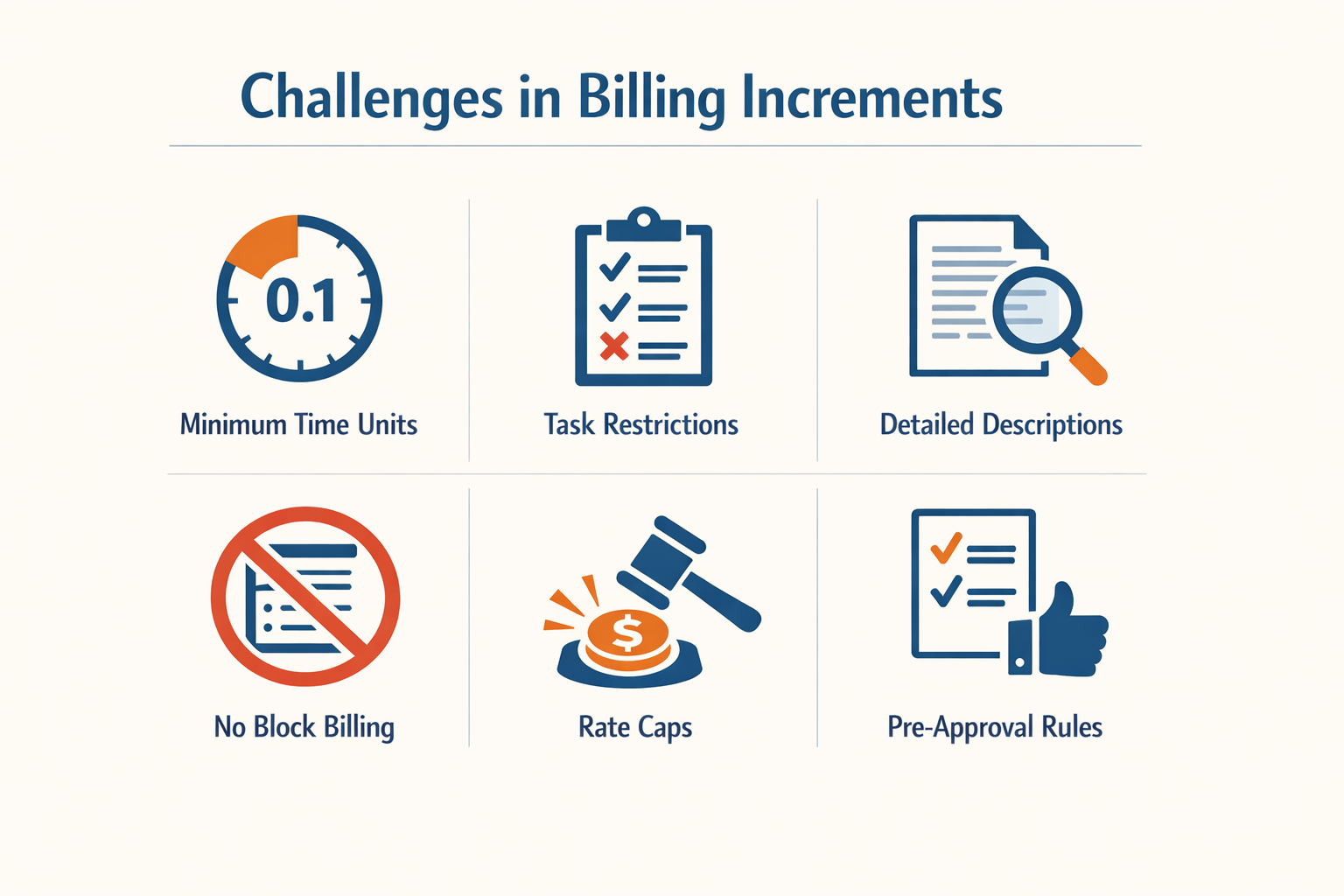
Attorneys and law firms face a persistent challenge when submitting invoices to insurance carriers: attorney billing increments that do not align with carrier requirements trigger reductions or outright rejections. A firm accustomed to billing in quarter-hour increments—0.25 hours—may discover that a carrier's outside counsel guidelines mandate tenth-of-an-hour precision. The mismatch is not cosmetic. When a guideline specifies 0.1-hour increments and the invoice rounds every task to the nearest quarter hour, the carrier's bill reviewer flags the discrepancy, and the invoice enters the appeal queue.
Conflicting Standards Across Panels
Different carriers publish different increment requirements, and some publish none at all. One carrier's guideline may state that all time entries must be billed to the nearest tenth of an hour. Another carrier's guideline is silent on the question, leaving the firm to guess whether 0.25-hour increments are acceptable or whether the absence of a rule implies a stricter standard. A third carrier may accept either increment but apply a reduction code to any entry that appears rounded without justification. Firms managing multiple panel appointments must track which carrier requires which increment, and a single timekeeper working on cases for three different carriers may need to record time differently depending on the matter.
The C.D. Cal. CJA Panel Manual states at page 13 that "time spent must be billed to the nearest tenth of an hour." That rule applies to Criminal Justice Act vouchers in the Central District of California, not to insurance defense invoices, but it illustrates the precision standard that some payers impose. A firm that habitually bills in 0.25-hour increments and submits a CJA voucher in that format will face a reduction or a request for corrected records. The same firm, working on a workers' compensation defense matter for a carrier with a similar rule, encounters the identical problem.
Contemporaneous Records and Increment Discipline
Carriers that specify tenth-of-an-hour billing expect the underlying time records to support that level of detail. A timekeeper who records "research motion in limine, 0.5" and later splits it into two 0.25-hour entries for formatting purposes has not created a contemporaneous record; the split is cosmetic, and a bill reviewer may treat it as such. Conversely, a timekeeper who records "review complaint, 8 minutes" and bills 0.1 hours has a defensible entry if the carrier audits the file. The increment requirement forces discipline at the point of capture, not at the point of invoice preparation.
Firms also struggle with the interaction between block billing prohibitions and increment requirements. A single line reading "draft motion, review discovery, conference with client, 2.5" violates block-billing rules regardless of the increment used. When the firm breaks the entry into three separate lines, each with its own tenth-of-an-hour time charge, the invoice becomes compliant with both the increment rule and the narrative-detail standard. The increment requirement, in this sense, reinforces the prohibition on block billing by making vague time entries harder to justify.
How to Align Attorney Billing Increments with Carrier Requirements

Aligning billing practices with carrier requirements for attorney billing increments requires deliberate procedural changes and consistent documentation. The following steps provide a framework for achieving compliance.
Step 1: Identify Applicable Carrier Guidelines
Read the outside counsel guidelines for each carrier you bill. Each guideline specifies whether tenth-of-an-hour (0.1) or quarter-hour (0.25) increments are required. Many insurance carriers publish these guidelines on their panel counsel portals or e-billing platforms. Where a carrier does not specify an increment, assume 0.1 is expected — it is the narrower standard and therefore the safer choice.
Carrier guidelines are not uniform. One carrier may require 0.1 increments while another permits 0.25. Document which increment applies to each matter before you enter the first line item.
Step 1
Catalog your carrier requirements
Create a reference table listing each carrier, the guideline version, and the required billing increment. Update this table whenever a carrier issues a revised guideline or you join a new panel.
Step 2: Configure Timekeeping Systems to Match the Required Increment
Once you know the increment for a matter, configure your timekeeping software to enforce it. Most practice management systems allow you to set a default increment per matter or client. Set the increment to match the carrier requirement before any timekeeper logs hours.
If your system does not support per-matter increments, institute a manual review step before invoice generation. A single line item billed at 0.25 when the guideline requires 0.1 will trigger rejection or reduction.
Step 3: Train Timekeepers on Increment Standards
Every attorney and paralegal who enters time must understand which increment applies and how to apply it. A common error is rounding up to the nearest quarter-hour out of habit when the carrier requires tenths.
The Central District of California CJA Panel Manual states at page 13 that "time spent must be billed to the nearest tenth of an hour." This is a federal court requirement, not a carrier guideline, but it illustrates the precision expected in public-funding contexts. Carrier guidelines for insurance defense often mirror this standard.
Conduct periodic training on increment requirements. Include examples of compliant and non-compliant entries. Emphasize that rounding practices must align with the applicable guideline, not the timekeeper's prior experience or preference.
Step 2
Document increment rules in your billing manual
Include a section in your firm's billing manual that lists increment requirements by carrier and provides examples. Require new timekeepers to review this section during onboarding.
Step 4: Review Invoices for Increment Compliance Before Submission
Before submitting an invoice to a carrier, review every line item to confirm that the billed increment matches the guideline. This review should be separate from substantive bill review — it is a mechanical check, but it is non-negotiable.
If your firm uses LEDES 1998B format, the HOURS/UNITS field (field 9) must reflect the correct increment. A value of 0.25 when the guideline requires 0.1 is a format error that many portals will flag automatically. For more on LEDES field requirements, see LEDES 1998B File Format - All 24 Fields Explained.
Step 5: Maintain Contemporaneous Time Records at the Source Increment
Carrier guidelines and court rules require contemporaneous time records. If your timekeepers log time in increments finer than 0.1 (for example, by the minute), round to the required increment at the point of entry, not during invoice preparation. This ensures that your source records match your billed entries.
The Central District of California CJA Panel Manual requires that attorneys "maintain contemporaneous time and attendance records" for all work performed, and that these records remain subject to audit for three years after final voucher approval. Insurance carriers conducting bill audits apply similar scrutiny. If your source records show minutes but your invoice shows tenths, the discrepancy invites questions.
Step 3
Audit a sample of time entries quarterly
Select a random sample of ten to twenty line items each quarter and compare the billed increment to the source time record. If discrepancies appear, retrain the responsible timekeepers and review the full invoice for similar errors.
Step 6: Address Rejections and Reductions Promptly
If a carrier rejects an invoice or reduces a line item for increment non-compliance, do not assume the error is isolated. Review all pending and recent invoices for the same carrier to identify whether the error is systemic.
When you appeal a reduction, cite the specific guideline provision that governs increments and demonstrate that your entry complies. If the guideline is silent, state that you applied the 0.1 standard as the industry default. Do not argue that 0.25 is "close enough" or that the difference is immaterial — carriers reject that reasoning.
Tips and Tricks

Attorneys who bill in tenth-of-an-hour increments can reduce invoice rejections by keeping contemporaneous time records. The C.D. Cal. CJA Panel Manual requires panel attorneys to maintain contemporaneous time and attendance records for all work performed, and those records must be kept for three years after approval of the final voucher. That same discipline applies outside the CJA context: when a carrier or bill reviewer challenges a line item, the attorney who can produce a contemporaneous record has a stronger position than the one who reconstructs time after the fact.
Track Time as It Happens
Waiting until the end of the day—or the end of the week—to log time introduces rounding errors and memory gaps. A task that took eight minutes becomes 0.2 hours if you round up, but 0.1 hours if you round down. Over dozens of line items, those rounding choices compound. Track time while the work is fresh, note the actual minutes, and round to the nearest tenth only when you prepare the invoice.
Avoid Block Billing Even When Using Tenths
Billing in tenth-of-an-hour increments does not cure block billing. A single line reading "research motion to dismiss, draft opposition, confer with client re settlement, 3.4" will trigger a reduction under most carrier guidelines, even though the increment is 0.1. Each task gets its own line, its own UTBMS activity code, and its own time entry. For guidance on how carriers define block billing and what they expect instead, see Block Billing: Reasons for Carrier Rejections and Solutions.
Prorate Time Spent on Multiple Matters
When one activity benefits two or more representations, prorate the time and cross-reference the matters in your supporting materials. The C.D. Cal. CJA Panel Manual states that attorneys must prorate any time spent in common on two or more cases and must cross-reference all cases on the supporting materials to the vouchers. The same principle governs insurance defense billing: if you travel to a courthouse for depositions in two matters, split the travel time proportionally and note the allocation in the narrative. Do not bill the full amount to both matters, and do not bill more time in any day than you actually spent performing services that day.
Distinguish Billable Tasks from Non-Billable Overhead
Secretarial work, invoice preparation, and routine administrative tasks are not billable under most guidelines. The C.D. Cal. CJA Panel Manual states explicitly that attorneys may not bill for secretarial services, whether performed by the attorney or other personnel, and may not bill for preparation of the voucher itself. Carrier outside counsel guidelines typically impose the same prohibition. If you spend time on a task that a paralegal or administrative assistant would ordinarily handle, either delegate it or charge only what a paralegal would charge, billed separately on the paralegal's own invoice.
Maintain Supporting Documentation for Three Years
The C.D. Cal. CJA Panel Manual requires panel attorneys to maintain contemporaneous time and attendance records and expense records for three years after approval of the final voucher, and those records are subject to audit. Carriers and their bill review vendors may request supporting documentation months or years after payment. Keep calendars, time logs, travel receipts, and email threads that corroborate the invoice. When a reduction is appealed, the attorney who can produce contemporaneous records has the best chance of reversing the write-down.
Frequently asked questions
What is the difference between 0.1 and 0.25 attorney billing increments?
Attorney billing increments of 0.1 hours equal six-minute blocks, while 0.25 increments equal fifteen-minute blocks. A 0.1 increment allows more precise time tracking; a three-minute phone call rounds to 0.1 hours (six minutes) rather than 0.25 hours (fifteen minutes). Over many line items, the difference affects total fees and compliance with carrier guidelines.
Do all insurance carriers require 0.1-hour billing increments?
No. Carrier requirements vary. Some carriers specify 0.1-hour increments in their outside counsel guidelines, others accept 0.25, and some remain silent. When a guideline does not specify an increment, assume 0.1 is expected — it is the narrower standard and reduces the risk of rejection.
Can I bill in quarter-hour increments if my carrier guideline does not mention increments?
When a carrier guideline is silent on attorney billing increments, the safer practice is to bill in tenth-of-an-hour increments. Many e-billing portals flag quarter-hour entries as non-compliant even when the guideline does not expressly prohibit them. Tenth-hour billing demonstrates precision and reduces the likelihood of reduction or rejection.
How do I know which billing increment my carrier requires?
Read the carrier's outside counsel guidelines, which are typically available on the panel counsel portal or e-billing platform. The increment requirement, if any, usually appears in the billing standards or invoice submission section. If the guideline is silent, contact the carrier's panel administrator or assume 0.1-hour increments.
Conclusion
Attorney billing increments are not a matter of personal preference or firm convention — they are a compliance requirement set by the entity paying the invoice. The Central District of California's CJA billing requirements state that time spent must be billed to the nearest tenth of an hour, and that standard appears in carrier outside counsel guidelines with similar clarity. When a guideline specifies 0.1-hour increments, a voucher submitted in quarter-hour blocks will be rejected or reduced, regardless of the total amount billed or the quality of the legal work performed.
Our team frequently encounters this topic when reviewing carrier outside counsel guidelines, and the pattern is consistent: carriers that publish increment requirements enforce them at the portal validation stage. The choice between 0.1 and 0.25 is not about precision versus simplicity in the abstract — it is about reading the controlling document and conforming your time entries to what that document requires. A firm that defaults to quarter-hour billing without checking the applicable guideline will spend more time appealing reductions than it would have spent recording time in tenths from the outset.
Maintaining contemporaneous time records in the increment the payor requires, cross-referencing multi-client travel and prorated work correctly, and ensuring that every line item reflects only the time reasonably spent on that task — these practices reduce rejection rates and preserve the relationship with the carrier. For a deeper look at how narrative detail and task coding interact with increment compliance, see our guide to block billing and carrier rejections. By aligning billing practice with the published standard before the first invoice goes out, firms avoid the cycle of rejection, appeal and write-down that follows from assuming the payor will accept whatever increment the firm prefers.