


Attorney Billing Cheat Sheet for Insurance Defense
Top takeaways
- Insurance carriers reject invoices that contain block billing, vague narratives, or unsupported charges for legal research and file review.
- Compliance with outside counsel guidelines, LEDES file formats, and UTBMS code requirements is not optional — it determines whether your invoice clears the portal or triggers a reduction.
- This attorney billing cheat sheet consolidates the core billing standards that panel counsel must follow to submit clean invoices and avoid write-downs.
Introduction
An attorney billing cheat sheet is a quick-reference guide that helps insurance defense counsel meet carrier billing requirements on the first submission. One entry reading "research and draft motion in limine, 4.2" is enough to trigger a reduction under most panel guidelines. The same invoice that clears submission at one carrier will fail validation at another if the LEDES file uses quarter-hour increments instead of tenths, or if the narrative lumps three tasks into a single line item. Insurance defense billing operates under a framework of published guidelines, standardized file formats, and code sets that reviewers apply mechanically — yet many timekeepers still draft narratives as if the adjuster were reading a story rather than parsing fields in a database.
Carriers have published outside counsel guidelines precisely because they encountered recurring billing practices that inflated invoices without adding value to the defense. Charging for extensive legal research on marginal issues and charging for file review unconnected to any particular objective are two examples that bill reviewers flag immediately. These are not edge cases. They appear frequently enough that the American Bar Association addressed them in Formal Opinion 01-421, which discusses the ethical boundaries of fee audits and the insured's contractual grant of access to confidential billing information.
Accurate billing in insurance defense means more than arithmetically correct totals. It means each line item carries a UTBMS task code that matches the work described, a narrative with enough detail to justify the time billed, and an increment that conforms to the carrier's published standard. When any of those elements is missing or misaligned, the invoice either bounces at the portal or lands on a bill reviewer's desk with a reduction code already queued. This attorney billing cheat sheet walks through the requirements that determine whether an invoice passes review on the first submission or returns with a demand for correction and resubmission.
Problem Statement
Insurance defense billing sits at the intersection of three conflicting pressures: carrier guidelines that prohibit entire categories of time entries, e-billing portals that reject invoices for formatting errors before a human reviewer ever sees them, and ethical obligations to bill accurately for work actually performed. A single invoice can fail at any of these checkpoints, and the rejection notice rarely tells you which rule you violated or how to fix it.
Carriers have published lists of billing practices they will not pay for. Extensive legal research on marginal issues is a frequent target, as is any entry labelled "file review" that does not tie to a specific task or deliverable. These are not new prohibitions — the American Bar Association noted in Formal Opinion 01-421 that insurance companies have long scrutinised charges for research unconnected to case strategy and for generic review time that serves no documented purpose. What has changed is the enforcement mechanism: where a bill reviewer once circled a questionable entry and called to discuss it, the e-billing portal now applies the reduction automatically and moves on to the next invoice.
Why Non-Compliance Persists
Most compliance failures trace to one of three gaps. First, the timekeeper does not know what the controlling guideline prohibits, either because no one distributed it or because it arrived as a 60-page PDF that no one read past the cover letter. Second, the narrative was written in haste at the end of a billing cycle, when the timekeeper no longer recalls the details that would make the entry defensible. Third, the invoice preparer assumes the portal will accept anything that fits in the character limit, and discovers only after submission that the format, the UTBMS task code, or the level of detail was wrong.
The cost of a rejected invoice is not limited to the delay. Every resubmission creates another review cycle, another opportunity for a different reviewer to apply a different standard, and another entry in the matter's billing history that signals to the carrier that this firm requires extra scrutiny. Where the rejection is for block billing or insufficient narrative detail, the timekeeper must reconstruct the work from memory or from calendar entries that may no longer exist, and the reconstruction is always less reliable than a contemporaneous record would have been.
Tensions between insurers and outside counsel remain near the boiling point when billing practices do not align with carrier expectations.
The result is a cycle in which the firm writes down time it cannot defend, the carrier assumes the next invoice will contain similar problems, and the timekeeper learns that detail does not matter because someone will cut the bill anyway. Breaking that cycle requires a documented process that starts when the time is recorded, not when the invoice is prepared.
What Does an Attorney Billing Cheat Sheet Include?
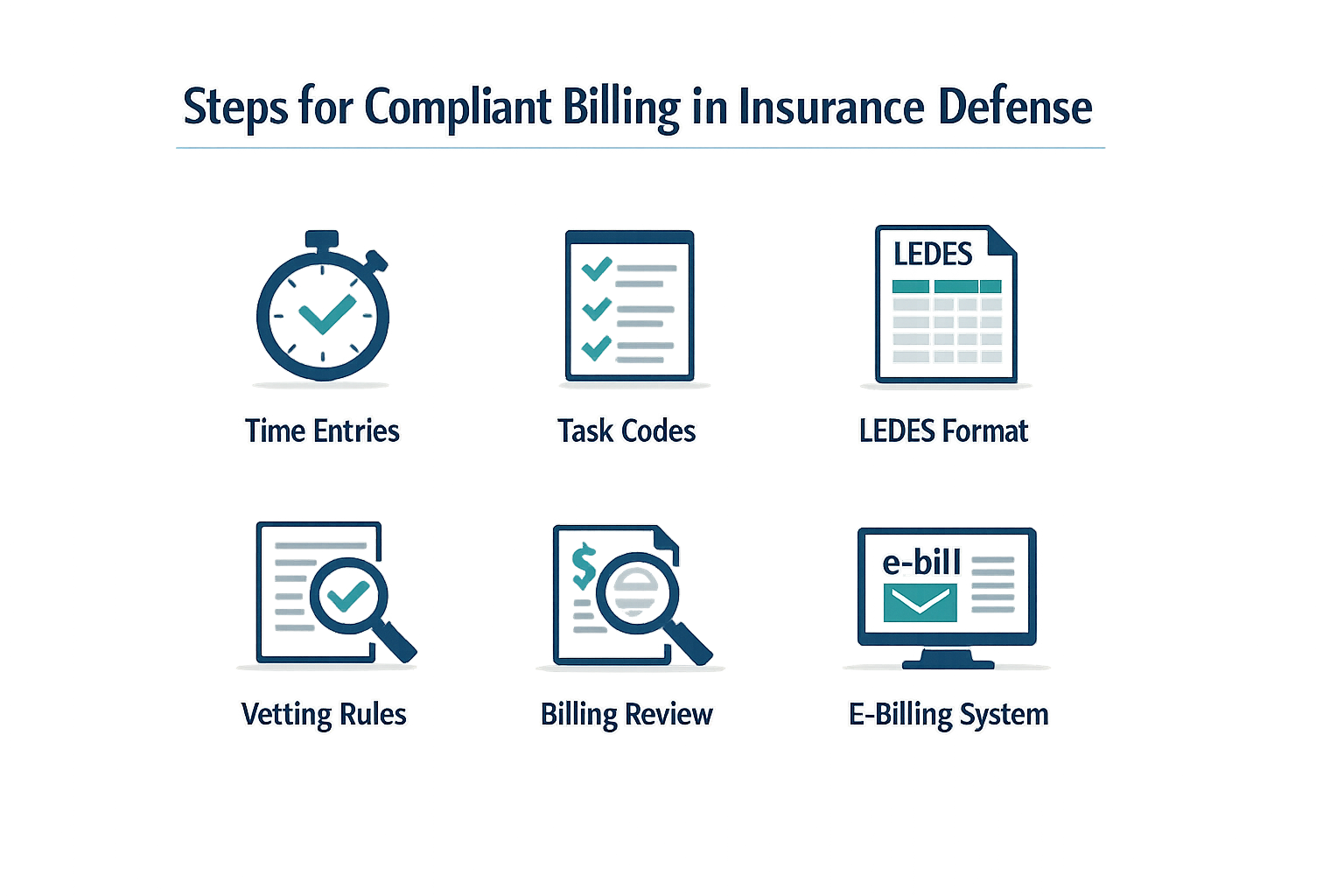
Compliant billing in insurance defense requires deliberate process controls, not guesswork. Each invoice must meet three separate tests: the carrier's outside counsel guidelines, the e-billing portal's validation rules, and the ethical standard of reasonableness. Missing any one of those tests triggers a rejection or reduction that delays payment and invites scrutiny on every subsequent invoice from that matter.
Step 1: Read and Annotate the Guideline Before Any Time Entry
Every carrier publishes outside counsel guidelines that specify billing increments, prohibited practices, pre-approval thresholds, and narrative requirements. The first step is not to submit an invoice — it is to read the guideline version that governs the matter, highlight every prohibition and threshold, and transfer those limits into the firm's timekeeping system as enforceable rules. If the guideline prohibits block billing, that prohibition applies on the day the engagement begins, not the day the first invoice is due.
Step 1
Obtain the controlling guideline
Request the current version of the carrier's outside counsel guidelines at intake. Confirm the version number and effective date. If the carrier references a portal link, download a PDF copy and timestamp it — portal pages change without notice, but your billing obligations are fixed to the version in effect when the matter opened.
Step 2
Mark prohibited activities
Highlight every phrase that includes "not permitted," "requires pre-approval," or "will be reduced." Common prohibitions include block billing, vague narrative entries, research without a stated objective, administrative tasks billed at attorney rates, and travel time above a specified cap. If the guideline states a billing increment — tenth of an hour, quarter hour, or six-minute minimum — that increment controls every line item, regardless of the firm's internal practice.
Step 3
Configure time-entry validation
If the firm's timekeeping software permits custom rules, configure it to reject entries that violate the guideline. For example, if the guideline prohibits "file review" without additional detail, configure the system to flag any narrative containing that phrase and require the timekeeper to specify what documents were reviewed and for what purpose. If the guideline caps conference calls at one hour without pre-approval, set a threshold alert at 1.0 hours for any activity code related to communication.
Step 2: Use UTBMS Codes Consistently and Match Them to Narratives
LEDES 1998B invoices require a UTBMS task code and activity code on every fee line item. These codes are not decorative — bill reviewers filter and sort invoices by code, and a mismatch between the code and the narrative is a common reduction trigger. If the activity code is A101 (plan and prepare for issue development and case assessment), the narrative must describe planning or preparation, not drafting or research. If the narrative says "research statute of limitations," but the activity code is A102 (plan and prepare for discovery), the line item will be questioned.
Narrative detail must be contemporaneous and specific. "Legal research" is insufficient under most guidelines. "Research California tolling rules for statute of limitations in construction defect action; review Smith v. Jones (2018) and draft memo to file" is sufficient. The narrative should answer three questions: what was done, why it was done, and what document or result it produced. If the guideline requires a minimum level of detail, that minimum applies to every entry, not just the entries the timekeeper considers important.
Step 3: Validate the LEDES File Before Submission
E-billing portals reject invoices that fail validation, and most validation errors are structural: incorrect field length, missing required fields, invalid code values, or mismatched line-item totals. These errors are preventable. Before submitting any LEDES file, run it through a validation tool that checks field formats, code validity, and mathematical consistency. A single malformed date field or an unrecognized expense code will cause the entire invoice to be rejected, regardless of the quality of the underlying work.
Step 4
Check field formatting and code validity
Confirm that every UTBMS task code, activity code, and expense code in the file matches the current UTBMS code set. Confirm that date fields follow the YYYYMMDD format, that invoice and line numbers are unique, and that timekeeper IDs match the format required by the portal. Many portals publish a validation schema or a test-submission feature — use it before submitting the live invoice.
Step 5
Reconcile line-item totals
The sum of all line-item amounts must equal the invoice total reported in the LEDES header. A mismatch of even one cent will trigger an automatic rejection. If the invoice includes adjustments, credits, or prior-period corrections, confirm that those adjustments are reflected in both the line-item detail and the header totals.
For a detailed breakdown of every field in a LEDES 1998B file and how portals validate them, see LEDES 1998B File Format - All 24 Fields Explained.
Step 4: Review for Ethical Reasonableness Before Submission
Meeting the carrier's guideline and passing portal validation are necessary, but they are not sufficient. Every invoice must also satisfy the ethical duty to charge reasonable attorney fees. Billing practices targeted by carriers — such as charging for extensive legal research on marginal issues or charging for file review unconnected to any particular objective — are not merely guideline violations; they are ethical issues that can trigger fee disputes, bar complaints, and coverage litigation.
Before submitting an invoice, a supervising attorney should review it for reasonableness: Are the hours proportionate to the result? Is there duplicative work that should be written off? Are junior tasks billed at senior rates? Are there entries that, while technically permissible, would be difficult to justify to a neutral reviewer? The time to answer those questions is before submission, not after a reduction notice arrives.
Tips and Tricks for Effective Billing
A billing entry reading "research and file review, 6.5" will draw scrutiny under most carrier guidelines. The combination of vague activity and block billing flags the line for reduction before a reviewer reads past the first comma. Small adjustments to how you describe and record work eliminate most rejection triggers.
Avoid Billing for Marginal Research
Carriers reject charges for extensive legal research on marginal issues. If the issue does not move the case forward, the time spent researching it is not compensable under standard outside counsel guidelines. Before you bill research hours, confirm that the question directly affects a motion, a discovery dispute, or trial preparation. When the research supports a tangential argument or explores an unlikely theory, expect a reduction or a request to write off the entry entirely.
Tie File Review to a Specific Objective
Charging for file review unconnected to any particular objective is a billing practice that carriers target for reduction. A line item that says "file review, 1.2" tells the reviewer nothing about what you accomplished or why the review was necessary at that moment. Instead, tie the review to the task that required it: "review file for deposition preparation," "review correspondence regarding settlement authority," or "review medical records in advance of expert call." The objective anchors the entry and demonstrates that the time served a defined purpose.
Billing for file review unconnected to any particular objective remains one of the practices most frequently targeted by insurance companies.
Use Tenth-of-an-Hour Increments
Most panel guidelines specify tenth-of-an-hour billing increments. Rounding to quarter hours inflates the invoice and triggers automatic adjustments during portal validation. If your timekeeping system defaults to quarter hours, change the setting before you generate the LEDES file. Reviewers notice patterns: if every entry ends in .25, .50, .75, or .00, the invoice will be flagged for manual review and potential across-the-board reduction.
Record Time Contemporaneously
Waiting until the end of the week to reconstruct your time produces vague narratives and inaccurate increments. Contemporaneous time records capture the specific objective, the precise duration, and the reasoning behind each task. When you enter time daily, you are less likely to lump multiple activities into a single block-billed entry. For detailed guidance on how carriers evaluate narrative detail and task separation, see Block Billing: Reasons for Carrier Rejections and Solutions.
Separate Distinct Tasks into Separate Line Items
One entry that combines three activities—"draft motion, review opposing brief, telephone conference with client"—is block billing, and it will be reduced. Each discrete task belongs on its own line with its own UTBMS task and activity code. Separating tasks allows the reviewer to evaluate each piece of work on its merits and eliminates the suspicion that you are hiding low-value activities inside a higher-value description.
Step 1
Break the block
When you finish a task, stop the timer and enter the line item immediately. Start a new timer for the next task. This habit prevents block billing at the source and ensures that each entry has a single, defensible objective.
Check Your LEDES File Before Submission
Portal rejections are common, and most are caused by formatting errors that a manual review would catch. Open the LEDES 1998B file in a text editor and scan for missing pipe delimiters, misaligned fields, and entries with blank task codes. Confirm that every timekeeper ID in the file matches a timekeeper record submitted to the carrier. One malformed line can reject the entire invoice, delaying payment by weeks.
Conclusion
An attorney billing cheat sheet is not a substitute for reading the carrier's outside counsel guidelines in full, but it anchors the daily discipline that keeps invoices out of the reduction queue. The practices outlined here — tenth-of-an-hour increments, contemporaneous narrative detail, UTBMS code precision, and pre-submission validation — reflect what bill reviewers enforce across the panel counsel universe. Guideline compliance is not a favour to the carrier; it is the threshold for getting paid without write-down or appeal.
Billing tensions between insurers and outside counsel have been documented for decades, yet the same billing abuses — vague file review entries, unconnected research charges, block billing — continue to trigger rejections. The carrier's e-billing portal and the LEDES file are mechanical gatekeepers; they will reject a non-compliant invoice whether the underlying work was brilliant or routine. The attorney who masters the format, the code set, and the narrative standard is the attorney whose invoices clear review on first submission.
Ongoing education in billing practices is not optional. Carrier guidelines are versioned documents; they change. UTBMS codes expand. E-billing platforms update their validation rules. A cheat sheet prepared in 2023 may be incomplete in 2025. The prudent practice is to verify the current guideline version before each new matter opens, and to audit a sample of submitted invoices quarterly for reduction patterns. Where a reduction occurs, read the reduction code, compare the rejected line item to the guideline text, and correct the practice firm-wide.
For a deeper examination of narrative sufficiency and how carriers define it, see Block Billing: Reasons for Carrier Rejections and Solutions. The principles in that article apply to every line item, not only those flagged as block billing. The carrier expects to see what was done, why it was necessary, and how long it took — in that order, in plain English, with no filler. Deliver that, and the cheat sheet has done its job.
FAQ
What is an attorney billing cheat sheet?
An attorney billing cheat sheet is a quick-reference document that summarizes the billing rules, code requirements, and narrative standards insurance defense counsel must follow when submitting invoices to carriers. It consolidates guidelines on LEDES file formats, UTBMS codes, prohibited billing practices, and common rejection triggers into a format timekeepers can consult during daily time entry.
How do I avoid block billing on my invoices?
Avoid block billing by separating each discrete task into its own line item with a unique UTBMS task code and a narrative that describes a single activity. Record time contemporaneously so you capture the specific objective and duration of each task. Never combine multiple activities — such as research, drafting, and client communication — into one entry.
What billing increment should I use for insurance defense work?
Most insurance carriers require tenth-of-an-hour billing increments (0.1, 0.2, 0.3, etc.). Rounding to quarter hours (0.25, 0.50, 0.75) inflates the invoice and may trigger automatic reductions during portal validation. Confirm the required increment in the carrier's outside counsel guidelines before generating your LEDES file.
Why do carriers reject charges for legal research?
Carriers reject charges for extensive legal research on marginal issues because such research does not advance the defense in a measurable way. Before billing research time, confirm that the question directly affects a motion, discovery dispute, or trial strategy. If the research explores a tangential argument or an unlikely theory, expect the carrier to reduce or disallow the entry.
What should I include in a file review narrative?
A compliant file review narrative ties the review to a specific objective: "review file for deposition preparation," "review correspondence regarding settlement authority," or "review medical records in advance of expert call." A generic entry such as "file review, 1.2" tells the reviewer nothing about what you accomplished and will be flagged for reduction.