


Ambetter Insurance Provider Billing Requirements and Updates
Introduction
Ambetter billing requirements are legally binding documents that define what the carrier will pay for and how providers must document that work. For healthcare providers working with Ambetter Insurance, understanding these requirements is the difference between clean claim processing and rejection cycles that delay payment for weeks.
As part of the Carrier Ready Knowledge Team, we focus on understanding and disseminating the intricacies of billing requirements across multiple carriers. Our expertise stems from a thorough examination of various guidelines and specifications, and we've observed how different carriers approach billing practices with varying levels of specificity and enforcement.
Ambetter billing requirements function like those of other major carriers: they establish the framework for maintaining a consistent relationship with external providers, specify which activities are billable, and set documentation standards that trigger acceptance or rejection at the portal level. Providers who treat these guidelines as optional face predictable consequences—rejections, write-downs, and the administrative burden of resubmission. For more context on how carriers structure their billing expectations, see Outside Counsel Guidelines for Insurance Litigation.
Why Ambetter Billing Requirements Matter
Non-compliance with Ambetter billing requirements appears consistently in carrier complaint data. The 2026 CLM Litigation Management Study identifies failure to follow guidelines and billing practices—including excessive billing, overbilling, and billing disputes—as commonly mentioned issues in the defense ecosystem. When a provider submits an invoice that violates a stated guideline, the carrier's bill review process flags it. The result is a reduction code, a rejection, or both.
Providers must formally accept Ambetter billing requirements before submission. The acceptance process typically involves navigating to the billing guidelines section of the carrier's portal, locating the required document, and completing an acknowledgment screen. This step is not ceremonial—it creates a record that the provider has reviewed and agreed to the terms that will govern every line item on every invoice submitted under that engagement.
Updates to Ambetter billing requirements occur periodically. Carriers revise guidelines to reflect changes in coding standards, documentation expectations, or approval thresholds. When Ambetter issues an updated guideline, providers must review the changes and accept the new version. Submitting invoices under an outdated or unaccepted guideline is a common trigger for portal-level rejection, even when the underlying work is compensable.
What Are Ambetter Billing Requirements?
Ambetter billing requirements are the formal rules governing how healthcare providers submit claims, document services, and receive payment from Ambetter Insurance. These requirements specify which activities are billable, what documentation must accompany each claim, and how providers must format their submissions to pass portal validation.
The requirements cover claim submission formats, pre-approval thresholds for specific services, narrative detail standards, and cost documentation protocols. Providers working with Ambetter must understand that these are not suggestions—they are contractual obligations that determine whether a claim is paid, reduced, or rejected.
Problem Statement
Providers submitting claims to health insurers face a recurring challenge: billing guidelines that define the financial relationship between the provider and the payor are often detailed, mandatory, and enforced through nonpayment. A Rhode Island ethics opinion examining insurer guidelines states plainly: "Noncompliance with the guidelines results in nonpayment." The same document explains that the guidelines "establish the financial relationship between the insurer and defense counsel," specifying reimbursable expenses, hourly rate schedules, permitted legal services, and activities for which no compensation will be made. When a provider submits a claim that does not conform to these requirements—whether through incomplete documentation, unsupported billing codes, or narrative entries that fail to meet the insurer's detail standards—the claim is rejected, reduced, or held pending additional information.
The consequences of non-compliance extend beyond a single rejected line item. A 2026 litigation management study identifies "failure to follow guidelines and billing abuse" as a commonly mentioned problem in the defense ecosystem, listing non-compliance with litigation guidelines and billing practices, excessive billing, overbilling, inflexibility on cost, billing disputes, and unethical billing practices as recurring issues. These are not abstract risks. When a provider's billing practices trigger a pattern of rejections, the insurer may escalate the matter to formal bill review, impose stricter pre-approval thresholds, or remove the provider from the panel altogether. The same study notes that billing guideline updates—including expanded alternative fee arrangements, flat fee structures, and AI billing guideline updates with auto-approval of AI-adjusted invoices—are among the most commonly mentioned innovations presented by law firms in the past year. Providers who do not track these updates risk submitting claims under superseded standards, a mistake that compounds the rejection rate and delays payment.
The Rhode Island opinion also provides a safety valve: "If the firm believes that any part of these billing requirements is inappropriate or would not be in the best interest of [insurer] or its insured(s) or customer(s), such issues must be discussed with [insurer], or [insurer's] designee." This language makes clear that the time to object to a guideline provision is before submission, not after the invoice is rejected. Providers who wait until a reduction notice arrives to argue that a guideline requirement is unreasonable have already lost the procedural path to relief. The guideline governs unless the insurer agrees in writing to waive or modify it, and that agreement must be obtained in advance.
Understanding what constitutes block billing is one example of a guideline requirement that providers frequently misinterpret. A single narrative entry that combines multiple tasks—research, drafting, correspondence—without separate time allocations for each is block billing, and most carrier guidelines either prohibit it outright or use it as a reduction trigger. The same principle applies to billing increments, narrative detail standards, and the use of UTBMS task and activity codes in LEDES file submissions. Providers who do not align their billing practices with these standards face systematic rejections, and the cumulative effect is delayed payment, increased administrative cost, and a deteriorating relationship with the payor.
Solution Steps
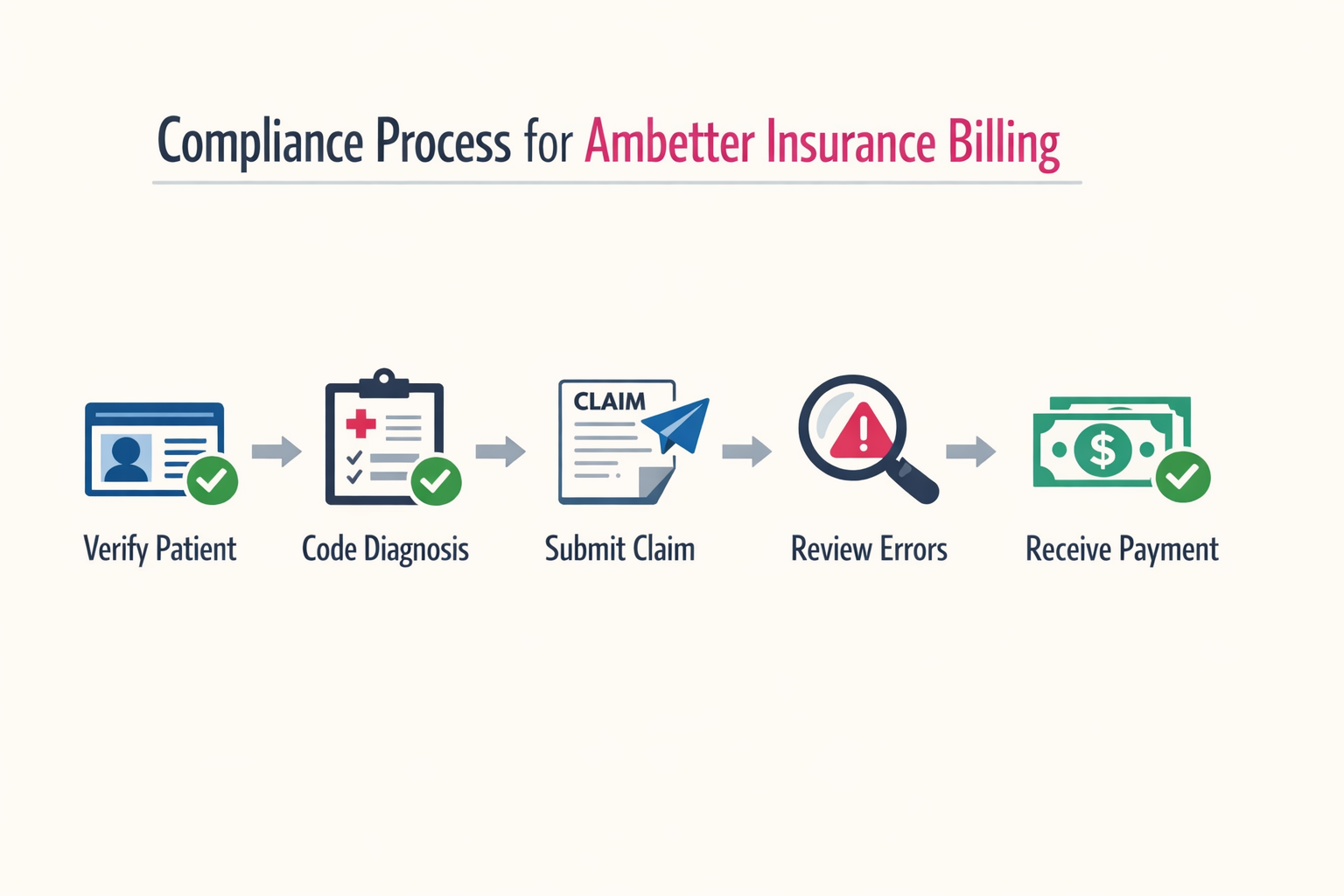
Billing guidelines outline your client's business practices and establish a framework for maintaining a consistent and equitable relationship with external legal counsel. This legally binding document defines your client's expectations regarding billable and non-billable activities. The same structural discipline applies when healthcare providers navigate Ambetter billing requirements — the controlling document sets the terms, and compliance means reading it closely and following what it says.
How Do I Access Ambetter Billing Requirements?
The first step is to identify where Ambetter Insurance publishes its billing requirements. Many carriers distribute guidelines through e-billing portals or provider portals. Click the Billing Guidelines tab at the top of the page; the Billing Guidelines and Other Information is displayed. If you do not see a dedicated tab, contact your Ambetter representative or check the provider resources section of the portal. Download the current version and note the effective date — guidelines change, and an outdated copy is worse than no copy at all.
Step 1
Access the billing guidelines
Log into the Ambetter provider portal or e-billing platform. Navigate to the Billing Guidelines section, typically found under a dedicated tab or in the resources menu. Download the most recent version and record the effective date on your internal compliance checklist.
Accept the Guidelines Through the Portal
Once you have reviewed the Ambetter billing requirements, formal acceptance may be required before you submit invoices. Under the Document Name column of the Billing Guidelines, click on the name of the Billing Guideline required to be accepted; the Acknowledgment screen displays. Alternatively, click the Accept link under the Accepted By column of the Billing Guideline required to be accepted, and the Acknowledgment screen displays. This acceptance step creates a binding record that you have read and agreed to the terms. Skipping it can result in invoice rejection before any substantive review occurs.
Coordinate Pre-Approval for Specific Activities
Some billing activities under Ambetter billing requirements require advance approval from the adjuster or claims representative. Billing Attorney and the adjuster should endeavor to agree on proposed activities outlined in the plan of action set forth in the Initial Case Assessment and updated in subsequent reporting forms. This principle applies to healthcare billing when a guideline specifies pre-approval thresholds for certain services, expert consultations, or cost categories. Document the approval in writing — an email thread or a portal message — and attach a reference to it in your invoice submission.
Step 2
Obtain pre-approval where required
Identify any services or activities that exceed pre-approval thresholds specified in the Ambetter billing requirements. Submit a written request to the assigned adjuster or claims representative, including a description of the proposed activity, estimated cost, and justification. Retain written confirmation of approval and reference it in the corresponding invoice line items.
Itemize Services to Avoid Bulk Billing Errors
Bulk billing — also known as block billing in legal contexts — is a common rejection trigger under Ambetter billing requirements. LEDES error code suffix 53 indicates bulk billing, with the resolution instruction: "Multiple services or expenses must be itemized as separate entries." Even if Ambetter's guidelines do not explicitly prohibit block billing, e-billing platforms often enforce itemization at the validation layer. Break down combined activities into discrete line items, each with its own date, description, and amount. For example, replace "consultation and follow-up, 2.5 hours" with two entries: "consultation, 1.5 hours" and "follow-up call, 1.0 hour."
Understanding what is block billing and how carriers interpret it can help you structure entries that pass validation on the first submission.
| Entry Type | Example | Validation Result |
|---|---|---|
| Bulk entry | "Review records and draft summary, 3.2" | Likely rejection (suffix 53) |
| Itemized | "Review medical records, 2.0" + "Draft summary report, 1.2" | Passes validation |
Submit Initial or Updated Case Plans as Required
Certain carriers require a case plan before they will process an invoice. LEDES error code suffix 26 states: "Initial Or Updated Case Plan Required To Pay Invoice," with the resolution: "Either an initial or updated Case Plan is required to pay the invoice." If Ambetter billing requirements or the e-billing platform impose this requirement, prepare and submit the case plan document before or concurrent with your first invoice. Update the plan when the scope of services changes or when the guideline specifies a reporting interval.
Step 3
Prepare and submit case plan documentation
Draft an initial case plan that outlines the anticipated scope of services, estimated costs, and timeline. Submit it through the designated portal or to the assigned adjuster. Update the plan whenever the scope changes or at intervals specified in the Ambetter billing requirements, and reference the plan version number in subsequent invoices.
Tips and Tricks
Billing compliance is not a one-time checklist. The carriers that publish outside counsel guidelines—and the third-party auditors they engage—look for patterns across invoices, not just isolated line items. A single invoice that follows the rules means nothing if the next three revert to block billing or vague narratives. Consistency across billing cycles is what keeps an invoice out of the reduction queue.
Maintain contemporaneous time records
Senior attorney review of each billing statement is a requirement in many carrier guidelines, including those published by Sompo International. That review is only effective if the underlying time records are contemporaneous and detailed. If the timekeeper waits until the end of the month to reconstruct what happened on the third, the narrative will be generic and the detail will be missing. Carriers and auditors can spot reconstructed entries; they read differently from entries made the same day the work was done.
Contemporaneous records also protect the firm when a carrier disputes a charge. If the dispute reaches an appeal, the firm's contemporaneous notes—date-stamped, task-specific, and tied to a case event—carry more weight than a revised narrative drafted weeks later.
Avoid services with no clear objective
ABA Formal Opinion 01-421 identifies a category of billing abuse: charging for work "unconnected to any particular objective." The opinion gives "file review" as an example. A line item reading "review file, 0.8" tells the reviewer nothing about what the attorney reviewed, why, or what decision or work product followed. If the review was preparation for a deposition, the narrative should say so. If it was a periodic check with no triggering event, many carrier guidelines will reduce or disallow it.
The same principle applies to legal research. Research is compensable when it addresses a defined issue in the case. Research on a marginal issue—or research that duplicates work already billed on a prior invoice—is a common reduction trigger. The 2026 CLM Litigation Management Study lists "excessive billing" and "billing disputes" among the most commonly mentioned reasons for dissatisfaction with defense counsel. One way to avoid that category is to tie every research entry to a motion, a brief, or a ruling that required the research.
Follow the prescribed billing format exactly
Sompo International's guidelines state that failure to follow the prescribed billing format will delay invoice audits, processing, and payment. That is not unique to Sompo; it is the rule across carrier panels. If the Ambetter billing requirements specify LEDES 1998B with UTBMS codes, submit LEDES 1998B with UTBMS codes. If it prohibits block billing, do not block-bill. If it requires narrative detail sufficient to identify the document reviewed or the issue researched, provide that detail.
Format compliance is not a courtesy—it is a condition of payment. E-billing portals validate file structure and reject submissions that fail validation. Even when a file passes automated validation, a human reviewer will reject an invoice that violates a stated guideline prohibition. The rejection-and-resubmission cycle adds weeks to the payment timeline and increases the risk that the carrier will reduce the invoice rather than request clarification.
The cheapest compliance strategy is to read the guideline before the first invoice, not after the first rejection.
Ensure costs and disbursements are reasonable and necessary
Carrier guidelines typically require that all costs and disbursements be reasonable and necessary. That standard is fact-specific, but a few patterns emerge. Costs that duplicate work the client could have done in-house—photocopying that the client's staff could have handled, for example—are frequent reduction targets. Costs incurred without pre-approval when the guideline required pre-approval will be disallowed. Costs that exceed the guideline's stated cap, even by a small margin, trigger reductions unless the firm obtained a written variance in advance.
The senior attorney review mentioned in the Sompo guidelines should include a costs review. If a cost would not survive scrutiny in a fee dispute, it should not appear on the invoice. For more on how carriers evaluate specific categories of work, see Paralegal Billing Cheat Sheet: What Carriers Pay For.
Stay current with guideline updates
Carrier guidelines are versioned documents. When a carrier publishes version 2025.5, that supersedes version 2024.1. The 2026 CLM study notes that carriers are updating billing guidelines and expanding alternative fee arrangements, and some are implementing AI-adjusted invoice workflows with auto-approval provisions. A firm that continues to bill under an outdated guideline will see rejections and reductions that could have been avoided by checking the carrier's portal or contacting the claims representative for the current version.
Guideline updates often tighten restrictions rather than relax them. A prohibition that was advisory in one version may become absolute in the next. The only way to know is to read the current version before submitting the next invoice.
Frequently asked questions
How often do Ambetter billing requirements change?
Ambetter billing requirements are updated periodically to reflect changes in coding standards, documentation expectations, and approval thresholds. Providers must check the portal regularly for new versions and accept updated guidelines before submitting invoices.
What happens if I submit a claim without accepting the current billing guidelines?
Submitting a claim without formal acceptance of the current Ambetter billing requirements typically results in automatic portal-level rejection, regardless of whether the line items are accurate or the services are compensable.
Where can I find Ambetter billing requirements?
Ambetter billing requirements are published through the carrier's provider portal or e-billing platform, usually under a dedicated Billing Guidelines tab or in the resources section. Contact your Ambetter representative if you cannot locate the current version.
Do Ambetter billing requirements allow block billing?
Most carrier guidelines, including Ambetter billing requirements, either prohibit block billing outright or flag it as a reduction trigger during bill review. Providers should itemize each service as a separate line item with its own date, description, and amount.
Conclusion
Ambetter billing requirements are not static documents. They define the financial relationship between the carrier and counsel, outlining which expenses are reimbursable and which activities will not be compensated. As the R.I. Sup. Ct. Ethics Advisory Panel, Op. 99-18 explains, noncompliance with the guidelines results in nonpayment — the consequence is immediate and contractual, not discretionary.
The trend in insurance defense billing is toward more aggressive bill audits. Carriers are tightening review protocols, expanding reduction codes, and holding counsel to stricter narrative and increment standards. This shift affects every line item submitted, from the tenth-of-an-hour increment to the level of detail required in a contemporaneous entry. The 2024 CLM Defense Counsel Study documents this change, noting that firms report both more aggressive bill audit practices and increased pressure from low rates.
As part of the Carrier Ready Knowledge Team, we focus on understanding and disseminating the intricacies of Ambetter billing requirements across multiple carriers. Our work is not legal advice but rather a detailed exploration of the billing landscape, ensuring that practitioners are informed about the latest updates and requirements. Providers who stay current with guideline revisions, accept billing guidelines formally through the portal, and structure their entries to meet the stated standards will reduce rejections and preserve revenue.
For deeper guidance on complying with carrier-specific billing standards, see our Outside Counsel Guidelines for Insurance Litigation resource. The controlling document is the guideline itself — read it, quote what it says, and structure your invoice accordingly.