


Acceptance Insurance Requirements for Medical Providers
Introduction
A single line item reading "review documents and draft correspondence, 2.5" is enough to trigger a reduction under most panel guidelines. Medical providers submitting invoices to insurance carriers face a landscape where each carrier defines its own set of billing requirements, and what passes review at one carrier may be rejected at another. As part of the Carrier Ready Knowledge Team, our role is to distill complex billing and credentialing guidelines into clear, actionable insights for medical providers.
When it comes to understanding the requirements for credentialing with Acceptance Insurance, providers must focus on the specific guidelines set forth by the carrier. Each carrier has its own set of rules, and Acceptance Insurance is no exception. The LEDES Oversight Committee publishes specifications for file formats and UTBMS code sets, but carriers retain the authority to layer additional restrictions on top of those standards. A submission that meets the LEDES 1998B technical specification may still fail carrier review if it violates a guideline provision on block billing, narrative detail, or pre-approval thresholds.
Carriers should view medical providers as partners rather than vendors, which can enhance collaboration and compliance. This shift in perspective is not merely aspirational — it reflects a practical recognition that panel selection, rate negotiation, and billing protocols function best when they are managed as a claims or legal function rather than isolated to separate vendor management teams. For providers, understanding outside counsel guidelines for insurance litigation is a foundational step toward aligning submissions with carrier expectations.
The administrative burden around billing and collection increases when providers lack clarity on what a carrier will accept. Rejection codes such as "does not meet a specific requirement" or "contains phrasing not allowed by client" signal that the invoice failed a guideline test, but they do not always specify which provision was violated. Providers who have not reviewed the controlling guideline are left to guess at the correction, leading to repeat rejections and delayed payment.
Understanding the specific requirements set by Acceptance Insurance is crucial for medical providers to ensure compliance and avoid billing issues. The next section examines the common challenges providers face when navigating these requirements and the consequences of misalignment.
Problem Statement
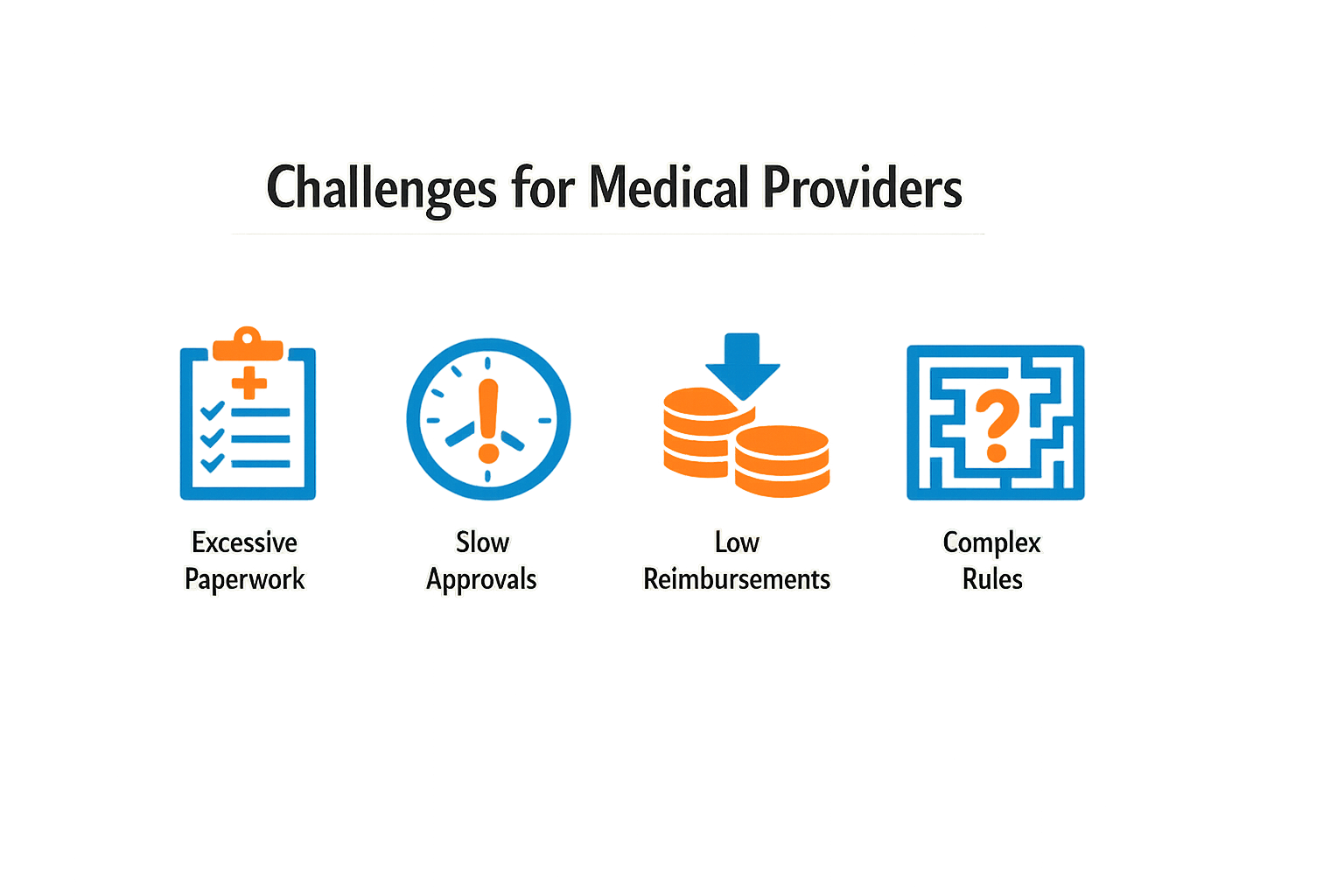
Medical providers navigating acceptance insurance requirements face a structural disadvantage that is rarely acknowledged in carrier guidance or credentialing materials. The information asymmetry is not incidental — it is built into the system. Carriers publish guidelines, maintain credentialing portals, and define submission standards, but the provider attempting to comply operates without the institutional knowledge, legal counsel, or procedural fluency that the carrier takes for granted.
The Knowledge Gap Between Provider and Carrier
A 2000 Florida Bar committee report on insurance practices observed that there is an inherent inequity in the ability of relatively unsophisticated insureds to present information compared to organized and informed insurance companies represented by experienced counsel. That observation, made in the context of insured client rights, applies with equal force to medical providers attempting to meet carrier credentialing and billing requirements. The carrier's guidelines are written by specialists who understand the nuances of LEDES file structure, UTBMS code sets, and billing increment conventions. The provider reading those guidelines may not have that background, and the carrier typically does not supply it.
The problem is not that providers are careless. The problem is that compliance depends on fluency with standards — LEDES 1998B field semantics, UTBMS task and activity codes, tenth-of-an-hour increments, narrative detail conventions — that are not taught in medical school or practice management courses. When a carrier rejects an invoice for a LEDES validation error or reduces a line item for insufficient narrative detail, the provider is left to reverse-engineer the requirement from the rejection code, often without access to the underlying guideline provision or the e-billing portal's validation logic.
Credentialing as a Moving Target
Credentialing requirements are not static. Carriers update their outside counsel guidelines, revise their panel criteria, and change their e-billing portal submission rules, often without direct notice to every provider on the panel. A provider who was credentialed under one version of a guideline may find that a subsequent invoice is rejected under a standard that was not in force when the credentialing application was approved. The carrier's guideline version number — if it has one — becomes the controlling document, but the provider may not know which version applies to a given matter or billing period.
For more on how carriers structure their billing requirements, see Outside Counsel Guidelines for Insurance Litigation.
The result is a compliance environment where the provider is held to standards that are difficult to locate, interpret, and track over time. The carrier has institutional processes for guideline maintenance, bill review, and reduction appeals. The provider has a credentialing packet, an e-billing login, and whatever guidance the carrier chose to publish. That imbalance is the core problem.
Solution Steps
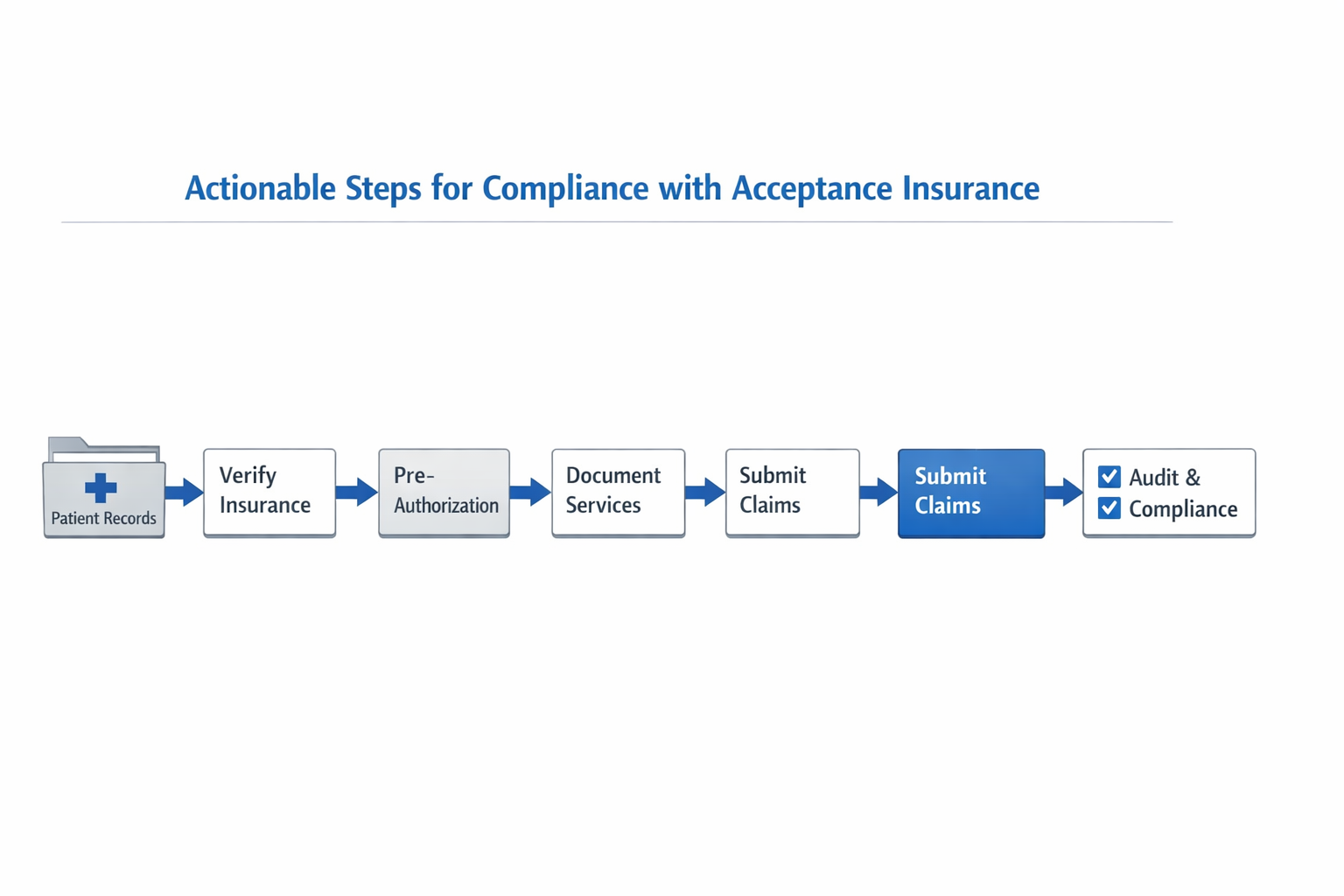
Meeting acceptance insurance requirements is not a guessing game. Each carrier publishes what it will and will not pay for, and following those specifications keeps invoices out of the rejection queue. The steps below outline a practical path to compliance.
Step 1: Verify approved provider status
Before submitting any invoice, confirm that every service provider on the claim appears on the carrier's approved list. ERMA's Quick Reference Handbook states plainly that members must use approved service providers. If a provider is not on the list, the invoice will be rejected regardless of how accurate the billing detail is. Check the carrier's provider directory or contact the claims administrator directly to verify status before any work begins.
Step 1
Confirm provider approval
Obtain written confirmation that each provider rendering service is on the carrier's approved panel. This is not a courtesy — it is a threshold requirement. An invoice from an unapproved provider will be rejected outright, and resubmitting under a different provider code is not a fix.
Step 2: Eliminate prohibited billing practices
LEDES error-code documentation identifies several billing practices that trigger automatic rejection: bulk billing, entries requiring prior approval but submitted without it, phrasing not allowed by the client, and unapproved rates. Review every line item against the carrier's published guideline to ensure none of these conditions are present. If the guideline prohibits block billing, split combined entries into separate tasks with individual time entries. If a rate has not been pre-approved, do not submit it.
Step 3: Align with third-party review requirements
Some carriers require that detailed billing invoices pass through a third-party review before payment. Virginia Legal Ethics Opinion 1723 addresses procedures that restrict the use of third-party vendors and require review of detailed billing invoices by a third party. Where such a requirement exists, the provider must structure submissions to accommodate that workflow. This may mean submitting invoices to a designated portal, attaching supporting documentation in a specified format, or adhering to narrative-detail standards that the reviewer can verify without follow-up questions.
For more on how billing descriptions must be structured to pass carrier review, see our guide on attorney billing descriptions that pass carrier review.
Step 2
Prepare for third-party review
If the carrier uses a third-party bill reviewer, submit invoices with enough narrative detail that the reviewer can verify each entry against contemporaneous records. Generic descriptions like "legal research" will not survive scrutiny. Specific task descriptions with time increments that match the guideline's billing-increment standard will.
Step 4: Document prior approvals
When a guideline requires prior approval for a category of work or a specific expense, obtain that approval in writing before the work is performed. Submitting an invoice with a line item marked "prior approval required" but no approval number or authorizing correspondence attached is a rejection trigger. Attach the approval document to the invoice submission, reference the approval number in the line-item narrative, and retain a copy in the matter file.
Step 5: Review before submission
Before submitting the invoice to the e-billing portal, conduct a final review against the carrier's guideline checklist. Verify that every provider is approved, every rate matches the pre-approved schedule, no prohibited practices appear in the narrative, and all required approvals are attached. A submission that clears this review is far less likely to be rejected, reducing the time and administrative cost of resubmission and appeal.
Tips and Tricks
Navigating acceptance insurance requirements demands attention to the carrier's published guidelines and a clear understanding of what triggers reductions or rejections. Medical providers who treat the carrier relationship as a partnership—rather than a transactional vendor arrangement—often find smoother credentialing and billing processes. This approach aligns with observations that carriers benefit when they view providers as partners, reducing friction around panel selection and administrative workflows.
Reduce Administrative Burden Early
Streamlining billing and collection processes before submission prevents downstream delays. When administrative tasks pile up, providers risk missing pre-approval thresholds or submitting invoices that lack the narrative detail carriers expect. Reducing the administrative burden around billing and collection can improve efficiency for medical providers, particularly when multiple carriers impose different billing increment rules or UTBMS code requirements. Establish internal checklists that map each carrier's guideline to your billing software's output—this prevents format mismatches that e-billing portals flag as validation errors.
Understand What Constitutes a Material Disincentive
Some carrier provisions create conflicts that affect the services a provider can reasonably deliver. For example, when a guideline imposes restrictions that result in a material disincentive to provide services that are reasonable and necessary, the provider faces an ethical tension. The R.I. Sup. Ct. Ethics Advisory Panel noted that such provisions can create a conflict of interest, making it critical to identify these restrictions during the credentialing phase. If a carrier's guideline prohibits billing for a category of work that your practice routinely performs, address the gap in writing before accepting the panel assignment.
Treat Rate Negotiations as Ongoing Conversations
Rate discussions should not be one-time events at the start of a panel relationship. Many providers wait years between rate increase requests, missing opportunities to align compensation with rising overhead or expanded service offerings. When you do request an increase, document the basis—whether it's inflation, new compliance costs, or changes in the carrier's own billing requirements. Anchor your request in the attorney billing increments: 0.1 vs. 0.25 requirements that the carrier enforces, showing how tighter billing standards increase the administrative cost per line item.
Carriers should look at firms as partners and not vendors.
Document Insured Cooperation Issues Immediately
Lack of cooperation from insureds causes unnecessary delays and expense, and carriers expect providers to flag these issues early. When an insured fails to respond to scheduling requests or provide necessary documentation, document each attempt and notify the carrier in writing. This creates a contemporaneous record that protects the provider if the carrier later questions the timeline or the necessity of follow-up work. The same principle applies to billing narratives: record the cooperation gap in the line item so the reviewer understands why a task took longer than expected.
Conclusion
Understanding acceptance insurance requirements is not a one-time compliance exercise — it is an ongoing practice that shapes every invoice, every line item, and every submission to an e-billing portal. The research and editorial work we perform as part of the Carrier Ready Knowledge Team focuses on distilling the specific rules that carriers publish, comparing them side by side, and identifying where practice may have drifted from the defined standards. When a carrier's guideline prohibits block billing or mandates tenth-of-an-hour increments, those are not suggestions — they are the controlling requirements for every timekeeper entry.
Medical providers and their billing teams must read the controlling document, quote what it says, and align every fee entry to that standard. A single line reading "research and draft motion in limine, 4.2" is enough to trigger a reduction under most panel guidelines, not because the work was unnecessary, but because the narrative failed to meet the carrier's published requirement for contemporaneous detail. The LEDES error code list published by the LEDES Oversight Committee confirms this: an entry that does not meet a specific requirement — bulk billing, prior approval, contains phrasing not allowed by client, unapproved rate — will be rejected at validation or flagged during bill review.
Carriers increasingly view the relationship with panel counsel and medical providers as a partnership rather than a vendor arrangement. One industry study noted that panel selection and rate negotiation should belong to claims or legal functions, and that carriers should reduce the administrative burden around billing and collection. That shift in perspective does not eliminate the requirement to comply with published guidelines — it underscores the importance of understanding them thoroughly so that the partnership can function without friction.
For medical providers navigating acceptance insurance requirements, the path forward is clear: obtain the current version of the carrier's outside counsel guidelines, identify the billing increment, narrative detail standard, and block billing prohibition, and structure every invoice to meet those requirements before submission. When an invoice is rejected or reduced, review the reduction code, compare the line item to the guideline language, and prepare a factual appeal that quotes the controlling provision. The carriers that publish these guidelines expect compliance, and the e-billing portals that enforce them are not discretionary gatekeepers — they are automated validators that apply the rules as written.
As we continue to examine LEDES file structures, UTBMS code sets, and the mechanics of e-billing portal submission, our goal remains the same: to provide medical providers with the factual foundation they need to submit invoices that pass carrier review on the first attempt. Acceptance insurance requirements are specific, they are enforceable, and they are the standard against which every fee entry will be measured. Read the guideline, follow the standard, and document your compliance — that is the practice that reduces write-downs and keeps the billing relationship on solid ground.
For additional guidance on structuring billing entries that meet carrier standards, see our Sample Attorney Billing Descriptions PDF That Pass Carrier Review.