


6-Minute Billing Increments: How Lawyers Bill in Tenths
Top takeaways
- 6-minute billing increments mean lawyers bill time to the nearest tenth of an hour, where one-tenth equals exactly six minutes
- Multiple carriers and courts require timekeepers to bill in tenths, not quarters or other fractions
- Billing in tenths allows precise tracking of short tasks while maintaining consistency across invoices and e-billing portals
- Rounding practices and increment selection directly affect invoice accuracy and carrier acceptance
Introduction
6-minute billing increments are the foundation of legal time-tracking. A tenth of an hour is six minutes. That conversion — from decimal billing units to clock time — sits at the center of legal time-tracking, fee entry, and invoice review. When a timekeeper records 0.3 hours for a task, the entry represents eighteen minutes of work. When a carrier outside counsel guideline states that time must be billed in increments no greater than one-tenth of an hour, it means every line item rounds to a multiple of six minutes.
The Central District of California's Criminal Justice Act panel manual states that time spent must be billed to the nearest tenth of an hour. PRISM's defense counsel standards require attorneys and paralegals to bill actual time spent in increments no greater than one-tenth of an hour for each entry. These requirements are not suggestions. They define the smallest allowable billing unit and control how timekeepers round partial tenths when the actual time falls between increments.
Understanding block billing and how carriers reject invoices requires first understanding what a compliant line item looks like at the increment level. A single task billed as 0.4 hours passes the increment test. The same task billed as 0.33 hours — one-third of an hour, or twenty minutes — does not, because one-third is not a multiple of one-tenth. The distinction matters during e-billing portal validation, during manual bill review, and when a reduction code flags an entry for rounding error.
Billing in tenths is a structural standard, not a pricing decision. It does not set the hourly rate, control staffing ratios, or determine whether a given narrative meets the guideline's detail requirements. It controls only the granularity of the time entry and the rounding method applied to partial increments. When a guideline prohibits billing in increments larger than one-tenth, it prohibits quarter-hour billing — 0.25, 0.50, 0.75 — and it prohibits rounding a seven-minute task up to 0.2 hours instead of down to 0.1.
The ABA's Formal Opinion 93-379 states that a lawyer must disclose to a client the basis on which the client is to be billed for professional time, and that any invoice should fairly reflect that basis. Billing in tenths satisfies the fair-reflection standard when the timekeeper records time contemporaneously and rounds consistently. It fails when the timekeeper batches multiple tasks into one entry, rounds every partial increment upward, or applies different increment rules to different types of work without disclosure.
Problem Statement
The six-minute billing increment is the industry standard, yet it remains a frequent source of confusion and dispute between law firms and their insurance carrier clients. According to the 2026 CLM Litigation Management Study, 82.8 percent of companies use the six-minute increment, virtually unchanged from 77 percent in 2023. That stability masks a persistent problem: many timekeepers do not understand what a tenth of an hour actually requires, and many clients do not trust that the increment is being applied honestly.
What Is the Rounding Problem?
A six-minute increment means that any task lasting between one second and six minutes is billed as 0.1 hours. A task lasting six minutes and one second rounds up to 0.2 hours, or twelve minutes. The arithmetic is simple, but the application is not. Timekeepers who record a two-minute task as 0.1 and a four-minute task as 0.1 are following the rule. Timekeepers who record ten such tasks in a day have billed one hour for work that took twenty minutes. That is not dishonest rounding — it is the mathematical consequence of the increment — but it looks like padding to a bill reviewer who sees ten 0.1 entries in a row.
The 2024 CLM Defense Counsel Study reported that 19 percent of attorneys were being asked to invoice in 0.05 increments, or three-minute intervals. That request reflects carrier frustration with the rounding effect. A three-minute increment reduces the maximum rounding error from five minutes and fifty-nine seconds to two minutes and fifty-nine seconds. But as the 2026 study confirms, the three-minute increment has not taken hold. Firms resist it because it doubles the number of time entries required to describe the same day, and carriers resist paying for the administrative cost of that change.
How Does the Block Billing Trap Work?
The increment problem is compounded by block billing, the practice of combining multiple tasks into a single narrative. A line reading "research motion in limine, draft reply, telephone conference with client, 1.8" does not tell the reviewer how much time each task consumed or whether the increment was applied to each task individually. If the timekeeper applied the increment to the total — 1.8 hours for all three tasks combined — the entry is compliant. If the timekeeper applied the increment to each task and then summed the rounded values, the entry may overstate the time by as much as fifteen minutes. The reviewer cannot tell which method was used, so the entry is rejected.
Most carrier outside counsel guidelines prohibit block billing outright. The prohibition is not about narrative style. It is about making the increment auditable. A guideline that requires separate line items for separate tasks is requiring the timekeeper to show the increment calculation for each task. That requirement eliminates the rounding ambiguity, but it also eliminates the efficiency of combining related tasks into a single entry.
What Is the Misalignment and Trust Issue?
The deeper problem is not the increment itself. It is the perception that the billable hour is misaligned with the value delivered. The 2026 CLM study lists "acknowledgment that the billable hour is misaligned" as one of the alternative fee arrangements commonly mentioned by respondents. That acknowledgment is not new, but it is increasingly explicit. Clients do not trust that the increment is being applied fairly, and they do not trust that the time recorded reflects the time required. The increment becomes a proxy for that distrust.
A tenth of an hour is a recording convention, not a pricing model. It was adopted because it is easier to multiply 0.1 by an hourly rate than to multiply six minutes by a rate expressed in dollars per hour. But the convention has outlived its administrative justification. Modern time-tracking software can handle any increment, including actual minutes. The six-minute increment persists because it is the default in LEDES 1998B and because changing it would require every firm and every e-billing portal to update their systems simultaneously. That coordination cost is high enough that the industry has chosen to live with the rounding problem rather than solve it.
Solution Steps
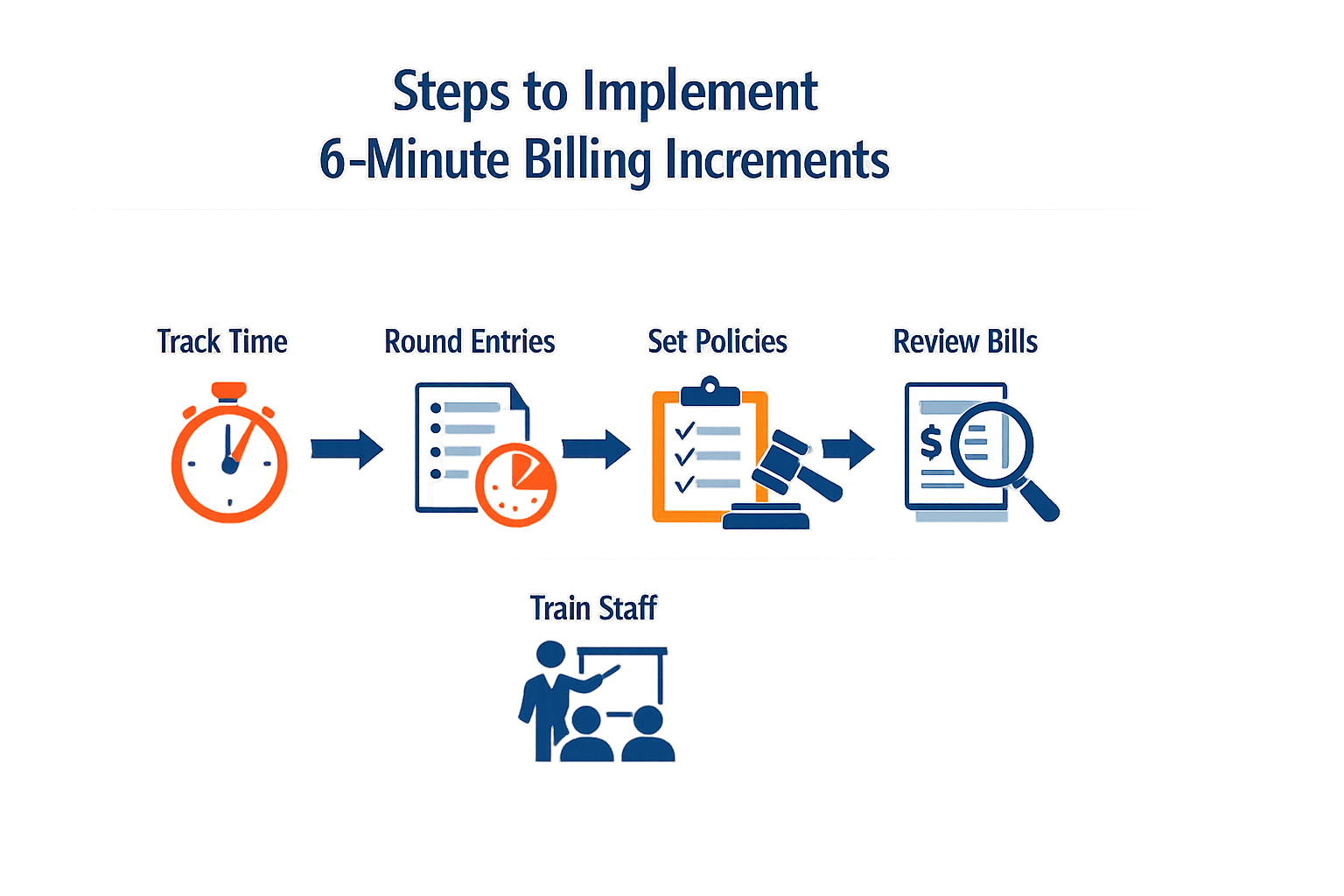
Implementing 6-minute billing increments requires a deliberate shift in how timekeepers record their work. The following steps outline a practical approach to adopting tenth-of-an-hour billing and ensuring compliance with outside counsel guidelines and e-billing portal requirements.
Step 1
Round to the nearest tenth of an hour
Attorneys must bill the actual amount of time spent on each task rounded to the nearest tenth of an hour. A tenth of an hour equals six minutes. If a task takes four minutes, round to 0.1 hours; if it takes seven minutes, round to 0.1 hours; if it takes eight minutes, round to 0.2 hours. Rounding down is the safer practice when the increment falls exactly between two tenths.
Step 2
Track time contemporaneously
Record time as tasks occur, not at the end of the day or week. Contemporaneous records support accurate rounding and provide the narrative detail required by most carrier guidelines. Reconstructed time entries often drift toward block billing or imprecise increments, both of which trigger reductions during bill review.
Step 3
Bill only compensable activities
When billing for in-court time, bill only for services related to the merits of the case — hearings before the court, reviewing case-related documents, or client and witness interviews. Do not bill wait time in excess of 30 minutes unless actively working on another case during that period. For detailed guidance on categorizing billable activities, see UTBMS Activity Codes A101-A111 for Legal Billing.
Step 4
Avoid aggregating tasks into daily totals
Attorneys are limited to billing the actual time worked in a day, but that does not mean collapsing numerous tasks into a single line item. Sufficient detail is still required to support both in-court and out-of-court entries. Each discrete task should appear as a separate line item with its own tenth-of-an-hour increment, task code, and narrative.
Validate entries before submission
Before submitting an invoice through an e-billing portal, verify that every line item uses a tenth-of-an-hour increment. Many portals validate the hours field and reject invoices containing fractional hours that do not align with the 0.1 increment standard. Correcting these errors after submission delays payment and creates additional administrative overhead.
Tips and Tricks
Accurate time tracking in 6-minute increments requires discipline and contemporaneous record-keeping. The Central District of California Criminal Justice Act panel manual states that time spent must be billed to the nearest tenth of an hour — a requirement that applies equally to appointed and retained counsel in most billing contexts. Lawyers who wait until the end of the day to reconstruct their time entries introduce rounding errors, memory gaps, and the risk of overstating or understating the work performed.
How Can You Track Time as It Happens?
Contemporaneous time tracking eliminates guesswork. Record the start and stop time for each discrete task immediately after completing it, even if the task lasted only three minutes. A quick email response or a brief client phone call may round up to 0.1 hours, but only if you capture it when it occurs. Lawyers who batch their time entries at the end of the week often cannot recall whether a task took four minutes or eight minutes, and that ambiguity leads to inconsistent billing.
Use a Conversion Chart Until the Pattern Is Automatic
The Florida Justice Administrative Commission publishes a chart that maps minute ranges to tenths: 1–6 minutes equals 0.1 hours, 7–12 minutes equals 0.2 hours, and so on through 55–60 minutes at 1.0 hours. Keep this chart visible until the conversion becomes second nature. Misapplying the increment — for example, billing 0.2 hours for a five-minute task — overstates the time and invites a reduction or rejection when the invoice reaches the carrier's bill review team.
Do Not Charge More Time Than Actually Spent
ABA Formal Opinion 93-379 addresses billing fairness: a lawyer must disclose the basis on which the client is billed, and any invoice should fairly reflect how charges were determined. While the opinion permits rounding up to a minimum billing unit, it does not permit charging a client for more time than the lawyer actually spent. A two-minute task may be billed at 0.1 hours under a tenth-of-an-hour increment, but it cannot be billed at 0.2 hours simply because the next task also took two minutes. Each task must be recorded separately, with its own start and stop time, and rounded independently.
A lawyer cannot charge clients for more time than actually spent on a matter, ensuring fairness in billing.
Separate Tasks to Avoid Block Billing
Block billing — combining multiple tasks into a single narrative and a single time entry — obscures the work performed and makes it impossible for a bill reviewer to verify that each task was billed at the correct increment. Instead of writing "research motion, draft motion, revise motion, 2.4," break the entry into three lines: "research motion in limine, 0.8," "draft motion in limine, 1.2," and "revise motion in limine, 0.4." Each line item can then be reviewed against the appropriate UTBMS activity code and checked for compliance with the carrier's guideline on narrative detail. For more on how block billing triggers rejections, see Block Billing: Reasons for Carrier Rejections and Solutions.
How Should You Round Each Task Independently?
Do not aggregate short tasks to justify a higher increment. If you spend four minutes on a status email and five minutes on a brief phone call, those are two 0.1-hour entries, not one 0.2-hour entry. Aggregating tasks to reach a higher billing unit is inconsistent with the fairness standard in ABA Formal Opinion 93-379 and will not survive scrutiny in an e-billing portal that flags entries without corresponding narrative detail.
Review Time Entries Before Submission
Before submitting an invoice to an e-billing portal, review each line item to confirm that the time increment matches the task description. A narrative reading "brief email to client" should not carry a 0.5-hour charge. A narrative reading "attend four-hour deposition" should not carry a 3.8-hour charge unless the actual attendance time was between 3 hours 43 minutes and 3 hours 48 minutes. Inconsistencies between the narrative and the billed time are among the most common reasons for invoice rejection.
Conclusion
The six-minute billing increment — one-tenth of an hour — remains the dominant standard in legal billing because it captures short-duration work without the rounding distortion that quarter-hour billing creates. The 2026 CLM Litigation Management Study confirms that 82.8% of companies continue to use the six-minute increment, a figure virtually unchanged from 77% in 2023. Three-minute increments have not displaced the tenth-of-an-hour convention, and the hourly model itself continues to anchor most fee arrangements despite ongoing discussion of alternatives.
Understanding how 6-minute billing increments work is not optional for any timekeeper submitting invoices to panel counsel programs or e-billing portals. PRISM's Defense Counsel Standards state that "attorneys and paralegals should bill actual time spent in increments, no greater than 1/10th of an hour for each entry," a requirement echoed in the outside counsel guidelines of most carriers. When a guideline specifies tenth-of-an-hour increments, a line item billed at 0.25 or 0.5 without corresponding work duration triggers a reduction code or an outright rejection at the portal validation stage.
Best Practices for Timekeepers
Record time contemporaneously, in the increment the client or carrier requires. If the guideline is silent on increments, tenth-of-an-hour is the safe default. Round each task independently — never aggregate multiple tasks into a single rounded block. Each line item must carry a narrative sufficient to show what the 0.1 or 0.2 represents, and the UTBMS activity code must match the work described. When a task genuinely takes two minutes, billing 0.1 is accurate; when it takes eight minutes, 0.2 is accurate. The increment is a reporting convention, not a license to inflate.
Carriers and corporate clients enforce billing increments because they produce predictable, auditable invoices. A timekeeper who masters tenth-of-an-hour recording, pairs it with compliant narratives, and submits clean LEDES 1998B files will see fewer rejections, faster payment, and stronger client relationships. The six-minute increment is not going away — it is the arithmetic backbone of the billable hour, and fluency in its mechanics is a baseline competency for any lawyer billing time.
FAQ
What are 6-minute billing increments?
6-minute billing increments represent one-tenth of an hour (0.1 hours). Lawyers round each task to the nearest multiple of six minutes: 1-6 minutes = 0.1 hours, 7-12 minutes = 0.2 hours, and so on.
Why do lawyers use 6-minute billing increments instead of actual minutes?
The tenth-of-an-hour standard simplifies rate calculations and maintains consistency across e-billing portals and LEDES file formats. Most carrier guidelines and court programs require tenth-of-an-hour billing.
How do I convert 6-minute billing increments to actual time?
Multiply the decimal by six: 0.1 hours = 6 minutes, 0.3 hours = 18 minutes, 0.5 hours = 30 minutes, 1.0 hours = 60 minutes.
Can I bill in quarter-hour increments instead of tenths?
Most carrier guidelines prohibit billing in increments larger than one-tenth of an hour. Quarter-hour billing (0.25, 0.5, 0.75) typically triggers rejections in e-billing portals that enforce tenth-of-an-hour standards.
What happens if I submit time entries not billed in tenths?
E-billing portals may automatically round down non-compliant entries or reject the entire invoice. A 0.15-hour entry may be reduced to 0.1 hours without notice.