

UTBMS Expense Codes (E101–E124): Carrier Treatment Guide
Introduction
What Are UTBMS Expense Codes (E101–E124)?
UTBMS Expense Codes (E101–E124) are the original 24-code set published by the American Bar Association in 1997 to standardize the reporting of litigation expenses. The codes range from E101 (Copying) through E124 (Other), covering categories such as printing, telephone, online research, travel, court fees, deposition transcripts, expert fees and professional services. Each code represents a distinct type of disbursement that a law firm incurs and seeks reimbursement for when submitting an invoice.
As part of the Carrier Ready Knowledge Team, our focus often turns to understanding the nuances of UTBMS Expense Codes (E101–E124). These codes are integral to the legal billing process, providing a standardized method for categorizing expenses. The LEDES 1998B File Format requires expense entries to carry a valid UTBMS code in the EXP_CODE field, and e-billing portals validate submissions against the code list before accepting an invoice.
The 2013 LEDES Oversight Committee published a revised expense code set—designated the X-series—that expands the original 24 categories into more than 100 subcodes. For example, E101 (Copying) splits into X101 (Copies/Blowbacks/Printing-Black & White, Internal), X102 (Copies/Blowbacks/Printing-Color, Internal), X103 (Copy Service, External) and X104 (Special Handling Copying/Scanning/Imaging, Internal). The revision allows for finer reporting granularity, but many carriers and e-billing systems continue to reference the 1997 E-series codes in their guidelines and rejection logic.
Why Carrier Treatment Matters
Carriers do not treat all UTBMS Expense Codes (E101–E124) equally. One insurer's outside counsel guidelines may permit local travel (E109) at actual cost, while another caps mileage reimbursement or requires pre-approval above a threshold. A third carrier may disallow local travel entirely, expecting counsel to absorb those costs as overhead. The same variance applies to codes like E103 (Word processing), E106 (Online research) and E111 (Meals). Without knowledge of the specific guideline in force, a firm submits an invoice that complies with the UTBMS standard but violates the carrier's billing rules—triggering a reduction, a request for additional documentation, or outright rejection of the line item.
Understanding how carriers interpret each code prevents these outcomes. It also informs front-end decisions: whether to incur an expense at all, how to document it, and which UTBMS code to assign when the nature of the charge could fit more than one category. The codes themselves are descriptive labels; the enforceable rules live in the carrier guidelines, and those guidelines often cite the codes by number when stating what is reimbursable and what is not.
Problem Statement
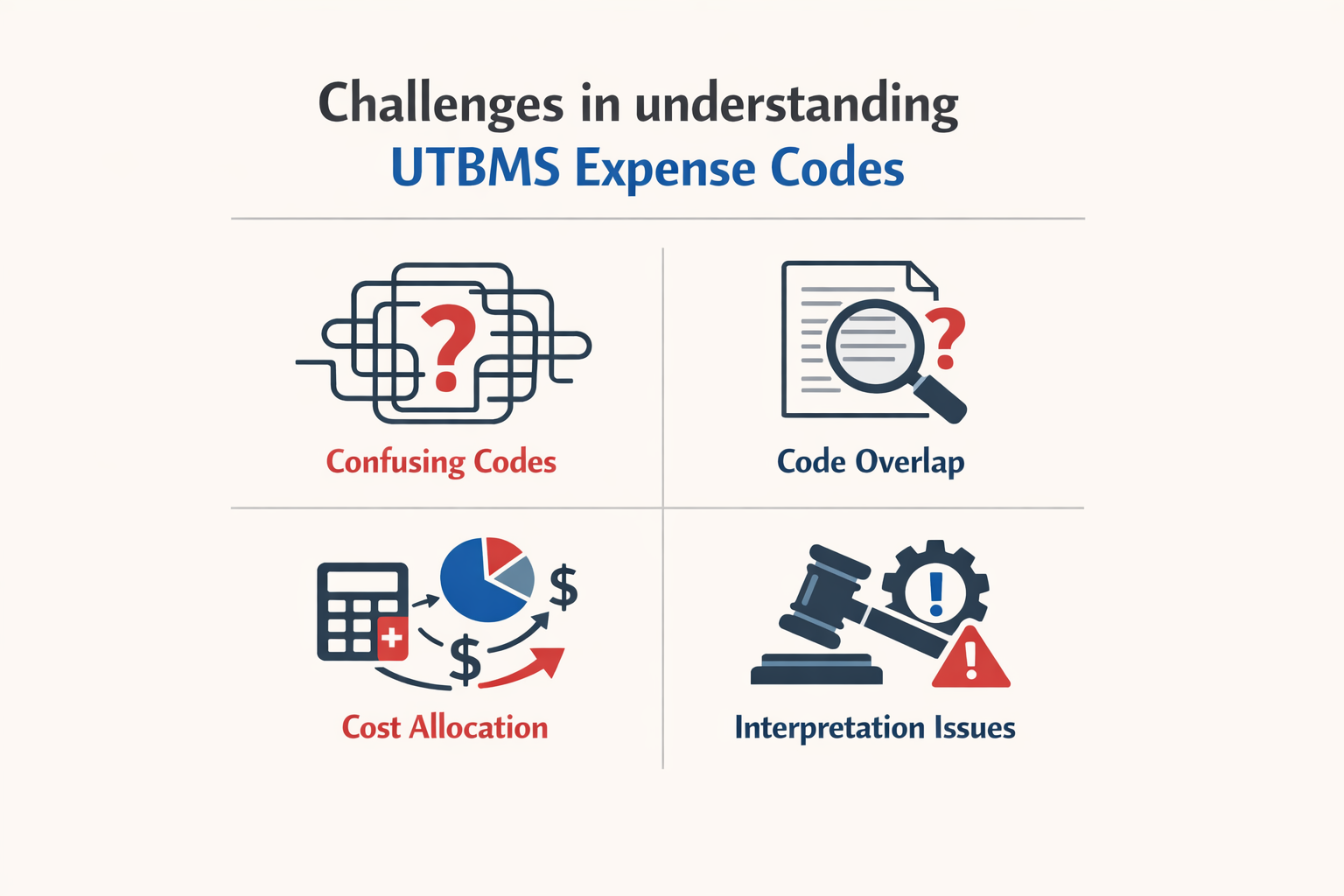
Legal professionals submit invoices coded with UTBMS Expense Codes (E101–E124) expecting straightforward reimbursement, only to encounter carrier reductions, portal rejections, and inconsistent treatment across matters. The 1997 ABA UTBMS Expense Code set defines 24 categories — from E101 Copying through E124 Other — but the definitions alone do not reveal which entries carriers flag, which require pre-approval, or where markup practices trigger automatic write-downs. A law firm may code a line item E106 Facsimile at cost and receive full payment on one matter, then code the same entry on another carrier's panel and face a reduction for failing to disclose a service-center markup or for billing a technology that the guideline treats as overhead.
Guideline Silence and Code Overlap
Carrier outside counsel guidelines rarely address every expense code by name. Where a guideline is silent on E105 Telephone or E108 Postage, counsel must infer treatment from general provisions on overhead, cost-plus-markup caps, or itemization thresholds. The 2013 LOC Revised UTBMS Expense Codes introduced granular subcodes — X101 through X122 and beyond — that split the original 24 categories into dozens of variants, but adoption is uneven. One carrier's e-billing portal may accept only the 1997 E-codes; another may require the X-series; a third may map both sets to a proprietary schema that surfaces no validation error until the invoice reaches manual review. When a single copying charge can be coded E101, X101, X102, X103 or X104 depending on color, internal versus external vendor, and special handling, the risk of selecting a code the reviewer interprets as non-reimbursable or requiring additional documentation rises sharply.
Markup, Cost-Plus and the Overhead Boundary
Most disputes center on whether an expense represents actual third-party cost or firm overhead dressed as a disbursement. The 1997 code set includes E103 Word Processing, E104 Facsimile, and E106 Online Research — all categories that many carriers now treat as included in hourly rates rather than separately reimbursable. When counsel bills E103 at an internal word-processing rate, the reviewer applies the guideline's overhead rule: if the expense did not require an out-of-pocket payment to a non-firm vendor, it is overhead and the line item is reduced to zero. Similarly, E109 Local Travel and E110 Out-of-Town Travel attract scrutiny when the narrative does not distinguish mileage, parking, taxi, airfare, and hotel into separate entries or when a single line aggregates costs across multiple timekeepers. The 2013 LOC revision attempts to impose structure — X114 Local Travel and X115 Out-of-Town Travel both state "If client requires a more granular breakdown, law firm or legal vendor should submit separate itemized expense line items" — but the phrase "if client requires" leaves the obligation ambiguous, and many portals accept a lump entry that the reviewer later splits and partially disallows.
Code Definitions and Billing Reality
The ABA UTBMS Expense Codes (1997) list offers one-line descriptions: E107 Delivery services/messengers, E112 Court fees, E115 Deposition transcripts. These descriptions do not specify whether a FedEx envelope sent for firm convenience is reimbursable, whether e-filing convenience fees fall under E112 or E124 Other, or whether a rough-draft deposition transcript ordered for trial preparation qualifies as E115 when the guideline reimburses only the final certified copy. Counsel codes the entry according to the category that seems closest, the portal accepts the file, and the reduction arrives weeks later with a terse explanation: "Expense not pre-approved" or "Guideline prohibits this category." The 2013 LOC code X112 Delivery Services/Messengers states "Excludes Postal Service charges (X113)," and X113 Postage states "Any costs for regular, certified and overnight mail through the Postal Service only" — a distinction invisible in the 1997 E-code set, where E107 and E108 together cover all delivery and postage without separating the Postal Service from private carriers. A carrier that adopted the LOC revision internally but still requires E-codes in the LEDES file will interpret an E108 entry that includes FedEx as miscoded, even though the 1997 definition does not exclude it.
The cheapest code to use is the one the reviewer interprets the same way you do, and that alignment happens only when the narrative, the guideline and the code definition all point in the same direction.
For further context on how activity codes interact with expense coding and billing structure, see UTBMS Activity Codes A101-A111 for Legal Billing.
Solution Steps
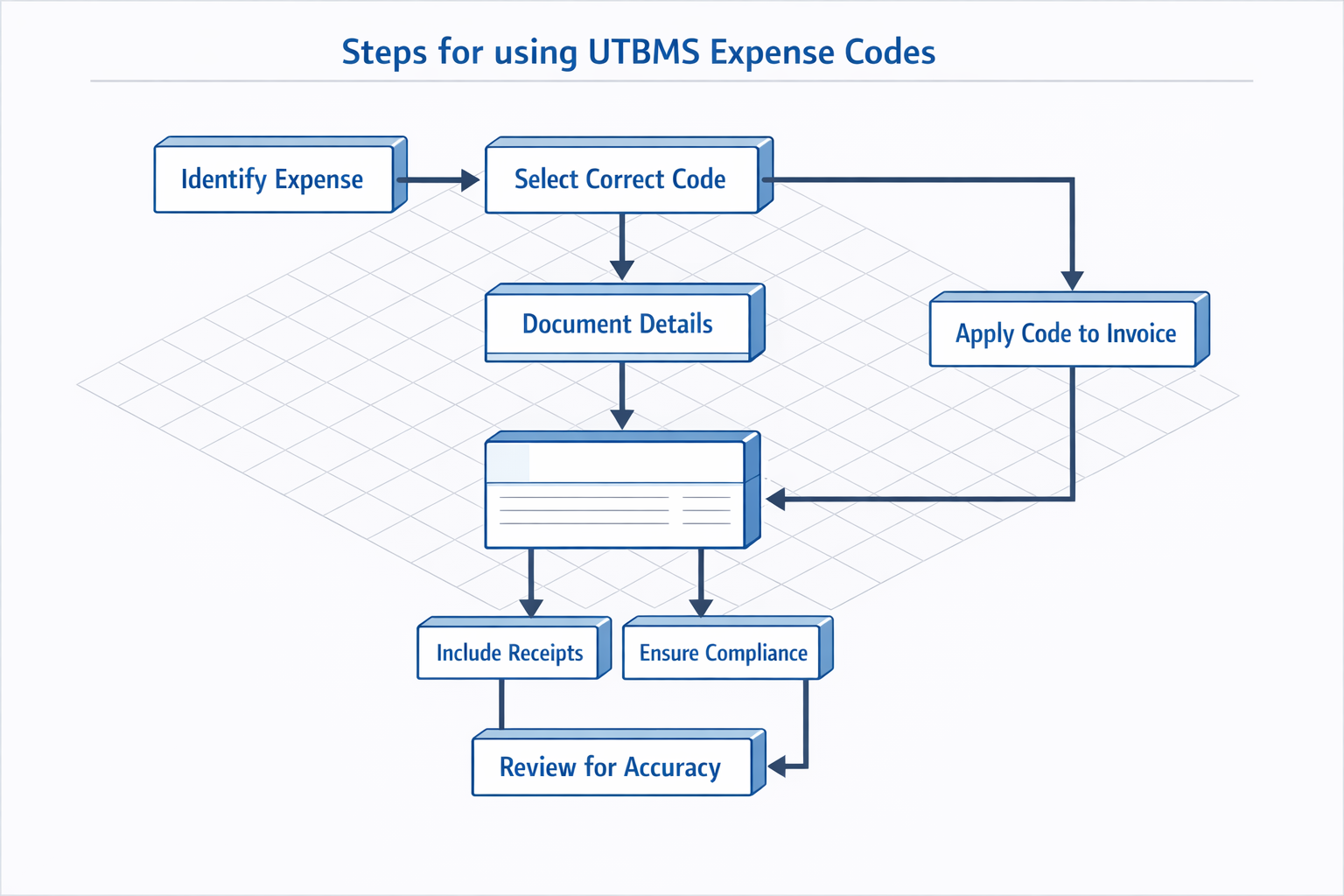
Effective use of UTBMS Expense Codes (E101–E124) requires a methodical approach that aligns with carrier guidelines and billing platform requirements. The steps below outline a practical workflow for categorizing expenses, validating entries, and submitting invoices that pass e-billing portal validation without triggering common reduction codes.
Step 1: Identify the Correct Expense Code from the UTBMS Set
Step 1
Match the expense to the published code definition
Begin by consulting the ABA UTBMS Expense Codes (1997), which defines 24 codes from E101 through E124. Each code corresponds to a distinct category: E101 for copying, E102 for outside printing, E103 for word processing, E104 for facsimile, E105 for telephone, E106 for online research, E107 for delivery services and messengers, E108 for postage, E109 for local travel, E110 for out-of-town travel, E111 for meals, E112 for court fees, E113 for subpoena fees, E114 for witness fees, E115 for deposition transcripts, E116 for trial transcripts, E117 for trial exhibits, E118 for litigation support vendors, E119 for experts, E120 for private investigators, E121 for arbitrators and mediators, E122 for local counsel, E123 for other professionals, and E124 for other expenses. Select the code that most narrowly describes the actual service or item purchased.
Step 2: Verify Carrier-Specific Treatment and Restrictions
Carrier outside counsel guidelines often impose additional restrictions on expense reimbursement beyond the UTBMS code definitions. Review the applicable guideline version for pre-approval thresholds, per-page rate caps, and outright prohibitions. For instance, some carriers disallow word processing charges (E103) entirely, while others cap copying costs (E101) at a fixed rate per page. If the guideline is silent on a particular code, that silence is not permission — contact the bill reviewer before submitting.
Step 3: Prepare the Line Item with Required Detail
Each expense line item in a LEDES 1998B file must include the UTBMS code, a narrative description, the date incurred, the quantity, the unit cost, and the total amount. The narrative should identify the vendor, the purpose tied to a UTBMS task code, and any invoice or receipt number. Vague entries like "copies, 150 pages" invite reduction; "Copies of medical records for Dr. Smith deposition, vendor invoice 4521, 150 pages at $0.10/page" does not.
Step 2
Document the expense with contemporaneous records
Attach or reference the underlying receipt, invoice, or vendor statement. Many e-billing portals require uploaded documentation for expenses above a threshold (commonly $50 or $100). Even when not required, having the backup ready accelerates the appeal process if the line item is flagged.
Step 4: Submit Through the E-Billing Portal and Monitor Validation
Upload the LEDES file to the carrier's designated e-billing platform. The portal will validate the file structure, check that UTBMS codes are recognized, and apply any automated guideline edits. Common validation errors include mismatched expense codes (using a 2013 LOC Revised code like X101 when the carrier expects E101), missing narratives, and amounts that exceed pre-set caps. Address validation errors immediately; a rejected file does not preserve your submission date.
Step 5: Respond to Reductions with Specific Guideline Citations
When a carrier reduces or disallows an expense, the reduction notice will cite a code or guideline section. Pull the exact language from the guideline, compare it to your line item, and draft a response that either (a) shows the expense falls within the allowed category, or (b) requests an exception with supporting documentation. Generic appeals ("this expense was necessary") rarely succeed; appeals that quote the guideline and attach a vendor invoice often do. For more on handling invoice rejections, consult the linked resource.
Tips and Tricks for Using UTBMS Expense Codes (E101–E124)
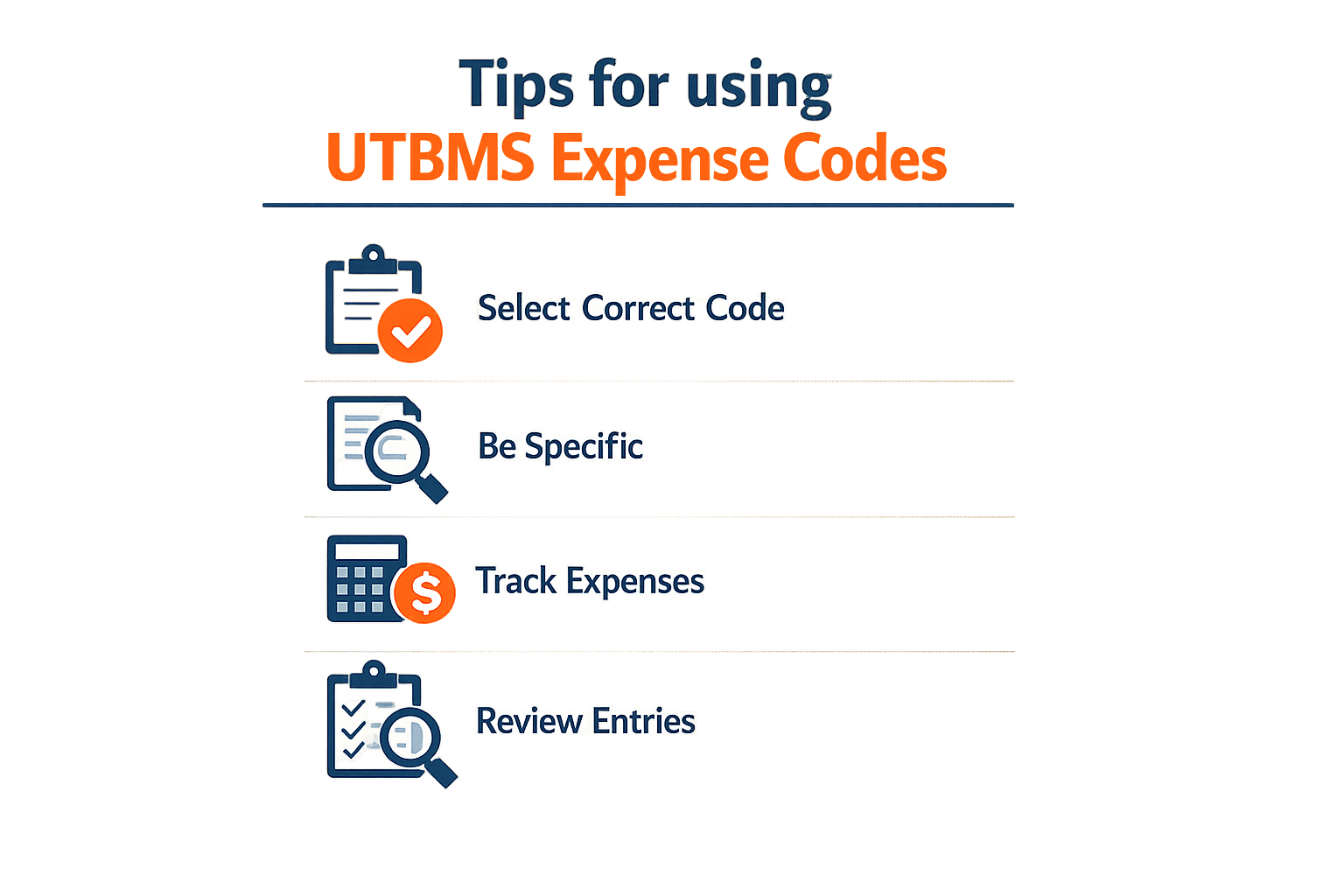
The codes themselves are defined, but practical billing success depends on how you apply them. When submitting an expense under X114 Local Travel, for instance, the 2013 LOC Revised UTBMS Expense Codes specify that the code covers ground transportation, mileage and parking. If the carrier guideline requires a more granular breakdown, you submit separate itemized line items rather than one aggregated charge. The code tells you what belongs in the category; the guideline tells you whether to consolidate or itemize.
The same principle applies to X115 Out-of-Town Travel. That code encompasses airfare, ground transportation, rental car, mileage, parking and hotel. Some carriers accept a single X115 line; others require each component on its own line. Read the guideline, then structure the invoice accordingly.
Match the Code to the Actual Expense
X101 and X102 distinguish black-and-white from color internal printing. X103 captures external copy services. X104 is reserved for special handling — oversized copying, binding, scanning and imaging that requires manual intervention. If you bill routine letter-size copies under X104, the reviewer will reduce the line to X101 rates. The code hierarchy reflects cost tiers, and the reviewer enforces those tiers.
X111 Online Legal Research covers services like LexisNexis and Westlaw. X117 Court and Governmental Agency Fees includes UCC and land-record filings but excludes late fees, which belong under X122. X122 itself covers late fees imposed by governmental or quasi-governmental agencies for missed deadlines — including, in IP matters, Petition for Extension of Time and Information Disclosure Statement fees — but excludes any late fee or finance charge on overdue legal bills. When a code explicitly excludes something, that exclusion is not negotiable.
Separate Communication Charges by Type
X106 Facsimile, X107 Telephone-Local, X108 Telephone-Long Distance and X109 Telephone-Mobile are distinct codes. X110 Conference Call/Video Call/Webinar Charges covers multi-party communication. If you bill a conference call under X108, you have misclassified it. Reviewers flag misclassifications, and portals that validate codes at submission will reject the line outright.
VOIP expenses present a recurring question. The 2013 LOC Revised UTBMS Expense Codes state that VOIP should be billed as a single line item rather than a per-call charge, under either X107 or X108 depending on whether the calls are local or long distance. If the carrier guideline prohibits VOIP pass-throughs entirely, the code becomes irrelevant — the guideline wins.
Understand Travel and Meal Separation
X114 and X115 exclude billable travel time. Travel time is an activity, not an expense, and belongs under activity code A115 for local travel or A112 for out-of-town travel. If you bill travel time as an expense, the line will be rejected. X116 Meals covers meals whether local or associated with travel, but many carrier guidelines cap meal reimbursement at a per-diem rate or require pre-approval above a threshold. The code permits the charge; the guideline sets the limit.
X114 and X115 exclude billable travel time — travel time is an activity, not an expense.
Apply Matter-Specific Codes Correctly
X118 Eviction Costs, X119 Foreclosure Costs, X120 Title Insurance Costs and X121 Immigration Costs are matter-specific codes for expenses not covered by the general set. X118 and X119 capture costs unique to eviction and foreclosure actions; X120 covers title service, examination and abstract costs; X121 includes credentials evaluation and fixed expense allowances in immigration matters. These codes exist because the general codes do not fit. If you bill a title search under X117, you have ignored the specific code, and the reviewer will flag it.
X112 Delivery Services/Messengers covers overnight services like FedEx, UPS and DHL, plus internal messenger services. X113 Postage is limited to the Postal Service — regular, certified and overnight mail sent through USPS. If you bill a FedEx charge under X113, the code is wrong. The distinction matters because some guidelines reimburse USPS at cost but cap courier charges or require pre-approval.
For more detail on how activity codes interact with expense codes in a LEDES file, see UTBMS Activity Codes A101-A111 for Legal Billing.
Conclusion
Understanding UTBMS Expense Codes (E101–E124) is not a matter of memorizing a list — it is a matter of knowing which codes carriers scrutinize, which require pre-approval, and which narrative detail satisfies the reviewer reading the invoice. The 1997 ABA set established 24 expense categories; the 2013 LEDES Oversight Committee revision expanded and subdivided them into more granular codes. Both sets remain in use, and carriers specify which set they accept in their outside counsel guidelines. When a firm submits an expense under E110 (out-of-town travel) to a carrier that requires the X-series codes, the portal rejects the file before a human reviewer sees it.
As part of the Carrier Ready Knowledge Team, our focus often turns to understanding the nuances of UTBMS Expense Codes (E101–E124). These codes are integral to the legal billing process, providing a standardized method for categorizing expenses. However, the treatment of these codes can vary significantly among carriers. For instance, across the published guidelines we've reviewed, certain entries like travel, intra-office conferences, and administrative time billed at attorney rates are frequently flagged for reductions. This pattern highlights the importance of understanding each carrier's specific guidelines to ensure compliance and avoid unnecessary reductions.
Carriers do not treat all expense codes equally. Copying, postage, and court fees are generally reimbursable at cost when supported by an invoice or receipt. Online legal research, local travel, and meals are reimbursable subject to caps, narrative justification, and sometimes prior approval. Word processing, facsimile, and telephone charges billed as overhead add-ons are routinely reduced or disallowed under guidelines that permit only actual third-party costs. The difference between a clean payment and a reduction often comes down to whether the narrative explains what the expense purchased, why it was necessary, and how much the third party charged.
The expense code is not a substitute for the narrative. A line reading "E115, $450" tells the reviewer nothing; a line reading "E115 deposition transcript, Dr. Martinez 3/12/25, 150 pp. @ $3.00/page, $450" tells the reviewer everything. When the narrative matches the code, matches the amount, and matches the carrier's guideline, the line clears. When any one of those three elements is missing or inconsistent, the line is flagged, and the timekeeper who submitted it answers questions or accepts a write-down.
For firms that bill multiple carriers, the solution is not to avoid expense codes — it is to maintain a reference table that maps each carrier's accepted code set, narrative requirements, and reimbursement caps, and to train timekeepers to write expense narratives the same way they write time narratives: contemporaneously, specifically, and with the guideline open in front of them. The UTBMS code is the label; the narrative is the proof. Both are required.
Frequently asked questions
How do UTBMS Expense Codes (E101–E124) differ from the X-series codes?
UTBMS Expense Codes (E101–E124) are the original 24-code set published by the ABA in 1997. The X-series codes, published by the LEDES Oversight Committee in 2013, expand the original 24 categories into more than 100 subcodes for finer reporting granularity. For example, E101 (Copying) splits into X101 (black-and-white internal), X102 (color internal), X103 (external vendor), and X104 (special handling). Many carriers still reference the 1997 E-series in their guidelines.
What happens if I use the wrong UTBMS expense code on an invoice?
Using the wrong code can trigger portal validation errors, manual review flags, or outright reductions. If you code a deposition transcript as E124 (Other) instead of E115 (Deposition transcripts), the reviewer may reduce the line or request clarification. Portals that validate codes at submission will reject mismatched entries before the invoice reaches human review.
Do all carriers accept the same UTBMS expense codes?
No. One carrier's e-billing portal may accept only the 1997 E-codes (E101–E124), another may require the 2013 X-series, and a third may map both sets to a proprietary schema. Always check the carrier's outside counsel guidelines and e-billing platform requirements before submitting.
Which UTBMS Expense Codes (E101–E124) are most frequently reduced by carriers?
Word processing (E103), facsimile (E104), telephone (E105), and online research (E106) are frequently reduced because many carriers treat these as overhead included in hourly rates. Local travel (E109) and meals (E111) are often capped or require pre-approval. Always review the specific carrier guideline before billing these categories.
Where can I find the official UTBMS Expense Codes (E101–E124) definitions?
The official 1997 ABA UTBMS Expense Codes list is available from UTBMS.com. The 2013 LOC Revised UTBMS Expense Codes document is also available from the same source. Both documents provide code-by-code definitions and exclusions.