

UTBMS Expense Codes (E101–E124): Full List and How Carriers Treat Each
Top takeaways
- UTBMS Expense Codes (E101–E124) provide a standardized framework for categorizing litigation expenses in legal billing.
- Each code represents a distinct expense type, from copying and telephone charges to travel, meals, and matter-specific costs.
- Carrier treatment of these codes varies by guideline, with certain entries frequently flagged for reduction or requiring pre-approval.
- Understanding the code definitions and carrier-specific restrictions is essential to avoid invoice rejections and write-downs.
- Proper coding and narrative detail improve the likelihood of reimbursement and reduce bill review friction.
Introduction to UTBMS Expense Codes (E101–E124)
UTBMS Expense Codes serve as the industry-standard taxonomy for categorizing non-time expenses in legal invoices. Originally developed by the LEDES Oversight Committee and revised by the Legal Electronic Data Exchange Standard working groups, the expense code set runs from E101 through E124, covering everything from internal photocopies to immigration matter costs. When a law firm submits an invoice in LEDES 1998B format, each expense line item carries one of these codes in the EXP_CODE field, telling the carrier or client exactly what the charge represents.
As part of the Carrier Ready Knowledge Team, our focus often turns to understanding the nuances of UTBMS expense codes. These codes are integral to the legal billing process, providing a standardized method for categorizing expenses. However, the treatment of these codes can vary significantly among carriers, and certain entries are frequently flagged for reductions.
The standardization matters because carriers and corporate clients use the codes to automate validation, apply guideline rules, and route invoices through e-billing portals. A code mismatch or an unsupported expense type triggers a rejection at the portal level, long before a human bill reviewer sees the invoice. Even when the portal accepts the file, the code determines whether the expense falls within the carrier's reimbursement policy or requires pre-approval, itemization, or supporting documentation.
What the Code Set Covers
The UTBMS expense code range divides into functional categories. Codes E101 through E110 address communication and document production: copies, printing, facsimile, telephone, and conference calls. Codes E111 through E113 cover legal research and delivery services. Codes E114 through E116 handle travel and meals. Codes E117 through E124 capture matter-specific expenses, including eviction costs, foreclosure costs, title insurance, and immigration-related charges.
Each code definition specifies what the category includes and, in some cases, what it excludes. For example, X114 Local Travel includes ground transportation, mileage, and parking, but excludes billable travel time, which belongs in activity code A115. X115 Out-of-Town Travel covers airfare, hotel, and rental cars, but excludes billable travel time coded to A112. The exclusions prevent double-billing and clarify the boundary between reimbursable expenses and compensable time.
Why Carriers Care About Expense Coding
Carriers apply different reimbursement rules to different expense types. Internal photocopies at a few cents per page rarely draw scrutiny. External copy services billed at vendor rates may require itemization or a cost ceiling. Online legal research charges often trigger guideline limits or require the firm to demonstrate that the research was case-specific and not general reference work. Travel and meal expenses frequently require pre-approval, adherence to per diem caps, and exclusion of alcohol or entertainment.
The code itself does not determine reimbursability — the carrier's outside counsel guidelines do. But the code is the first filter. If an expense is coded to X116 Meals and the guideline states that meals require prior written approval, the bill reviewer flags every X116 line item that lacks an approval reference. If the guideline caps out-of-town travel at coach airfare and the narrative does not specify the fare class, the reviewer reduces or rejects the charge.
Structure of This Guide
This article walks through the full E101–E124 code set, explains what each code covers, and identifies the carrier treatment patterns that appear most often in published guidelines. The goal is not to replace the carrier's specific guideline — nothing does — but to give timekeepers and billing staff a working reference for coding expenses correctly and anticipating the questions that bill reviewers will ask.
Understanding the Challenges with UTBMS Expense Codes
Most firms treat UTBMS Expense Codes as a dropdown menu: pick the code that seems closest and move on. That approach breaks down the moment a carrier bill reviewer opens the invoice. The codes themselves — X101 through X121 in the 2013 LOC Revised set — are specific, but the boundaries between them are not always intuitive, and the consequences of a mismatch are immediate.
Common Misclassification Patterns
One frequent error is conflating internal and external charges. X101 and X102 cover black-and-white and color copies performed in-house, billed per page. X103 covers the same work when performed by an external party. Submitting an outside copy-service invoice under X101 triggers a validation error in most e-billing portals, because the code definition explicitly states "in-house and not by an external vendor." The portal does not care that both involve copying; it reads the code definition literally.
Another persistent issue is the travel-time exclusion. X114 (Local Travel) and X115 (Out-of-Town Travel) both exclude billable travel time. The 2013 LOC Revised UTBMS Expense Codes state at code X114 that the code excludes billable travel time (A115), and at code X115 that it excludes billable travel time (A112). Firms that bill mileage, parking and two hours of attorney time under a single X114 line item are double-billing: the expense code covers the cost of getting there, and the activity code covers the time spent traveling. Carriers flag this pattern consistently.
Telephone charges present a similar trap. X107, X108 and X109 distinguish local, long-distance and mobile calls. The definitions note that VOIP expenses should be billed as a single line item rather than per-call. Firms that itemize dozens of VOIP calls at a few cents each are misapplying the code and cluttering the invoice with entries the carrier will not pay.
Granularity and Aggregation Conflicts
Some carriers require itemized breakdowns; others prohibit them. X114 and X115 both state, "If client requires a more granular breakdown, law firm or legal vendor should submit separate itemized expense line items." That conditional clause means the default is aggregated: one line for all local travel, one line for all out-of-town travel. A firm that submits five X114 entries for five trips to the courthouse in one month is complying with the code definition only if the carrier guideline explicitly requires per-trip detail. Most do not. The result is an invoice with unnecessary line items, each of which the reviewer must validate, and each of which increases the probability of a narrative or documentation request.
The converse problem appears with codes like X111 (Online Legal Research). LexisNexis and Westlaw both fall under X111, but some carriers cap total research spend per matter or per month. A firm that aggregates all research into one X111 line obscures which database generated the charge, making it impossible for the reviewer to apply a database-specific cap. The carrier reduces the entire line to the lower cap, and the firm loses reimbursement it would have received if it had split the entry.
Specialty Code Confusion
X118 (Eviction Costs), X119 (Foreclosure Costs), X120 (Title Insurance Costs) and X121 (Immigration Costs) exist to capture practice-area-specific expenses not covered elsewhere. Firms working outside those areas sometimes misuse them as catch-all codes for anything unusual. A litigation firm billing a process-server fee under X118 because "it's related to getting possession of the property" is misreading the code. X118 covers costs "specifically associated with an eviction action" — service of process in a commercial dispute is not an eviction cost, even if the dispute involves real property.
For a detailed explanation of how expense codes interact with activity codes in the LEDES file structure, see UTBMS Activity Codes A101-A111 for Legal Billing.
Steps to Effectively Use UTBMS Expense Codes (E101–E124)
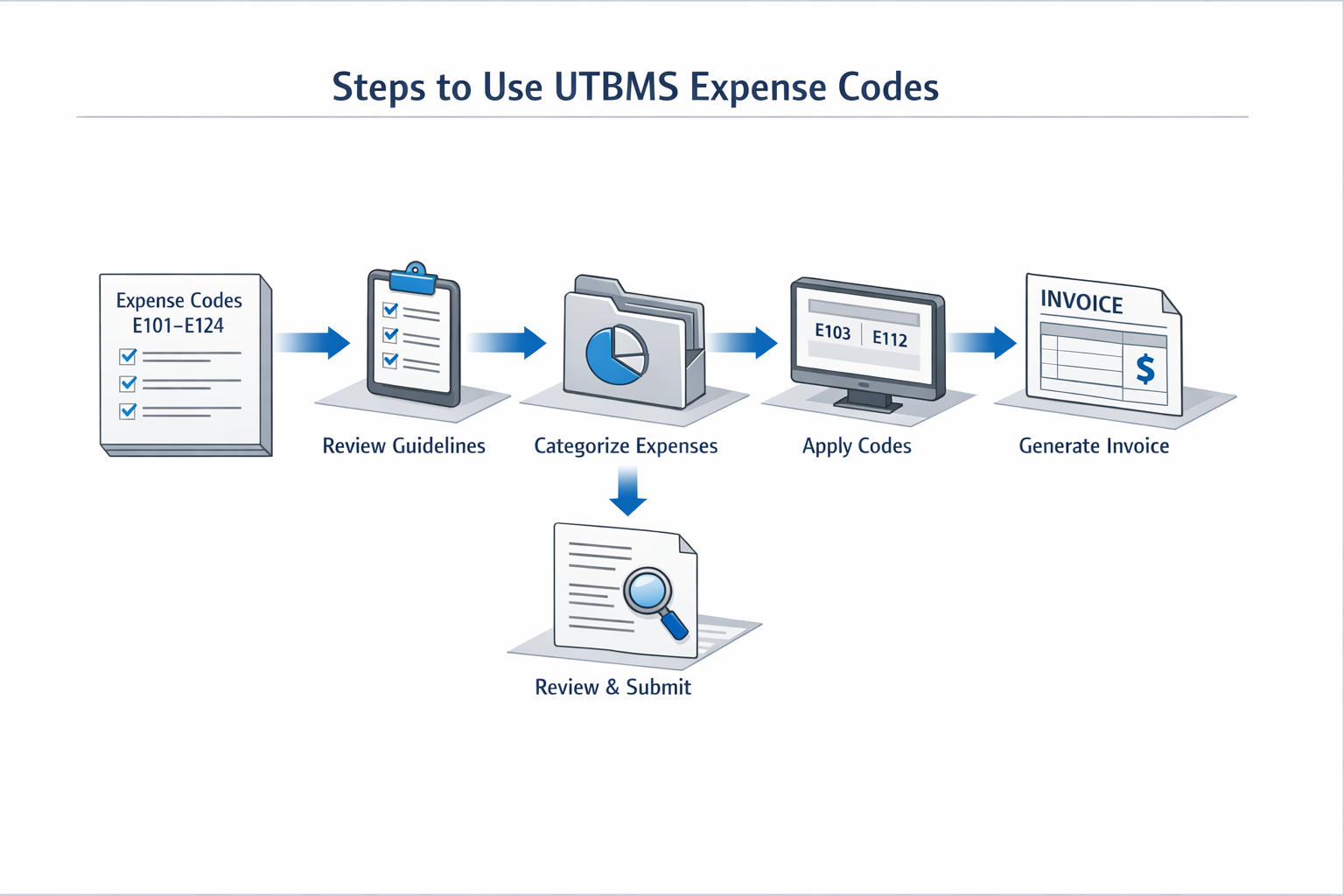
Proper use of UTBMS Expense Codes requires methodical assignment at the point of entry, not retrospective cleanup before submission. The codes themselves are narrow: X101 covers black-and-white internal copying, X102 covers color internal copying, and X103 covers external copy services. When an expense straddles two definitions, the code that matches the actual service performed controls.
Step 1
Identify the expense category before recording the charge
Read the expense code definitions in the 2013 LOC Revised UTBMS Expense Codes specification and match the charge to the code that describes what was purchased. X111 is online legal research; X112 is delivery services and messengers, excluding Postal Service charges; X113 is Postal Service charges only. A FedEx charge goes to X112, not X113. A Westlaw charge goes to X111, not a general administrative code.
Step 2
Separate bundled expenses into distinct line items
When one vendor invoice covers multiple UTBMS categories, create a separate line item for each code. Out-of-town travel (X115) includes airfare, ground transportation, rental car, mileage, parking and hotel, but some carriers require a granular breakdown. If the guideline is silent, one line item under X115 is compliant; if the guideline specifies itemization, split airfare, ground transport, lodging and parking into separate X115 entries with descriptive narratives.
Step 3
Apply local versus out-of-town travel codes correctly
X114 is local travel: ground transportation, mileage and parking within the local area. X115 is out-of-town travel: airfare, ground transportation, rental car, mileage, parking and hotel associated with travel outside the local area. The distinction is geographic, not dollar-based. A $200 taxi ride to a deposition across town is X114; a $50 airport shuttle in another city is X115.
Step 4
Use the correct telephone code for the service type
X107 is local telephone; X108 is long distance telephone; X109 is mobile telephone; X110 is conference call, video call or webinar charges. If the firm uses VOIP, bill the monthly service charge as a single line item under X107 or X108, not as per-call charges. A Zoom subscription for client depositions goes to X110, not X107.
Step 5
Code internal versus external services accurately
Internal services—performed in-house by the firm—use one set of codes; external services—performed by a third-party vendor—use another. X101 and X102 are internal black-and-white and color copying; X103 is external copy service. X104 is special handling copying, scanning and imaging performed in-house; if the same service is performed by a vendor, it goes to X103 or another external code, depending on the service.
Step 6
Review carrier guidelines for code-specific restrictions
Some carriers cap internal copying at cost, prohibit markups on X101 and X102 charges, or disallow certain codes entirely. Before submitting an invoice, cross-reference each expense code against the carrier's outside counsel guidelines. If the guideline states that meals (X116) require pre-approval above a dollar threshold, an X116 charge without approval documentation will be reduced regardless of code accuracy.
For a detailed explanation of how UTBMS codes integrate into the full LEDES 1998B File Format - All 24 Fields Explained, consult the field-by-field breakdown of the LEDES specification.
Tips and Tricks for Navigating UTBMS Expense Codes
The difference between a clean invoice and a reduction often lies in small details reviewers notice first. Expense codes carry semantic weight beyond their dollar amounts — a code tells the reviewer what you did, and many carriers flag certain categories automatically. The codes below appear frequently in reduction logs.
Match the Code to the Service Rendered
X111 covers online legal research charges — LexisNexis, Westlaw and similar services. X112 covers delivery services and messengers, including internal firm messengers, but excludes Postal Service charges. X113 is reserved for Postal Service costs only: regular, certified and overnight mail, plus any statutory mailings sent through the Postal Service. When a carrier sees X112 and the narrative says "postage," the line item is flagged for review. Use the code that matches the vendor and the service, not the one that sounds close.
X114 and X115 separate local travel from out-of-town travel. X114 includes ground transportation, mileage and parking for local trips; X115 covers airfare, ground transportation, rental car, mileage, parking and hotel for out-of-town trips. Both codes exclude billable travel time — that time goes under activity code A115 for local travel or A112 for out-of-town travel. If you bill X114 and also bill time under A115 for the same trip, the expense and the time entry must align by date and destination. Mismatched dates or contradictory narratives trigger questions.
Separate Line Items for Granular Expenses
X114 and X115 permit bundling multiple sub-expenses into one line item — taxi, mileage and parking under X114, for example. Many carriers accept that bundling, but some require separate line items for each sub-expense. The 2013 LOC Revised UTBMS Expense Codes state that if the client requires a more granular breakdown, the firm should submit separate itemized line items. Check the outside counsel guidelines before you combine. If the guideline is silent, separate line items reduce the risk of a reduction for lack of detail.
X101 and X102 distinguish black-and-white from color copies performed in-house. X103 covers copy services performed by an external party. If you bill X101 for color copies, the code is wrong — the reviewer sees a mismatch between the code definition and the likely service. If you bill X103 and the narrative says "internal copies," the code is wrong again. The distinction matters because some carriers reimburse in-house and external copying at different rates, and some disallow one category entirely.
X101 is for black-and-white copies performed in-house; X102 is for color copies in-house; X103 is for external copy services.
Watch the Specialty Codes
X118, X119, X120 and X121 are narrow codes for eviction, foreclosure, title insurance and immigration matters. X118 covers eviction costs not already provided for in other codes; X119 covers foreclosure costs not already provided for; X120 covers title service, examination and abstract costs; X121 covers immigration costs such as credentials evaluation and fixed expense allowances, again excluding costs covered by other codes. These codes exist because certain practice areas generate recurring expense categories that do not fit the general codes. If you bill X119 on a commercial dispute that is not a foreclosure, the code is a red flag. If you bill X121 on an employment matter that has no immigration component, the line item will be questioned. Use specialty codes only when the matter type matches the code definition.
For more guidance on how carriers review and reject invoices based on coding errors, see E-Billing Portal Invoice Rejections: Common Causes and Fixes.
Avoid Code Drift
Code drift happens when a firm uses one code for a category of expenses over time, then discovers the code does not match the definition. X106 covers facsimile charges. If your firm bills X106 for email transmission costs, the code is wrong — facsimile and email are different services, and the code set does not define an email-specific code. When a carrier's bill reviewer sees X106 with a narrative that says "email," the line item is flagged. If no code fits the expense perfectly, use the closest match and write a narrative that explains the service. Do not stretch a code to cover something it does not describe.
X107 and X108 separate local and long-distance telephone charges. Both codes note that if the expense is VOIP, bill it as a single line item rather than a per-call charge. X109 covers mobile telephone charges. If you bill X107 for a mobile call, the code is wrong. If you bill X108 for a VOIP expense and break it into per-call charges, you are not following the code definition. Small errors compound when reviewers see them across multiple invoices.
Document the Narrative
X104 covers special handling for oversized copying, binding, scanning, imaging and photograph reproduction performed in-house and requiring manual handling. The phrase "manual handling" is part of the definition. If you bill X104 and the narrative does not explain why manual handling was required, the reviewer may question whether the expense fits the code. X110 covers conference call, video call and webinar charges — multi-party communication by telephone, video or external service. If you bill X110 for a two-party call, the code does not fit. The narrative should confirm that the call involved multiple parties.
X116 covers meals, whether local or associated with travel, when payable by the client. Many carriers limit meal reimbursement by dollar amount, by occasion, or by requiring pre-approval. The code itself does not tell the reviewer whether the meal is reimbursable — the guideline does. If the guideline caps meals at a per-person amount, the narrative should state the number of attendees and the per-person cost. If the guideline requires pre-approval for client meals, the narrative should reference the approval. The code is correct, but the line item still gets reduced if the narrative does not support reimbursement under the guideline.
Conclusion and Final Thoughts on UTBMS Expense Codes (E101–E124)
The UTBMS Expense Codes (E101–E124) provide a standardized framework for categorizing disbursements in legal billing, but their value depends entirely on accurate application and consistent compliance with carrier guidelines. Each code represents a specific type of expense, from internal copying and legal research charges to travel, meals, and specialized costs like immigration or foreclosure-related disbursements. Understanding which code applies to a given line item is the first step; understanding how a specific carrier reviews that code is what determines whether the invoice clears the portal without a reduction.
As part of the Carrier Ready Knowledge Team, our focus often turns to understanding the nuances of UTBMS expense codes, specifically E101 through E124. These codes are integral to the legal billing process, providing a standardized method for categorizing expenses. However, the treatment of these codes can vary significantly among carriers.
Carrier guidelines do not treat all expense codes equally. Some codes, such as those for online legal research or out-of-town travel, routinely face scrutiny regarding necessity, pre-approval, or markup limits. Others, like postage or delivery services, are generally accepted at cost but may be rejected if the narrative does not explain the recipient or purpose. The absence of a supporting narrative or backup documentation is a common trigger for reduction, regardless of the code selected. A line item coded X111 for online legal research that lacks a description of the search performed or the relevance to the matter may be reduced even when the charge itself is reasonable.
Accurate coding alone does not guarantee acceptance. The expense must be supported by a clear narrative, submitted under the correct code, and aligned with the carrier's published thresholds and documentation requirements. When a guideline states that meals require pre-approval above a certain dollar amount, coding the charge as X116 does not override that requirement. When a guideline prohibits markups on internal services, coding an internal copy charge as X101 and applying a per-page rate above cost invites a reduction. The code identifies the category; the guideline determines the treatment.
For firms submitting invoices to multiple carriers, maintaining a reference chart that maps each code to the common restrictions across those guidelines reduces the risk of avoidable rejections. The chart need not be complex: a simple table listing the code, the expense type, the most restrictive pre-approval threshold, and the most common reduction reason provides a quick check before submission. Over time, this reference becomes a working tool that reflects the actual billing environment, not the abstract code set.
The UTBMS expense code structure is stable, but carrier interpretation evolves. Guidelines are revised, portals add validation rules, and bill review practices shift in response to patterns in submitted invoices. Staying current with guideline updates and monitoring rejection trends are ongoing responsibilities. A code that cleared without issue last year may face new scrutiny this year if the carrier has tightened its policy on that category. For additional context on related billing standards, see UTBMS Activity Codes A101-A111 for Legal Billing.
Understanding UTBMS Expense Codes (E101–E124) is not a one-time learning exercise. It is a continuous process of applying the code set accurately, reading the controlling guideline carefully, and documenting each expense in a way that answers the question a bill reviewer will ask. The code identifies the expense; the narrative and the guideline determine whether it is paid.