

UTBMS Expense Codes (E101–E124): Full List and Carrier Treatment
Introduction
When a law firm submits an invoice through an e-billing portal, every expense line carries a UTBMS Expense Code. These codes, numbered E101 through E124 in the current standard, tell the carrier's bill reviewer exactly what category of cost the firm is claiming. One entry coded E115 means out-of-town travel; another coded E111 means online legal research. The code itself is a three-character field in the LEDES 1998B file, and it determines which guideline provisions apply to that line item.
As part of the Carrier Ready Knowledge Team, our focus often turns to understanding the nuances of UTBMS expense codes, specifically E101 through E124. These codes are integral to the legal billing process, providing a standardized method for categorizing expenses. Across the published guidelines we've reviewed, certain entries like travel, meals billed without receipts, and copying charges above stated thresholds are frequently flagged for reductions.
The expense code set is maintained by the LEDES Oversight Committee and published alongside the UTBMS Activity Codes A101-A111 for Legal Billing and task code tables. Where activity codes describe what work was performed, expense codes describe what the firm paid for on the client's behalf. Both sets appear in the same invoice file, and both are subject to carrier guideline limits, but the rules governing expenses are distinct. A guideline may permit activity code A104 (document review) without restriction while capping expense code E103 (photocopying) at ten cents per page. Mixing the two categories or selecting the wrong expense code triggers validation errors at submission or reductions during bill review.
Carrier treatment of these codes varies by guideline version, matter type, and jurisdiction. One carrier may reimburse conference call charges under code E110 without question; another may require pre-approval for any charge above twenty-five dollars. A third may disallow the code entirely and instruct counsel to absorb the cost as overhead. These differences are not published in a single consolidated table, and they change when a carrier issues a new guideline version. The result is that a firm billing multiple carriers must track dozens of distinct rules for the same expense code, and a single invoice may require different coding strategies depending on the destination portal.
This article catalogs the full UTBMS Expense Code set from E101 to E124, explains what each code means, and describes common carrier treatments based on published outside counsel guidelines. It does not provide legal advice, predict the outcome of a fee dispute, or guarantee reimbursement for any particular expense. It does give billing staff and timekeepers the information they need to select the correct code, write a compliant narrative, and understand why a reduction code appeared on the remittance advice.
Problem Statement
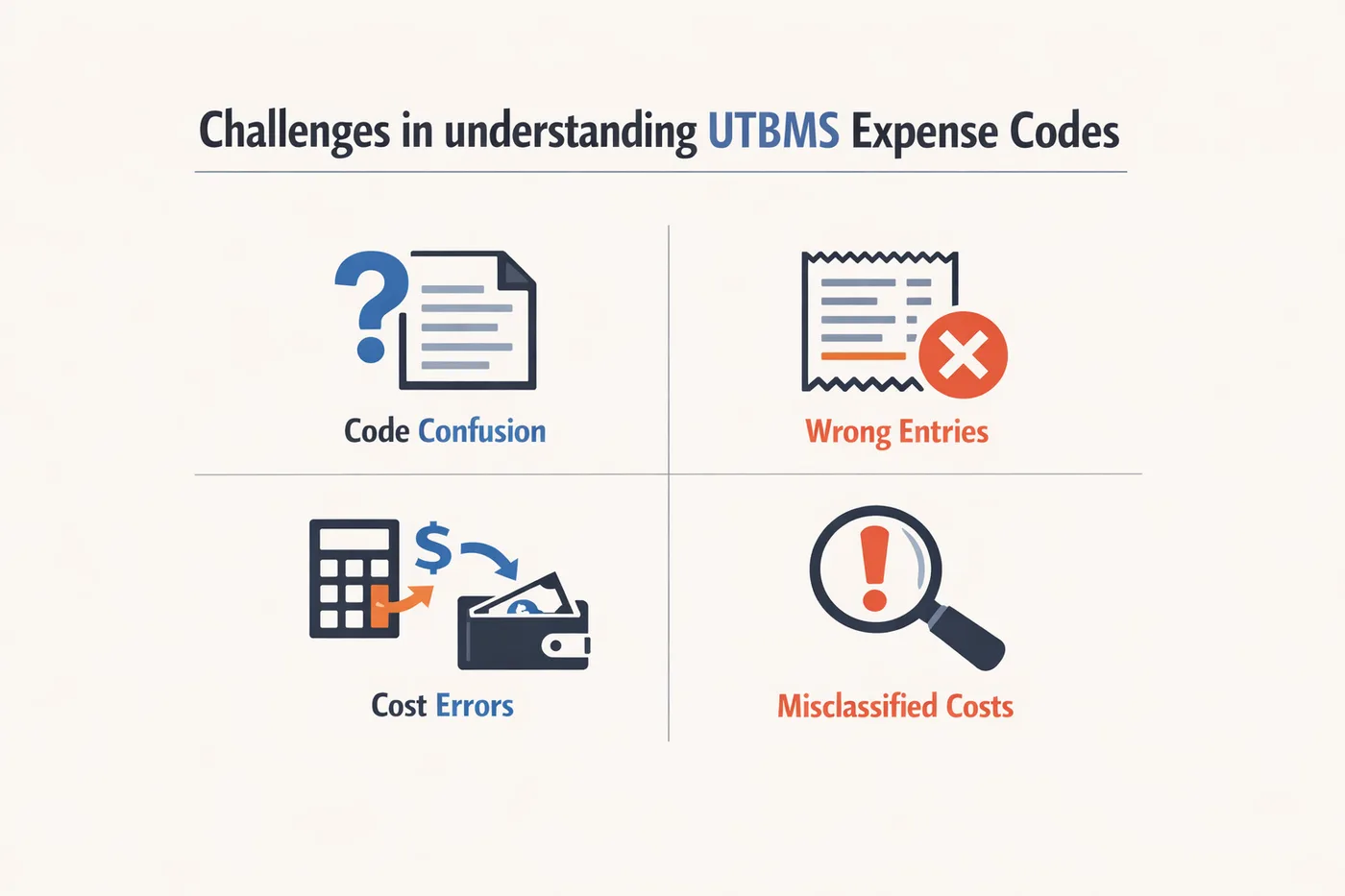
Law firms submitting invoices through e-billing portals encounter a recurring obstacle: expense line items rejected or reduced because the UTBMS Expense Code selected does not match the carrier's interpretation of what that code permits. A firm bills ground transportation under one code, the portal flags it for pre-approval. Another firm submits copying charges under a code the guideline explicitly excludes. The rejection arrives with a reduction code and no further explanation.
The 2013 LEDES Oversight Committee revision of the UTBMS Expense Codes introduced granular distinctions that many timekeepers and billing staff overlook. Code X114, Local Travel, covers ground transportation, mileage and parking, but excludes billable travel time, which belongs under activity code A115. Code X115, Out-of-Town Travel, similarly excludes billable travel time, directing it instead to A112. When a timekeeper enters travel hours under an expense code rather than an activity code, the e-billing portal rejects the line item at validation, and the invoice does not reach the reviewer's queue.
Mismatched Expectations Between Codes and Carrier Guidelines
Carriers publish outside counsel guidelines that layer additional restrictions onto the UTBMS code set. A guideline may state that all delivery services require pre-approval above a threshold dollar amount, or that mobile telephone charges are not reimbursable at all. The UTBMS code set defines X109, Telephone-Mobile, as "any mobile telephone charges," but a carrier guideline that prohibits mobile charges will reduce every line item coded X109 to zero, regardless of the code's published definition.
Firms that rely solely on the UTBMS code descriptions, without cross-referencing the controlling guideline, submit invoices that comply with the code set but violate the client's billing rules. The result is a pattern of reductions that appears arbitrary until the firm pulls the guideline and maps each prohibited category to its corresponding UTBMS code. Understanding block billing reasons for carrier rejections provides additional context on how narrative and coding issues compound to trigger portal flags.
Granularity and the Risk of Aggregation
Several UTBMS Expense Codes permit aggregation unless the client requires a more granular breakdown. Code X114 states, "If client requires a more granular breakdown, law firm or legal vendor should submit separate itemized expense line items." Code X115 carries identical language. When a guideline requires separate line items for airfare, hotel, rental car and meals, a single X115 entry summarizing all out-of-town travel violates the guideline's itemization standard, even though the code definition allows aggregation in the absence of a client requirement.
Billing staff who do not read the guideline's itemization section submit consolidated travel entries that trigger portal rejections for insufficient detail. The rejection code may read "narrative insufficient" or "itemization required," but the root cause is a mismatch between the code's conditional permission and the guideline's mandatory rule.
Code Overlap and Vendor Service Boundaries
The distinction between internal and external services creates confusion at the code level. Code X103, Copy Service (External), applies when an external party performs and bills the copying. Code X104, Special Handling Copying/Scanning/Imaging (Internal), applies to in-house work requiring manual handling. A firm that uses an in-house copy center for routine work but codes it X103 because the copy center bills the matter internally has misread the code boundary: X103 requires an external vendor, not an internal cost center.
Similar confusion arises with codes X107, Telephone-Local, and X108, Telephone-Long Distance, when the firm uses a VOIP system. Both code definitions state, "if VOIP expense bill as a single line item as opposed to a per call charge." A firm that bills VOIP usage per call, rather than as a monthly allocation, has ignored the code's instruction and risks a reduction for improper coding methodology.
The cheapest way to resolve an expense code dispute is to read the code definition and the guideline side by side before the invoice leaves the firm.
Solution Steps
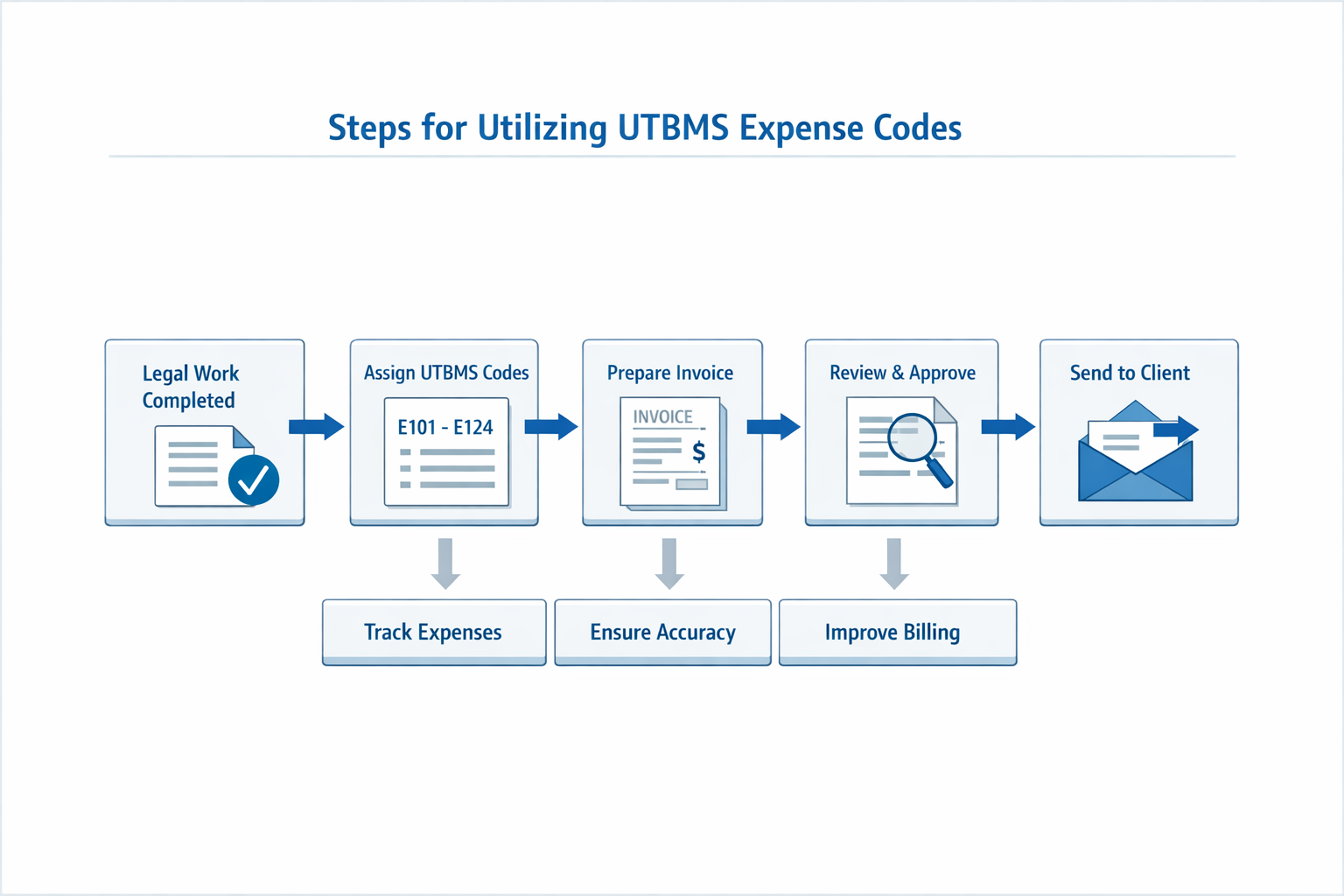
Law firms submitting invoices to carriers must approach UTBMS Expense Codes with precision. The codes themselves are standardized, but carrier treatment of each code is not. A line item coded X112 for overnight delivery will pass validation at one carrier and trigger a reduction at another if the narrative fails to meet that carrier's documentation threshold. The steps below outline a repeatable process for coding, documenting, and verifying expense entries before submission.
Step 1: Identify the Correct Expense Code
Step 1
Match the expense to its published definition
Every expense must map to a single code from the UTBMS Expense Code set. X103 covers external copy services—any black-and-white or color copy, binding, and reassembly charges performed by an external party and paid by the law firm. X104 covers special handling copying, scanning, imaging, and photograph reproduction handled in-house and requiring manual handling. X106 is for facsimile charges, X107 for local telephone charges, X108 for long-distance telephone charges, and X109 for mobile telephone charges. X110 captures conference call, video call, and webinar charges for multi-party communication. X111 is reserved for online legal research services such as LexisNexis or Westlaw. X112 includes delivery services and messengers—overnight carriers like FedEx, UPS, or DHL, as well as internal law firm messenger services, but excludes postal service charges. X114 covers local travel: ground transportation, mileage, and parking associated with local travel, excluding billable travel time. X115 addresses out-of-town travel: airfare, ground transportation, rental car, mileage, parking, and hotel, again excluding billable travel time. X116 applies to any meals, whether local or associated with travel, payable by the client.
When an expense does not fit cleanly into one code, consult the carrier's outside counsel guidelines before defaulting to a miscellaneous code. Some carriers prohibit miscellaneous codes outright; others require pre-approval for any expense not listed in their approved code set.
Step 2: Document the Expense with Sufficient Narrative Detail
Step 2
Write a line-item narrative that answers who, what, when, and why
The expense code identifies the category. The narrative justifies the charge. A line reading "X112, $45.00" with no further detail will fail most carrier validations. The narrative must state the service provider, the destination or recipient, the date, and the connection to the matter. For example: "FedEx overnight delivery to opposing counsel, motion papers, March 15, 2025." If the carrier guideline specifies a narrative format, follow it exactly.
Carriers that conduct manual bill review often reduce or reject expenses with vague narratives even when the code is correct. The reviewer cannot verify necessity without context, and the absence of context is treated as a documentation failure.
Step 3: Verify Compliance with Carrier-Specific Prohibitions
Step 3
Cross-check the expense against the carrier's outside counsel guidelines
Some carriers prohibit certain expense categories entirely. Others impose dollar thresholds, require pre-approval, or mandate that specific expenses be absorbed as overhead. Before coding an expense, confirm that the carrier permits it. If the guideline states that local travel must be billed at IRS mileage rates, do not bill actual costs without written pre-approval. If the guideline caps meal reimbursements at $75 per person per day, flag any meal expense above that threshold and obtain approval before submission.
Step 4: Assemble the Line Item in LEDES Format
Step 4
Populate the LEDES 1998B expense fields with exact values
The LEDES 1998B file format dedicates specific fields to expense data: EXP/FEE/INV_ADJ_TYPE, LINE_ITEM_EXPENSE_AMOUNT, LINE_ITEM_UNIT_COST, LINE_ITEM_NUMBER_OF_UNITS, and LINE_ITEM_ADJUSTMENT_AMOUNT. The UTBMS Expense Code goes in the EXP/FEE/INV_ADJ_TYPE field. The total expense amount goes in LINE_ITEM_EXPENSE_AMOUNT. If the expense is unit-based—such as mileage or per-page copying—populate LINE_ITEM_UNIT_COST and LINE_ITEM_NUMBER_OF_UNITS. If the carrier has reduced the expense, the reduction amount goes in LINE_ITEM_ADJUSTMENT_AMOUNT. Every field must be populated correctly, or the e-billing portal will reject the file during validation.
For a detailed breakdown of each LEDES field and its validation rules, see LEDES 1998B File Format - All 24 Fields Explained.
Step 5: Submit the Invoice and Monitor for Rejections
Step 5
Upload the LEDES file to the carrier's e-billing portal and track the validation result
Most e-billing portals perform automated validation at the time of upload. If a required field is missing, a code is unrecognized, or a narrative exceeds the character limit, the portal will reject the file and return an error message. Review the error message, correct the identified issue, and resubmit. If the file passes validation but the carrier subsequently reduces or rejects a line item during manual review, the portal will issue a reduction code and a reason. Document the reduction code, compare it to the carrier's published reduction code list, and determine whether to appeal or accept the adjustment.
Tracking rejection patterns across multiple invoices reveals which codes and narratives trigger the most frequent reductions. Use that data to refine documentation standards before the next billing cycle.
Tips and Tricks
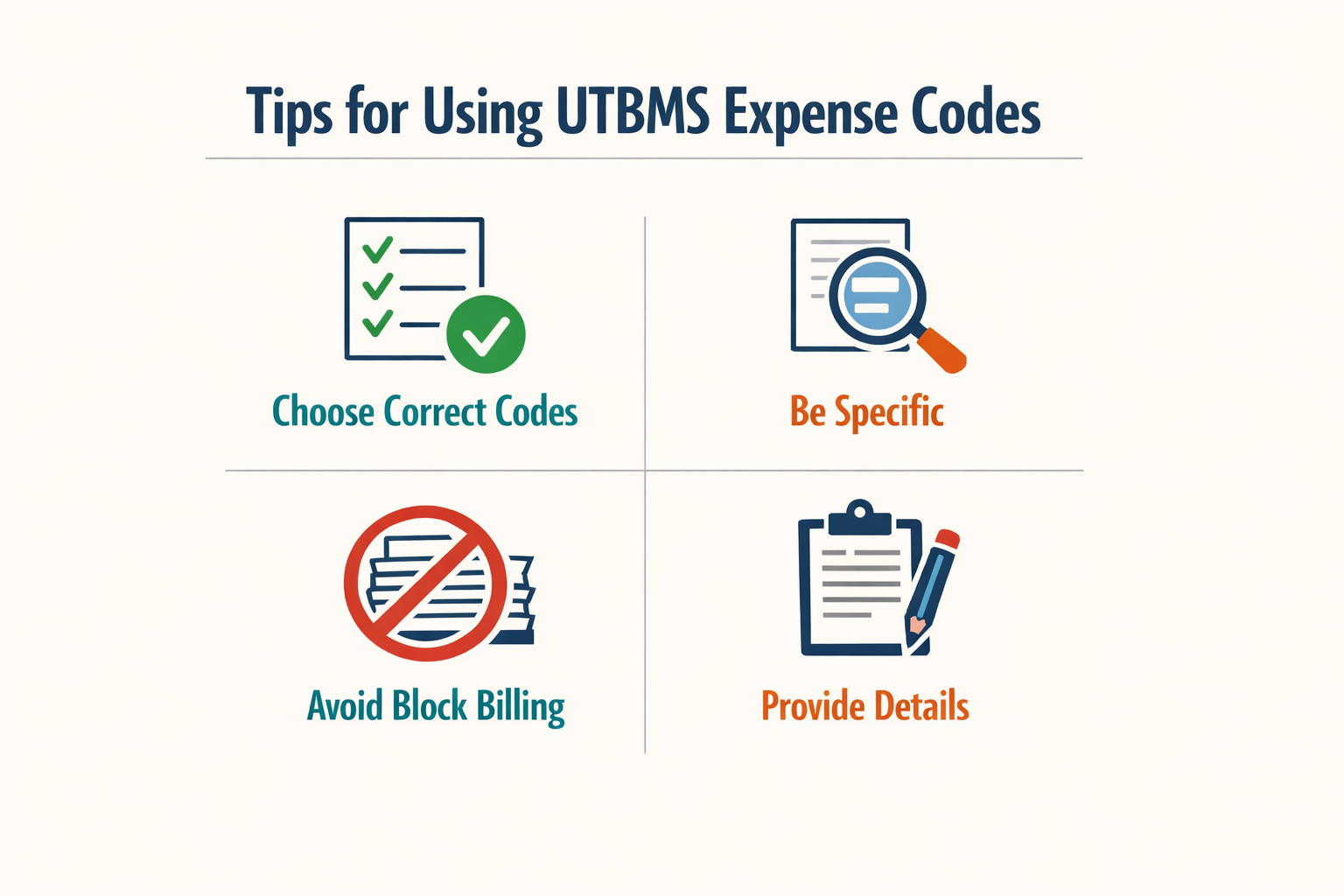
A single misclassified expense can trigger a reduction, even when the underlying charge is legitimate. Carriers review UTBMS expense codes with the same scrutiny they apply to task and activity codes, and the distinction between similar codes often determines whether an item is paid or rejected.
Match the Expense to the Code Definition
The UTBMS expense code set includes granular distinctions that matter. X103 Copy Service (External) applies when an outside vendor performs copying, binding or reassembly and the law firm pays the vendor directly. X104 Special Handling Copying/Scanning/Imaging (Internal) covers oversized copying, binding, scanning, imaging and photograph reproduction handled in-house and requiring manual handling. Submitting an external vendor invoice under X104, or an internal manual-handling charge under X103, invites a reduction.
Telephone charges split across four codes. X107 Telephone-Local covers local calls; if the service is VOIP, bill it as a single line item rather than per-call charges. X108 Telephone-Long Distance applies to long-distance calls, with the same VOIP instruction. X109 Telephone-Mobile captures mobile telephone charges. X110 Conference Call/Video Call/Webinar Charges applies to multi-party communication, whether by telephone, video or an external platform. Mixing these categories or billing a video-conference charge under X108 creates an immediate validation error in most e-billing portals.
Separate Travel Components When the Guideline Requires It
X114 Local Travel includes ground transportation (taxi, subway), mileage and parking associated with local travel, and excludes billable travel time, which falls under activity code A115. X115 Out-of-Town Travel covers airfare, ground transportation (taxi, subway, train), rental car, mileage, parking and hotel, and excludes billable travel time, which is coded A112. If a carrier guideline requires a more granular breakdown, submit separate itemized expense line items rather than a single aggregated charge. A line reading "X115 Out-of-Town Travel, $1,847.00" with no detail will be rejected by any carrier that requires airfare, hotel and ground transportation to appear as distinct entries.
X116 Meals applies to any meals, whether local or associated with travel, that are payable by the client. Some carriers cap meal reimbursement by location or impose per diem limits; others prohibit alcohol or require receipts above a threshold. The code itself is neutral, but the narrative and supporting documentation must align with the carrier's published meal policy.
Use the Code That Matches the Service Provider
X112 Delivery Services/Messengers covers overnight delivery services like FedEx, UPS or DHL, and messenger services including internal law firm or legal vendor messenger services. It excludes Postal Service charges, which are coded X113. If you bill a USPS certified-mail receipt under X112, the portal will reject it or the bill reviewer will reduce it and note the incorrect code. X111 Online Legal Research applies to electronic legal research service charges, such as LexisNexis or Westlaw. Billing a Westlaw charge under a generic "research" code, or mixing it with library or document-retrieval expenses, creates ambiguity that reviewers resolve against the firm.
X106 Facsimile captures any facsimile charges. Many carriers have eliminated reimbursement for fax transmission entirely, treating it as overhead; if the guideline is silent, assume the charge will be reduced and consider whether the item is worth the appeal.
Align Your Narrative With the Code's Scope
Each UTBMS expense code has a defined scope. When the narrative describes an expense that falls outside that scope, the reviewer reduces the line even if the amount is reasonable. "Conference call service, client deposition preparation" fits X110 Conference Call/Video Call/Webinar Charges. "Conference room rental, client deposition preparation" does not; it belongs in a facilities or meeting-space code if the carrier permits such charges at all. The code and the narrative must tell the same story.
For a deeper look at how e-billing portals validate expense codes and reject mismatches, see E-Billing Portal Invoice Rejections: Common Causes and Fixes.
The code and the narrative must tell the same story, or the reviewer will write a different ending.
Conclusion
Understanding the UTBMS Expense Codes (E101–E124) is not optional for firms submitting invoices to carrier panels or e-billing portals. Each code carries a specific definition, and each carrier's outside counsel guidelines impose distinct treatment rules — pre-approval thresholds, markup prohibitions, receipt requirements and outright exclusions. A line item coded E124 for expert fees will clear validation in one portal and trigger a rejection in another if the carrier guideline caps expert reimbursement or requires advance written approval above a stated dollar limit. The difference between a clean submission and a reduction is whether the timekeeper or billing coordinator knows which expenses the controlling guideline permits, which it restricts, and which documentation it demands.
As part of the Carrier Ready Knowledge Team, our focus often turns to understanding the nuances of UTBMS expense codes. These codes provide a standardized method for categorizing expenses, yet their treatment can vary significantly among carriers. For instance, across the published guidelines we've reviewed, certain entries are frequently flagged for reductions. This pattern highlights the importance of understanding each carrier's specific guidelines to ensure compliance and avoid unnecessary reductions.
The solution is straightforward: read the guideline version that governs the matter, map each anticipated expense to the correct UTBMS code, confirm that the guideline does not prohibit or cap that code, and submit the line item with the required narrative detail and supporting documentation. When the guideline is silent on a code, submit the expense at actual cost with a contemporaneous receipt and a narrative that states what the charge covered and why it was necessary to the representation. Firms that follow this discipline see fewer rejections, shorter appeal cycles, and cleaner cash flow. For additional guidance on structuring compliant invoices and avoiding common submission errors, see E-Billing Portal Invoice Rejections: Common Causes and Fixes.
Billing best practices begin with accurate coding and end with verifiable documentation. The UTBMS Expense Codes (E101–E124) give reviewers a common vocabulary; the carrier guideline tells them which words in that vocabulary are acceptable. Adherence to both standards is the only reliable path to timely payment and sustained panel membership.