

UTBMS Expense Codes E101–E124: Carrier Treatment Guide
Introduction
The UTBMS Expense Code set, specifically codes E101 through E124, establishes a uniform language for categorizing disbursements in legal billing. These codes cover a wide range of expenses: X103 addresses external copy services, X106 covers facsimile charges, X107 and X108 distinguish local from long-distance telephone charges, X111 captures online legal research costs, X112 handles delivery services and messengers, and X114 and X115 separate local travel from out-of-town travel. Each code carries a precise definition, and those definitions are not interchangeable.
As part of the Carrier Ready Knowledge Team, our focus often turns to understanding the nuances of these expense codes and how carriers interpret them. Across the published guidelines we've reviewed, certain entries like internal copying billed at premium rates, intra-office conferences, and administrative time billed at attorney rates are frequently flagged for reductions. This pattern highlights the importance of understanding each carrier's specific guidelines to ensure compliance and avoid unnecessary reductions.
Carrier outside counsel guidelines do not treat all expense codes equally. Some carriers reimburse X111 online legal research charges at cost, while others cap the amount or require pre-approval above a stated threshold. X115 out-of-town travel may be reimbursable for airfare, ground transportation, rental car, mileage, parking, and hotel, but the same guideline may prohibit first-class airfare or require the lowest available fare. X116 meal expenses are payable by some clients and capped or excluded by others. The code itself does not determine reimbursement; the controlling guideline does.
E-billing portals validate UTBMS codes at submission, but validation confirms only that the code exists in the standard set. It does not confirm that the expense is reimbursable under the applicable guideline. An invoice may pass portal validation and still trigger a reduction code during bill review if the coded expense violates a guideline provision. Understanding the interplay between the code definition, the narrative detail, and the guideline requirement is the only reliable path to a clean submission.
Problem Statement
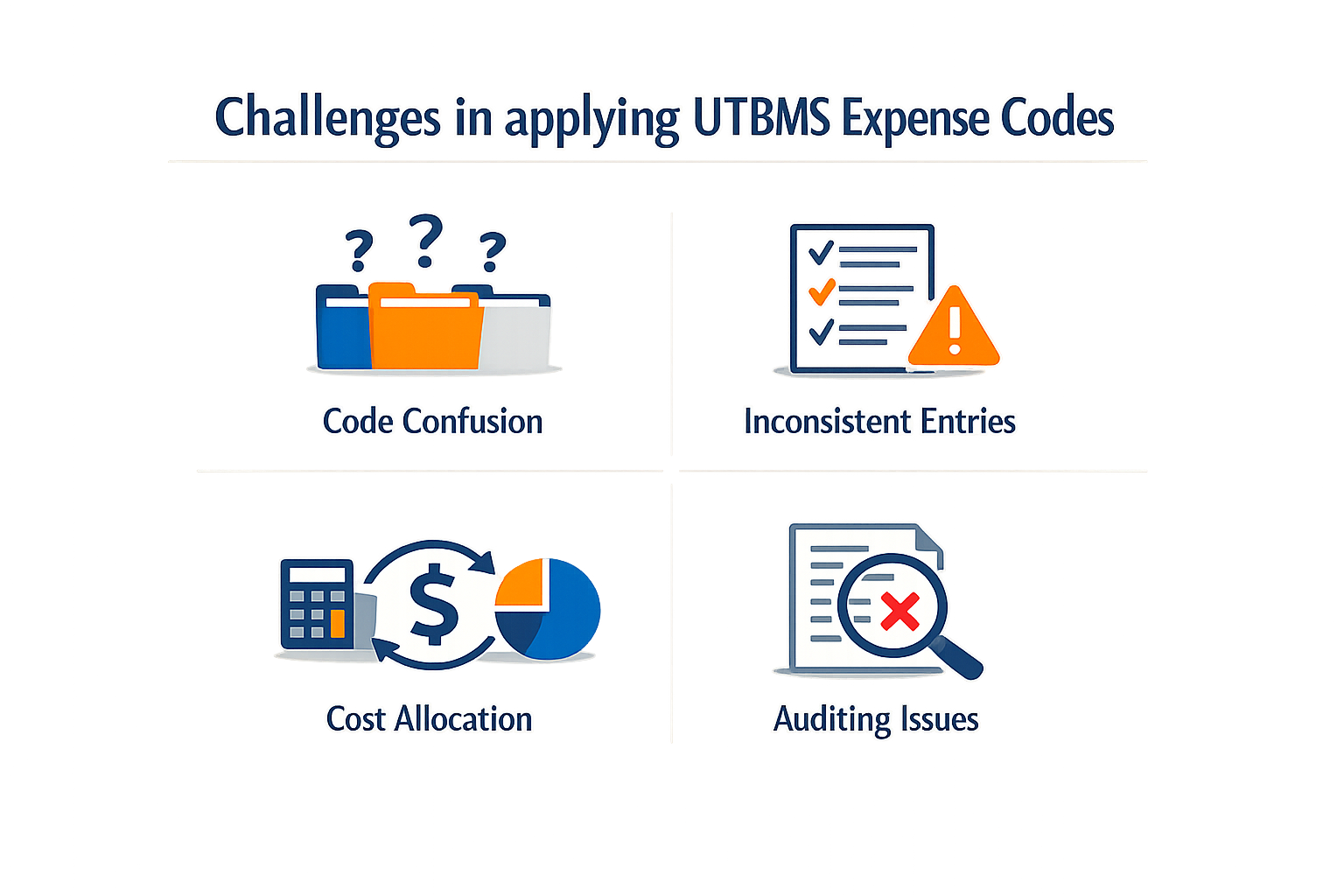
Legal practitioners submit invoices with UTBMS expense codes expecting reimbursement, but carrier treatment of these codes varies widely. One carrier reimburses meals under X116 without question; another flags every meal entry for reduction unless pre-approved. A firm bills out-of-town travel under X115, itemizing airfare and hotel separately as the code definition permits, only to have the portal reject the invoice because that carrier's guideline requires a single aggregated line. The UTBMS specification describes what each code covers — it does not prescribe how carriers will treat the entry.
Inconsistent Carrier Interpretation
The 2013 LOC Revised UTBMS Expense Codes define X115 as "any airfare, ground transportation (taxi, subway, train), rental car, mileage, parking, and hotel associated with out-of-town travel" and note that "if client requires a more granular breakdown, law firm or legal vendor should submit separate itemized expense line items." That conditional clause creates divergence. Some carriers accept a single X115 line; others demand separate entries for airfare, hotel, and ground transport. A firm that submits granular detail to a carrier expecting aggregation will trigger a formatting rejection. A firm that submits one consolidated line to a carrier expecting itemization will receive a reduction request or an outright denial.
Similar ambiguity surrounds X114 Local Travel, which includes "ground transportation (taxi, subway), mileage and parking" and carries the same conditional language about granular breakdowns. One carrier's guideline prohibits separate mileage and parking entries under X114, treating them as duplicate billing; another requires them. The code definition permits both approaches, leaving the practitioner to guess which interpretation governs the current matter.
Overhead and Administrative Expense Confusion
Codes X103 through X110 cover copying, scanning, telephone, and communication charges. The definitions distinguish internal from external services and specify when manual handling justifies a separate charge. X103 Copy Service (External) applies "when that service is performed by an external party and paid by the law firm," while X104 Special Handling Copying/Scanning/Imaging (Internal) covers "any special oversized copying, binding, scanning, imaging and photograph reproduction handled in-house which requires manual handling." Routine in-house copying — the kind generated by a networked multifunction device without manual intervention — falls outside X104, yet many invoices code every photocopy charge to X104 regardless of whether manual handling occurred.
Carriers respond by writing guidelines that cap or exclude certain codes entirely. One major carrier reimburses X111 Online Legal Research only when the research relates to a discrete motion or brief, not when it supports general case analysis. Another carrier reimburses X106 Facsimile and X107 Telephone-Local at cost but treats X108 Telephone-Long Distance and X109 Telephone-Mobile as overhead unless the call was to an expert, a witness, or opposing counsel. The code definitions do not contain these limitations; the carrier guidelines do.
Travel and Meal Reimbursement Thresholds
X116 Meals covers "any meals, whether local or associated with travel, payable by the client." The phrase "payable by the client" is a qualifier, not a guarantee. Published panel guidelines commonly impose per-meal dollar caps, require pre-approval for any meal expense when travel is local, or exclude meals entirely unless the timekeeper traveled more than a specified distance from the office. One guideline states that local meals are reimbursable only when the timekeeper worked past 8:00 p.m. and the client approved overtime in advance. Another reimburses meals during out-of-town travel but only at the federal per diem rate for the destination city, regardless of actual cost.
The X115 and X114 definitions exclude "billable travel time" — that is coded to activity codes A112 or A115 — but they do not exclude travel time from reimbursement consideration. Some carriers reimburse mileage at the IRS standard rate and separately reimburse parking; others reimburse parking only when the timekeeper traveled to a hearing, a deposition, or a client meeting, not when the destination was the firm's satellite office. The code definitions are silent on these distinctions, yet they determine whether a line item survives review.
The UTBMS expense code set is a common vocabulary, not a reimbursement entitlement — what the code permits and what the carrier pays are separate questions.
Understanding how to apply UTBMS expense codes accurately requires more than reading the code definitions. It requires knowing which carrier guideline governs the matter, what that guideline says about each code, and whether the guideline's requirements override the flexibility the code definition appears to grant. For a detailed breakdown of how task and activity codes interact with expense entries, see UTBMS Activity Codes A101-A111 for Legal Billing. Without that knowledge, even a correctly coded invoice will fail.
Solution Steps
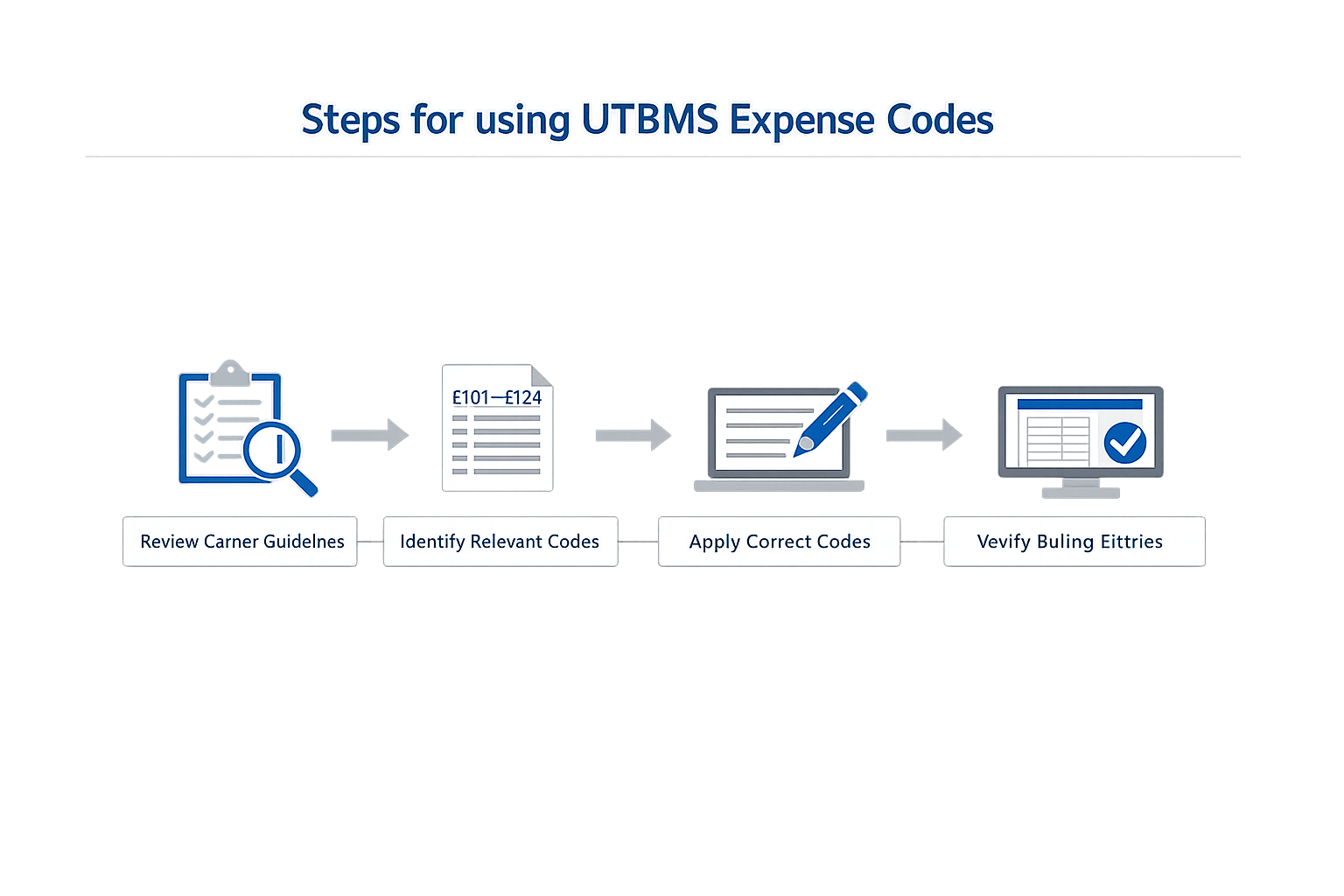
Correct use of UTBMS Expense Codes in submitted invoices requires deliberate steps at the point of entry and again before submission. The codes themselves are standardized, but carrier treatment is not.
Step 1: Identify the Correct Expense Code Before Entry
Step 1
Match the expense to the published definition
Before entering an expense line item, confirm which UTBMS code applies. The 2013 LOC Revised UTBMS Expense Codes define each code precisely. For example, X116 Meals includes any meals, whether local or associated with travel, payable by the client. X114 Local Travel covers ground transportation, mileage and parking associated with local travel, but excludes billable travel time. X115 Out-of-Town Travel includes airfare, ground transportation, rental car, mileage, parking and hotel, again excluding billable travel time. Do not guess or default to a general code when a specific one exists.
Step 2: Verify the Carrier's Published Guideline Treatment
Step 2
Read the carrier guideline before submission
Once the correct code is selected, consult the carrier's outside counsel guidelines for that matter. Many carriers specify which expense codes require pre-approval, which are reimbursed at cost versus at a markup, and which are prohibited outright. For instance, some carriers allow X112 Delivery Services at cost but disallow internal messenger charges above a threshold. Others permit X111 Online Legal Research only when the research is case-specific and not for general legal education. The guideline is controlling; the UTBMS definition tells you what the code means, but the guideline tells you whether the carrier will pay it.
Step 3: Provide Narrative Detail Sufficient to Survive Review
Step 3
Write a narrative that ties the expense to the matter
An expense code alone does not justify reimbursement. The narrative field must state what the expense was for, why it was necessary, and how it advanced the matter. A line reading "X116 Meals, $47.82" is insufficient under most panel guidelines. A line reading "X116 Meals — lunch meeting with opposing counsel to discuss settlement parameters, $47.82" ties the expense to a specific case event. Bill reviewers reduce entries that lack this connection, even when the code itself is permitted.
Step 4: Separate Bundled Expenses Into Distinct Line Items
Some UTBMS codes permit bundling — X114 Local Travel and X115 Out-of-Town Travel both state that if the client requires a more granular breakdown, the firm should submit separate itemized expense line items. Do not assume bundling is acceptable. When a carrier guideline requires itemization, a single aggregated entry under X115 for airfare, hotel, rental car and meals will be rejected or reduced. Submit each component as a separate line with its own narrative.
Step 5: Cross-Check Against Pre-Approval Thresholds
Before finalizing the invoice, compare each expense line item to the carrier's pre-approval schedule. If X111 Online Legal Research is capped at two hundred dollars per month without approval, and the invoice includes three hundred dollars, either obtain retroactive approval or expect a write-down.
Step 6: Validate the LEDES File Before Portal Submission
Most e-billing portals validate UTBMS codes at the time of upload. A file containing an invalid or deprecated code will be rejected at the portal level, not reviewed by the carrier. Run the LEDES 1998B file through a validator that checks expense code syntax and confirms that each code exists in the current UTBMS specification. LEDES 1998B File Format - All 24 Fields Explained covers the structure and field requirements for clean portal acceptance.
Portal rejection is mechanical; it does not mean the expense was unreasonable, only that the file was malformed. Correct the code, regenerate the file, and resubmit.
Tips and Tricks
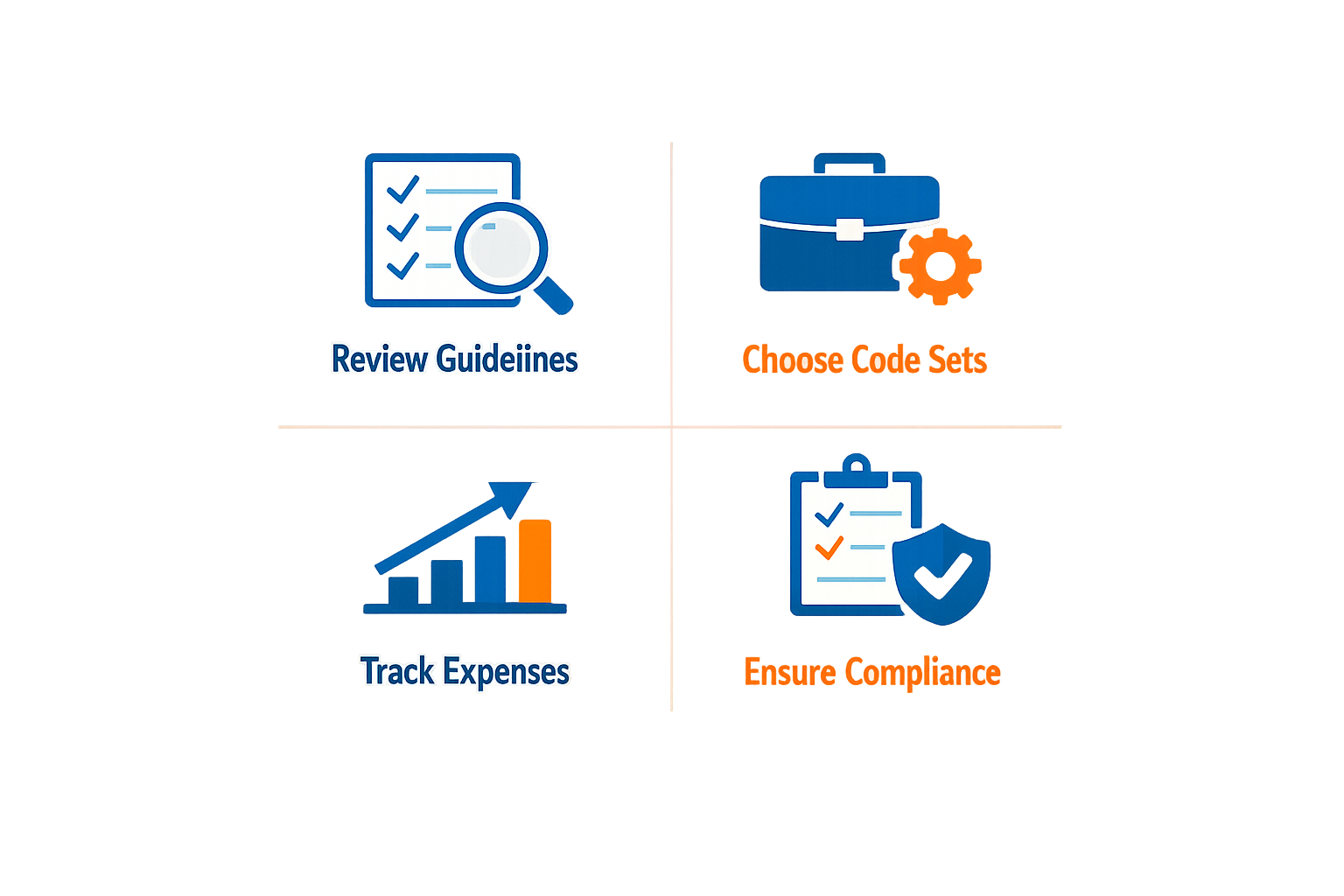
Successful expense billing under UTBMS codes requires more than knowing the definitions. Carriers reject entries when the code, the narrative, or the supporting documentation does not align with their published guidelines.
Match the Code to the Carrier's Allowable List
Not every carrier permits every UTBMS expense code. Before submitting an invoice, confirm that the guideline allows the code you plan to use. A line coded X116 for meals may be reimbursable under one panel guideline and flatly prohibited under another. When a carrier's guideline is silent on a code, do not assume permission — reach out for written clarification or submit the expense under a general disbursement code with a detailed narrative.
Provide Granular Detail Where the Code is Broad
Certain codes, such as X114 Local Travel and X115 Out-of-Town Travel, bundle multiple expense types into a single line. The UTBMS standard itself notes that clients may require a more granular breakdown. If the carrier guideline specifies itemization — for example, separate entries for airfare, hotel, and ground transportation — submit separate lines even though the standard permits aggregation. A single X115 entry reading "travel expenses, Chicago deposition, $1,847.32" will trigger a request for backup or an outright reduction when the guideline demands line-by-line detail.
Separate Communication Charges by Type
The X-series includes distinct codes for facsimile (X106), local telephone (X107), long-distance telephone (X108), mobile telephone (X109), and conference calls (X110). Bill review teams flag invoices that lump these charges together or use a single code for multiple communication types. When you incurred both a conference-call fee and long-distance charges on the same day, submit two lines with the appropriate codes. The narrative for each should identify the specific call or service, not a generic "telephone charges."
A bundled communication charge coded X107 that includes mobile and conference fees will be reduced to the lowest-tier rate or rejected entirely.
Document External Vendor Charges at Cost
X103 Copy Service (External) covers charges when an external party performs the service and the law firm pays the vendor. Carriers expect these entries to reflect actual cost, not a markup. Attach the vendor invoice or receipt to the submission. If the e-billing portal does not accept attachments at the line level, reference the vendor name and invoice number in the narrative and upload the backup as a matter-level document. A reduction notice that cites "no supporting documentation" is difficult to appeal when the carrier's portal log shows no attachment.
Reserve Special-Handling Codes for True Special Handling
X104 Special Handling Copying/Scanning/Imaging (Internal) is defined as work requiring manual handling — oversized copying, binding, scanning, imaging, and photograph reproduction. Routine photocopying does not qualify. When you bill X104, the narrative must explain what made the handling special: "binding of 12-volume trial exhibit set" or "scanning of 48 oversized engineering drawings." A narrative reading "special copying" without detail invites a reduction to the standard per-page rate or a complete disallowance.
Understand the Difference Between Local and Out-of-Town Travel
X114 and X115 split on geography, not distance. Local travel (X114) covers ground transportation, mileage, and parking within the local area; out-of-town travel (X115) adds airfare, rental cars, hotels, and ground transportation at the destination. The codes exclude billable travel time — that is an activity code (A112 or A115), not an expense. Do not code attorney time spent traveling as an X-series expense; doing so triggers a validation error in most e-billing portals and a manual reduction when the error slips through.
For more on how e-billing portals validate and reject line items, see E-Billing Portal Invoice Rejections: Common Causes and Fixes.
Confirm Meal Reimbursement Limits Before Submission
X116 Meals includes any meal, local or travel-related, that the client has agreed to pay. Many carrier guidelines cap meal reimbursement at a per-diem rate or require receipts above a threshold. A $75 dinner without a receipt may be reduced to $50 if the guideline specifies a $50 cap for unrecepted meals. When the guideline is silent, apply a conservative standard: submit receipts for any meal over $25 and note whether the meal was client-mandated (a working lunch with the client) or incidental to travel.
Track Online Research by Platform and Search
X111 Online Legal Research covers charges from LexisNexis, Westlaw, and similar services. Carriers expect the narrative to identify the platform and, where possible, the research topic. "Westlaw research, summary judgment standard" is stronger than "legal research." Some guidelines require that research charges be billed at cost or capped at a monthly allocation. If your firm's Westlaw contract allocates cost by matter, include the allocation methodology in the first invoice narrative and reference it in subsequent months.
Use Conference-Call Codes Only for Multi-Party Services
X110 Conference Call/Video Call/Webinar Charges applies to multi-party communication services, whether by telephone, video, or webinar platform. A two-party telephone call, even if long-distance, is coded X108, not X110. The distinction matters: some guidelines reimburse conference-service fees at cost but cap long-distance charges at a per-minute rate. Miscoding a two-party call as X110 may result in a reduction when the reviewer pulls the vendor invoice and sees only two participants.
Keep Delivery-Service Documentation
X112 Delivery Services/Messengers includes overnight carriers (FedEx, UPS, DHL) and messenger services, but excludes postal charges (X113). Attach the tracking number and recipient to the narrative: "FedEx overnight to opposing counsel, tracking 1234567890." If the guideline requires receipts for expenses over a threshold, upload the FedEx invoice even when the charge is below the threshold — it eliminates a follow-up request and speeds approval.
Conclusion
Understanding UTBMS Expense Codes E101–E124 is not optional for firms billing insurance carriers — it is the baseline for compliance. Each code carries a specific definition, and carriers enforce those definitions through invoice review, reduction codes, and portal rejections. A line item coded X116 for meals, for example, must describe a meal expense payable by the client; coding a different type of expense under X116 invites a reduction, even if the underlying expense is legitimate.
Carrier outside counsel guidelines set the rules for which expenses are reimbursable, at what rate, and under what conditions. The UTBMS code is the label; the guideline is the rule. When the two do not align — when a firm submits an expense the guideline prohibits, or codes it incorrectly — the invoice is rejected or reduced. The appeal path exists, but it requires contemporaneous records, a clear narrative, and a citation to the controlling guideline provision. Most reductions stand because the documentation is not there.
As part of the Carrier Ready Knowledge Team, our focus often turns to understanding the nuances of UTBMS expense codes. These codes are integral to the legal billing process, providing a standardized method for categorizing expenses. However, the treatment of these codes can vary significantly among carriers. Certain entries like travel, intra-office conferences, and administrative time billed at attorney rates are frequently flagged for reductions. This pattern highlights the importance of understanding each carrier's specific guidelines to ensure compliance and avoid unnecessary reductions.
Firms that invest time in learning the LEDES 1998B File Format and the UTBMS code sets reduce their rejection rate and improve their cash flow. The effort is not glamorous, but the result is measurable: fewer write-downs, faster payment, and a cleaner audit trail when the dispute comes.