


Reservation of Rights Letter: Guide for Defense Counsel
Introduction
A reservation of rights letter is a formal notice from an insurer to its insured stating that the insurer is providing a defense under the policy but reserves the right to deny coverage later based on specific facts or legal theories. For defense counsel, this letter is not merely procedural correspondence — it is a signal that the relationship between insurer and insured may involve competing interests, and that the structure of the defense may change as a result.
As the Carrier Ready Knowledge Team, we often delve into the nuances of reservation of rights letters and their implications for defense counsel. These letters are crucial in the insurance defense context, as they notify the insured that the insurer may not cover certain claims under the policy. This can significantly impact how defense counsel approaches a case.
What a Reservation of Rights Letter Signals
When an insurer issues a reservation of rights letter, it typically identifies allegations in the underlying complaint that fall outside the policy's coverage or that raise coverage questions requiring further investigation. Common triggers include claims for punitive damages, intentional conduct, or allegations that pre-date the policy period. The letter preserves the insurer's ability to litigate coverage issues in a separate declaratory relief action or to deny indemnity after the defense concludes.
For counsel assigned by the insurer, the letter creates a fork in the road. Panel counsel may continue the defense, but the insured now has a statutory right under California law to select independent counsel at the insurer's expense when a true conflict of interest exists. Cal. Civ. Code section 2860, subdivision (b) provides that a conflict of interest may exist "when an insurer reserves its rights on a given issue and the outcome of that coverage issue can be controlled by counsel first retained by the insurer for the defense of the claim." The statute clarifies that no conflict arises solely because the insured is sued for an amount exceeding policy limits or because punitive damages are alleged.
The Cumis Framework and Independent Counsel
The right to independent counsel in California stems from the decision in San Diego Navy Federal Credit Union v. Cumis Insurance Society, 162 Cal.App.3d 358. In that case, the court held that when an insurer provides a defense under a reservation of rights and a conflict of interest exists, the insured is entitled to independent counsel paid for by the insurer. This principle was later codified in Civil Code section 2860.
Under section 2860, subdivision (a), the insurer must provide independent counsel unless the insured expressly waives that right in writing. When independent counsel is selected, section 2860, subdivision (f) allows both the insurer's counsel and independent counsel to participate in all aspects of the litigation, and both must cooperate fully in exchanging information consistent with their ethical obligations.
Defense counsel navigating this framework must understand that the reservation of rights letter does not by itself create a conflict — the conflict arises when the reserved issue can be influenced by litigation strategy. For example, if the insurer reserves on intentional conduct and the complaint alleges both negligence and intentional tort, counsel's choice of which theory to contest most vigorously could affect whether the insurer ultimately owes indemnity. In such cases, independent counsel is appropriate.
Practical Implications for Defense Counsel
When defense counsel receives notice of a reservation of rights letter, the first step is to evaluate whether a conflict of interest exists under section 2860, subdivision (b). If the reserved issue is one that counsel's litigation decisions could control — such as the scope of damages, the characterisation of conduct, or the applicability of policy exclusions — the insured should be advised of the right to independent counsel.
Defense counsel must also be mindful of billing and reporting obligations. Independent counsel selected under section 2860 owes a duty to disclose all non-privileged information to the insurer and to inform and consult with the insurer on all matters relating to the action, as stated in section 2860, subdivision (d). This includes compliance with the insurer's outside counsel guidelines, LEDES 1998B file format requirements, and e-billing portal submission protocols. Any claim of privilege asserted by independent counsel is subject to in camera review.
The reservation of rights letter also affects settlement dynamics. If the insurer has reserved on coverage and the case can be settled within policy limits, independent counsel and the insured must determine whether the insurer's reservation creates an incentive for the insurer to settle at a lower amount or to decline settlement altogether. These considerations are beyond the scope of billing mechanics, but they inform the broader context in which defense counsel operates.
Problem Statement
A reservation of rights letter arrives, and the defense landscape changes. The insurer commits to pay for defense counsel but explicitly states that coverage for some or all claims may not exist. Defense counsel, whether selected by the carrier or independently retained, must now navigate a case where the party funding the defense has announced a potential conflict.
The core challenge is structural: the insurer's reservation creates a divergence between the insurer's interest in limiting exposure and the insured's interest in a defense that does not compromise coverage. California Civil Code section 2860, subdivision (b), states that a conflict of interest may exist when an insurer reserves its rights on a given issue and the outcome of that coverage issue can be controlled by counsel first retained by the insurer. The statute does not say "will exist" — it says "may exist." That conditional phrasing places the burden on defense counsel to evaluate whether the reservation in fact creates a disqualifying conflict in the matter at hand.
Recognizing When a Conflict Arises
Not every reservation triggers independent counsel. Section 2860, subdivision (b), clarifies that no conflict exists as to allegations or facts for which the insurer denies coverage outright, and no conflict is deemed to exist solely because the insured is sued for an amount exceeding policy limits or because punitive damages are alleged. The conflict arises when the insurer reserves rights on an issue and the defense strategy could influence the coverage determination.
In San Diego Navy Federal Credit Union v. Cumis Insurance Society, 162 Cal.App.3d 358, the court held that when an insurer provides its own counsel but reserves the right to assert noncoverage later, a conflict of interest exists between the insurer and the insured, and the insured has a right to independent counsel paid for by the insurer. The reasoning turned on the fact that defense counsel's handling of the case — what facts are developed, what admissions are made, what settlement posture is taken — directly affects the coverage question the insurer has reserved.
Disclosure and Cooperation Obligations
Once independent counsel is retained under section 2860, subdivision (d) imposes a duty on that counsel and the insured to disclose to the insurer all information concerning the action except privileged materials relevant to coverage disputes. The insured and independent counsel must timely inform and consult with the insurer on all matters relating to the action. This creates a second layer of complexity: defense counsel must distinguish between case-development information that must be shared and privileged material that may be withheld if it bears on the coverage dispute.
The statute permits in camera review of any claim of privilege, but it does not provide a roadmap for when a document or communication is "relevant to coverage disputes." Defense counsel operating under a reservation must therefore evaluate each piece of information for both its litigation value and its potential impact on the coverage question, a task that panel counsel — whose fees the insurer pays without question — does not face.
Billing and Guideline Compliance Under Reservation
Carrier outside counsel guidelines typically apply to panel counsel, and when independent counsel is retained under section 2860, the guidelines may or may not govern that counsel's billing. Some carriers attempt to impose the same billing increments, narrative standards and rate caps on independent counsel that apply to panel firms. Others acknowledge that independent counsel is selected by the insured and paid at reasonable rates, which may differ from panel rates.
Defense counsel must determine which guideline provisions, if any, control the engagement. If a carrier's guideline states that block billing is prohibited and independent counsel submits a block-billed invoice, the carrier may reject the invoice or reduce the fees. The insured, not the carrier, selects independent counsel, but the carrier pays the bill, and the statute does not override all billing standards — it requires the insurer to pay for counsel at reasonable rates, which is a coverage question, not a guideline question.
Solution Steps for Addressing Reservation of Rights Letters
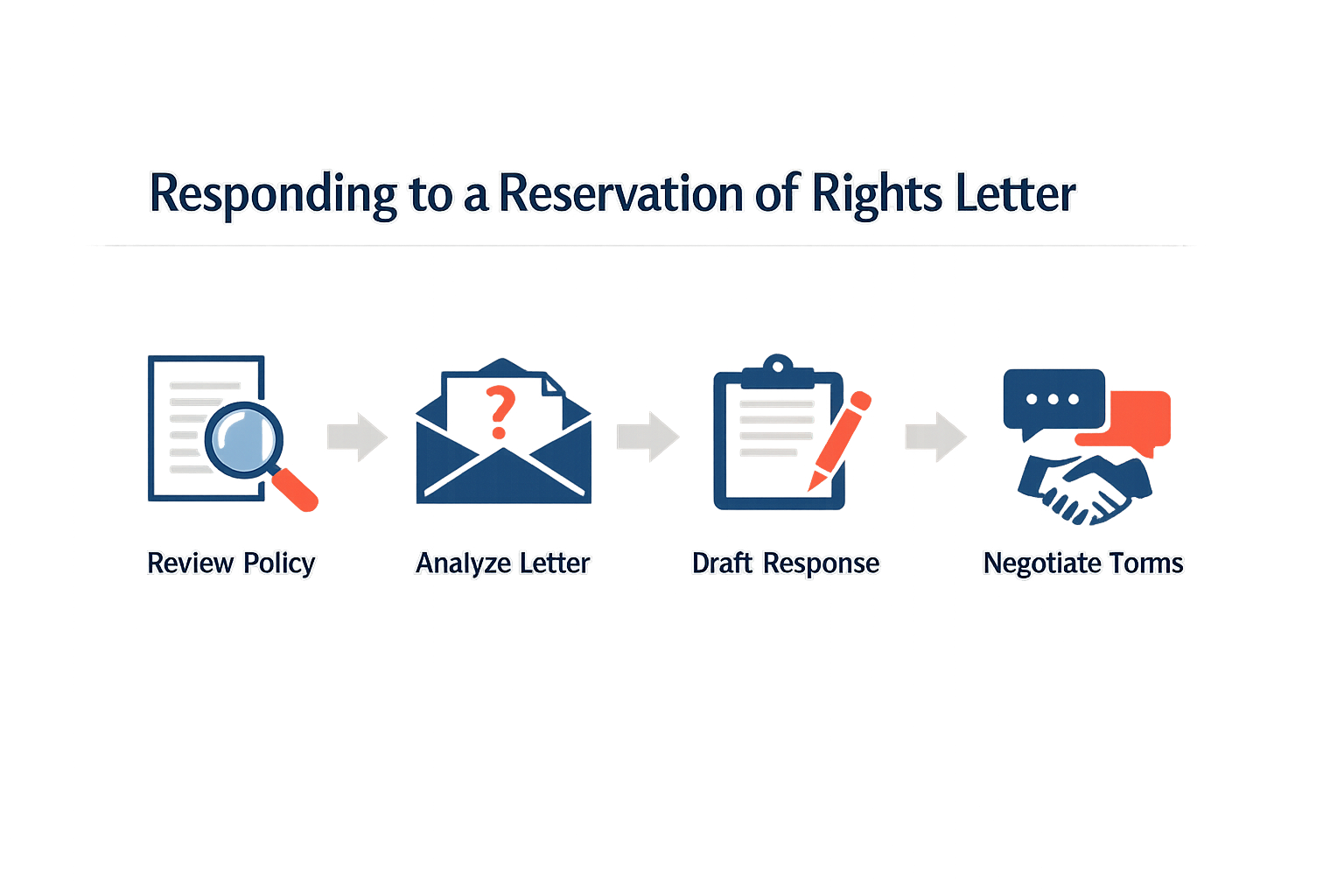
When a carrier issues a reservation of rights letter, defense counsel must navigate a series of procedural and ethical steps to protect both the insured's interests and their own billing compliance. The following workflow reflects the statutory framework under California Civil Code section 2860 and the practical realities of carrier panel practice.
Step 1: Determine Whether a Conflict of Interest Exists
Step 1
Assess the conflict trigger
Cal. Civ. Code § 2860, subd. (b) states that a conflict of interest does not exist as to allegations or facts for which the insurer denies coverage. However, when an insurer reserves its rights on a given issue and the outcome of that coverage issue can be controlled by counsel first retained by the insurer, a conflict of interest may exist. Defense counsel must review the reservation letter to identify whether the reserved issue is one the defense strategy could influence — for example, whether the claim arises from an excluded act or whether the injury occurred during the policy period.
No conflict is deemed to exist solely because the insured is sued for an amount exceeding policy limits or because punitive damages are alleged. If the reservation letter addresses only these two scenarios, the insured has no statutory right to independent counsel under section 2860.
Step 2: Notify the Insured of the Right to Independent Counsel
Step 2
Provide written notice
If a conflict exists, Cal. Civ. Code § 2860, subd. (a) requires the insurer to provide independent counsel unless the insured expressly waives that right in writing. Defense counsel appointed by the carrier must inform the insured, in clear terms, that a possible conflict may arise or does exist. The notice should explain what the conflict is, how it could affect the defense, and that the insured may select independent counsel at the carrier's expense.
The waiver form prescribed by Cal. Civ. Code § 2860, subd. (e) includes the statement: "I have been advised and informed of my right to select independent counsel to represent me in this lawsuit. I have considered this matter fully and freely waive my right to select independent counsel at this time. I authorize my insurer to select a defense attorney to represent me in this lawsuit." If the insured signs this waiver, panel counsel may continue the defense without triggering the independent counsel obligation.
Step 3: Coordinate with Independent Counsel if Selected
Step 3
Establish dual-counsel protocols
When the insured selects independent counsel, Cal. Civ. Code § 2860, subd. (f) requires that both the counsel provided by the insurer and the independent counsel be allowed to participate in all aspects of the litigation. Counsel must cooperate fully in the exchange of information consistent with each counsel's ethical and legal obligations to the insured. This means joint status conferences, shared discovery plans, and coordinated motion practice.
Independent counsel and the insured must disclose to the insurer all information concerning the action except privileged materials relevant to coverage disputes, and must timely inform and consult with the insurer on all matters relating to the action, per Cal. Civ. Code § 2860, subd. (d). Any claim of privilege asserted is subject to in camera review. Information disclosed by the insured or by independent counsel is not a waiver of privilege as to any other party.
Step 4: Document the Defense Strategy and Coverage Posture
Defense counsel should maintain a contemporaneous record of how the reservation of rights letter affects case strategy. If the carrier has reserved on whether the injury is covered, for example, counsel should document any discovery or motion practice that could bear on that coverage question. This record serves two purposes: it demonstrates compliance with the duty to inform the insurer under section 2860, and it provides a factual foundation if the carrier later disputes the reasonableness of fees.
Many e-billing portals require narrative entries that distinguish covered from reserved issues. A line item reading "research coverage defenses, 2.5" will trigger a rejection if the carrier's guidelines prohibit billing for coverage work. The safer entry is "research liability defenses bearing on policy-period issue, 2.5," which makes clear the work advances the defense even though it touches a reserved coverage question.
Step 5: Preserve the Insured's Duty to Cooperate
Cal. Civ. Code § 2860, subd. (f) provides that nothing in the independent counsel statute relieves the insured of the duty to cooperate with the insurer under the terms of the insurance contract. Defense counsel must ensure the insured understands this continuing obligation. Failure to cooperate — for example, refusing to attend a deposition or withholding documents from the carrier — can jeopardise coverage even when independent counsel has been appointed.
When independent counsel is in place, the insured may feel insulated from the carrier's oversight. Counsel should clarify that the duty to cooperate survives the appointment and that the carrier retains the right to monitor the defense, attend hearings, and review pleadings and discovery.
Tips and Tricks for Defense Counsel
Defense counsel operating under a reservation of rights letter face a dual obligation: representing the insured while maintaining transparency with the carrier. The statutory framework provides clear guidance, but practical execution requires attention to procedural detail and proactive communication.
Maintain Full Cooperation with the Carrier
Cal. Civ. Code § 2860, subd. (f) states that nothing in the independent counsel provisions relieves the insured of the duty to cooperate with the insurer under the terms of the insurance contract. Defense counsel must ensure that the insured understands this continuing obligation. Cooperation includes timely disclosure of case developments, witness information, and discovery materials — anything that does not fall within the narrow privilege for coverage-dispute communications.
When independent counsel is retained, both the carrier's monitoring counsel and independent counsel are permitted to participate in all aspects of the litigation. This dual-counsel arrangement requires structured communication protocols. Establish at the outset who receives what information and when. A breakdown in coordination between counsel creates exposure for the insured and complicates the carrier's ability to evaluate coverage.
Understand the Privilege Boundaries
Cal. Civ. Code § 2860, subd. (d) requires independent counsel and the insured to disclose to the insurer all information concerning the action except privileged materials relevant to coverage disputes. The statute carves out a narrow privilege: communications between the insured and independent counsel that bear on whether coverage exists are protected. Everything else must be shared.
This is not a general attorney-client privilege that shields all strategy discussions. If a fact pattern emerges that affects liability but not coverage, the carrier is entitled to know. Defense counsel must evaluate each communication and document to determine whether it touches the coverage question. When in doubt, disclose — the statute contemplates in camera review by the superior court if a privilege claim is disputed, and an overly broad assertion of privilege undermines the cooperation duty.
Any information disclosed by the insured or by independent counsel is not a waiver of the privilege as to any other party.
The statute provides that disclosures to the carrier do not waive privilege against other parties. This protection allows counsel to share information with the insurer without opening the door to discovery by opposing counsel. Make this clear to the insured when explaining the disclosure obligations.
Coordinate Billing and Narrative Detail
When independent counsel submits invoices, the carrier applies its outside counsel guidelines and bill review standards even though the insured selected the attorney. Guidelines that prohibit block billing apply with equal force to independent counsel. A line item reading "research coverage issues, draft motion, conference with client, 6.5" will be reduced or rejected, and the fact that the matter involves a reservation of rights does not excuse the narrative deficiency.
Separate time entries by task and activity. Use UTBMS codes where the carrier requires them, and ensure that each entry identifies what was done, for what purpose, and with enough detail that a reviewer can assess reasonableness without seeing the underlying file. Independent counsel fees are subject to the same reasonableness standard as panel counsel fees, and a carrier that pays under a reservation of rights retains the right to challenge billing that violates its guidelines.
Clarify the Scope of the Reservation Early
Not every reservation of rights letter triggers the independent counsel obligation. Cal. Civ. Code § 2860, subd. (b) provides that a conflict of interest does not exist as to allegations or facts in the litigation for which the insurer denies coverage. The conflict arises when the insurer reserves its rights on a given issue and the outcome of that coverage issue can be controlled by counsel first retained by the insurer for the defense of the claim.
Defense counsel should identify at the outset which claims and defenses fall within the reservation and which do not. If the carrier denies coverage entirely for certain allegations, those allegations do not create a conflict — the carrier has no interest in the outcome because it will not pay regardless. The conflict exists where the carrier's litigation decisions could affect whether coverage applies. Document this analysis in writing and share it with the insured and the carrier to establish a common understanding of when independent counsel is required and when panel counsel may continue.
Prepare for Disputes Over Counsel Selection
Cal. Civ. Code § 2860, subd. (e) permits the insured to waive the right to select independent counsel by signing a specific written statement. Carriers sometimes present this waiver at the outset, before the insured has consulted independent counsel. Defense counsel retained by the insured should review whether the waiver was informed and voluntary. If the insured signed under pressure or without understanding the conflict, the waiver may not be enforceable.
When the insured selects independent counsel, the insurance contract may contain a provision setting forth the method of selection. Some carriers require the insured to choose from a pre-approved list or to obtain carrier consent before retaining counsel. These provisions are enforceable if they are consistent with section 2860. Defense counsel should review the policy's independent counsel clause and confirm that the selection process complies with both the contract and the statute.
Conclusion
A reservation of rights letter creates a documented divergence between what the carrier defends and what it might ultimately pay. For defense counsel, that divergence is not theoretical. It shapes billing expectations, staffing decisions, and the boundary between covered and uncovered work. The sources reviewed here — particularly 162 Cal.App.3d 358 — establish that the insured may retain independent counsel paid by the carrier when the reservation creates a conflict, and that the defense attorney's work in the underlying case directly affects the later coverage determination.
As the Carrier Ready Knowledge Team, we often delve into the nuances of reservation of rights letters and their implications for defense counsel. These letters are crucial in the insurance defense context, as they notify the insured that the insurer may not cover certain claims under the policy. While reviewing various carrier guidelines, it's evident that the duty to pay independent counsel is frequently misunderstood, and understanding these guidelines and legal precedents is essential for defense counsel to navigate potential conflicts of interest and ensure compliance with both statutory requirements and carrier expectations.
When the reservation letter arrives, read it alongside the complaint and the policy. Identify which allegations fall outside coverage, which might trigger exclusions, and which the carrier disputes on procedural grounds. That analysis determines whether you bill under panel guidelines or under a Cumis arrangement, whether pre-approval thresholds apply, and whether the carrier may later challenge time spent on uncovered claims. The reservation is not a courtesy notice — it is a binding statement of the carrier's position, and it governs the financial relationship from the date of issue forward.
Carriers issue these letters to preserve their rights, but they also create obligations. If the reservation triggers independent counsel, the carrier pays reasonable fees under Civil Code section 2860, and those fees are not subject to the same guideline constraints that apply to panel counsel. If the reservation does not trigger independent counsel, the assigned attorney still owes undivided loyalty to the insured, and billing must reflect that duty. Either way, contemporaneous records, narrative detail, and tenth-of-an-hour increments remain the baseline expectations for any submitted invoice.
For more on how carriers evaluate submitted invoices and common rejection patterns, see Block Billing: Reasons for Carrier Rejections and Solutions. The principles that apply to panel billing — clear task codes, sufficient narrative, and compliance with stated guidelines — apply with equal force when the reservation letter is in play. The difference is that the reservation may shift who pays, not whether the work must be documented.
By examining these documents, we aim to provide clarity and guidance, although it's important to remember that our insights are informational and not legal advice. A reservation of rights letter is a control document. Treat it as such, bill accordingly, and preserve the record that supports every line item.