


Paralegal Billing Cheat Sheet: What Carriers Pay For and What They Cut
Introduction
One entry reading "legal research, document review, file organization, 3.5" is enough to trigger a reduction under most panel guidelines. Carriers pay for paralegal time when the work is substantive, properly classified, and described with enough narrative detail to survive bill review. When any of those elements is missing, the line item gets cut — sometimes entirely, more often down to a fraction of the submitted amount.
Paralegal billing sits at the intersection of timekeeper classification, UTBMS task and activity codes, and the specific prohibitions in each carrier's outside counsel guidelines. A paralegal entry that would sail through one portal gets rejected by another, not because the work was unnecessary, but because the invoice failed to demonstrate compliance with that carrier's published rules. The LEDES 1998B file submitted to the e-billing portal carries a timekeeper classification field that determines the rate the system will accept; if the classification is wrong, the portal rejects the file before a human reviewer ever sees the narrative.
Understanding what carriers pay for in paralegal billing means reading the controlling documents — the outside counsel guidelines, the LEDES specification, and the UTBMS code sets — and then structuring every line item to satisfy all three. Firms that treat paralegal billing as a simplified version of attorney billing discover, after the first round of reductions, that carriers apply a different set of rules. For a detailed breakdown of how activity codes map to paralegal tasks, see UTBMS Activity Codes A101-A111 for Legal Billing.
What Makes Paralegal Billing Different
Carriers distinguish paralegal time from attorney time at the file-validation stage, using the timekeeper classification submitted in the LEDES file. The classification is not a label for internal accounting; it is a data element that the e-billing portal reads to determine whether the submitted hourly rate falls within the guideline's paralegal rate cap. A line item coded as PARALGL (the LEDES timekeeper classification for paralegals) that carries an attorney-level rate will be rejected automatically, before any bill reviewer examines the narrative.
Outside counsel guidelines specify tasks that are reimbursable when performed by a paralegal and tasks that must be performed by an attorney or absorbed as overhead. Most guidelines prohibit billing paralegal time for administrative work — filing, calendaring, routine correspondence, and document organization that does not require legal judgment. When a paralegal entry includes both substantive and clerical work, reviewers apply the lowest permissible classification to the entire entry, which often means a reduction to zero.
Block billing is a frequent cause of paralegal reductions. An entry that reads "review correspondence, draft discovery responses, coordinate with client, 4.8" fails the narrative-detail test that most guidelines impose, and the reviewer has no way to separate the reimbursable discovery work from the non-reimbursable coordination. The result is a reduction code citing insufficient detail, and the firm is left to appeal with contemporaneous records that may not exist.
The next section examines the specific guideline prohibitions and coding errors that account for the majority of paralegal billing reductions, and what those reductions look like when they appear in the bill-review report.
Problem Statement
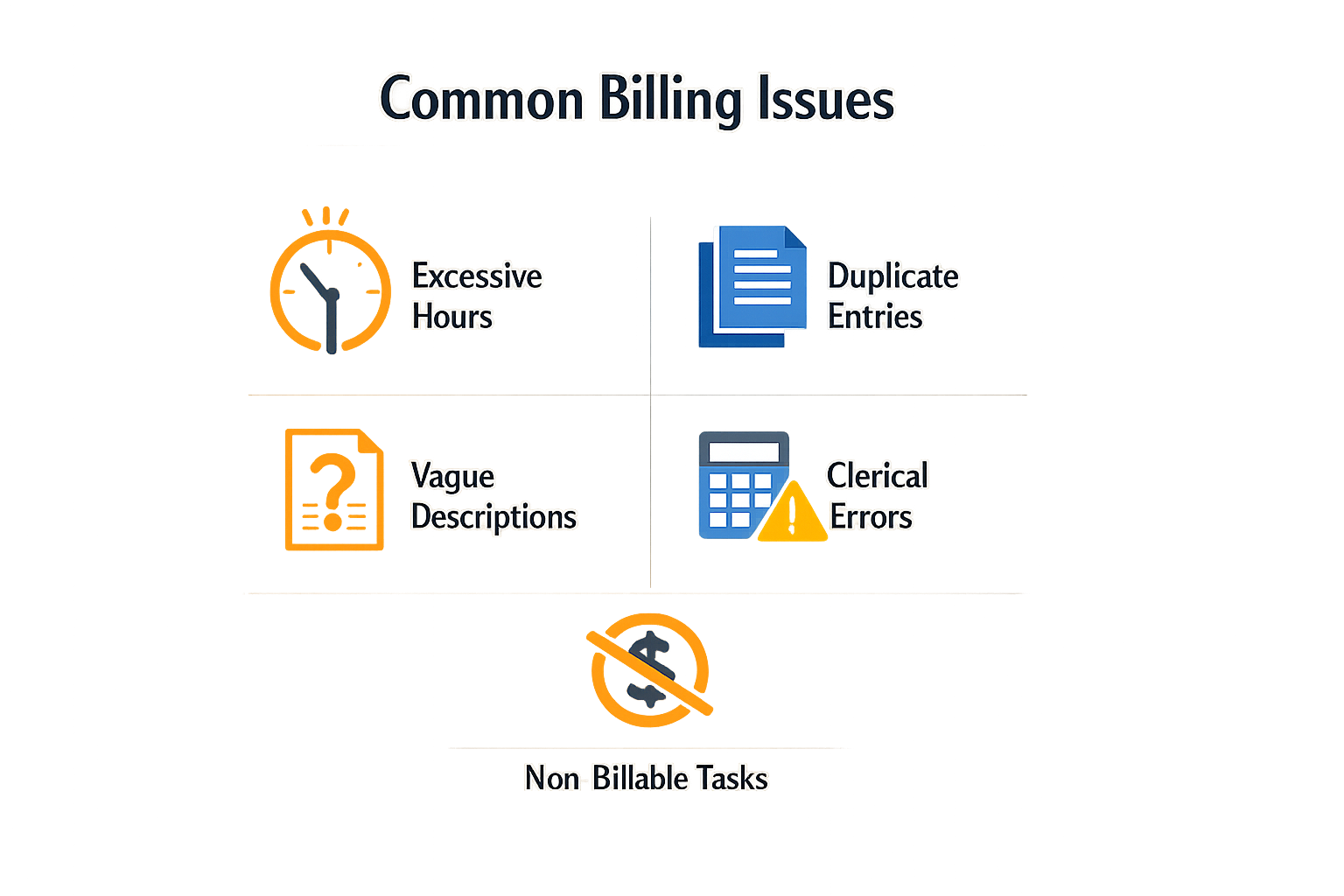
A line item reading "paralegal, review and summarize documents, 8.5" will trigger a reduction at most carriers, even when the work was necessary and the rate is within guideline limits. The problem is not the task or the timekeeper — it is the way the entry is coded and described. Carriers reject or reduce paralegal time for three recurring reasons: the timekeeper classification does not match the work performed, the narrative fails the block-billing test, or the UTBMS task code signals attorney-level work billed at a paralegal rate.
Mismatched Timekeeper Classifications
LEDES 1998B and the LEDES Oversight Committee's revised timekeeper classifications define what each code means. A timekeeper coded as a paralegal who performs legal research, drafts pleadings, or attends depositions alone is performing work that many guidelines reserve for attorneys. When the narrative describes attorney-level tasks but the rate and classification say paralegal, the bill reviewer flags the line. The guideline does not prohibit paralegals from working — it prohibits billing attorney work at paralegal rates without disclosure or pre-approval.
Some firms use contract or temporary staff and code them generically. The LEDES classifications distinguish TEMPAT (contract attorney) from TEMPOS (contract other staff), and a reviewer reading the file expects consistency between the code, the rate, and the task. A mismatch in any dimension invites a reduction, and the appeal path requires proof that the timekeeper's credentials and the work performed align with the code submitted.
Block Billing and Narrative Deficiencies
Block billing — lumping multiple tasks into one time entry — is prohibited or disfavored in nearly every published carrier guideline. A single line reading "review correspondence, draft discovery responses, conference with client, 6.3" gives the reviewer no way to allocate time among the tasks or verify that each increment was reasonable. The carrier's outside counsel guidelines typically require contemporaneous, task-specific entries, and a block entry is neither.
Paralegal time is particularly vulnerable because reviewers expect detailed narratives for non-attorney work. When an attorney bills 2.0 hours for a motion, the reviewer may accept a brief description; when a paralegal bills the same 2.0 hours, the reviewer wants to know exactly what the paralegal did and why it took that long. The double standard exists because carriers worry about undisclosed delegation — attorney work re-labeled as paralegal work to reduce the effective rate. A vague narrative confirms the suspicion rather than dispelling it.
A block entry gives the reviewer no choice but to reduce the entire line, because the guideline prohibits the format and the narrative provides no basis to parse out compliant time.
Task Code and Activity Code Misalignment
UTBMS task codes and activity codes describe the work, and reviewers compare them to the timekeeper classification and rate. A paralegal billing under task code L310 (depositions) with activity code A103 (analyze and prepare for deposition) is within bounds; the same paralegal billing under L320 (expert witnesses) with activity code A105 (conduct expert analysis) is not, because expert analysis is attorney work. The codes are not decorative — they drive automated edits in the e-billing portal and manual review downstream.
Carriers also watch for activity codes that imply supervisory or strategic work. A paralegal billing A101 (plan and prepare) on a complex motion is likely to be questioned, because planning is typically attorney work. A paralegal billing A102 (identify and revise) on a standard form is more defensible. The line between permissible paralegal tasks and impermissible attorney tasks is not always clear, but the UTBMS codes make the distinction visible, and the reviewer will enforce it.
For more on how activity codes map to billing expectations, see UTBMS Activity Codes A101-A111 for Legal Billing.
Solution Steps
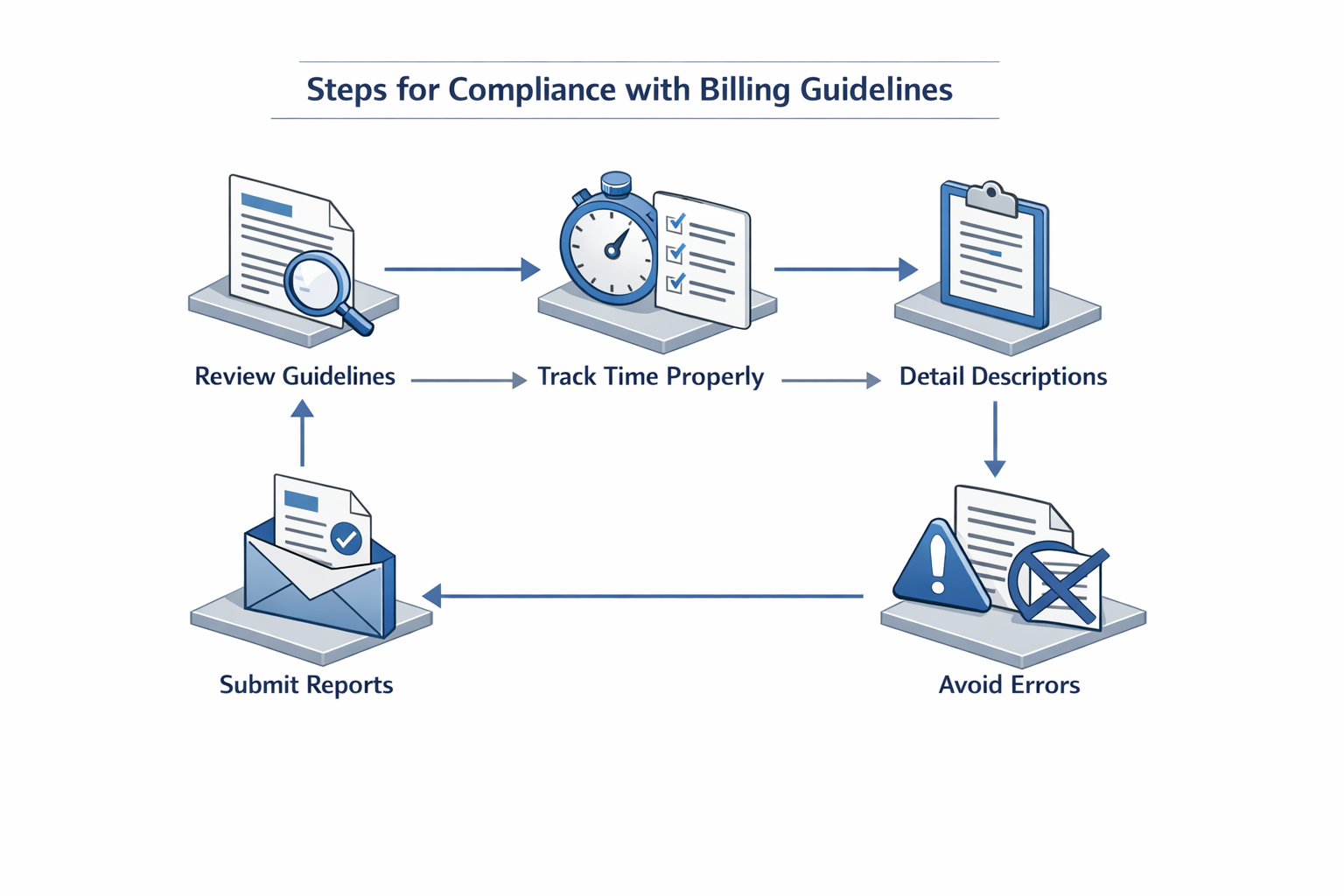
Compliance with carrier billing guidelines begins before the first entry is keyed. Paralegals who wait until invoice assembly to check guideline requirements find themselves rewriting narratives, splitting block entries, and explaining why a line item that seemed fine in the time-entry system triggered a rejection at the portal. The steps below assume the paralegal has access to the controlling outside counsel guideline and knows which LEDES format and UTBMS code set the carrier requires.
Step 1
Classify the timekeeper correctly
Every LEDES invoice assigns each timekeeper a classification code. The LEDES Oversight Committee publishes a revised timekeeper classification reference that defines codes such as PARALGL (paralegal), LGLAST (legal assistant), and CLKSEC (clerk or secretary). Paralegals performing substantive legal work under attorney supervision belong in PARALGL. Administrative tasks—filing, scanning, calendaring—belong in LGLAST or CLKSEC, and many guidelines cap or prohibit billing for clerical work entirely. Misclassifying a paralegal as an associate or a legal assistant as a paralegal invites an immediate reduction or a request to resubmit the entire invoice.
Step 2
Use the approved billing increment
Most carrier guidelines specify tenth-of-an-hour increments (six-minute blocks) for all timekeepers. A few permit quarter-hour rounding for paralegals, but silence in the guideline is not permission. Where the guideline is silent, use tenths. Rounding a 0.1 task to 0.25 because the firm's default is quarter-hour will trigger a write-down when the bill reviewer sees the pattern. If the guideline explicitly permits quarter-hour increments for paralegals, document that fact in the matter file so the appeal record is clean if the reduction comes anyway.
Step 3
Write a narrative that passes the block-billing test
Block billing—combining multiple tasks in one line item—is prohibited under most panel guidelines. A single entry reading "review correspondence, update case summary, calendar hearing" describes three tasks and will be reduced or rejected. Each task gets its own line. The narrative must state what was done, not why it mattered or what the paralegal learned. "Review defendant's motion in limine regarding expert testimony" is a task description. "Review defendant's motion in limine to determine admissibility strategy" is a mixed task-and-analysis entry that some reviewers flag as attorney work billed at a paralegal rate. For more on the mechanics of narrative construction and common rejection triggers, see Block Billing: Reasons for Carrier Rejections and Solutions.
Step 4
Assign the correct UTBMS task and activity codes
UTBMS task codes (L100–L600 for litigation, plus others for transactional and other work types) and activity codes (A101–A199) describe what was done. The activity code is more granular: A101 is plan/prepare, A102 is draft/revise, A103 is review/analyze. Assigning A199 (other) or reusing the same task-activity pair for every entry signals to the bill reviewer that the timekeeper does not understand the code set or is hiding the nature of the work. Incorrect codes do not always trigger an automatic rejection, but they make the invoice easier to reduce during manual review. The carrier's e-billing portal may validate codes on submission; if it does, a wrong code stops the invoice before it reaches the reviewer.
Step 5
Submit through the designated portal and monitor for rejections
Carriers require submission through a named e-billing platform. The platform validates the LEDES file structure, checks mandatory fields, and applies the carrier's automated rules. A file that fails validation is rejected immediately with an error code. A file that passes validation enters the queue for manual review. The paralegal or billing coordinator must monitor the portal for status updates. Rejections and reduction notices appear in the portal, not in email, unless the platform is configured to send alerts. When a reduction appears, the appeal window starts on the date the reduction posts, not the date someone logs in and notices it.
Accurate Timekeeper Classification Reduces Disputes
Timekeeper classification is not cosmetic. The LEDES classification codes communicate to the bill reviewer what kind of work the timekeeper is qualified to perform and at what rate the client agreed to pay. A paralegal classified as PARALGL signals that the work is substantive and non-clerical; a paralegal classified as LGLAST or CLKSEC signals administrative support. The distinction matters because many guidelines prohibit or cap reimbursement for clerical time, and some apply a lower rate to legal assistants than to paralegals even when both are performing similar tasks. Contract paralegals and temporary staff have their own classifications (TEMPPL for contract paralegal, TEMPOS for contract other staff), and using the wrong code can trigger a rate adjustment or a question about why the firm is billing for temporary help without pre-approval.
Tips and Tricks
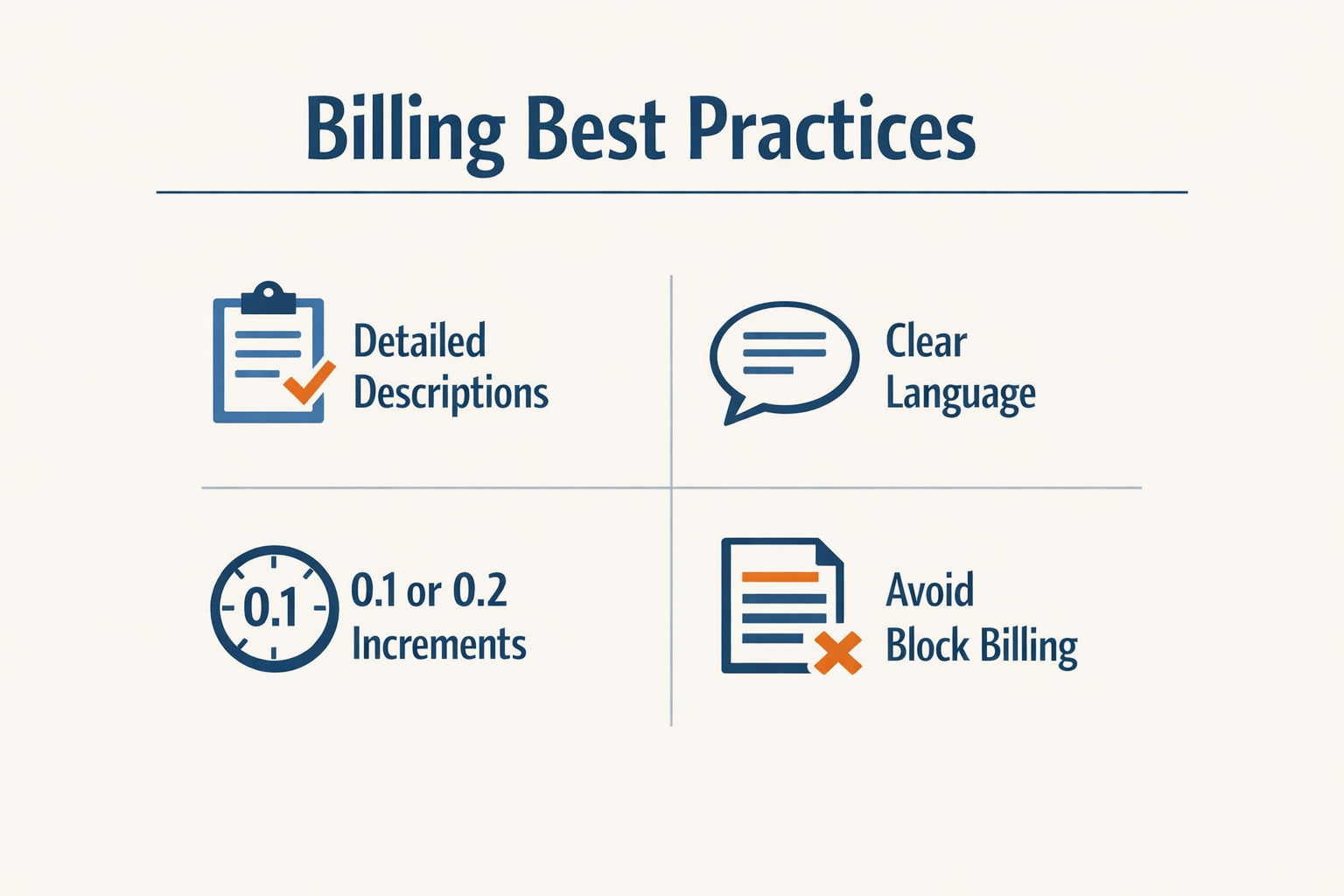
A paralegal entry reading "reviewed documents, 3.5" will not survive most panel bill reviews. The narrative lacks the detail reviewers expect, and the increment may not match the carrier's published standard. Small adjustments to how you describe work and record time can prevent reductions before the invoice leaves your desk.
Use Contemporaneous, Specific Narratives
Record what you did, not what the case needed. "Reviewed correspondence from opposing counsel regarding discovery extension" is acceptable. "Case work" is not. Carriers expect enough detail to confirm the task happened and that it advanced the matter. If a reviewer cannot tell what you did from the narrative alone, the line will be reduced or rejected.
Avoid block billing. A single entry that combines multiple tasks — "reviewed correspondence, drafted response, updated case calendar, 2.1" — violates most carrier guidelines and will be reduced. Each discrete task gets its own line item, its own time entry, and its own narrative.
Bill in the Correct Increment
Most carriers specify tenth-of-an-hour increments. A task that took eight minutes is 0.2 hours, not 0.25. Rounding up to the next quarter-hour when the guideline requires tenths is a billing error, and reviewers will adjust it. If the guideline is silent, tenth-of-an-hour is the safer default.
Do not aggregate time across the day and enter it as one block. Record each task as you complete it, in the increment the guideline permits. If you wait until the end of the day to reconstruct your time, you are more likely to round incorrectly or combine tasks into a single entry.
Classify Your Timekeeper Code Accurately
LEDES 1998B and the LEDES Oversight Committee's revised timekeeper classifications define what each code means. A paralegal is not a legal assistant, and a legal assistant is not a clerk. If your role involves substantive case work under attorney supervision, you are likely classified as a paralegal. If your role is administrative support, you may be classified as a clerk or secretary. The distinction matters because carriers pay different rates for different classifications, and misclassification triggers adjustments.
For more on how carriers interpret UTBMS Activity Codes A101-A111 for Legal Billing, see our breakdown of the task and activity code sets that bill reviewers rely on.
Avoid Common Pitfalls
Do not bill for clerical work at a paralegal rate. Filing, scanning, and routine calendar updates are administrative tasks. If the guideline prohibits billing for clerical work, those tasks are written off regardless of who performed them. If the guideline permits clerical billing, it will be at a clerk rate, not a paralegal rate.
Do not bill for work the carrier excluded in the engagement letter or the outside counsel guidelines. If the guideline says travel time is capped at fifty percent of the actual rate, bill it that way. If the guideline says intra-office conferences require pre-approval above a stated threshold, obtain that approval before the conference happens. After-the-fact appeals rarely succeed when the guideline was clear.
The line between a billable task and an administrative task is not always obvious, but the carrier's outside counsel guidelines usually spell it out.
Do not use vague UTBMS codes. Activity code A199 ("Other") is a placeholder, not a default. If your task fits a published code, use that code. If it does not, the task may not be compensable under the carrier's billing structure.
Review Before You Submit
Run a pre-submission check on every invoice. Confirm that each line item has a narrative, a timekeeper classification, a task code, an activity code, and a time entry in the correct increment. Confirm that no entry combines multiple tasks. Confirm that the total time for each timekeeper is consistent with the work described. An invoice that clears these checks will reach the reviewer with fewer automatic rejections and a lower risk of reduction.
If your e-billing portal flags a validation error, fix it before resubmitting. A rejected file does not get reviewed; it gets returned to you for correction. Each resubmission delays payment and increases the chance that the reviewer will scrutinize the corrected invoice more closely.
Conclusion
Paralegal billing survives carrier review when the timekeeper classification, narrative detail, and task code all point to the same conclusion: that the work billed was substantive, contemporaneous, and performed by the classification shown in the LEDES file. A line reading "PRLGLJR, L310, research statute, 0.3" will clear validation. A line reading "PRLGLJR, L110, prepare for trial, 4.5" will not — the task code L110 (Fact Investigation/Development) does not match trial preparation, and 4.5 hours without further detail is block billing under most carrier guidelines.
The LEDES Oversight Committee publishes revised timekeeper classifications to standardize how firms represent paralegal work across formats — 1998B, 1998BI, XML 2.0 and XML 2.1. Carriers rely on those classifications during automated validation and human review. When a firm submits a paralegal entry under the wrong classification, or uses a generic narrative that could describe attorney work, the reduction follows the same path every time: the portal flags the line, the bill reviewer applies a reduction code, and the firm receives a rejection notice with no appeal path unless the guideline explicitly provides one.
Understanding what carriers pay for means reading the controlling guideline, matching your entries to the published UTBMS task and activity codes, and writing narratives that a reviewer can verify against contemporaneous records. The work paralegals perform is compensable when it is billed as paralegal work, coded to reflect what actually happened, and described with enough detail that an adjuster reading the invoice six months later can reconstruct the day. For more on how narrative detail and task codes interact during portal submission, see UTBMS Activity Codes A101-A111 for Legal Billing.
Carrier guidelines are not suggestions. They are the terms under which the panel appointment was accepted, and they govern every line item from the first status letter through the final closing invoice. Firms that treat guideline compliance as a post-submission cleanup task will spend more time appealing reductions than firms that build compliance into their fee-entry workflow from the start.