


What Is Insurance Defense? The Tripartite Relationship Explained
Introduction to Insurance Defense
Insurance defense is the practice area in which an attorney represents a policyholder—the insured—against a third-party liability claim, with the insurer funding and directing the defense under the policy's duty to defend. The arrangement creates what practitioners call the tripartite relationship: insurer, insured, and defense counsel. Each party has obligations to the others, and the structure governs everything from case strategy to how time entries are written and billed.
Most liability policies require the insurer to defend any suit seeking damages covered by the policy, even when coverage is questionable. The insurer selects and pays panel counsel to handle the defense, and that counsel owes professional duties to the insured, not the insurer. This can create tension when the insurer's interest in minimising exposure diverges from the insured's interest in a complete defence, especially when some claims fall outside policy coverage or when the insurer reserves rights on a coverage issue.
California Civil Code section 2860, subdivision (a) addresses this tension directly: when a conflict of interest arises that creates a duty to provide independent counsel, the insurer must do so unless the insured waives that right in writing. A conflict may exist when the insurer reserves its rights on a coverage issue and the outcome of that issue can be controlled by counsel first retained by the insurer. The statute does not deem a conflict to exist solely because the insured is sued for an amount exceeding policy limits or because punitive damages are alleged.
The tripartite relationship shapes billing practice in insurance defense. Carriers publish outside counsel guidelines that specify billing increments, prohibit block billing, require UTBMS task and activity codes, and set narrative detail standards. Defense counsel submits invoices through e-billing portals in LEDES 1998B format, and bill reviewers apply reduction codes when entries violate guideline provisions. Understanding who owes what duty to whom, and when independent counsel must be provided, is the foundation for navigating block billing prohibitions and carrier guideline compliance.
When independent counsel is selected under section 2860, subdivision (d) imposes disclosure obligations: counsel and the insured must disclose to the insurer all information concerning the action except privileged materials relevant to coverage disputes, and must timely inform and consult with the insurer on all matters relating to the action. This duty to communicate runs alongside the duty to submit compliant invoices, and both are essential to maintaining the relationship.
The tripartite structure is not unique to California, but California's codification of the independent-counsel right and the disclosure obligations makes the state's insurance defense billing environment particularly rule-bound. Counsel practicing in this area must know when a conflict triggers the section 2860 right, how to bill for independent counsel work, and what the insurer may and may not control when it is paying for a defence it does not direct.
Understanding the Challenges in Insurance Defense
The tripartite relationship in insurance defense — insurer, insured, and defense counsel — creates structural tension that no guideline can fully eliminate. When an insurer reserves its rights on coverage while providing counsel to defend the insured, the attorney owes duties to two parties whose interests may diverge. California Civil Code section 2860, subdivision (b) states that a conflict of interest may exist when an insurer reserves its rights on a given issue and the outcome of that coverage issue can be controlled by counsel first retained by the insurer for the defense of the claim. The statute does not require a coverage denial to trigger independent counsel; a reservation of rights is enough if the reserved issue is one the defense attorney's work can affect.
Coverage Disputes and the Reservation of Rights
A reservation of rights letter tells the insured that the carrier will defend the lawsuit but may later disclaim coverage for part or all of any judgment. The insured then faces a lawyer paid by a party that may refuse to pay the judgment. In San Diego Navy Federal Credit Union v. Cumis Insurance Society, Inc., 162 Cal.App.3d 358, the court held that when an insurer provides its own counsel but reserves its right to assert noncoverage at a later date, a conflict of interest exists between the insurer and the insured, and the insured has a right to independent counsel paid for by the insurer. The decision turned on the fact that the reserved coverage issues — whether the conduct was wilful, whether punitive damages were covered, and whether a breach-of-contract claim fell within the policy — were all questions that the defense attorney's factual development and strategic choices could influence.
Settlement Authority and Communication Gaps
When panel counsel represents the insured under a reservation of rights, settlement decisions present another friction point. The insurer controls the purse and typically the settlement authority; the insured faces personal exposure above the policy limit or on uncovered claims. In the Cumis case, the insurer authorized defense counsel to make a settlement offer lower than the plaintiff's demand, and counsel did not contact the insured before or during the settlement conference. That gap — counsel paid by the carrier, negotiating on behalf of the insured, without direct consultation — illustrates the structural problem: the attorney's economic relationship runs to the insurer, but the fiduciary duty runs to the insured.
Block billing and narrative detail standards add another layer when independent counsel submits invoices to the carrier for payment. The insurer's outside counsel guidelines govern billing format and task codes, but independent counsel's loyalty runs solely to the insured. Civil Code section 2860, subdivision (d) requires independent counsel and the insured to disclose to the insurer all information concerning the action except privileged materials relevant to coverage disputes, and to inform and consult with the insurer on all matters relating to the action. The statute balances the insured's need for unconflicted representation with the insurer's need to monitor the defense it is funding.
Waiver and the Insured's Choice
The insured may waive the right to select independent counsel by signing a written waiver that tracks the language in Civil Code section 2860, subdivision (e). The waiver must state that the insured has been advised and informed of the right to select independent counsel, has considered the matter fully, and freely waives that right. A waiver is not effective unless it is knowing and voluntary, and the statute provides the exact form to ensure clarity. Where no waiver is signed and a conflict exists, the insurer must provide independent counsel unless the insured expressly declines in writing.
Where the insured selects independent counsel, both the counsel provided by the insurer and independent counsel selected by the insured shall be allowed to participate in all aspects of the litigation.
Key Steps in the Tripartite Relationship
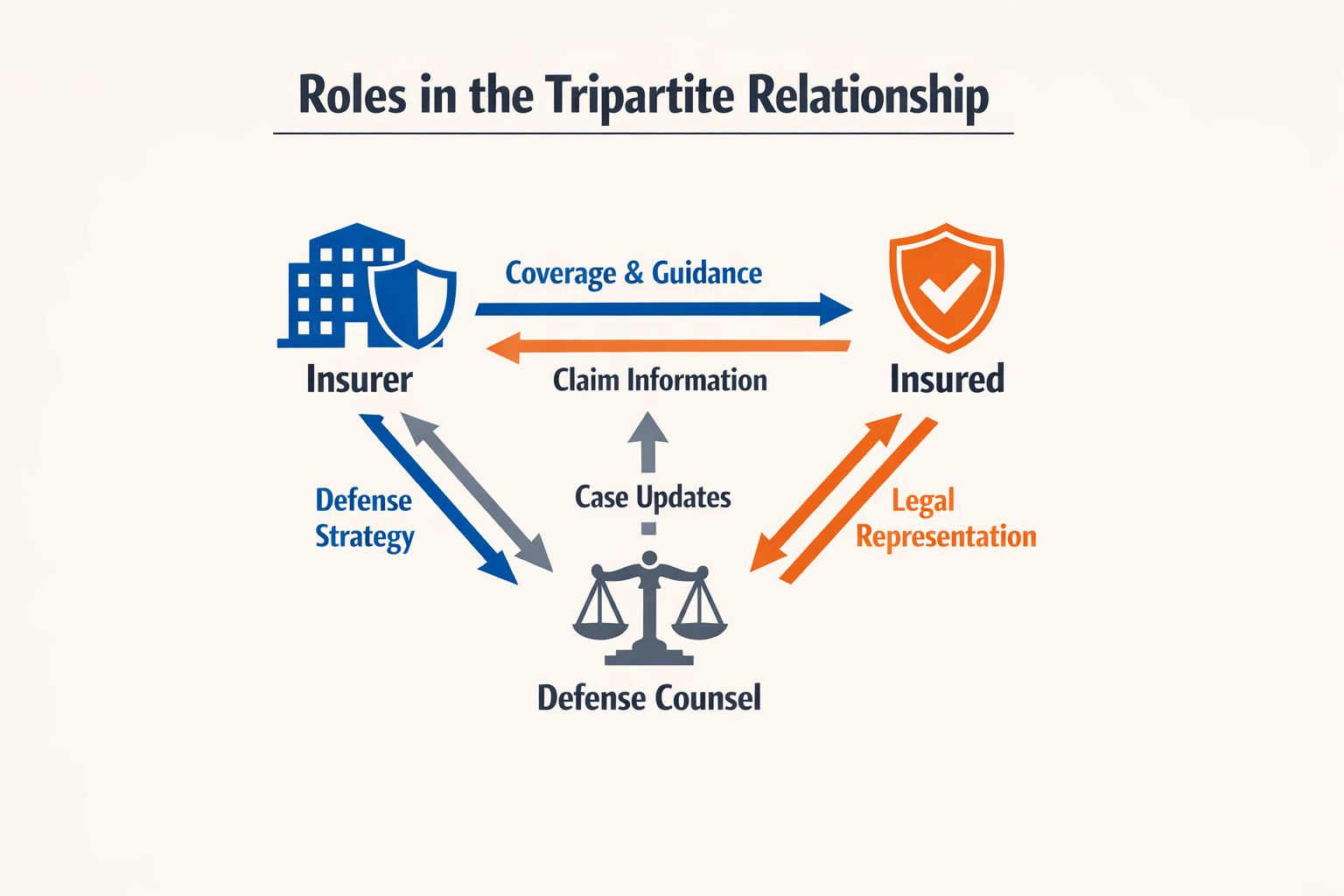
The tripartite relationship in insurance defense assigns specific duties to each participant. The insurer pays for the defense and selects counsel. The insured cooperates with that counsel and discloses facts material to the claim. Defense counsel represents the insured's interests while billing the insurer under the policy's duty to defend. When these roles function as designed, the insured receives a defense without paying attorney fees out of pocket, and the insurer controls costs through panel counsel and outside counsel guidelines.
California Civil Code section 2860 governs what happens when a conflict of interest arises. When the policy imposes a duty to defend and a conflict exists, the insurer must provide independent counsel to represent the insured unless the insured waives that right in writing. A conflict does not exist solely because the claim exceeds policy limits or includes punitive damages, but it may exist when the insurer reserves rights on an issue and the outcome of that coverage issue can be controlled by the defense counsel the insurer first retained.
The Insurer's Role: Funding and Oversight
The insurer funds the defense and typically selects counsel from a panel of approved firms. Panel counsel must comply with the carrier's outside counsel guidelines, which specify billing increments, narrative detail standards, and staffing ratios. The insurer reviews invoices through an e-billing portal, applies reduction codes where entries violate guideline prohibitions, and tracks matter budgets. When independent counsel is required under section 2860, the insurer still pays the fees but loses some control over counsel selection.
The Insured's Duties: Cooperation and Disclosure
The insured must cooperate with defense counsel and disclose all information concerning the action. When independent counsel has been selected, section 2860, subd. (d) requires both the insured and that counsel to disclose to the insurer all information except privileged materials relevant to coverage disputes, and to inform and consult with the insurer on all matters relating to the action. Any disclosure to the insurer does not waive the privilege as to any other party. The insured's duty to cooperate remains in force under the insurance contract even when independent counsel is involved.
Defense Counsel's Obligations: Representation and Communication
Defense counsel represents the insured, not the insurer. When independent counsel is selected under section 2860, both the insurer-provided counsel and the independent counsel may participate in all aspects of the litigation. Section 2860, subd. (f) requires both counsel to cooperate fully in exchanging information consistent with each counsel's ethical and legal obligations to the insured. In practice, this means independent counsel bills the insurer, submits invoices through the e-billing portal, and complies with outside counsel guidelines to the extent those guidelines do not interfere with the duty of loyalty to the insured.
Step 1
Identify whether a conflict exists
The insurer evaluates whether a coverage defense or reservation of rights creates a conflict under section 2860, subd. (b). A conflict may exist when the insurer reserves rights on an issue and the defense counsel's handling of that issue affects the coverage outcome. Allegations of punitive damages or claims exceeding policy limits do not alone create a conflict.
Step 2
Offer independent counsel or obtain a waiver
If a conflict exists, the insurer must offer independent counsel. The insured may waive the right to select independent counsel by signing the waiver statement set forth in section 2860, subd. (e). Without a written waiver, the insured selects counsel and the insurer pays reasonable fees.
Step 3
Establish communication and billing protocols
Once counsel is appointed, the insurer provides its outside counsel guidelines, e-billing portal credentials, and matter budget. Defense counsel submits invoices in LEDES 1998B file format with UTBMS task and activity codes. The insured and counsel disclose case developments to the insurer, withholding only privileged materials related to coverage disputes.
Best Practices for Managing the Tripartite Relationship
When a reservation of rights appears, the tripartite relationship shifts from theory to operational reality. The insurer, insured and defense counsel each hold distinct interests, and managing those interests without collision requires discipline at every stage — from the first tender letter to the final invoice.
Establish Clear Communication Protocols Early
The insured should receive notice of the reservation in writing, with enough specificity to understand which claims or damages the carrier may disclaim. Vague reservation language creates confusion about what the appointed counsel is defending and on whose behalf. Defense counsel should confirm in writing the scope of the engagement, the party or parties being represented, and any limitations the carrier has placed on settlement authority or pre-approval thresholds.
Recognize When Independent Counsel Is Required
When the insurer reserves rights and appoints its own panel counsel, a conflict of interest may arise. The attorney paid by the carrier faces a temptation to develop facts that favour the coverage denial rather than the insured's defence. California law addresses this directly: under Civil Code section 2860, the insured may select independent counsel at the carrier's expense when a conflict exists. The leading case, San Diego Navy Federal Credit Union v. Cumis Insurance Society, 162 Cal.App.3d 358, held that a reservation of rights combined with carrier-appointed counsel creates the conflict that triggers the independent-counsel right.
Carriers that resist independent counsel often cite cost, but the statute and case law do not make cost a defence. The insured's right to conflict-free representation outweighs the carrier's preference for panel rates. When the insured invokes section 2860, the carrier must pay reasonable fees for counsel of the insured's choosing, subject only to a reasonableness standard — not to the carrier's outside counsel guidelines or panel billing rates.
Maintain Separate Files and Privilege Boundaries
Defense counsel working under a reservation must keep coverage analysis and defence strategy in separate files. Communications about coverage go to the carrier alone; communications about trial strategy and settlement posture go to the insured. Mixing the two creates privilege problems and ethical exposure. Panel counsel guidelines often require contemporaneous time records and narrative detail sufficient for bill review, but those narratives must not disclose privileged defence strategy to the bill reviewer.
For guidance on how billing detail intersects with privilege, see Block Billing: Reasons for Carrier Rejections and Solutions, which explains how to write compliant narratives without waiving work-product protection.
The attorney paid by the carrier faces a temptation to develop facts that favour the coverage denial rather than the insured's defence.
Clarify Settlement Authority and Pre-Approval Limits
Most carrier outside counsel guidelines specify a dollar threshold above which settlement requires carrier consent. When the insured holds independent counsel under section 2860, settlement authority becomes more complex: the insured controls the defence, but the carrier controls the money. The best practice is to document settlement authority in the engagement letter and to obtain written consent from both the insured and the carrier before any settlement discussion that approaches policy limits.
Failure to clarify authority creates exposure for all three parties. If the insured agrees to settle above the carrier's authorised amount, the carrier may refuse to pay the excess. If the carrier refuses a reasonable settlement within limits and the case proceeds to a judgment above limits, the carrier may face bad-faith exposure.
Manage Billing and Fee Disputes Proactively
Independent counsel under section 2860 submits invoices to the carrier, but the carrier's right to review those invoices for reasonableness does not give the carrier the right to impose panel guidelines, block-billing prohibitions, or UTBMS task code requirements on non-panel counsel. Reasonableness is measured by the standards of the legal community, not by the carrier's internal billing policies.
When a carrier reduces an independent-counsel invoice, the insured and counsel should document the basis for the original fee, provide contemporaneous time records, and appeal the reduction in writing. Most e-billing portals allow a formal appeal, and the appeal should cite section 2860 and the reasonableness standard rather than attempting to comply with guidelines that do not apply.
Conclusion: The Importance of the Tripartite Relationship in Insurance Defense
The tripartite relationship — insurer, insured, and defense counsel — is the structural foundation of insurance defense. When a carrier accepts a tender and assigns counsel, that assignment creates duties running in three directions at once. The insurer pays for the defense and retains the right to control settlement within policy limits. The insured receives representation but remains exposed to any judgment that exceeds those limits. Defense counsel owes undivided loyalty to the insured while the insurer writes the checks. That arrangement works when everyone's interests align, but a reservation of rights or a coverage dispute can fracture the structure instantly.
California Civil Code section 2860 codifies the insured's right to independent counsel when a conflict of interest arises. The statute does not eliminate the tripartite relationship; it reconfigures it. Under section 2860, subdivision (f), both the insurer's panel counsel and the insured's independent counsel "shall be allowed to participate in all aspects of the litigation," and both must cooperate fully in the exchange of information consistent with their ethical obligations. The insurer still funds the defense, the insured still directs strategy on covered claims, and counsel still owes the insured complete loyalty — but now two sets of lawyers must coordinate without stepping on each other's toes or disclosing privileged material that could harm the insured in a later coverage action.
Managing the Relationship Through Documentation and Communication
Every participant in the tripartite relationship benefits from clear, contemporaneous records. Panel counsel submits invoices through an e-billing portal, and those invoices must satisfy the carrier's outside counsel guidelines on narrative detail, billing increments, and block billing. Independent counsel bills under the same standards, and the insurer reviews both sets of invoices with the same reduction codes. When a bill is rejected, the appeal path is identical whether the timekeeper is panel or Cumis counsel. The difference is not in the billing rules but in who controls the defense strategy and whether privileged materials flow to the carrier.
The insured's cooperation duty survives the appointment of independent counsel. Section 2860, subdivision (d), requires both the insured and independent counsel "to disclose to the insurer all information concerning the action except privileged materials relevant to coverage disputes, and timely to inform and consult with the insurer on all matters relating to the action." That duty is not optional, and it does not disappear when the insured suspects the carrier will deny coverage. The statute balances the insured's need for confidentiality on coverage issues against the insurer's need to monitor the defense it is funding. Any privilege claim is subject to in camera review, and any disclosure to the insurer does not waive the privilege as to other parties.
Why the Tripartite Relationship Matters
Understanding the tripartite relationship is not an academic exercise. It determines who selects counsel, who directs the defense, and who pays for what. It governs the flow of information between the insured and the carrier, and it defines the limits of the attorney-client privilege when coverage is in dispute. For defense counsel, it means recognizing that the insured — not the insurer — is the client, even when the insurer is paying the bill. For the insured, it means knowing when a conflict triggers the right to independent counsel and when that right can be waived. For the insurer, it means accepting that a reservation of rights comes with a cost: the insured gets to pick the lawyer, and that lawyer's loyalty runs one direction only.
The tripartite relationship is not a problem to be solved; it is a structure to be managed. When all three parties understand their roles, their duties, and the points at which their interests diverge, the relationship functions as intended. When any party misunderstands or ignores those boundaries, the result is fee disputes, coverage litigation, and malpractice claims. The stakes are high, the rules are specific, and the case law is settled. For additional context on how billing standards intersect with these relationships, see Block Billing: Reasons for Carrier Rejections and Solutions. The tripartite relationship works when everyone knows what it is and acts accordingly.